Quick Answer: Mod Electric Bikes & EV Incentives
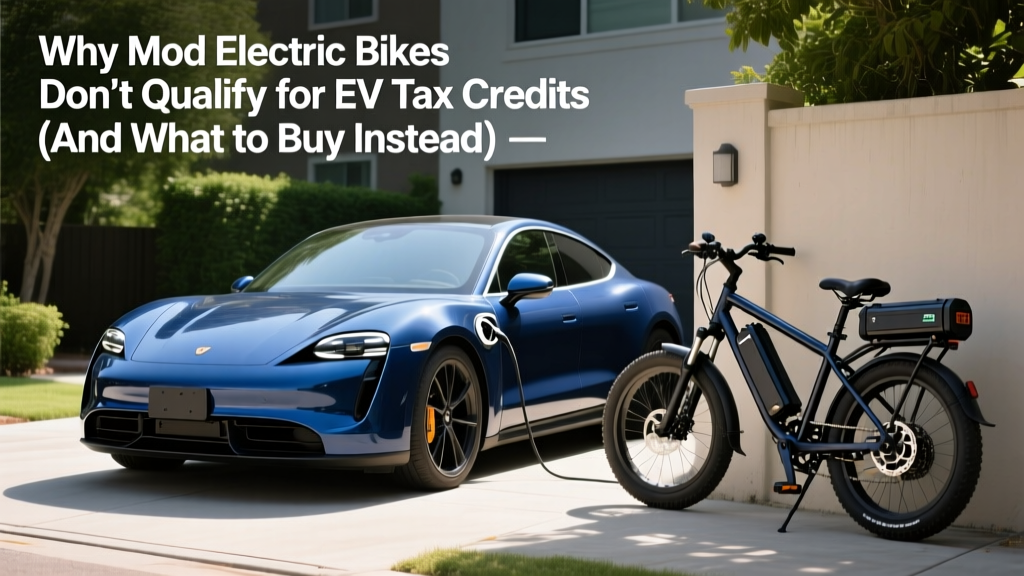
Mod electric bikes — like most e-bikes, e-scooters, and electric motorcycles — do not qualify for the federal §30D Clean Vehicle Tax Credit in 2026. The IRS restricts this credit to four-wheeled, highway-capable vehicles with a gross vehicle weight under 14,000 lbs that meet specific battery-sourcing, MSRP, and buyer-income thresholds. A modified or aftermarket electric bicycle falls entirely outside these parameters. If your goal is to access federal EV purchase incentives, you'll need to look at qualifying plug-in cars, SUVs, or trucks instead. Below, we break down exactly what you can claim, what mod electric bikes actually cost to own, and which electrified vehicles deliver genuine savings.
The Mod Electric Bike Trend — and the Tax-Credit Misconception
Mod electric bikes — typically stock pedal-assist e-bikes that owners have modified with higher-wattage hub motors, larger battery packs, or aftermarket controllers — have surged in popularity as urban commuters seek alternatives to car ownership. A typical modded e-bike setup might push 1,500–3,000 watts through a 48V or 52V battery pack (roughly 0.7–1.5 kWh of usable energy), achieving speeds of 30–45 mph and ranges of 30–60 miles per charge.
The misconception arises because people see "electric" and "battery" and assume federal EV incentives apply. They don't. The IRS §30D Clean Vehicle Credit is explicit: qualifying vehicles must be four-wheeled, manufactured primarily for use on public roads, and produced by a qualified manufacturer. Two-wheeled and three-wheeled electric vehicles were removed from the §30D credit structure after 2022. Some states offer separate e-bike rebate programs (Colorado, California, and Vermont have active programs as of 2026), but these are state-level, income-variable, and typically range from $300 to $1,500 — far below the up-to-$7,500 federal credit available for qualifying cars.
What the §30D Federal Tax Credit Actually Covers in 2026
If you're researching mod electric bikes because you want an electrified commute with financial incentives, it's worth understanding what the federal credit actually rewards. Under current IRS rules for 2026, the §30D credit offers up to $7,500 for new qualifying plug-in vehicles, split into two components:
- $3,750 — Battery Component Requirement: A percentage of battery components must be manufactured or assembled in North America (escalating thresholds each year).
- $3,750 — Critical Minerals Requirement: A percentage of critical minerals in the battery must be sourced from the U.S. or free-trade-agreement partners.
Additional eligibility constraints include:
| Requirement | 2026 Threshold |
|---|---|
| Vehicle MSRP cap (cars) | $55,000 |
| Vehicle MSRP cap (SUVs/trucks/vans) | $80,000 |
| Buyer AGI cap (single filer) | $150,000 |
| Buyer AGI cap (head of household) | $225,000 |
| Buyer AGI cap (joint filers) | $300,000 |
| Vehicle type | 4-wheeled, highway-capable, <14,000 lbs GVWR |
| Minimum battery capacity | 7 kWh |
| Point-of-sale transfer | Allowed — credit applied at dealer as down-payment reduction |
A mod electric bike with a 1.2 kWh battery pack doesn't come close to the 7 kWh minimum — and it has two wheels, not four. The math simply doesn't work.
Real Cost of Owning a Mod Electric Bike vs. an Entry-Level EV
Let's put actual numbers to both options so you can see where each makes financial sense.
| Cost Factor | Mod Electric Bike (Typical Build) | 2026 Chevy Equinox EV LT (Base Qualifying EV) |
|---|---|---|
| Purchase price | $2,500–$5,500 (bike + mods) | ~$33,000 MSRP (before credit) |
| Federal tax credit | $0 | Up to $7,500 (if sourcing/AGI requirements met) |
| Effective purchase price | $2,500–$5,500 | ~$25,500 (with full credit) |
| Energy cost per mile | ~$0.005–$0.01 (electricity) | ~$0.03–$0.04 (electricity at $0.16/kWh, 3.2 mi/kWh) |
| Annual insurance | $0–$150 (renters/liability) | $1,400–$2,200 |
| Annual maintenance | $100–$300 (tires, brakes, chain) | $200–$500 (cabin filter, tires, wipers) |
| Registration/title | $0 (not a registered vehicle in most states) | $100–$400/year (state-dependent) |
| Range per charge | 30–60 miles | EPA est. 319 miles |
| Weather suitability | Poor (rain, snow, extreme cold) | Full climate control, all-season |
| Cargo/passenger capacity | 1 rider, ~20 lbs cargo | 5 passengers, 26.4 cu ft cargo |
The mod electric bike wins on upfront cost and per-mile energy expense. But it loses on weather reliability, passenger capacity, range, safety (no airbags, no crash-test ratings), and access to federal incentives. For a single commuter in a warm, flat city with secure bike storage, the e-bike math can work. For anyone needing year-round transportation, carrying passengers, or driving in rain and cold, the EV is the only practical choice — and the $7,500 credit narrows the price gap substantially.
Charging Reality: E-Bike vs. EV at Home
One area where mod electric bikes genuinely shine is charging simplicity — but there are nuances worth understanding.
Mod electric bike charging: Most modded builds use a 48V or 52V lithium pack (NMC chemistry, typically 14–28 Ah). A standard charger delivers 200–400 watts, meaning a full charge from a 120V household outlet takes 3–6 hours. No special electrical work is needed. Total energy per charge: roughly 0.7–1.5 kWh, costing about $0.11–$0.24 at the national average of $0.16/kWh.
EV home charging: A Level 2 home charger (240V, 32–48A) delivers 7.7–11.5 kW, adding roughly 25–44 miles of range per hour. A full charge of an 85 kWh battery takes 8–11 hours on Level 2 — typically done overnight. Installation of a 240V/50A circuit with a hardwired Level 2 unit averages $800–$2,000 depending on panel capacity and conduit run length. If your home's electrical panel is already at capacity (common in older homes with 100A service), a panel upgrade to 200A can add $1,500–$3,500.
The key ownership insight: EV home charging requires an upfront investment that e-bike charging does not. But once installed, the convenience of plugging in at home and waking to a full "tank" every morning is transformative — and you're charging a vehicle that can carry your family 300+ miles in any weather.
Common Misconceptions About Mod Electric Bikes and EV Incentives
| Myth | Fact |
|---|---|
| "Any electric vehicle qualifies for the $7,500 tax credit." | Only 4-wheeled, highway-capable plug-in vehicles with ≥7 kWh batteries meeting sourcing, MSRP, and income requirements qualify under §30D. |
| "E-bikes are classified as EVs for tax purposes." | The IRS classifies qualifying clean vehicles separately from low-speed electric bicycles (15 U.S.C. §2085 governs e-bike classification as consumer products, not motor vehicles). |
| "Modding an e-bike with a bigger battery makes it EV-eligible." | Battery size doesn't change vehicle classification. A 2 kWh e-bike battery is still a bicycle, not a qualifying clean vehicle. |
| "State e-bike rebates are as generous as federal EV credits." | Most state e-bike rebates range $300–$1,500 and are often income-capped or lottery-based. The federal EV credit is up to $7,500 and available at point of sale. |
| "Mod electric bikes are street-legal everywhere." | Many jurisdictions limit e-bikes to 750W motor output and 20 mph (Class 1/2) or 28 mph (Class 3). Modded bikes exceeding these limits may be classified as unregistered motor vehicles — creating legal and insurance liability. |
Decision Framework: Should You Buy a Mod Electric Bike or an EV?
Choose a Mod Electric Bike If:
- Your one-way commute is under 20 miles on bike-friendly roads
- You live in a mild climate (rarely below 40°F, minimal snow/ice)
- You have secure, indoor bike storage at home and work
- You don't need to carry passengers or significant cargo
- Your total transportation budget is under $6,000
- You already own a car for longer trips and bad weather
Choose a Qualifying Electric Vehicle If:
- You need year-round, all-weather transportation
- Your commute exceeds 20 miles or includes highways
- You carry passengers, groceries, or gear regularly
- You qualify for the §30D credit (income under caps, vehicle under MSRP caps)
- You have access to home Level 2 charging (or can install it)
- You want NHTSA crash-tested safety, airbags, and insurance coverage
- You need a single vehicle that handles all driving scenarios
What First-Time EV Buyers Should Know Before Purchasing
If the mod electric bike route doesn't meet your needs and you're pivoting to a full EV purchase, here are the practical realities that dealerships rarely volunteer:
Real-world range is 15–30% below EPA estimates in cold weather and highway driving. An EV rated at 315 miles EPA will realistically deliver 220–260 miles at 75 mph in 30°F temperatures. Plan your charging stops around the lower number.
DC fast charging follows a taper curve. A vehicle advertised at "200 kW peak charging" only sustains that rate up to roughly 40–55% state of charge. Above 80%, charging slows dramatically to protect the battery. A realistic 10–80% charge session on a 200 kW-capable vehicle takes 22–30 minutes, not the 15 minutes that peak-rate marketing implies.
Home charging access is the single biggest ownership factor. If you can install a Level 2 charger at home, EV ownership is effortless — you wake up with a full battery every day. If you rely entirely on public charging, your experience will be defined by your local network's reliability, pricing, and availability. Check fueleconomy.gov for EPA-rated efficiency data on any vehicle you're considering.
The §30D credit is not guaranteed. Battery sourcing requirements tighten annually. A vehicle that qualifies in January may not qualify by December if the manufacturer hasn't met the escalating critical-mineral thresholds. Always verify current eligibility on IRS.gov before signing a purchase agreement, and confirm whether the credit can be transferred at point of sale to reduce your down payment.
Insurance costs 15–30% more for EVs than comparable gas vehicles due to higher repair costs (specialized body shops, battery replacement risk, aluminum body panels). Get quotes before committing to a purchase.
Can I claim any federal tax credit for buying an electric bike in 2026?
No. The federal §30D Clean Vehicle Credit applies only to four-wheeled plug-in vehicles meeting specific battery, sourcing, MSRP, and income requirements. Electric bicycles, e-scooters, and electric motorcycles are excluded. Some states offer separate e-bike rebate programs — check your state's energy or transportation department for current offerings.
Are modded electric bikes legal to ride on public roads?
It depends on your state and the modifications. Federal law (15 U.S.C. §2085) defines a low-speed electric bicycle as having a motor under 750W and a top motor-powered speed of 20 mph. If your modifications push the bike beyond these limits, it may be classified as an unregistered motor vehicle in many jurisdictions, requiring licensing, registration, and insurance that e-bikes normally don't need. Check your state's e-bike classification laws (Class 1, 2, or 3) before modifying.
What's the cheapest qualifying EV I can buy in 2026 with the full $7,500 credit?
As of early 2026, vehicles like the Chevrolet Equinox EV LT (~$33,000 MSRP) and certain Hyundai/Kia EV trims can qualify for the full $7,500 credit if battery-sourcing requirements are met and buyer income is under the AGI caps. With the credit applied at point of sale, effective pricing can drop to the mid-$25,000 range. Always verify current eligibility on IRS.gov, as sourcing compliance changes throughout the year.
How much does it cost to charge an EV at home versus fueling a gas car?
At the 2026 national average electricity rate of ~$0.16/kWh and an EV efficiency of 3.0–3.5 miles per kWh, home charging costs roughly $0.045–$0.055 per mile. A gas car averaging 28 MPG at $3.30/gallon costs about $0.118 per mile. Over 12,000 annual miles, that's roughly $540–$660 for EV home charging versus $1,414 for gas — a savings of $750–$870 per year. Public DC fast charging is more expensive ($0.30–$0.50/kWh), narrowing the gap if you can't charge at home.
Do mod electric bikes need insurance?
In most states, e-bikes that meet the federal low-speed definition (under 750W, under 20 mph motor-powered) don't require vehicle insurance. However, if your modifications push the bike beyond these thresholds, it may be reclassified as a moped or motorcycle, requiring liability insurance. Even for legal e-bikes, a renters or umbrella policy that covers theft and liability is recommended — a $4,000 modded e-bike is an attractive theft target.