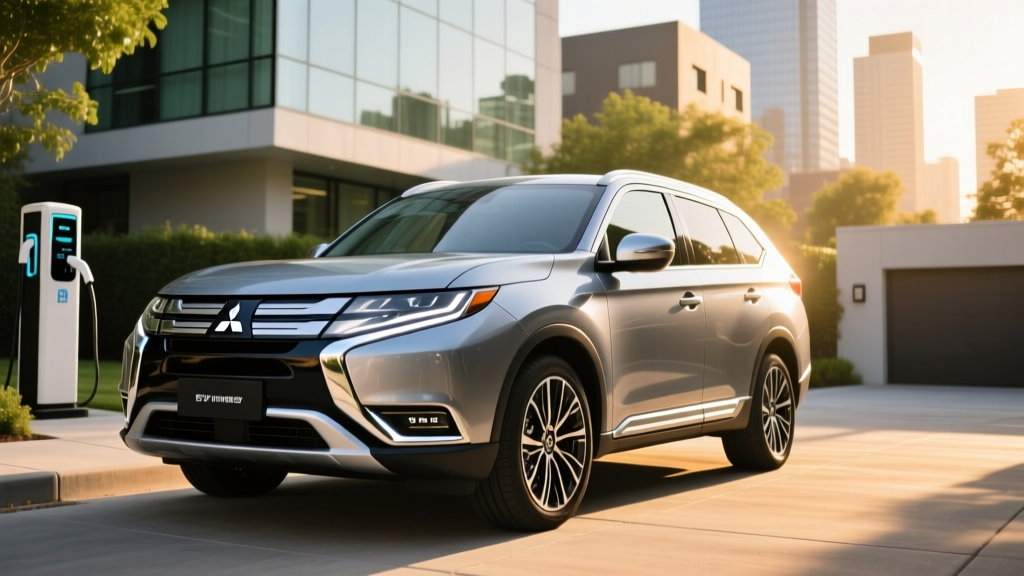
Quick Answer: Is the Outlander EV Right for You?
The Mitsubishi Outlander PHEV (plug-in hybrid) delivers 38 miles of EPA-rated electric-only range and 64 MPGe combined, making it a practical bridge for buyers who want daily electric commuting without full EV range anxiety. With a starting MSRP around $41,640, it qualifies for a partial §30D federal tax credit (up to $3,750–$7,500 depending on battery sourcing and your income). If your daily commute is under 35 miles and you have Level 2 home charging access, you can drive mostly on electricity and save an estimated $800–$1,200/year versus a comparable gas-only midsize SUV.
Outlander PHEV Specs: Range, Battery, and Charging Numbers
| Spec | 2026 Outlander PHEV (SEL trim shown) |
|---|---|
| EV-only range (EPA) | 38 miles |
| Combined MPGe (electric + gas) | 64 MPGe |
| Gas-only combined MPG | 26 MPG |
| Battery capacity (usable) | ~20 kWh, NMC lithium-ion |
| Level 1 charging (120V) | ~1.4 kW, ~14 hours 0–100% |
| Level 2 charging (240V) | ~3.6 kW, ~5.5 hours 0–100% |
| DC fast charging (CHAdeMO) | ~22 kW peak, 0–80% in ~38 min |
| Combined horsepower | 248 hp |
| 0–60 mph | ~7.2 seconds |
| Drivetrain | S-AWC (twin-motor AWD) |
| Battery warranty | 10 years / 100,000 miles |
| Base MSRP (ES trim) | $41,640 |
Real-world range note: The EPA rates the Outlander PHEV at 38 electric miles, but expect 30–34 miles in mixed highway driving and as low as 25–28 miles in sub-40°F winter conditions. Battery thermal management is passive (no active liquid cooling for the traction battery), which means cold-weather range loss is more pronounced than in liquid-cooled BEVs. In warm city driving with regenerative braking, some owners report reaching 40+ miles.
Outlander PHEV vs. Gas SUV vs. Full EV: Cost Comparison
The Outlander PHEV sits between a gas-only midsize SUV (like the Honda CR-V or Toyota RAV4 gas) and a full battery-electric vehicle (like the Hyundai Ioniq 5 or Tesla Model Y). Here's how the numbers stack up over a typical ownership cycle:
| Factor | Outlander PHEV | Gas SUV (RAV4 AWD) | Full EV (Ioniq 5 SEL) |
|---|---|---|---|
| Base MSRP | $41,640 | $33,445 | $45,500 |
| Est. federal tax credit | Up to $3,750–$7,500* | $0 | Up to $7,500* |
| Annual fuel/energy cost† | ~$1,100 | ~$2,100 | ~$650 |
| 5-year fuel/energy cost | ~$5,500 | ~$10,500 | ~$3,250 |
| Annual maintenance | ~$450 | ~$650 | ~$250 |
| Home charger install needed? | Recommended (L2) | No | Yes (L2 strongly recommended) |
*Tax credit eligibility depends on MSRP caps ($80,000 for SUVs), buyer income limits ($150K single / $300K joint), and battery critical-mineral sourcing. Verify current-year rules at IRS.gov §30D. PHEVs must have ≥7 kWh battery capacity to qualify — the Outlander's ~20 kWh pack meets this threshold.
†Based on 15,000 miles/year, $3.50/gal gas, $0.14/kWh electricity, and Outlander driven 70% in EV mode on a 30-mile daily commute.
Real-World Charging: What Owners Actually Experience
The Outlander PHEV uses a CHAdeMO connector for DC fast charging and a J1772 connector for Level 1 and Level 2 AC charging. This is a critical detail: CHAdeMO infrastructure is shrinking in the U.S. as most public networks have standardized on CCS and NACS (Tesla's connector). You'll find CHAdeMO plugs at some Electrify America and EVgo stations, but availability is declining.
At the Outlander's peak DC rate of ~22 kW, a "fast charge" adds roughly 30 miles of EV range in 38 minutes. That's functional for a top-up on a road trip, but it's dramatically slower than a BEV charging at 150–250 kW. Most PHEV owners do 90%+ of their charging at home on Level 2, which is the intended use case.
Common Outlander PHEV Misconceptions
| Myth | Fact |
|---|---|
| "I'll never need gas." | With only 38 EV miles, road trips and longer commutes require gas. The 26 MPG gas mode is comparable to a non-hybrid SUV, not a Prius. |
| "DC fast charging makes road trips easy." | At 22 kW peak, DC charging is a trickle compared to BEVs. Plan to use the gas engine on highway trips — that's what it's designed for. |
| "Any outlet will charge it fine overnight." | Level 1 (120V) takes ~14 hours for a full charge. If you deplete the battery on your commute, a standard outlet won't fully recharge it by morning. Level 2 is strongly recommended. |
| "The battery will need expensive replacement." | Mitsubishi covers the battery for 10 years/100,000 miles. PHEV batteries are smaller and experience less stress than BEV packs. Degradation is typically 10–15% over 8–10 years based on fleet data. |
Home Charging Setup and Installation Costs
For Outlander PHEV ownership to make financial sense, you need reliable home charging. Here's what to budget:
| Item | Cost Range |
|---|---|
| Level 2 charger (240V, 32A–40A) | $350–$700 |
| Electrician labor (240V outlet or hardwire) | $500–$1,500 |
| Permit (if required by local code) | $50–$200 |
| Electrical panel upgrade (if needed, 100A→200A) | $1,500–$3,500 |
| Total typical install | $900–$2,400 (without panel upgrade) |
Since the Outlander PHEV only draws ~3.6 kW on Level 2, you don't need a 48A charger — a standard 32A unit on a NEMA 14-50 outlet is more than sufficient. Have a licensed electrician verify your panel capacity before purchase. If your home lacks a 240V circuit near your parking spot, costs trend toward the higher end.
Without home charging, PHEV ownership becomes significantly less compelling. Relying on public Level 2 chargers (at $0.25–$0.49/kWh) erodes fuel savings, and the Outlander's declining CHAdeMO DC network makes public fast charging impractical. If you can't charge at home or at work, a conventional hybrid (like the RAV4 Hybrid at 39 MPG combined) may save you more with zero infrastructure requirements.
Tax Credit Eligibility: What You Can Actually Claim
§30D Federal Tax Credit Requirements (Current-Year Rules)
- Vehicle MSRP cap: ≤$80,000 for SUVs/vans/pickups (Outlander qualifies)
- Buyer income cap: ≤$150,000 single / $225,000 head of household / $300,000 joint AGI
- Battery capacity: ≥7 kWh (Outlander's ~20 kWh qualifies)
- Critical minerals requirement: Percentage of battery minerals sourced from U.S. or FTA partners (determines $3,750 half-credit)
- Battery components requirement: Percentage of components manufactured/assembled in North America (determines other $3,750 half-credit)
- Point-of-sale transfer: You can transfer the credit to the dealer for an upfront price reduction instead of claiming it on your tax return
- FEOC restriction: No battery components from Foreign Entities of Concern (China, Russia, etc.) after phase-in dates
The Outlander PHEV's credit amount has fluctuated as Mitsubishi adjusts battery sourcing. Check the latest eligibility at fueleconomy.gov before purchasing, as the critical-mineral and component requirements tighten annually. Even a partial $3,750 credit meaningfully narrows the price gap with gas competitors.
Decision Framework: Should You Buy the Outlander PHEV?
Choose the Outlander PHEV if:
- Your daily round-trip commute is under 35 miles and you can charge at home nightly
- You want AWD capability (S-AWC twin-motor system is excellent in snow/rain)
- You take 3+ road trips per year and don't want to plan around DC charging stations
- You need three-row seating (the Outlander offers a small third row, rare for PHEVs in this price bracket)
- You want to reduce emissions and fuel costs but aren't ready for a full BEV
Choose a full BEV (Ioniq 5, Model Y, EV6) instead if:
- You have reliable home Level 2 charging AND access to public DC fast chargers (NACS or CCS)
- Your daily commute exceeds 40 miles (you'd use gas constantly in the Outlander)
- You want minimal maintenance (no oil changes, no gas engine service)
- You're targeting the full $7,500 tax credit and your chosen BEV qualifies
Choose a conventional hybrid (RAV4 Hybrid, CR-V Hybrid) instead if:
- You cannot charge at home or work — a PHEV without charging access is just a heavier, less efficient hybrid
- Your budget is under $35,000 and you want to avoid the PHEV price premium
- You want simpler ownership with no charging cables or connector compatibility concerns
5-Year Ownership Cost Breakdown
| Cost Category | Outlander PHEV | RAV4 Gas AWD | Notes |
|---|---|---|---|
| Purchase price (after est. credit) | ~$37,890 | ~$33,445 | Assumes $3,750 credit for Outlander |
| Fuel/energy (5 years) | ~$5,500 | ~$10,500 | Outlander at 70% EV-mode commuting |
| Maintenance (5 years) | ~$2,250 | ~$3,250 | PHEV still needs oil changes, but less brake wear due to regen |
| Insurance (5 years, est.) | ~$9,500 | ~$8,250 | PHEVs/BEVs typically cost 10–15% more to insure |
| Home charger install | ~$1,500 | $0 | One-time Level 2 setup |
| Total 5-year cost | ~$56,640 | ~$55,445 | Near parity; savings widen in years 6–10 |
The Outlander PHEV reaches approximate cost parity with a gas RAV4 around year 4–5 if you charge at home and drive primarily in EV mode. The breakeven accelerates if gas prices rise or if you qualify for the full $7,500 credit. Depreciation data from IIHS and resale trackers shows the Outlander PHEV holding value reasonably well, aided by Mitsubishi's 10-year/100,000-mile powertrain warranty — one of the longest in the segment.
Frequently Asked Questions
Can I drive the Outlander PHEV on electricity alone for my commute?
Yes, if your one-way commute is under ~18 miles (36 miles round-trip). The EPA rates it at 38 EV miles, but real-world highway and cold-weather driving reduces that to 28–34 miles. For longer commutes, the gas engine kicks in seamlessly — you won't be stranded.
Does the Outlander PHEV qualify for the full $7,500 federal tax credit?
It depends on current battery-sourcing compliance. The Outlander has historically qualified for the $3,750 half-credit (critical minerals portion) but has fluctuated on the battery-component half. Check fueleconomy.gov and confirm with your dealer before signing. You must also meet income caps ($150K single / $300K joint).
What happens if I never plug it in?
You'll get roughly 26 MPG combined as a gas-only vehicle — comparable to a non-hybrid midsize SUV but worse than a dedicated hybrid like the RAV4 Hybrid (39 MPG). You'll also carry the dead weight of the battery and electric motors, which hurts efficiency. Not plugging in defeats the entire purpose of buying a PHEV.
How long does the battery last, and what does replacement cost?
Mitsubishi warranties the battery for 10 years / 100,000 miles (capacity retention above ~70%). Based on PHEV fleet data, degradation is typically 10–15% over a decade. Out-of-warranty replacement costs are estimated at $5,000–$8,000 (battery pack + labor), though most owners will never need one within normal ownership periods.
Is CHAdeMO a problem for the Outlander's future?
It's a growing concern. Most new DC fast-charging infrastructure in the U.S. uses CCS or NACS. CHAdeMO stations are declining, which limits the Outlander's public fast-charging options. For daily use this doesn't matter (you charge at home), but it reduces flexibility on road trips. Mitsubishi may adopt NACS in future model years, but current models remain CHAdeMO-equipped.
How does the Outlander PHEV compare to the Toyota RAV4 Prime?
The RAV4 Prime offers 42 miles of EV range, 94 MPGe, and a significantly faster DC charge rate. It's the segment benchmark. However, RAV4 Prime availability has been constrained by high demand, and dealer markups are common. The Outlander PHEV is more readily available, offers a third row (the RAV4 does not), and provides competitive — if slightly lower — efficiency. Cross-shop both and check local dealer stock.