The Quick Answer
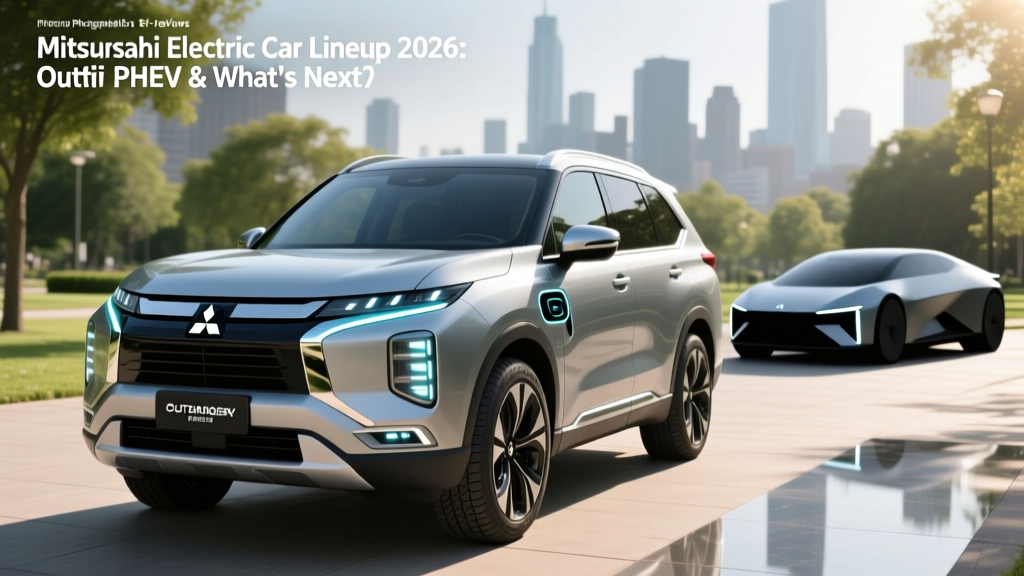
As of 2026, Mitsubishi does not sell a fully electric vehicle (BEV) in the United States. The closest thing to a Mitsubishi electric car you can buy today is the Mitsubishi Outlander PHEV, a plug-in hybrid that delivers approximately 38 miles of electric-only range before the gasoline engine kicks in. If you need a pure battery-electric Mitsubishi, you'll have to wait: Mitsubishi has announced a new dedicated EV platform targeting a 2027–2028 U.S. launch, but no production model is currently available for purchase. For now, the Outlander PHEV—starting around $41,000 MSRP—remains the brand's electrified offering, and it's a practical bridge for buyers who want electric commuting without full range-anxiety commitment.
What Mitsubishi Offers Right Now: The Outlander PHEV
The 2026 Mitsubishi Outlander PHEV is a three-row compact SUV with a plug-in hybrid powertrain. It pairs a 2.4-liter four-cylinder engine with twin electric motors and a 20.0 kWh battery pack (lithium-ion, NMC chemistry). The result is a vehicle that can handle most daily commutes on electricity alone while retaining a gas tank for longer road trips.
| Spec | Value |
|---|---|
| EPA Electric-Only Range | 38 miles |
| Total Range (electric + gas) | ~400 miles |
| Battery Capacity | 20.0 kWh (NMC) |
| Combined MPG (gas mode) | 25 MPG |
| MPGe (electric + gas combined) | 64 MPGe |
| Level 2 Charge Rate | ~3.3 kW |
| DC Fast Charge (CHAdeMO) | ~22 kW peak; 0–80% in ~38 min |
| 0–60 mph | ~7.9 seconds |
| Combined Horsepower | 248 hp |
| Base MSRP (ES trim) | $41,000 |
| Battery Warranty | 10 years / 100,000 miles |
The Outlander PHEV uses a CHAdeMO connector for DC fast charging—a standard that has been largely eclipsed by CCS and NACS in North America. This is a genuine limitation: most new public fast-charging stations deploy CCS or NACS plugs, and CHAdeMO infrastructure is shrinking. You can still find CHAdeMO chargers at many Electrify America and older stations, but the trend is not in this connector's favor.
Data sourced from fueleconomy.gov and Mitsubishi's official specifications.
EV vs. PHEV vs. Gas: Where the Outlander Fits
Shoppers searching for a Mitsubishi electric car are often weighing whether to go full BEV, stick with a PHEV, or buy a conventional gas vehicle. Here's how those options compare in practical terms.
| Vehicle Type | Example | Annual Energy Cost | Notes |
|---|---|---|---|
| Outlander PHEV (mixed driving) | 2026 Outlander PHEV | ~$1,350 | Assumes 60% electric / 40% gas; $0.14/kWh, $3.40/gal |
| Gas-only compact SUV | 2026 Outlander gas (26 MPG) | ~$1,960 | $3.40/gal regular |
| Full BEV | 2026 Hyundai Ioniq 5 (310 mi range) | ~$680 | $0.14/kWh home charging; 3.6 mi/kWh |
The PHEV saves roughly $600/year over the gas-only Outlander, but a comparable BEV saves over $1,200/year versus gas. The gap narrows if you can't charge at home—if you're relying on public DC fast charging at $0.35–$0.50/kWh, BEV costs climb significantly, and the PHEV's flexibility becomes more valuable.
Real Costs and Savings: 5-Year Ownership Breakdown
Let's put concrete numbers around what owning a 2026 Outlander PHEV actually costs compared to its gas-only sibling.
| Category | Outlander PHEV | Outlander Gas |
|---|---|---|
| Purchase Price (base MSRP) | $41,000 | $30,000 |
| Federal Tax Credit (§30D) | Up to $3,750* | $0 |
| Fuel/Energy (5 years) | $6,750 | $9,800 |
| Maintenance (5 years) | $2,800 | $3,500 |
| Insurance (5 years, avg.) | $8,500 | $7,800 |
| Estimated Depreciation | $18,000 | $14,500 |
| Total 5-Year Cost | ~$37,300 | ~$36,600 |
*The Outlander PHEV may qualify for a partial federal tax credit under IRS §30D rules. Eligibility depends on your income, the vehicle's MSRP (must be ≤$80,000 for SUVs), battery component sourcing, and critical-mineral requirements. PHEVs with smaller batteries often qualify for $3,750 rather than the full $7,500. Always verify current-year rules with a tax professional. The credit can be transferred to the dealer at point of sale as of 2024 onward.
The bottom line: the PHEV's fuel and maintenance savings largely offset its higher purchase price over five years, but the gas version still edges out slightly on total cost due to the lower upfront price and milder depreciation. The PHEV makes strongest financial sense if you can charge at home nightly and drive mostly within its 38-mile electric range.
Real-World Ownership: What First-Time Buyers Need to Know
If you're considering the Outlander PHEV as your first electrified vehicle, these are the practical realities that spec sheets don't highlight.
Home Charging Is Essential for PHEV Value
The Outlander PHEV's 20.0 kWh battery charges at roughly 3.3 kW on Level 2 (240V). That means a full charge takes about 6.5 hours—perfectly adequate for overnight replenishment on a standard Level 2 home charger. However, if you lack home charging access and rely on public infrastructure, you'll rarely drive in electric mode, and the PHEV becomes an expensive gas SUV. A basic Level 2 home installation (charger + electrician + permit) typically runs $800–$2,000 depending on your electrical panel.
Cold Weather Reduces Electric Range
Expect the 38-mile EPA electric range to drop to roughly 25–30 miles in freezing temperatures. The battery's chemistry is less efficient in cold, and cabin heating draws additional power. The Outlander PHEV does have a gasoline engine as backup, so you won't be stranded—but your electric commuting benefit shrinks in winter months.
The CHAdeMO Problem
Mitsubishi stuck with CHAdeMO for DC fast charging while the rest of the North American market standardized on CCS and, increasingly, NACS (Tesla's connector). For a PHEV with a small battery, DC fast charging matters less than it does for a full BEV—you're only adding 38 miles of range, not 300. Still, it limits your options at newer public stations, and it may hurt resale value as CHAdeMO infrastructure continues to contract.
Common Misconceptions About Mitsubishi's EV Plans
| Myth | Fact |
|---|---|
| "Mitsubishi sells a fully electric car in the U.S." | As of 2026, Mitsubishi offers no BEV in the U.S. market. The Outlander PHEV is a plug-in hybrid, not a pure EV. |
| "The Outlander PHEV qualifies for the full $7,500 tax credit." | PHEVs with smaller batteries and evolving sourcing rules often qualify for $3,750 or nothing at all, depending on the tax year and your income. Check IRS §30D guidelines. |
| "PHEVs don't need charging." | Without regular charging, a PHEV operates as a heavier, less efficient gas car. You're paying a premium for a battery you never use. |
| "Mitsubishi has no EV plans." | Mitsubishi's "Challenge 2025" and subsequent roadmaps outline new EVs on the Renault-Nissan-Mitsubishi Alliance CMF-EV platform, targeting 2027–2028 launches globally. |
| "The 38-mile electric range covers most commutes." | It covers many commutes—the U.S. average one-way commute is ~16 miles. But highway driving, cold weather, and accessory use reduce real-world electric range to 25–32 miles. |
Mitsubishi's EV Roadmap: What's Coming
Mitsubishi is a junior partner in the Renault-Nissan-Mitsubishi Alliance, and its EV development leans heavily on shared platforms. The Alliance's CMF-EV architecture underpins vehicles like the Nissan Ariya and Renault Megane E-Tech, and Mitsubishi has confirmed it will use this platform for future BEVs.
What we know so far:
- Next-generation Outlander PHEV: Expected to carry over and potentially expand battery capacity in the next redesign cycle (likely 2028+).
- Dedicated BEV: Mitsubishi has signaled a compact/midsize electric SUV for global markets, potentially arriving in the U.S. by 2028. Specs remain preliminary and unconfirmed for the North American market.
- Alliance sharing: Expect technology overlap with the Nissan Ariya (87 kWh battery, up to 304 miles EPA range, CCS/NACS charging) as a reference point for what a Mitsubishi BEV might offer.
Until a production model is officially announced with U.S. specs and pricing, treat all future Mitsubishi BEV details as preliminary.
Decision Framework: Should You Buy the Outlander PHEV or Look Elsewhere?
Choose the Mitsubishi Outlander PHEV if:
- You need three rows and AWD in an electrified vehicle under $50,000
- Your daily commute is under 30 miles round-trip and you can charge at home
- You take road trips where a gas tank's flexibility matters (rural areas, charging deserts)
- You want Mitsubishi's 10-year/100,000-mile powertrain and battery warranty
- You're not ready to commit to a full BEV but want to reduce fuel consumption
Look at a full BEV instead if:
- You want maximum fuel savings and lowest per-mile energy cost
- You have reliable home charging and rarely drive more than 250 miles in a day
- You want access to the broadest public charging networks (CCS/NACS)
- You want the full $7,500 federal tax credit (available on qualifying BEVs like the Hyundai Ioniq 5, Tesla Model Y, or Ford Mustang Mach-E, subject to IRS §30D rules)
- You want a vehicle with lower long-term maintenance (no oil changes, fewer moving parts)
Stick with a gas vehicle if:
- You have no access to home or workplace charging
- Your budget is under $30,000 and you can't absorb the PHEV premium
- You drive predominantly long highway routes where the PHEV's electric range provides minimal benefit
Frequently Asked Questions
Does Mitsubishi make a fully electric car?
Not in the United States as of 2026. Mitsubishi's only electrified vehicle sold in the U.S. is the Outlander PHEV, a plug-in hybrid. Globally, Mitsubishi has sold EVs like the i-MiEV (discontinued) and has announced plans for new BEVs on the Alliance CMF-EV platform, but none are currently available to American buyers.
How much does it cost to charge the Outlander PHEV at home?
The Outlander PHEV's usable battery capacity is approximately 17.5 kWh (from the 20.0 kWh pack, accounting for buffer). At the U.S. average residential electricity rate of ~$0.16/kWh, a full charge costs roughly $2.80. That gives you about 38 miles of electric range, or approximately $0.07 per mile on electricity—compared to ~$0.13 per mile on gasoline at $3.40/gallon and 25 MPG.
Can I DC fast charge the Outlander PHEV?
Yes, but only at CHAdeMO-equipped stations, which are increasingly rare. Peak charge rate is approximately 22 kW, and a 0–80% charge takes about 38 minutes. For a PHEV with 38 miles of electric range, DC fast charging is a marginal benefit—most owners will charge overnight on Level 2 at home.
Is the Outlander PHEV good in snow and cold weather?
The Outlander PHEV's twin-motor AWD system (Mitsubishi calls it S-AWC) provides solid traction in snow. However, expect electric-only range to drop by 20–35% in freezing conditions due to battery chemistry limitations and cabin heating demand. The gas engine seamlessly compensates, so you won't be stranded—but your winter fuel costs will be higher.
What's the warranty on the Outlander PHEV battery?
Mitsubishi covers the PHEV battery for 10 years or 100,000 miles, whichever comes first. The warranty guarantees the battery will retain a minimum capacity threshold (typically 60–70% of original capacity, per Mitsubishi's terms). This is one of the stronger PHEV battery warranties in the segment and reflects Mitsubishi's long-standing experience with PHEV technology dating back to the 2013 Outlander PHEV in global markets.
How does the Outlander PHEV compare to the Toyota RAV4 Prime?
The Toyota RAV4 Prime offers 42 miles of electric range (vs. the Outlander's 38), a more powerful 302 hp powertrain, and uses the more common J1772/CCS connector ecosystem. The RAV4 Prime starts around $44,000—roughly $3,000 more than the Outlander PHEV. The Outlander counters with a third row (the RAV4 Prime is two-row only), a longer basic warranty (5yr/60k vs. Toyota's 3yr/36k), and a lower entry price. If you need three rows, the Outlander PHEV is the more practical pick; if you prioritize electric range and performance, the RAV4 Prime wins.