Quick Answer: Is the MINI Countryman Electric Worth It?
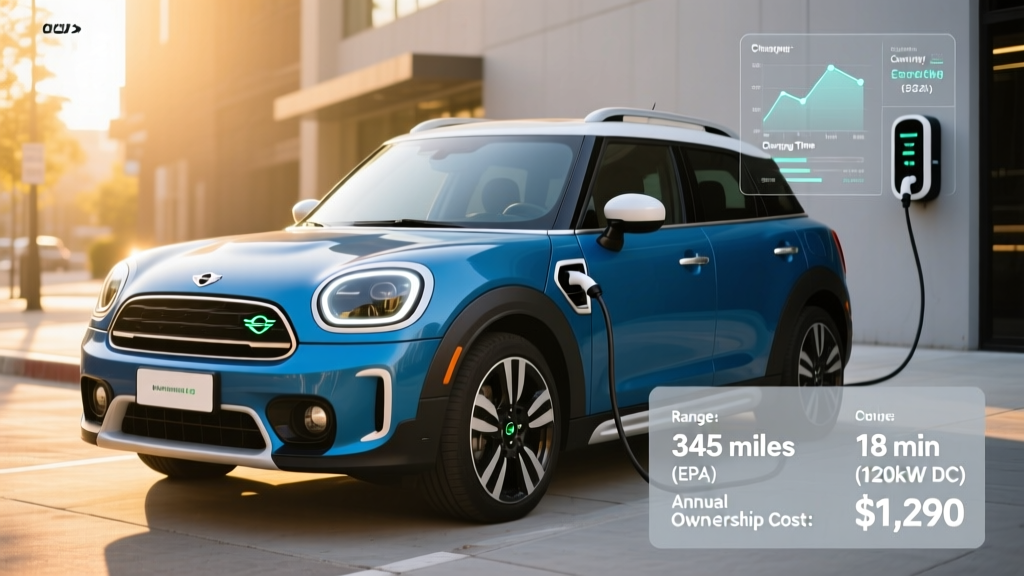
The 2026 MINI Countryman Electric (SE ALL4) offers an EPA-estimated 242 miles of range from a 64.7 kWh (usable) battery, peaks at 130 kW DC fast charging (10–80% in ~29 minutes), and starts at $44,900 before incentives. It's a practical compact luxury EV crossover for buyers who want premium styling and all-wheel drive without stepping up to a Tesla Model Y or BMW iX. However, its real-world highway range drops to roughly 200–215 miles, and federal tax credit eligibility depends on battery sourcing and your income. If you have Level 2 home charging and drive under 200 miles daily, it's a compelling daily driver. If you road-trip frequently or lack home charging, consider the range and public-charging limitations carefully.
Range and Efficiency: EPA vs. Real World
The Countryman SE ALL4 pairs dual motors (combined 308 horsepower, 364 lb-ft torque) with a 64.7 kWh usable NMC battery pack. The EPA rates it at 242 miles combined, with efficiency rated at approximately 102 MPGe (33 kWh/100mi). That places it mid-pack among compact luxury EV crossovers — behind the Tesla Model Y Long Range (320+ mi) but competitive with the Volvo EX40 and ahead of the base BMW iX1.
Real-World Range Expectations
EPA Sticker: 242 miles
Highway (70 mph, 75°F): ~210–220 miles
Cold Weather (30°F, mixed): ~170–190 miles
City/Regen-Heavy Driving: ~240–250 miles
The Countryman's boxy SUV shape creates more aerodynamic drag than sleeker EVs, which hurts highway efficiency. In cold weather, expect a 20–25% range reduction — typical for EVs without a heat pump standard. The Countryman does offer a heat pump as part of an available cold-weather package, which can reduce cold-weather losses to roughly 15%.
For context, a 40-mile daily round-trip commute means charging roughly every 4–5 days even in winter. A 300-mile road trip will require one DC fast-charge stop.
Charging Speed: Home and DC Fast Charging
The Countryman Electric supports three charging tiers. Understanding the difference between kW (power/charge rate) and kWh (energy/battery capacity) is critical here — a higher kW means faster charging, while kWh determines how much energy the battery stores.
| Level | Power (kW) | Miles Added per Hour | 0–100% / 10–80% Time | Connector |
|---|---|---|---|---|
| Level 1 (120V) | ~1.4 kW | ~3–4 mi/hr | ~45+ hours (full) | J1772 / NACS adapter |
| Level 2 (240V, 48A) | ~11 kW | ~30–33 mi/hr | ~6.5 hours (full) | J1772 (or NACS w/ adapter) |
| DC Fast Charge | 130 kW peak | ~150+ mi in 15 min | ~29 min (10–80%) | CCS1 (or NACS w/ adapter) |
The 130 kW peak DC charge rate is adequate but not class-leading. The Hyundai Ioniq 5 peaks at 240 kW on 800V architecture, and the Tesla Model Y can sustain high rates on Superchargers. The Countryman's charge curve tapers significantly above 80% SoC — charging from 80–100% can take nearly as long as 10–80%, so plan to unplug at 80% during road trips.
Home charging reality: A full Level 2 install (240V/48A hardwired charger) typically costs $800–$2,000 including equipment and electrician labor, depending on whether your panel needs an upgrade. On Level 2, the Countryman replenishes overnight easily. Level 1 (standard outlet) is impractical as a primary charge method at only ~3–4 miles per hour.
Performance and Driving Impressions
The dual-motor ALL4 system delivers 308 hp and a 0–60 mph time of approximately 5.6 seconds. That's brisk for daily driving, though a step below the Tesla Model Y Performance (3.5 sec) or the BMW iX xDrive50 (4.4 sec). The Countryman's ride quality leans firm but controlled, typical of MINI tuning. Regenerative braking offers adjustable levels via paddle shifters, though it does not achieve true one-pedal driving at the strongest setting — you'll still need the brake pedal for full stops.
Interior tech centers on a 9.4-inch circular OLED display running MINI's Operating System 9, with wireless Apple CarPlay and Android Auto. Cargo space measures approximately 16.3 cu ft behind the rear seats, expanding to ~48 cu ft with seats folded — competitive with the Volvo EX40 but less than the Model Y's 30 cu ft (rear seats up).
Pricing, Trims, and Federal Tax Credit Eligibility
| Spec | 2026 MINI Countryman SE ALL4 |
|---|---|
| Base MSRP | $44,900 |
| EPA Range | 242 miles |
| Battery (usable) | 64.7 kWh, NMC |
| DC Fast Charge Peak | 130 kW |
| 10–80% DC Charge Time | ~29 minutes |
| Level 2 Charge Rate | 11 kW |
| Horsepower | 308 hp (dual motor) |
| 0–60 mph | 5.6 seconds |
| MPGe (combined) | ~102 MPGe |
| Cargo Volume | 16.3 / 48 cu ft |
| Battery/Powertrain Warranty | 8 years / 100,000 miles |
The Countryman SE ALL4 starts at $44,900, with the Signature and Iconic trims adding $3,000–$7,000 for premium features like a panoramic roof, Harman Kardon audio, and advanced driver assistance. The JCW (John Cooper Works) performance variant is expected above $55,000.
Federal §30D Tax Credit: Do You Qualify?
The IRS §30D clean vehicle credit offers up to $7,500, but eligibility depends on multiple requirements that change periodically:
- MSRP Cap: SUVs must be priced at or below $80,000 (the Countryman qualifies)
- Buyer Income Cap: Modified AGI must not exceed $150,000 (single) / $300,000 (joint)
- Battery Sourcing: Critical minerals and battery components must meet phased-in percentage thresholds from US/free-trade-agreement countries — MINI, as a BMW Group brand, sources components globally, and eligibility varies by model year and production batch
- Final Assembly: Vehicle must undergo final assembly in North America — verify your specific VIN at fueleconomy.gov
- Point-of-Sale Transfer: You can transfer the credit to the dealer at purchase to reduce the sale price, rather than waiting for a tax refund
Important: Always confirm credit eligibility for your specific VIN and tax situation with a tax professional. Rules are subject to change, and partial credits ($3,750) may apply if only one of the two sourcing requirements is met.
Countryman Electric vs. Gas Countryman vs. Competitors
| Metric | Countryman SE ALL4 (EV) | Countryman S ALL4 (Gas) | Tesla Model Y LR (EV) |
|---|---|---|---|
| Base MSRP | $44,900 | $39,900 | $48,990 |
| EPA Range / MPG | 242 mi / 102 MPGe | 28 MPG combined | 320 mi / 122 MPGe |
| Fuel/Energy Cost (15k mi/yr) | ~$600–$850/yr* | ~$2,100/yr** | ~$550–$750/yr* |
| Maintenance (annual avg) | ~$300 | ~$700 | ~$300 |
| 0–60 mph | 5.6 sec | 6.3 sec | 4.8 sec |
| Federal Tax Credit | Up to $7,500*** | None | Up to $7,500*** |
*Based on $0.14/kWh national average home electricity; public DC charging costs more (~$0.30–0.48/kWh). **Based on $3.50/gal premium and 28 MPG. ***Subject to IRS §30D eligibility.
The gas Countryman S ALL4 starts $5,000 lower but costs roughly $1,200–$1,500 more per year in fuel and maintenance. Over 5 years and 75,000 miles, the EV's energy and maintenance savings total approximately $7,500–$10,000 — effectively erasing the price premium before any tax credit. With the full $7,500 credit, the EV becomes the clear financial winner for buyers who qualify and have home charging.
Real Ownership Costs Over 5 Years
| Cost Category | Countryman Electric (5 yr) | Countryman Gas (5 yr) |
|---|---|---|
| Purchase Price (after credit) | ~$37,400* | $39,900 |
| Energy/Fuel (75,000 mi) | ~$3,500 (home charging) | ~$10,500 |
| Maintenance | ~$1,500 | ~$3,500 |
| Insurance (avg) | ~$9,500 | ~$8,000 |
| Home Charger Install | ~$1,200 | $0 |
| 5-Year Total | ~$53,100 | ~$61,900 |
*Assumes full $7,500 federal credit. Insurance estimates vary significantly by driver, location, and provider — EV insurance premiums tend to run 10–20% higher than comparable gas vehicles due to repair costs and battery replacement risk.
The Countryman Electric saves approximately $8,800 over 5 years for buyers who qualify for the full tax credit and charge primarily at home. Without the credit, savings narrow to roughly $1,300 — still positive but less compelling. If you rely on public DC fast charging exclusively, energy costs roughly double, which can flip the economics negative.
Common Misconceptions About the Countryman Electric
| Myth | Fact |
|---|---|
| "242 miles of range isn't enough" | Average US daily driving is ~37 miles (FHWA data). 242 mi covers 95%+ of daily needs with multi-day buffer. Road trips require planning but are manageable with DC fast charging. |
| "EV batteries need replacing every few years" | MINI warranties the battery for 8 years/100,000 miles with a 70% capacity retention threshold. Industry data shows NMC batteries typically retain 85–90% capacity at 100,000 miles with normal use. |
| "Charging takes too long" | Home Level 2 charging happens overnight while you sleep (~6.5 hr for full charge). Road-trip DC stops take ~29 min for 10–80%, similar to a gas station rest stop with food and restroom break. |
| "It qualifies for the full $7,500 tax credit" | Credit eligibility depends on battery sourcing, your income, and final assembly location — verify your VIN before assuming the full amount. |
| "EVs are worse in cold weather" | Range drops 15–25% in freezing temps, but EVs start instantly (no cold cranking), cabin preconditioning via app is effective, and available heat pump minimizes losses. |
Decision Framework: Should You Buy the Countryman Electric?
Choose the MINI Countryman Electric If:
- You have access to Level 2 home charging (garage or driveway with 240V circuit)
- Your daily driving is under 150 miles round-trip
- You want a compact luxury crossover with distinctive styling and premium interior
- You qualify for the federal tax credit (check income and sourcing rules)
- You value all-wheel drive for rain/snow without a gas powertrain
- You want lower ongoing fuel and maintenance costs
Consider a Gas/Hybrid or Different EV If:
- You lack reliable home or workplace charging access
- You regularly drive 300+ miles without stopping (road-trip heavy lifestyle)
- You live in a region with sparse DC fast-charging infrastructure
- You need maximum cargo space — the Tesla Model Y offers significantly more
- You want 300+ miles of range — look at the Model Y Long Range or Hyundai Ioniq 5
- You don't qualify for the tax credit and need to minimize upfront cost
What First-Time EV Buyers Should Know
If the Countryman Electric is your first EV, prepare for a few ownership adjustments:
- Install a Level 2 charger before delivery. A 240V/48A hardwired unit (like a ChargePoint Home Flex or Wallbox Pulsar Plus) costs $500–$700 for equipment plus $300–$1,300 for electrician labor. If your electrical panel is at capacity, a panel upgrade adds $1,500–$3,000.
- Download charging apps now. Electrify America, EVgo, and ChargePoint cover most public networks. Plan road trips with PlugShare or A Better Routeplanner to identify reliable DC chargers along your route.
- Understand the charge curve. The Countryman's 130 kW peak only holds from roughly 10–50% SoC. Above 80%, charging slows dramatically to protect battery health. On road trips, charge to 80% and move on rather than waiting for a full battery.
- Precondition before fast charging. Use the MINI app to warm the battery while still plugged in at home or en route to a charger. A warm battery charges significantly faster than a cold one.
- Budget for insurance. Get quotes before purchasing — EV premiums average 10–20% higher than equivalent gas models. Shop multiple providers; some offer EV-specific discounts.
Does the MINI Countryman Electric qualify for the $7,500 federal tax credit?
Eligibility depends on IRS §30D rules including battery component and critical-mineral sourcing thresholds, buyer income limits ($150K single / $300K joint), and the $80,000 SUV MSRP cap. The Countryman's MSRP qualifies, but sourcing requirements may limit the credit to $3,750 or zero depending on the production batch. Always verify your specific VIN at fueleconomy.gov and consult a tax professional.
What is the real-world range of the Countryman Electric?
Expect roughly 210–220 miles on the highway at 70 mph in mild weather, 170–190 miles in freezing conditions, and 240+ miles in city driving with regenerative braking. The EPA's 242-mile combined estimate is achievable in mixed suburban driving but optimistic for sustained highway or cold-weather use.
Can I charge the Countryman Electric on Tesla Superchargers?
MINI has committed to NACS adapter compatibility for access to Tesla's Supercharger network. With a NACS adapter (included or available separately depending on model year), you can access V3 Superchargers (up to 150 kW, though the Countryman peaks at 130 kW). Confirm adapter availability with your dealer at purchase.
How long will the Countryman Electric battery last?
MINI warranties the high-voltage battery for 8 years or 100,000 miles, whichever comes first, guaranteeing at least 70% of original capacity. Based on industry NMC degradation data, most owners will see 85–90% capacity retention at 100,000 miles. Battery replacement, if ever needed out of warranty, is estimated at $10,000–$15,000 based on comparable BMW Group battery packs.
Is the Countryman Electric good in snow and winter?
Yes, with caveats. The ALL4 dual-motor AWD system provides strong traction, and the low center of gravity (battery pack under the floor) aids stability. Range drops 15–25% in freezing temperatures — opt for the available heat pump to minimize this. Precondition the cabin and battery while plugged in for best winter performance.
How does it compare to the BMW iX1?
The Countryman Electric and BMW iX1 share the same FAAR platform and similar powertrains. The iX1 offers slightly less range (~230 mi EPA equivalent) and a more BMW-oriented interior, while the Countryman provides MINI's distinctive design language and a slightly larger cargo area. Pricing is comparable, so the choice comes down to brand preference and styling.