The Quick Answer: Should You Buy a Midsize Electric Pickup Truck?
Bottom line: A midsize electric pickup truck makes sense if you need 250+ miles of range, daily commuting efficiency, and moderate towing (under 7,500 lbs), and you can charge at home. Expect to pay $55,000–$75,000 before incentives, spend roughly $600–$1,200 on a Level 2 home charger install, and save $1,500–$2,500 per year on fuel and maintenance compared to a gas equivalent. If you regularly tow over 5,000 lbs long-distance, haul in sub-freezing climates, or lack home charging access, a hybrid or diesel midsize truck may serve you better today.
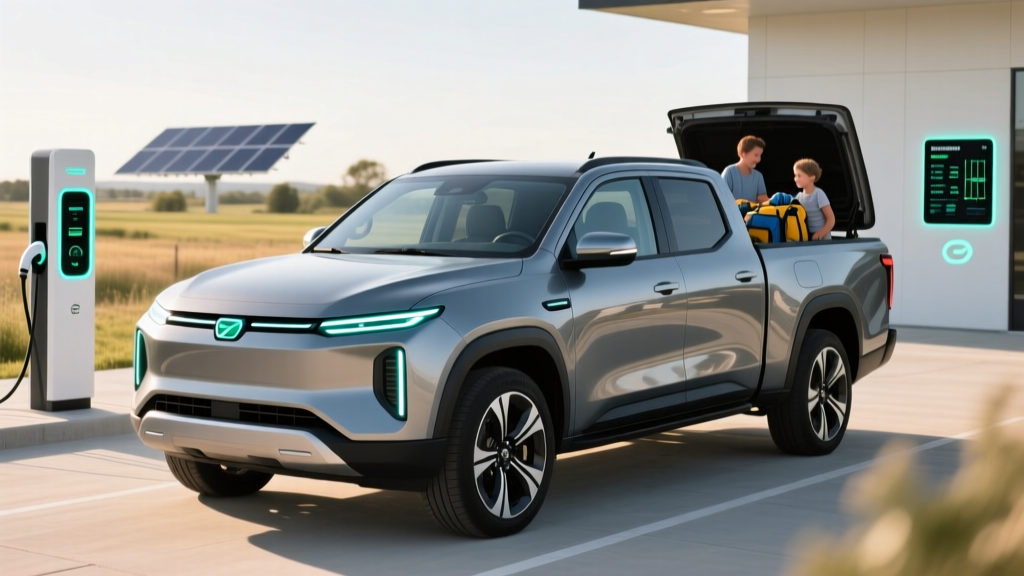
The midsize electric pickup truck segment has matured considerably. The Rivian R1T remains the category benchmark, while new entrants have expanded choice. These trucks deliver instant torque, lower per-mile energy costs, and usable frunk storage—but they also carry higher purchase prices, real towing-range penalties, and charging logistics that gas-truck buyers simply don't face.
This guide gives you the exact numbers you need to decide: EPA range, battery capacity, charging speeds, total cost of ownership, and the tax-credit rules that actually apply in 2026.
2026 Midsize Electric Pickup Trucks: The Current Lineup
As of the 2026 model year, the midsize electric pickup truck market includes one established player and several announced models. Here is where things stand with verified specifications.
| Spec | Rivian R1T (Dual-Motor, Standard Battery) | Rivian R1T (Dual-Motor, Max Battery) | Ford Maverick EV (Announced) | Tesla Cybertruck AWD |
|---|---|---|---|---|
| EPA Range | 270 mi | 352 mi | ~250 mi (est.) | 340 mi |
| Battery (usable kWh) | 92 kWh (NMC) | 128 kWh (NMC) | TBA | 123 kWh (NMC) |
| Peak DC Fast Charge | 220 kW | 220 kW | TBA | 250 kW |
| 10–80% Charge Time | ~30 min | ~40 min | TBA | ~28 min |
| Level 2 Charge Rate | 11.5 kW | 11.5 kW | TBA | 11.5 kW |
| Horsepower | 533 hp | 533 hp | TBA | 600 hp |
| 0–60 mph | 4.5 sec | 4.5 sec | TBA | 4.1 sec |
| Max Towing | 11,000 lbs | 11,000 lbs | ~2,000 lbs (est.) | 11,000 lbs |
| Payload | 1,760 lbs | 1,760 lbs | ~1,500 lbs (est.) | 2,500 lbs |
| Starting MSRP | $69,900 | $75,900 | ~$35,000 (est.) | $79,990 |
| Battery/Powertrain Warranty | 8 yr / 175,000 mi | 8 yr / 175,000 mi | TBA | 8 yr / 120,000 mi |
Note: The Tesla Cybertruck is technically larger than a traditional midsize truck but competes closely on price and buyer cross-shopping. The Ford Maverick EV has been announced with preliminary specifications; final EPA numbers are pending certification. The Chevrolet Colorado EV and Ram 1500 REV have been discussed but lack confirmed 2026 model-year availability.
Real-World Range: What the EPA Sticker Doesn't Tell You
EPA vs. Reality: The Rivian R1T Max Battery carries a 352-mile EPA rating. In real-world highway driving at 70 mph, expect 280–310 miles. In cold weather (below 32°F), plan for 220–260 miles of usable range. Towing a 5,000-lb trailer at highway speed cuts range roughly in half—150–175 miles before needing a charge.
This is the single biggest ownership surprise for first-time electric truck buyers. The physics are straightforward: a midsize electric pickup truck weighs 6,000–7,000 lbs empty and presents a large frontal area. At highway speeds, aerodynamic drag dominates energy consumption. Add a trailer, and you're pushing 10,000+ lbs of combined weight through the air.
For daily commuting and around-town use, range is rarely an issue. Most owners charge at home overnight and start every day with a full battery. It's the 300-mile road trip with a trailer where planning matters. According to fueleconomy.gov, electric trucks lose efficiency faster than sedans at sustained highway speeds due to weight and drag coefficient.
Charging: Home Setup, Public Networks, and What It Costs
Charging a midsize electric pickup truck at home is where the economics work best. Here's what you need to know about each level.
| Level | Power (kW) | Miles of Range Per Hour | Typical Use Case |
|---|---|---|---|
| Level 1 (120V) | 1.4 kW | 3–5 mi/hr | Emergency / overnight trickle |
| Level 2 (240V, 48A) | 11.5 kW | 25–35 mi/hr | Daily home charging |
| DC Fast Charge | 150–250 kW | ~500+ mi/hr (peak) | Road trips, rapid top-ups |
kW vs. kWh — the critical distinction: kW (kilowatts) measures the rate of charging—how fast energy flows into your battery. kWh (kilowatt-hours) measures the battery's total capacity—how much energy it stores. A 128 kWh battery charged at 11.5 kW takes roughly 11 hours from empty to full.
Home Level 2 Installation Cost
| Component | Cost Range |
|---|---|
| Level 2 Charger (hardware) | $400–$700 |
| Electrician labor (240V/60A circuit) | $600–$2,000 |
| Permit & inspection | $50–$250 |
| Electrical panel upgrade (if needed) | $1,500–$3,500 |
| Total (no panel upgrade) | $1,050–$2,950 |
| Total (with panel upgrade) | $2,550–$6,450 |
Most midsize electric pickup truck owners need a 60-amp dedicated circuit to support 48A continuous charging at 11.5 kW. If your home has a 200-amp panel with available capacity, installation stays on the lower end. Older homes with 100-amp panels often require an upgrade—factor this into your purchase budget.
Public charging reality: DC fast charging on networks like Electrify America, EVgo, and the Tesla Supercharger network (now open to Rivian via adapter) delivers 150–250 kW peak. However, peak rate is not sustained rate. The Rivian R1T peaks near 220 kW up to roughly 40% state of charge, then tapers progressively. A 10–80% session takes about 30–40 minutes depending on battery size and ambient temperature. Cold batteries charge slower—preconditioning (warming the battery before arrival at the charger via navigation routing) is essential in winter.
Cost of Ownership: Electric Truck vs. Gas Truck
Let's compare a Rivian R1T Dual-Motor Standard against a comparably equipped gas midsize truck (such as a Toyota Tacoma TRD or Ford Ranger Lariat) over 5 years and 75,000 miles.
| Cost Category | Rivian R1T (EV) | Gas Midsize Truck |
|---|---|---|
| Purchase Price (MSRP) | $69,900 | $45,000 |
| Federal Tax Credit (§30D) | Up to $7,500* | $0 |
| Effective Purchase Price | $62,400 | $45,000 |
| Home Charger Install | $1,500 | $0 |
| Fuel/Energy (75,000 mi) | $5,400† | $11,250‡ |
| Maintenance (5 yr) | $1,200 | $3,800 |
| Insurance (5 yr avg.) | $12,500 | $8,500 |
| Total 5-Year Cost | $83,000 | $68,550 |
| Cost Per Mile | $0.31/mi (energy) | $0.55/mi (fuel) |
*§30D credit eligibility depends on income caps, MSRP limits, battery sourcing, and critical mineral requirements. See IRS.gov for current rules. Trucks classified as SUVs for tax purposes have an $80,000 MSRP cap.
†Based on $0.14/kWh national average home electricity and 2.2 kWh/mi consumption. Public DC fast charging at $0.35–$0.50/kWh raises this cost.
‡Based on $3.50/gallon and 22 MPG combined.
The electric truck costs more upfront but saves $5,850–$7,200 on fuel and maintenance over five years. Insurance premiums for electric trucks run 20–40% higher due to repair costs and battery replacement risk. The break-even point against a gas truck typically falls between 6–9 years for most owners, depending on mileage, electricity rates, and whether the full tax credit applies.
Federal Tax Credit: What Actually Applies in 2026
The §30D Clean Vehicle Credit remains available but with strict eligibility criteria that disqualify many buyers and some configurations. Here's the checklist:
- MSRP cap: $80,000 for vehicles classified as SUVs/pickups (most midsize electric trucks qualify)
- Buyer income limits: AGI must not exceed $300,000 (joint), $225,000 (head of household), or $150,000 (single)
- Battery sourcing: Increasing percentages of battery components must be manufactured or assembled in North America, and critical minerals must be sourced from the U.S. or free-trade-agreement countries
- Point-of-sale transfer: You can transfer the credit to the dealer at purchase for an immediate price reduction rather than waiting for tax filing
- Final assembly: Vehicle must undergo final assembly in North America
The Rivian R1T is assembled in Normal, Illinois, and has historically qualified for at least partial credit. However, battery sourcing requirements tighten annually. Always verify current eligibility at fueleconomy.gov before purchasing, as component sourcing can change mid-model-year.
Common Misconceptions About Electric Pickup Trucks
| Myth | Fact |
|---|---|
| "Electric trucks can't tow." | The R1T and Cybertruck are rated for 11,000 lbs. The issue is range while towing—expect 50% range reduction at highway speeds with a loaded trailer. |
| "The battery will need replacing in 5 years." | NMC batteries in modern EVs retain 85–92% capacity after 150,000 miles based on fleet data. Warranty covers replacement if capacity drops below 70% within 8 years. |
| "Charging takes too long for road trips." | A 10–80% DC fast charge takes 28–40 minutes. Combined with a meal or rest stop, this is manageable for most trips—but requires route planning in rural areas. |
| "Electric trucks are worse in winter." | Range drops 15–30% in freezing temps due to battery chemistry and cabin heating. Heat pumps (standard on R1T) reduce this penalty. Regenerative braking is limited when the battery is cold. |
| "You can't go off-road." | Electric trucks deliver instant torque at zero RPM, excellent for rock crawling. The R1T has completed the Trans-America Trail. Ground clearance and approach angles are competitive with gas off-road trucks. |
Decision Framework: Is a Midsize Electric Pickup Truck Right for You?
Choose a midsize electric pickup truck if:
- You can install a Level 2 charger at home (garage or driveway with 240V access)
- Your daily driving is under 150 miles round-trip
- You tow occasionally but not frequently over long distances
- You value low per-mile operating cost and instant acceleration
- You qualify for the §30D tax credit (income and sourcing requirements)
Stick with gas or consider a hybrid truck if:
- You lack reliable home charging (apartment, street parking, no garage)
- You regularly tow 5,000+ lbs over distances exceeding 150 miles
- You operate primarily in extreme cold climates (consistent sub-20°F winters)
- Your budget caps below $50,000 and you need a truck now
- You frequently drive in areas with sparse DC fast-charging infrastructure
The midsize electric pickup truck is a compelling daily driver and light-duty workhorse that falls short only in heavy sustained towing and remote-area travel. If your use case fits within those boundaries, the fuel savings, reduced maintenance, and driving refinement make a strong case. If you're regularly pushing the limits of range and towing, the infrastructure hasn't caught up yet—plan accordingly.
Frequently Asked Questions
What is the best midsize electric pickup truck in 2026?
The Rivian R1T remains the most complete midsize electric pickup truck available, offering up to 352 miles of EPA range, 11,000-lb towing, and a well-built interior. The Tesla Cybertruck competes on performance and charging speed but is larger and polarizing in design. Budget buyers should watch for the Ford Maverick EV, which targets a ~$35,000 starting price but has not yet confirmed final specs or availability.
How much does it cost to charge an electric truck at home?
At the national average electricity rate of $0.14/kWh, fully charging a 92 kWh battery (Rivian R1T Standard) costs about $12.88. A 128 kWh Max Battery costs roughly $17.92. Compare this to $60–$80 for a tank of gas in a comparable midsize truck. Over 15,000 miles per year, home charging costs approximately $1,080 versus $2,380 for gas.
Can I tow a trailer long-distance with an electric truck?
Yes, but with significant planning. Expect range to drop to 150–175 miles when towing 5,000 lbs at highway speed. You'll need DC fast chargers every 120–140 miles along your route, and each charge stop will take 30–45 minutes. For frequent long-distance towing, a diesel or gas truck remains more practical today.
Do electric trucks qualify for the $7,500 tax credit?
Some do, but eligibility depends on your income (AGI under $300,000 for joint filers), the truck's MSRP (under $80,000 for trucks/SUVs), battery component sourcing, and final assembly location. The Rivian R1T has qualified for partial to full credit depending on battery configuration and model year. Always check IRS.gov and fueleconomy.gov for the latest eligibility before purchasing.
What happens to the battery after 100,000 miles?
Modern NMC batteries degrade gradually. Industry fleet data shows 85–92% capacity retention at 150,000 miles. The Rivian R1T battery warranty covers replacement if capacity falls below 70% within 8 years or 175,000 miles. Out-of-warranty battery replacement currently costs $15,000–$25,000 depending on capacity, though prices are declining annually.