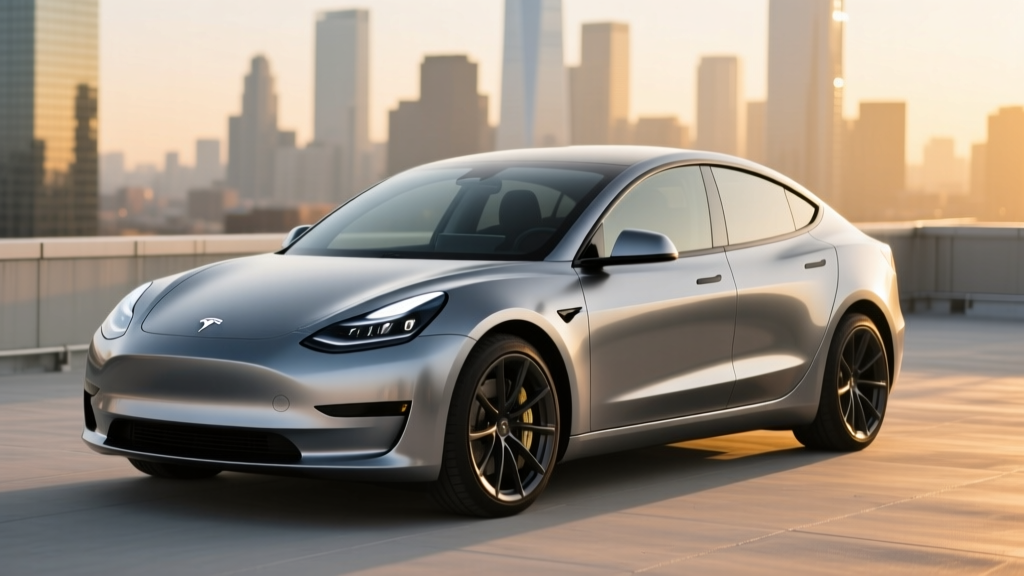
The midnight silver Tesla paint option has become one of the most sought-after finishes in the Model 3 lineup, and for good reason — it's a no-cost color that shifts between deep gunmetal gray and subtle blue depending on the light. But a striking paint job doesn't charge your battery or get you through a Rocky Mountain winter. This review puts the 2026 Model 3 Long Range AWD — the variant most commonly configured in midnight silver — through a data-driven evaluation of its range, charging behavior, ownership costs, and whether it still earns its spot against a rapidly closing competitive field.
2026 Tesla Model 3 Long Range AWD: Spec Snapshot
| Spec | Value |
|---|---|
| EPA Range | 341 miles |
| Battery (usable) | ~79 kWh, NMC (nickel manganese cobalt) |
| Drivetrain | Dual-motor AWD |
| Horsepower | ~384 hp combined |
| 0-60 mph | 4.2 seconds |
| Peak DC Fast Charge | 250 kW (CCS via NACS adapter or native NACS) |
| 10-80% DCFC Time | ~27 minutes |
| Level 2 Home Charge | 11.5 kW (~44 mi/hr) |
| EPA Efficiency | 131 MPGe combined / 25 kWh/100 mi |
| Cargo Volume | 23.1 cu ft (rear trunk + frunk) |
| Rear Legroom | 35.3 inches |
| Battery Warranty | 8 years / 120,000 miles (70% retention) |
| Base MSRP | $47,740 (before destination) |
Sources: EPA fueleconomy.gov, Tesla Model 3 Design Studio.
Real-World Range: What the EPA Sticker Doesn't Tell You
Real-World Highway (70-80 mph, 65°F): ~280-300 miles
Real-World Highway (30°F, heater on): ~230-260 miles
City/Commuter (mixed regen, moderate climate): ~310-330 miles
The 341-mile EPA figure is legitimate for mixed driving in moderate temperatures, but highway-heavy road trips at sustained 75+ mph will pull efficiency down to roughly 280-300 miles of practical range before you're hunting for a charger at 10% SoC. In freezing temperatures, expect a 20-30% reduction due to cabin heating demands and reduced battery chemistry efficiency — even with Tesla's heat pump, which is one of the better thermal management systems on the market.
The ~79 kWh NMC pack provides strong energy density, which is why the Long Range achieves this range in a relatively compact sedan. However, NMC chemistry is more sensitive to sustained high states of charge than LFP. Tesla recommends daily charging to 80% for Long Range models, reserving 100% for road trips. This means your practical daily range is closer to 270 miles — still more than adequate for nearly all commutes.
Charging Speed: DC Fast, Level 2, and the Supercharger Advantage
| Charging Level | Power | Speed / Notes |
|---|---|---|
| Level 1 (120V outlet) | ~1.4 kW | ~4-5 mi/hr — emergency/trickle only |
| Level 2 (240V, 48A Wall Connector) | 11.5 kW | ~44 mi/hr — full charge overnight in ~7.5 hrs |
| DC Fast (Tesla Supercharger V3) | Up to 250 kW peak | 10-80% in ~27 min; peak tapers above 50% SoC |
| DC Fast (non-Tesla CCS station) | Up to 250 kW (adapter) | Speeds vary by station; some 50-150 kW sites will be slower |
The 250 kW peak charge rate on V3 Superchargers is among the fastest in its class, but the charge curve matters more than the peak number. The Model 3 Long Range holds near-peak speed from roughly 10-45% SoC, then progressively tapers. You'll add about 175 miles in the first 15 minutes, but the final 30% takes nearly as long. Plan road-trip charging stops around 10-80% for the most time-efficient sessions.
For home charging, Tesla's Wall Connector at 48 amps delivers a full overnight charge. If your electrical panel supports a 60A circuit, you'll wake up to a full battery every morning. Installation typically runs $500-$2,000 depending on panel proximity and whether a service upgrade is needed — a licensed electrician should evaluate your 200A panel capacity before committing.
With the 2026 Model 3's native NACS port, you have full access to Tesla's Supercharger network (over 25,000 stalls in North America) without an adapter. For Electrify America, EVgo, and other CCS networks, Tesla sells a CCS adapter, and an expanding number of third-party networks are adding NACS connectors.
Performance and Driving Dynamics
The dual-motor AWD powertrain delivers 384 horsepower and a 4.2-second 0-60 mph time — quick enough to merge confidently onto any freeway and genuinely rapid for a sedan in this price bracket. The instant torque delivery characteristic of EVs makes the Model 3 feel even quicker in real-world stoplight-to-stoplight driving than the numbers suggest.
The Highland refresh (introduced for the 2024 model year and carried into 2026) significantly improved ride quality with revised dampers and acoustic glass, reducing road noise that plagued earlier Model 3s. The steering remains precise, if somewhat numb on center, and the regenerative braking is strong enough for near one-pedal driving in most conditions.
Pricing, Trims, and Federal Tax Credit Eligibility
| Trim | MSRP (incl. destination) | Est. After §30D Credit* |
|---|---|---|
| Model 3 RWD | $39,990 | ~$32,490 (if eligible) |
| Model 3 Long Range AWD | $48,990 | ~$41,490 (if eligible) |
| Model 3 Performance | $54,990 | ~$47,490 (if eligible) |
*Federal tax credit estimates assume full §30D eligibility. Actual credit depends on battery sourcing, buyer income, and MSRP caps.
The midnight silver paint is a no-cost option across all trims, which makes it an easy choice over the $1,500-$2,500 premium colors like Ultra Red or Quicksilver. Configured in Long Range AWD with midnight silver, no additional options, and standard 18" wheels, you're looking at roughly $48,990 before any incentives.
§30D Federal Tax Credit Rules (2026)
- MSRP Cap: Sedans must be under $55,000 — all Model 3 trims qualify
- Buyer Income Cap: AGI must not exceed $150,000 (single), $225,000 (head of household), or $300,000 (joint)
- Battery Sourcing: Critical minerals and battery components must meet escalating percentage thresholds from qualifying trade partners — check IRS approved vehicle list for current-year eligibility
- Point-of-Sale Transfer: You can transfer the credit to the dealer at purchase, reducing your out-of-pocket cost immediately rather than waiting for tax filing
The Model 3 has historically qualified for the full $7,500 credit, but battery sourcing requirements tighten annually. Always verify your specific vehicle's VIN against the IRS qualified list before finalizing a purchase. Consult a tax professional for your personal situation.
Interior, Tech, and the Minimalist Cabin
The 2026 Model 3 interior centers on a 15.4-inch touchscreen that handles virtually every vehicle function — climate, mirrors, glovebox, navigation, media, and vehicle settings. The Highland update added ventilated front seats, ambient lighting, rear-seat ventilation controls via an 8-inch rear screen, and improved materials including soft-touch surfaces replacing the harder plastics of pre-2024 models.
Notable tech features include:
- Autopilot (standard): SAE Level 2 driver assistance with adaptive cruise and lane-keeping — requires continuous driver supervision
- Full Self-Driving (Supervised): Optional ($8,000 or $99/month) — still Level 2 despite the name; adds automatic lane changes, traffic light recognition, and city-street navigation
- Sentry Mode & Dashcam: Continuous recording via external cameras
- Over-the-air updates: Regular feature additions and performance tweaks
- Phone-as-key: Bluetooth-based entry with no fob required
The biggest cabin drawback remains visibility — the rear window is small, and the absence of traditional instrument cluster means glancing at speed requires looking at the center screen. The turn-signal stalks were removed in the Highland refresh, replaced by steering-wheel-mounted buttons that some drivers find unintuitive, particularly in roundabouts.
Cargo, Passenger Space, and Practicality
The Model 3 offers 23.1 cubic feet of combined cargo space (rear trunk plus front trunk/frunk). The frunk is useful for charging cables or a small bag, but it's compact compared to the Model Y. Rear legroom at 35.3 inches is adequate for adults on shorter trips but tight for taller passengers on long highway drives — this is where competitors like the Hyundai Ioniq 6 (with 37.1 inches rear legroom) have a measurable advantage.
The trunk opening is a traditional sedan design rather than a hatchback, which limits what you can load. A full-size stroller fits, but loading bulky items requires more maneuvering than in a crossover. If cargo flexibility is a priority, the Model Y is the more practical Tesla, though at a higher price point.
How It Stacks Up Against Competitors
Pros
- Supercharger network access (most reliable DC charging in North America)
- Class-leading efficiency at 131 MPGe combined
- Strong real-world range of 280-300 mi highway
- Midnight silver at no extra cost
- Over-the-air updates continuously improve the vehicle
- Strong resale value relative to most EVs
Cons
- Rear legroom and trunk opening limit family practicality
- Steering-wheel turn-signal buttons are polarizing
- No Apple CarPlay or Android Auto
- Panel gap consistency still varies unit to unit
- FSD (Supervised) costs $8,000 and remains Level 2
- Insurance premiums run 15-25% higher than comparable gas sedans
Against the Hyundai Ioniq 6 SE (EPA 361 mi, ~$42,000), the Model 3 trades some range and rear-seat space for superior charging infrastructure and software. The BMW i4 eDrive40 (EPA 307 mi, ~$57,000) offers a more premium interior and traditional controls but at a significant price premium and without Supercharger access. The Polestar 2 (EPA 276-320 mi depending on trim, ~$49,000) provides a more conventional cabin experience but can't match Tesla's efficiency or charging speed.
Who Should Buy the Midnight Silver Tesla Model 3?
- You commute 30-80 miles daily and can charge at home
- You take 3-5 road trips per year and want reliable DC fast-charging access
- You value software, OTA updates, and a tech-forward interface
- You want AWD traction in snow/ice without an SUV price tag
- You regularly carry rear-seat passengers over 6 feet tall
- You need hatchback or large cargo flexibility (consider Model Y or Ioniq 5)
- You prefer physical buttons and a traditional instrument cluster
- You cannot install a Level 2 home charger
Frequently Asked Questions
What is the real-world range of the midnight silver Tesla Model 3?
The EPA rates the 2026 Model 3 Long Range AWD at 341 miles. In real-world highway driving at 70-80 mph in moderate temperatures, expect 280-300 miles. In freezing conditions with cabin heat, that drops to roughly 230-260 miles. City driving with regenerative braking can approach or slightly exceed the EPA figure.
How fast does it charge at home and on the road?
On a Level 2 home charger (11.5 kW / 48A), the Model 3 adds about 44 miles of range per hour, fully charging in roughly 7.5 hours. At a Tesla V3 Supercharger, it peaks at 250 kW and charges from 10-80% in approximately 27 minutes, though the charge curve tapers significantly above 50% SoC.
How much does a midnight silver Model 3 cost after tax credits?
The midnight silver paint is a no-cost option. A 2026 Model 3 Long Range AWD starts at $48,990 including destination. If you qualify for the full $7,500 §30D federal credit (subject to income caps, battery sourcing rules, and MSRP limits — all of which the Model 3 currently meets), your effective price drops to approximately $41,490. State incentives may reduce this further.
Does the 2026 Tesla Model 3 qualify for the federal EV tax credit?
As of early 2026, the Model 3 qualifies for the §30D credit, but eligibility depends on your adjusted gross income (under $150K single / $300K joint), the vehicle's battery component and critical-mineral sourcing percentages, and its MSRP being under the $55,000 sedan cap. Verify your specific vehicle on the IRS qualified vehicles list before purchasing.
Is the Model 3 worth buying over the Hyundai Ioniq 6 or BMW i4?
The Model 3 Long Range wins on charging infrastructure (Supercharger access), software integration, efficiency (131 MPGe vs Ioniq 6's 140 MPGe on the SE Light trim but with less AWD availability), and resale value. The Ioniq 6 offers more rear legroom and slightly higher EPA range. The BMW i4 delivers a more traditional luxury experience but costs $8,000-$10,000 more and lacks Supercharger access. For most buyers prioritizing total cost of ownership and road-trip practicality, the Model 3 remains the default recommendation.
What is the battery warranty on the 2026 Model 3?
Tesla covers the Long Range AWD battery and drive unit for 8 years or 120,000 miles, whichever comes first, with a minimum 70% capacity retention guarantee. If the battery degrades below 70% State of Health within that window, Tesla will repair or replace it. Real-world degradation data from fleet operators suggests most Model 3 packs retain 88-92% capacity at 100,000 miles with normal charging habits.