Quick Answer: Is a Miata EV Conversion Worth It?
A Mazda Miata EV conversion typically costs $15,000 to $35,000+ in parts and labor on top of the donor car price ($2,000–$8,000 for an NA/NB/NC chassis). Expect 60 to 150 miles of real-world range depending on battery pack size (15–40 kWh), and charging on a standard Level 2 home setup at 3.3–7.2 kW. It's a passion project for enthusiasts who want a lightweight, zero-emission roadster — not a cost-saving commuter hack. If your goal is affordable daily EV driving, a used Nissan Leaf or Chevy Bolt will cost less and deliver more range with a factory warranty.
What Exactly Is a Miata EV Conversion?
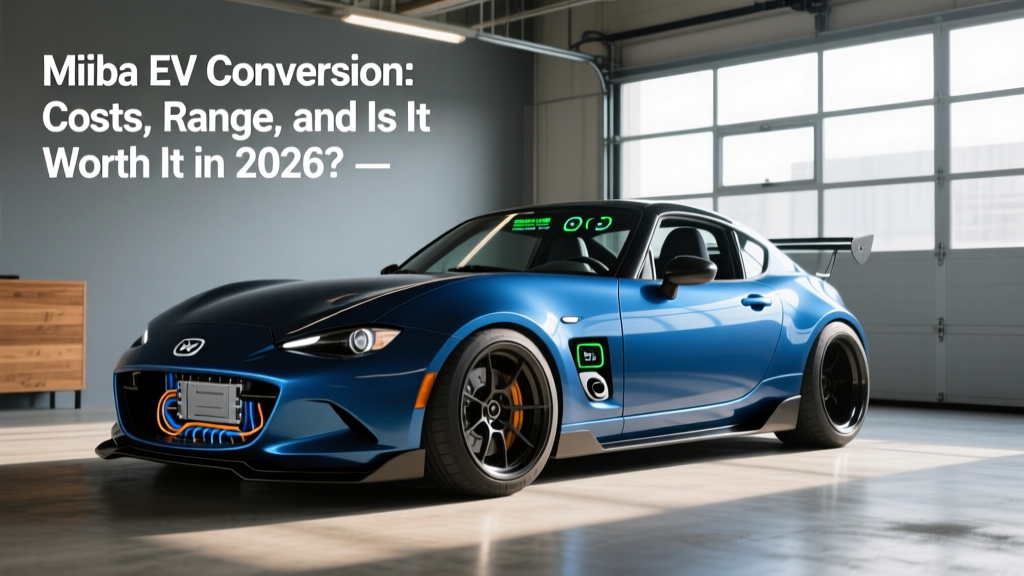
An EV conversion replaces the Miata's internal combustion engine, fuel tank, exhaust, and transmission (sometimes) with an electric motor, motor controller, battery pack, and onboard charger. The Miata — particularly the NA (1990–1997) and NB (1998–2005) generations — is one of the most popular donor cars for conversions because of its light weight (roughly 2,100–2,400 lbs stock), simple mechanical layout, and abundant aftermarket support.
Popular conversion kits and components in 2026 include offerings from companies like EV West, Zero EV, and Stealth EV, which sell packaged drivetrain kits using salvaged Tesla drive units, Hyper9 motors, or NetGain WarP9 motors paired with modular lithium-ion battery packs. Some builders opt for Chevy Volt or Nissan Leaf battery modules for cost savings.
Real Costs: Miata EV Conversion vs. Buying a New EV
The financials of a conversion don't pencil out as a "budget EV" strategy. Here's a realistic breakdown based on 2026 component pricing and typical build configurations:
| Cost Category | Miata EV Conversion (Budget Build) | Miata EV Conversion (Premium Build) | Used Chevy Bolt EUV (2023) | New Tesla Model 3 RWD (2026) |
|---|---|---|---|---|
| Vehicle / Donor Car | $3,000–$5,000 | $5,000–$8,000 | $16,000–$20,000 | $38,990 MSRP |
| Motor + Controller | $3,500–$5,000 | $6,000–$9,000 | Included | Included |
| Battery Pack | $4,000–$7,000 (15–20 kWh) | $10,000–$16,000 (30–40 kWh) | Included (65 kWh) | Included (~60 kWh LFP) |
| Charger + BMS + Wiring | $2,000–$3,000 | $3,000–$5,000 | Included | Included |
| Labor (if not DIY) | $3,000–$5,000 | $8,000–$15,000 | N/A | N/A |
| Registration / Inspection | $200–$800 | $200–$800 | $150–$300 | $150–$300 |
| Total Estimated | $15,700–$25,800 | $32,200–$53,800 | $16,150–$20,300 | ~$39,140+ |
| Range (Real-World) | 60–80 miles | 120–150 miles | ~220 miles (EPA 247) | ~290 miles (EPA 341) |
| Warranty | None (DIY) / Limited (shop) | None (DIY) / Limited (shop) | Remaining factory / battery 8yr | 4yr/50k + 8yr/120k battery |
Federal tax credit note: EV conversions do not qualify for the IRS §30D clean vehicle credit. That credit applies only to new, qualifying factory-built EVs meeting MSRP caps, buyer income limits, and battery-component/critical-mineral sourcing requirements. Some states may offer incentives for converted vehicles, but these vary widely — check your state's energy office or DMV.
Range, Charging, and Performance: What to Expect
The Miata's lightweight chassis is both its greatest advantage and its biggest packaging constraint. There's simply limited physical space for batteries once you remove the engine, fuel tank, and exhaust.
Battery Capacity and Real-World Range
Most Miata conversions land between 15 kWh and 40 kWh of usable battery capacity. Because the car is light (~2,400–2,800 lbs post-conversion) and relatively aerodynamic for a roadster, efficiency tends to be strong — roughly 200–280 Wh/mile in mixed driving.
- 15–20 kWh pack: 60–80 miles real-world range (50–65 miles at sustained highway speeds or in cold weather)
- 25–30 kWh pack: 90–120 miles real-world range
- 35–40 kWh pack: 120–150 miles real-world range (requires creative packaging — often using the trunk and rear differential area)
Cold-weather range loss of 15–30% applies here just as it does to factory EVs, since most conversions lack the sophisticated heat-pump thermal management found in modern production EVs.
Charging Speed
Most conversions use a 3.3 kW or 6.6 kW onboard charger, meaning Level 2 charging at home adds roughly 12–25 miles of range per hour. A 30 kWh pack from 10–80% takes about 3.5 to 6 hours on Level 2.
DC fast charging is rare in conversions due to cost ($2,000–$5,000+ for a CCS or CHAdeMO module) and the added weight and complexity. Most builders accept that this is a car you charge at home overnight.
Performance
This is where conversions shine. Even modest setups deliver instant torque that makes the Miata feel significantly quicker than stock:
- Budget motor (Hyper9 or similar): ~120–150 HP, 0–60 mph in ~6.5–7.5 seconds
- Premium motor (Tesla small drive unit): ~200–270 HP, 0–60 mph in ~4.5–5.5 seconds
- Stock 1990 Miata: 116 HP, 0–60 mph in ~8.8 seconds
EV Conversion vs. Gas Miata: Operating Cost Comparison
| Cost Factor | Gas Miata (NA 1.8L, 26 MPG combined) | EV-Converted Miata (250 Wh/mi) |
|---|---|---|
| Fuel / Energy | $1,523/yr (gas at $3.30/gal) | $480/yr (electricity at $0.16/kWh) |
| Oil Changes | $150–$250/yr | $0 |
| Brake Wear | $200–$400 every 30k mi | Minimal (regen braking extends pad life) |
| Exhaust / Emissions | $300–$800 occasional | $0 |
| Insurance | $800–$1,200/yr | $1,000–$1,600/yr (specialty/specialty agreed-value) |
| Annual Total (est.) | $2,673–$3,773 | $1,480–$2,080 |
The EV conversion saves roughly $1,000–$1,700 per year in operating costs. At a conversion cost of $20,000–$35,000, the payback period versus a running gas Miata is 12 to 35 years — this is not a financial decision. It's an enthusiasm decision.
Common Myths About Miata EV Conversions
| Myth | Fact |
|---|---|
| "You'll save money versus buying a real EV." | Conversion costs ($15K–$50K+) plus donor car almost always exceed the cost of a used factory EV with more range, DC fast charging, and a warranty. |
| "It's just as reliable as a factory EV." | Conversions built by experienced shops can be reliable, but there's no OEM validation, no crash-test data for the modified vehicle, and troubleshooting falls on you or your builder. |
| "Any mechanic can fix it." | Most general mechanics won't touch a conversion. You need someone versed in high-voltage EV systems or the specific components your build uses. |
| "It qualifies for the $7,500 federal tax credit." | It does not. The IRS §30D credit applies only to qualifying new factory-built EVs. Converted vehicles are ineligible. |
| "Weight distribution is ruined." | Skilled builders achieve near 50/50 weight distribution by placing batteries in the engine bay and rear (where the fuel tank was). Some conversions actually weigh less than stock. |
Real-World Ownership Considerations
Home Charging Access Is Essential
Because DC fast charging is uncommon in conversions, you need reliable Level 2 home charging. A 240V / 30–50A circuit with a J1772 connector (or NACS if using Tesla-derived components) is standard. Installation costs $500–$2,500 depending on panel capacity and run length. If you live in an apartment or lack dedicated parking, a conversion becomes impractical.
Registration and Insurance Vary by State
Registering a converted EV requires navigating your state's DMV inspection process. Some states (California, Oregon, Washington) have clear pathways for "specially constructed" or converted electric vehicles. Others require custom inspection paperwork, brake and light certifications, and VIN verification. Budget $200–$800 and several weeks for the process.
Insurance requires a specialty provider (Hagerty, Grundy, or similar agreed-value insurers) since mainstream carriers often won't underwrite a modified vehicle at its build cost.
Resale Value Is Niche
The buyer pool for a converted Miata is small. You'll likely recover 40–60% of your conversion investment at resale, depending on build quality, documentation, and component choices. Meticulous build logs, labeled wiring, and named components (not generic "EV parts") significantly help resale.
Decision Framework: Should You Convert or Buy?
Choose a Miata EV Conversion If:
- You're a hands-on enthusiast who enjoys fabrication, wiring, and problem-solving
- You want a lightweight, fun roadster with instant torque and zero tailpipe emissions
- You have access to a garage with 240V charging and don't need 200+ mile range
- You view the project as a hobby, not a cost-saving measure
- You want a unique vehicle that no one else at Cars & Coffee will have
Buy a Factory EV If:
- You need reliable daily transportation with 250+ mile range
- You want DC fast charging for road trips
- You want a warranty, OTA updates, and dealer service support
- You want to qualify for the §30D federal tax credit (up to $7,500 for qualifying new EVs, $4,000 for used EVs under $25,000)
- You need modern safety features (AEB, lane-keeping, airbags validated for the vehicle's configuration)
Keep Your Gas Miata If:
- It's already paid off, running well, and you drive it fewer than 5,000 miles per year
- You enjoy the manual transmission and engine character — things no conversion replicates
- Your annual fuel cost is under $800 (the conversion math never pencils out)
Frequently Asked Questions
How long does a Miata EV conversion take?
A professional shop typically takes 3 to 6 months for a complete conversion. A skilled DIY builder working weekends might take 6 to 18 months. Sourcing specific battery modules and controllers can add lead time — some components have 4–8 week wait times in 2026.
What battery chemistry is best for a conversion?
Most builders use NMC (nickel manganese cobalt) cells salvaged from Chevy Volt, Tesla Model S/X, or Nissan Leaf packs because of their high energy density — critical in a space-constrained car like the Miata. LFP (lithium iron phosphate) cells are safer and longer-lasting but heavier and bulkier per kWh, making them harder to package. For a Miata, NMC modules are usually the pragmatic choice.
Can I keep the manual transmission?
Yes, many conversions retain the stock 5-speed or 6-speed manual, using an adapter plate to mate the electric motor to the bell housing. You lose the clutch (electric motors don't idle) but can still shift gears. Some builders prefer a direct-drive single-speed reduction gear for simplicity and weight savings, but keeping the manual preserves the Miata driving experience.
Is a converted Miata safe in a crash?
This is an honest concern. The Miata's original crash structures were designed around its gasoline powertrain layout. Relocating mass and removing structural components (engine, transmission tunnel bracing) can alter crash behavior. No conversion shop performs NHTSA crash testing. High-voltage battery placement must be carefully shielded and secured to prevent intrusion or thermal events. This is a real risk that factory EVs don't carry.
Do I need a special driver's license or inspection?
No special license is required — just a standard driver's license. However, most states require the converted vehicle to pass a brake and lamp inspection, and some require a smog-exemption certification or special "specially constructed vehicle" (SPCNS) registration. Check with your local DMV before starting the build.
What's the top speed of a converted Miata?
Most conversions are electronically limited or naturally top out around 90–110 mph depending on motor RPM limits and gear ratios. Tesla drive unit swaps can push higher, but the Miata's aerodynamics and chassis weren't designed for high-speed stability. This is a back-road car, not a highway cruiser.