The Bottom Line on Miata Electric Conversions
A Miata electric conversion typically costs $15,000 to $35,000+ on top of the donor car price, yielding 80 to 150 miles of real-world range, roughly 100–170 horsepower, and a 0–60 mph time between 6 and 9 seconds depending on the drivetrain. The total project investment (donor NA/NB Miata + conversion kit + labor) usually lands between $22,000 and $45,000. Conversions do not qualify for the federal §30D new or used EV tax credit. If your goal is a fun, short-range weekend EV with a unique character, a conversion delivers. If you need daily-driver range, DC fast charging, or modern ADAS safety, a production EV like a used Tesla Model 3 or Chevy Bolt EUV is the more practical path.
What a Miata Electric Conversion Actually Involves
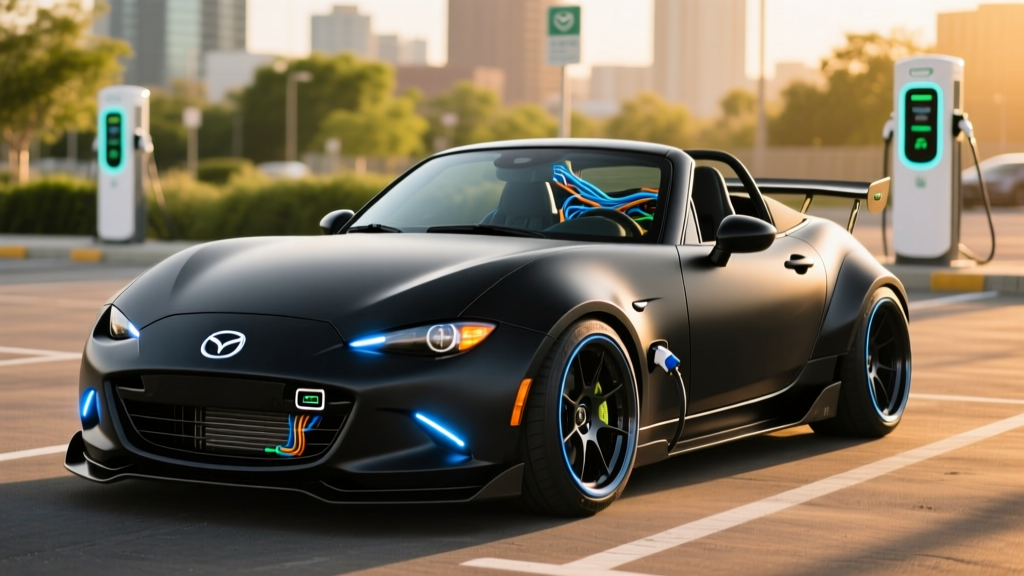
An electric vehicle conversion replaces the internal combustion engine, fuel tank, exhaust, and transmission (in most builds) with an electric motor, motor controller, and battery pack. For the Mazda MX-5 Miata — spanning the NA (1990–1997), NB (1999–2005), and NC (2006–2015) generations — the lightweight chassis (roughly 2,100–2,400 lbs stock) makes it one of the most popular donor platforms in the EV conversion community.
The core components of a typical Miata EV swap include:
- Electric motor: Commonly a NetGain Hyper9, HPEVS AC-50, or a salvaged Tesla drive unit (SDU/LDU). Power output ranges from 60 kW (~80 hp) to 150 kW (~200 hp).
- Motor controller: Matched to the motor — a Curtis 1238 for smaller builds, or a Cascadia Motion inverter for Tesla-sourced drivetrains.
- Battery pack: Typically salvaged Nissan Leaf modules, Chevy Volt packs, or Tesla modules, wired in series/parallel. Usable capacity usually falls between 18 kWh and 35 kWh.
- Battery Management System (BMS): Essential for cell balancing, thermal monitoring, and safe charge/discharge limits.
- Charging system: An onboard Level 2 charger (typically 3.3 kW to 6.6 kW) for home and public AC charging. Most conversions do not include DC fast charging capability.
- Ancillary systems: Electric vacuum pump for power brakes, electric power steering pump (or manual rack), DC-DC converter to run the 12V system, and cabin heater (PTC or heat pump).
Professional shops like EV West (California) and various boutique converters offer turnkey Miata builds, while DIY kits from EV West and others let experienced builders tackle the project at home.
Cost Breakdown: Miata Conversion vs. Buying a Production EV
The economics of a conversion are fundamentally different from purchasing a factory EV. Here is how the numbers stack up for a 2026 buyer:
| Cost Category | Miata EV Conversion | Used Tesla Model 3 (2021–2023) | New Chevy Bolt EV (2025 final year) |
|---|---|---|---|
| Vehicle / Donor Car | $4,000–$8,000 (NA/NB) | $18,000–$25,000 | $28,400 MSRP (base) |
| Conversion Kit / Parts | $8,000–$20,000 | N/A | N/A |
| Labor (if professional) | $5,000–$15,000 | N/A | N/A |
| Total Investment | $17,000–$43,000 | $18,000–$25,000 | $28,400 |
| Federal Tax Credit (§30D) | $0 (not eligible) | Up to $4,000 (used EV credit, income-capped) | Up to $7,500 (new EV credit, subject to sourcing/income rules) |
| Effective Cost After Credit | $17,000–$43,000 | $14,000–$25,000 | $20,900–$28,400 |
| EPA Range | N/A (no EPA testing) | 272–358 mi (EPA) | 259 mi (EPA) |
| Real-World Range Estimate | 80–150 mi | 240–320 mi | 220–250 mi |
| Warranty | None (or shop-specific limited) | Remaining factory / battery 8yr/120K mi | 3yr/36K mi bumper; 8yr/100K mi battery |
Key takeaway: A Miata conversion is a passion project, not a cost-saving measure. You will spend as much or more than a used production EV while getting a fraction of the range, no warranty, and no tax credit. The value proposition is driving experience, not economics.
Range, Charging, and Performance: The Real Numbers
Because conversions are not EPA-tested, range figures are estimates based on battery capacity and vehicle efficiency. Here is what typical Miata EV builds deliver:
| Spec | Budget Build (~20 kWh) | Mid-Range Build (~30 kWh) | High-End Build (~40 kWh / Tesla drive unit) | Stock Gas Miata (NA 1.8L) |
|---|---|---|---|---|
| Usable Battery | ~18 kWh (LFP or NMC) | ~27 kWh (NMC modules) | ~36 kWh (Tesla modules) | N/A (12-gal tank) |
| Efficiency | ~250 Wh/mi | ~240 Wh/mi | ~230 Wh/mi | ~25 MPG combined |
| Real-World Range | 65–80 mi | 100–120 mi | 130–155 mi | ~300 mi |
| Cold-Weather Range (30°F) | 50–65 mi | 75–95 mi | 100–125 mi | ~280 mi |
| Motor Power | 60 kW / ~80 hp | 100 kW / ~134 hp | 150 kW / ~200 hp | 133 hp |
| 0–60 mph | 8–9 sec | 6–7 sec | 4.5–5.5 sec | ~8.5 sec |
| Level 2 Charge Time (0–100%) | ~6 hr at 3.3 kW | ~8 hr at 3.3 kW / ~5 hr at 6.6 kW | ~10 hr at 3.3 kW / ~6 hr at 6.6 kW | N/A |
| DC Fast Charging | No | Rarely (adds $3K–$5K) | Sometimes (CCS retrofit) | N/A |
| Top Speed | ~85 mph | ~100 mph | ~115 mph | ~120 mph |
Charging reality: Most Miata conversions rely exclusively on Level 2 AC charging. A 30 kWh pack at 3.3 kW takes roughly 9 hours from empty to full — fine for overnight home charging, but it means no practical road-trip capability. Adding DC fast charging (CCS or CHAdeMO) is possible but adds $3,000–$5,000 in hardware and significant integration complexity. Even then, charge rates on small packs are modest — expect a peak of 20–40 kW, meaning a 10–80% session still takes 30–50 minutes.
Cold-weather caveat: Lithium-ion battery chemistry loses 15–30% of usable capacity in freezing temperatures. A build that delivers 110 miles in 70°F weather may drop to 80 miles at 30°F, and cabin heating (typically a 2–3 kW PTC element) further reduces range. If you live in a cold climate, plan for 25–30% less range in winter.
Running Costs: Fueling, Maintenance, and Insurance
Where a converted Miata EV does shine is in operating cost — once the build is complete and paid for.
Energy Cost Per Mile
At an average US residential electricity rate of $0.16/kWh (EIA 2025 data) and a conversion efficiency of roughly 250 Wh/mile, your energy cost is approximately $0.04 per mile. A stock NA Miata getting 25 MPG at $3.30/gallon costs $0.13 per mile in fuel. On 8,000 miles of weekend driving per year, that is roughly $720 in annual savings on energy.
Maintenance
EV conversions eliminate oil changes, spark plugs, timing belts, fuel filters, and exhaust system repairs. However, you inherit new maintenance considerations:
- Battery health monitoring: Cell balancing and capacity checks via BMS data
- Coolant system: Many motor controllers and Tesla drive units require glycol coolant loops
- Brake wear: Regenerative braking reduces pad wear significantly, but the Miata's small brakes may need upgrading for the added weight of batteries (typically 200–400 lbs added)
- Suspension: Stiffer springs or upgraded shocks are often needed to handle the weight increase and maintain handling balance
Insurance
Converted EVs can be challenging to insure. Major carriers may not recognize the vehicle's modified value. Specialty insurers like Hagerty or Grundy (agreed-value policies) are often the best route. Expect premiums of $800–$1,500/year for a $30,000 agreed-value build, depending on your driving record and state.
Tax Credits, Registration, and Legal Considerations
This is where many prospective converters are disappointed:
- Federal §30D New EV Credit ($7,500): Not available. The credit applies only to new qualifying vehicles purchased from a manufacturer. A conversion does not qualify. See IRS §30D rules.
- Federal Used EV Credit (up to $4,000): Also not available. The vehicle must be purchased from a licensed dealer, and the sale must be reported by the dealer to the IRS. Private-party conversions do not meet this requirement.
- State incentives: Some states offer rebates for EV conversions (California's CC4ALL program has occasionally included conversion provisions, and states like Colorado have offered conversion tax credits). Check your state's current energy office or DMV for details — these programs change frequently.
- Registration and inspection: Most states require a converted EV to pass a special inspection and receive a new title designation (often "Specially Constructed Vehicle" or similar). The process varies widely — California's BAR referee process, for example, can take weeks and requires specific documentation. Some states have no clear pathway, making registration difficult.
- Emissions testing: A converted EV is exempt from emissions testing in most jurisdictions, which can simplify annual registration.
Myths vs. Facts About Miata EV Conversions
| Myth | Fact |
|---|---|
| "It will be cheaper than buying a new EV." | Total cost ($22K–$45K) often equals or exceeds a used Tesla Model 3 or new Bolt — with far less range, no warranty, and no tax credit. |
| "The Miata's light weight means amazing range." | Batteries add 200–400 lbs. The converted car often weighs 2,500–2,800 lbs. Efficiency is good (~250 Wh/mi) but range is limited by the small battery pack that fits. |
| "I can charge it anywhere." | Without DC fast charging (most builds), you are limited to Level 2 AC charging at 3.3–6.6 kW. Public Level 2 chargers add 15–25 miles per hour — impractical for road trips. |
| "It handles just like a gas Miata." | Weight distribution changes significantly. Battery placement (typically in the trunk and where the fuel tank was) shifts the center of gravity. Suspension upgrades are usually necessary to preserve the Miata's legendary handling. |
| "I'll save a fortune on maintenance." | You save on ICE maintenance but gain EV-specific concerns: BMS monitoring, coolant loops, high-voltage safety, and the risk of expensive battery replacement ($4,000–$8,000 for a new pack). |
| "Any mechanic can work on it." | Most general mechanics will not touch a custom EV conversion. You need either the original builder, an EV specialty shop, or strong DIY electrical skills. |
Decision Framework: Should You Convert or Buy?
Choose a Miata Electric Conversion If:
- You want a unique, fun weekend car with open-top electric motoring
- You have (or can budget for) $20K–$40K beyond the donor car cost
- You have reliable home Level 2 charging access (garage or driveway with a 240V outlet)
- Your typical drives are under 60 miles round-trip
- You enjoy DIY projects or have a trusted EV conversion shop nearby
- You value the driving experience and community over range and convenience
- You understand there is no warranty, no tax credit, and limited resale market
Choose a Production EV Instead If:
- You need 200+ miles of daily range and DC fast charging for road trips
- You want a warranty, tax credit eligibility, and straightforward insurance
- You lack reliable home charging (conversions are impractical without it)
- You live in a cold climate where a small-battery conversion would lose 25–30% of its already-limited range
- You want modern safety features (AEB, lane-keeping, blind-spot monitoring) — a 1990s Miata chassis has none of these, and they cannot be retrofitted
- You want predictable total cost of ownership and strong resale value
Frequently Asked Questions
How long does a Miata electric conversion take?
A professional shop typically takes 3–6 months from start to finish. A DIY build by an experienced hobbyist can take 6–18 months depending on skill level, parts availability, and how much fabrication is required for battery enclosures and motor mounts.
What is the weight difference after conversion?
Most Miata EV conversions add 200–400 lbs over the stock gas car, bringing curb weight to approximately 2,500–2,800 lbs. The battery pack is the primary weight contributor. Careful placement (low and centered) helps preserve handling, but suspension upgrades (stiffer springs, upgraded sway bars) are common.
Can I use Tesla batteries in a Miata conversion?
Yes. Tesla Model S/X battery modules are popular in higher-end conversions because of their high energy density and proven longevity. However, they require careful BMS integration, a compatible inverter (such as a Cascadia Motion or OpenInverter controller), and a coolant system. Tesla drive units (SDU or LDU) paired with Tesla modules are considered the premium Miata conversion drivetrain, delivering 150+ kW and sub-6-second 0–60 times.
How long will the battery last before needing replacement?
Lithium-ion battery packs in conversions typically retain 80%+ capacity after 8–12 years or 100,000+ miles if properly managed (kept between 20–80% state of charge, not regularly exposed to extreme heat). Salvaged Leaf or Volt modules may degrade faster depending on their prior use. Budget $4,000–$8,000 for a future battery replacement.
Is a converted Miata safe in a crash?
This is the most significant compromise. A 1990s or early-2000s Miata lacks modern crumple zones, side-impact beams, airbags (NA generation), and electronic stability control. The NHTSA and IIHS do not crash-test conversions. If safety is a priority, a modern production EV is objectively safer. For weekend canyon carving at moderate speeds, the risk is comparable to driving any vintage car.
Can I take a converted Miata on a road trip?
Realistically, only if your route has reliable Level 2 charging stops every 50–80 miles and you are willing to stop for 2–4 hours at each one. Without DC fast charging, a Miata conversion is not a practical road-trip vehicle. Plan your drives as out-and-back loops from home, or invest in a trailer for longer hauls.