The Short Answer
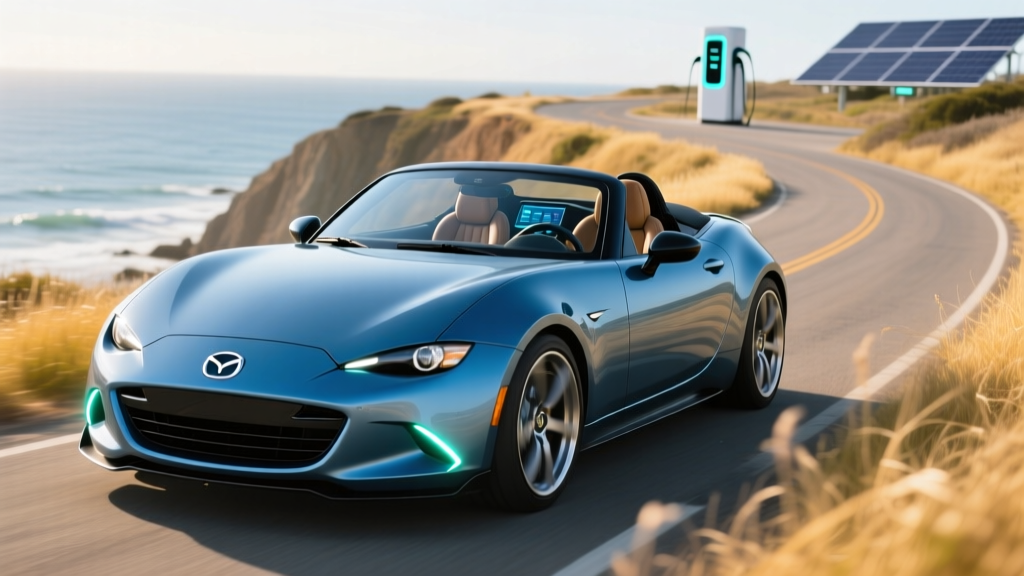
As of 2026, Mazda does not sell a production electric Miata (MX-5). The current fourth-generation ND2 MX-5 remains a lightweight, gas-powered roadster. However, Mazda has confirmed a next-generation MX-5 will incorporate electrification — likely a mild-hybrid or plug-in hybrid system — and the EV conversion aftermarket is building battery-swapped Miatas with 120–180 miles of range for $25,000–$45,000 on top of a donor car. If you want a two-seat electric sports car today, your realistic options are a conversion, the MG4 XPOWER (not sold in the US), or waiting for Mazda's official next-gen announcement.
Why There's No Factory Electric Miata Yet
The Mazda MX-5 Miata has survived four generations by adhering to a simple formula: light weight, rear-wheel drive, and an affordable price. The 2025 ND2 Miata weighs roughly 2,340 lbs and starts at $29,490. Adding a battery pack large enough for meaningful range — say 60 kWh for ~220 miles — would add 800–1,000 lbs, fundamentally altering the car's character and pushing the price well above $45,000.
Mazda has acknowledged this tension publicly. At the 2024 Tokyo Auto Salon, then-CEO Masahiro Moro stated the next MX-5 would "definitely" feature some form of electrification, though he stopped short of confirming a fully electric variant. Mazda's broader strategy includes a mix of mild hybrids, plug-in hybrids, and battery-electric vehicles across its lineup, with the CX-70 PHEV and upcoming CX-50 EV signaling the company's multi-path approach.
The lightweight sports car segment faces a particular challenge with batteries. The EPA rates the 2025 Miata at 26 city / 35 highway / 29 combined MPG — already efficient for a gas sports car. Converting that efficiency to an electric equivalent requires battery weight that works against the Miata's core identity.
EV Conversion: Building Your Own Electric Miata
The most direct path to a Miata electric car in 2026 is an aftermarket EV conversion. Several shops specialize in swapping internal-combustion powertrains for electric motors and battery packs in classic and modern Miatas.
What a Conversion Gets You
| Spec | Typical Miata EV Conversion | 2025 Gas Miata (ND2) |
|---|---|---|
| Powertrain | Single electric motor, RWD | 2.0L inline-4, RWD |
| Horsepower | td>150–250 HP (tunable)181 HP | |
| 0–60 mph | 4.5–6.5 seconds | 5.8 seconds (manual) |
| Battery Capacity | 30–45 kWh (usable) | N/A (12.9-gal tank) |
| EPA Range | Not EPA-rated; ~120–180 mi real-world | ~335 mi (on 12.9 gal) |
| Weight | ~2,600–2,900 lbs | ~2,340 lbs |
| DC Fast Charging | Rarely included (Level 2 only typical) | N/A |
| Level 2 Charge Time | 5–8 hours (0–100%) | N/A |
| Estimated Build Cost | $25,000–$45,000 + donor car | $29,490–$38,090 MSRP |
Real-World Conversion Considerations
Most Miata EV conversions use salvaged battery modules from Nissan Leafs, Tesla Model S packs, or purpose-built LFP (lithium iron phosphate) modules. LFP chemistry is popular for conversions because it tolerates daily 100% charging without accelerated degradation, though its lower energy density means more weight for the same range compared to NMC (nickel manganese cobalt) packs.
Expect 3.5–4.5 miles per kWh in a converted Miata, depending on motor efficiency and driving style. A 40 kWh usable pack yields roughly 140–180 miles of real-world range in mild weather. Highway driving at 75 mph or cold-weather operation (below 40°F) can reduce that by 20–35%, bringing effective range to 100–130 miles — adequate for weekend canyon carving, not for road trips.
Charging is almost exclusively Level 2 (240V, 6.6–7.2 kW) in conversions. Most builders do not integrate DC fast charging hardware due to cost, packaging constraints, and the safety complexity of managing high-voltage DC in a custom build. This means a full charge takes 5–8 hours at home.
Electric Miata vs. Gas Miata: Cost and Ownership Breakdown
Let's compare the five-year ownership costs of a gas-powered 2025 Miata Sport against a typical EV-converted NA/NB Miata (1990–2005 donor).
| Cost Category | 2025 Gas Miata Sport (5 Yr) | EV-Converted Miata (5 Yr) |
|---|---|---|
| Purchase Price | $29,490 | $8,000 (donor) + $35,000 (conversion) = $43,000 |
| Fuel / Electricity | $6,840 (15,000 mi/yr × $3.80/gal ÷ 29 MPG) | $2,700 (15,000 mi/yr × $0.14/kWh ÷ 3.8 mi/kWh) |
| Maintenance | $2,500 (oil, filters, spark plugs, brakes) | $800 (cabin filter, brake fluid, tires — no oil changes) |
| Insurance (avg) | $7,200 ($1,440/yr) | $8,400 ($1,680/yr — specialty/modified vehicle) |
| Federal Tax Credit | $0 | $0 (conversions do not qualify for §30D new EV credit) |
| Estimated Resale Value | ~$18,000 | ~$15,000–$22,000 (niche market) |
| 5-Year Net Cost | ~$28,030 | ~$47,900 |
The gas Miata wins on pure economics for a daily driver. The EV conversion makes financial sense only if you value the driving experience of instant electric torque in a lightweight chassis, want to eliminate tailpipe emissions, or plan to keep the car long-term as a hobby vehicle. Maintenance savings are real — no oil changes, no timing chain, far less brake wear thanks to regenerative braking — but they don't offset the $14,000+ upfront conversion premium.
Insurance is a notable hidden cost. Converted EVs often require specialty insurers (Hagerty, Grundy) who understand modified vehicles. Standard carriers may decline coverage or quote steep premiums. Get an insurance quote before committing to a build.
What Mazda's Electrified Future Means for the MX-5
Mazda's confirmed electrification roadmap offers clues about the next Miata. The automaker's "Multi-Electrification Strategy" targets a mix of:
- Mild hybrids (MHEV): A 48V system adding 15–20 HP of torque fill, enabling stop-start and slight efficiency gains without significant weight penalty. This is the most likely near-term MX-5 solution.
- Plug-in hybrids (PHEV): A larger battery (15–20 kWh) providing 25–40 miles of electric-only range plus a gas engine for extended trips. Heavier, but preserves road-trip capability.
- Battery electric (BEV): A full EV Miata would likely require a dedicated EV platform. Mazda's large-platform EVs (CX-60, CX-80) use a longitudinal architecture too heavy for a Miata. A small, lightweight EV platform remains unannounced.
Industry analysts expect the next-generation MX-5 to debut around 2027–2028, likely as a mild hybrid first, with a PHEV variant possible later. A full BEV Miata is not expected before 2030 at the earliest, and may never arrive if Mazda determines the weight compromise is unacceptable.
Alternatives: Two-Seat Electric Sports Cars You Can Actually Buy
If the electric Miata concept appeals to you but a conversion isn't practical, consider these alternatives available or arriving soon in the US market:
| Vehicle | Type | EPA Range | 0–60 mph | Starting MSRP | Notes |
|---|---|---|---|---|---|
| 2025 Mazda MX-5 Miata | Gas (ICE) | ~335 mi (tank) | 5.8s | $29,490 | The benchmark lightweight roadster |
| Fiat 500e (2024+) | BEV | 149 mi | 8.5s | $34,095 | Fun city EV, not a sports car |
| Mini Cooper SE (2025) | BEV | 114 mi | 7.3s | $31,895 | Go-kart feel, limited range |
| BMW i4 M50 | BEV | 227 mi | 3.7s | $70,700 | Fast, heavy, 4-door Gran Coupe |
| Porsche 718 Boxster EV (announced) | BEV | ~200 mi (est.) | ~3.5s (est.) | ~$85,000 (est.) | Expected 2025–2026; closest premium analog |
The Porsche 718 Boxster EV (electric generation confirmed by Porsche) is the closest production analog to what an electric Miata would represent — a lightweight, rear-drive electric sports car — but at roughly three times the Miata's price. Nothing in the current US market combines the Miata's sub-$35,000 price, sub-2,500-lb weight, and open-top driving with a fully electric powertrain.
Decision Framework: Should You Pursue an Electric Miata?
Choose an EV-converted Miata if:
- You want a weekend hobby car with instant torque and silent canyon runs
- You have home Level 2 charging (240V, 30A+ circuit) and drive under 100 miles per outing
- You're comfortable with a niche vehicle that may be harder to insure and resell
- You value the build process and customization as much as the end product
- Budget is $40,000–$55,000 total (donor + conversion + charging equipment)
Choose the gas-powered 2025 Miata if:
- You want a warranty-backed, EPA-certified vehicle you can buy at any Mazda dealer today
- You road-trip or drive more than 200 miles between fuel stops regularly
- You want the lowest total cost of ownership in the two-seat sports car segment
- You prefer the engagement of a manual transmission and high-revving engine
- You don't have reliable home charging access
Wait for the next-gen electrified MX-5 if:
- You want factory warranty, modern safety tech, and dealer service support
- You're willing to wait until 2027–2029 for a potential mild-hybrid or PHEV Miata
- You want electrification benefits (instant torque fill, regenerative braking) without full BEV range limitations
Myths vs. Facts About the Electric Miata
| Myth | Fact |
|---|---|
| "Mazda is releasing an electric Miata in 2026." | False. No production BEV Miata has been announced. The current ND2 is gas-only, and the next-gen is expected ~2027–2028, likely as a mild hybrid first. |
| "An EV conversion ruins the Miata's handling." | Partially true. Batteries add 300–600 lbs, raising weight and potentially shifting weight distribution. Skilled builders place batteries low and central to mitigate this, but a converted Miata will never match the stock car's curb weight. |
| "Converted EVs qualify for the $7,500 federal tax credit." | False. The IRS §30D credit applies only to new qualifying vehicles from OEMs meeting battery-sourcing, MSRP, and buyer-income requirements. Aftermarket conversions do not qualify. |
| "Electric Miatas have no range for real driving." | Misleading. A well-built conversion with a 40 kWh pack delivers 140–180 real-world miles — enough for most weekend drives. It is not a road-trip car, but neither is a gas Miata with a 12.9-gallon tank on aggressive driving. |
| "EV conversions are unreliable." | Depends entirely on the builder. Reputable shops using quality components (Tesla drive units, LG or CATL cells, proper BMS) produce reliable vehicles. Budget builds with mismatched salvaged cells carry real risk. |
First-Time EV Buyer Essentials (If You're Considering a Conversion)
If an electric Miata conversion would be your first EV, understand these realities before committing:
Home charging is nearly mandatory. Without a Level 2 home charger (240V, NEMA 14-50 or hardwired), you'll rely on public Level 2 stations — which are slower, less convenient, and often unreliable. Home Level 2 installation typically costs $500–$2,000 depending on your electrical panel capacity and run distance. A 200-amp panel is usually sufficient; older homes with 100-amp service may need a $1,500–$3,000 panel upgrade.
Cold weather reduces range 20–35%. Most conversions lack the sophisticated thermal management (heat pumps, battery preconditioning) found in production EVs like Teslas or Hyundais. If you live where winters drop below freezing, plan for 100–120 miles of effective winter range from a 40 kWh pack.
kW vs. kWh matters. Kilowatts (kW) measure power — how fast you charge or how much force the motor delivers. Kilowatt-hours (kWh) measure energy — the battery's total capacity, like gallons in a gas tank. A 40 kWh battery charged at 7.2 kW takes roughly 5.5 hours from empty to full.
Maintenance is simpler but different. No oil changes, no spark plugs, no exhaust system. But you'll need to monitor battery State of Health (SoH) over time, and replacement cells or modules for a custom pack are not available at an auto parts store. Establish a relationship with your conversion shop for long-term support.
Frequently Asked Questions
Will Mazda ever make a fully electric Miata?
Mazda has confirmed the next MX-5 will include electrification, but the company has not committed to a full BEV variant. A mild-hybrid or plug-in hybrid is far more likely for the next generation (expected ~2027–2028) to preserve the lightweight character. A full electric Miata, if it arrives, is unlikely before 2030.
How much does a Miata EV conversion cost in 2026?
Expect $25,000–$45,000 for the conversion itself, plus $5,000–$15,000 for a donor car (NA/NB/NB2 chassis from 1990–2005 are most common). Total project cost typically lands between $35,000 and $55,000 depending on battery size, motor choice, and finish quality.
Can I daily-drive an electric Miata?
Yes, if your commute is under 80 miles round-trip, you have home Level 2 charging, and you accept limited road-trip capability. The 120–180 mile real-world range is adequate for daily driving in most metro areas but requires planning for longer trips. Cold weather and highway speeds reduce range significantly.
Does an EV-converted Miata qualify for any tax credits?
No. The federal IRS §30D new clean vehicle credit applies only to new OEM-manufactured EVs meeting MSRP caps ($55,000 for cars), buyer income limits, and battery critical-mineral sourcing requirements. Aftermarket conversions of existing gas vehicles do not qualify. Some states offer rebates for EV conversions — check your local energy office.
What's the best donor Miata for an EV conversion?
The NB-generation (1999–2005) is the most popular donor: it's affordable ($5,000–$12,000), has a robust aftermarket, and its engine bay and trunk offer reasonable packaging space for batteries and a motor. The NA (1990–1997) is lighter but has less space. The NC (2006–2015) is heavier and more complex. Avoid the ND (2016+) — too expensive and too integrated for most conversion shops.
How does an electric Miata compare to a gas Miata for driving feel?
Different, not necessarily worse. Electric motors deliver instant torque from 0 RPM, making a converted Miata feel punchier around town and through low-speed corners. But you lose the high-revving engine character, manual shifting engagement, and the exhaust note that many Miata owners love. The added battery weight (300–600 lbs) slightly dulls the steering feel and increases braking distances. It's a trade-off: electric immediacy vs. analog engagement.