Quick Answer: Mexico's electric car market in 2026 offers roughly 25+ battery-electric models ranging from the BYD Dolphin Mini (~$280,000 MXN / ~$15,000 USD) to luxury options exceeding $1.2 million MXN. However, public DC fast-charging infrastructure remains concentrated along the Mexico City–Guadalajara–Monterrey corridor, making home charging essential. Most buyers find EVs economical when daily driving stays under 150 km and home solar or off-peak electricity rates apply. Expect real-world range 15-25% below WLTP/EPA stickers at highway speeds, and factor in limited dealer service networks outside major metros.
The Mexico Electric Car Landscape in 2026
Mexico's EV adoption has accelerated, but the market operates under fundamentally different constraints than the United States. There is no federal purchase incentive equivalent to the US §30D tax credit. Electricity rates from CFE (Comisión Federal de Electricidad) vary by tariff class and region, and public charging networks — while growing through providers like Evergo, ChargeNow, and Tesla Superchargers — cover only a fraction of the country's highway system.
For a Mexican buyer considering an electric vehicle, the decision hinges on three practical variables: access to home or workplace charging, typical daily driving distance, and proximity to a brand-authorized service center. If any of these three conditions is unfavorable, a conventional hybrid (HEV) like the Toyota Prius or a plug-in hybrid (PHEV) may deliver better real-world value.
Available Mexico Electric Car Models: Specs and Pricing
Below is a snapshot of battery-electric vehicles sold or officially available in Mexico as of the 2026 model year. Prices are approximate MSRPs in Mexican Pesos (MXN) and may vary by dealer and state-level taxes.
| Model | Battery (kWh) | WLTP Range | Real-World Range* | Peak DC Charge (kW) | 10-80% Time | 0-100 km/h | Approx. Price (MXN) |
|---|---|---|---|---|---|---|---|
| BYD Dolphin Mini | 38.9 (LFP) | 302 km | 230-260 km | 40 kW | ~50 min | 12.5 sec | $280,000 |
| Chevrolet Equinox EV 2LT | 85 (NMC) | 513 km | 380-430 km | 150 kW | ~28 min | 8.0 sec | $699,900 |
| Hyundai Ioniq 5 Std Range | 58 (NMC) | 384 km | 290-340 km | 150 kW | ~22 min | 8.5 sec | $799,000 |
| Tesla Model 3 RWD | 57.5 (LFP) | 491 km (EPA) | 370-420 km | 170 kW | ~25 min | 6.1 sec | $719,900 |
| Volvo EX30 Single Motor | 69 (NMC) | 475 km | 350-400 km | 153 kW | ~26 min | 5.7 sec | $849,000 |
| BMW iX1 eDrive20 | 64.7 (NMC) | 474 km | 350-400 km | 130 kW | ~30 min | 8.6 sec | $990,000 |
| MG 4 EV | 51 (LFP) | 350 km | 270-310 km | 88 kW | ~35 min | 8.5 sec | $449,900 |
*Real-world range reflects mixed driving at highway speeds of 100-110 km/h, moderate climate use. WLTP figures tend to overstate range versus the more conservative EPA standard used in the US.
Charging Infrastructure: The Real Bottleneck
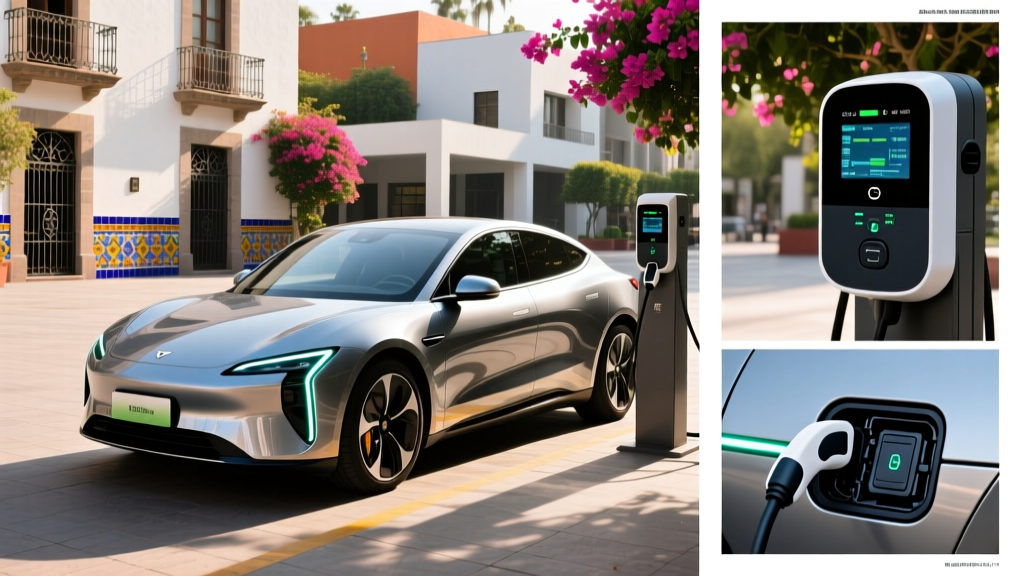
Mexico's public charging network in 2026 includes roughly 2,500-3,000 public AC Level 2 connectors and approximately 400-600 DC fast-charging stations, heavily concentrated in Mexico City, Guadalajara, Monterrey, and the Bajío corridor. Tesla's Supercharger network offers the most reliable highway coverage, with roughly 40+ stations — but these remain exclusive to Tesla vehicles (no NACS adapter access for non-Tesla EVs in Mexico as of early 2026).
Outside these corridors, DC fast charging is sparse. A road trip from Mexico City to Oaxaca (~460 km) or to Mérida (~1,300 km) requires meticulous planning, and some routes simply lack viable en-route DC charging. This is the single largest practical limitation for Mexican EV ownership.
Home Charging Costs vs. Gasoline (MXN per 100 km)
| Scenario | Energy Cost per 100 km | Notes |
|---|---|---|
| Home charging (CFE Tarifa 1, ~$1.80 MXN/kWh) | $27 - $36 MXN | Based on 15-20 kWh/100 km efficiency |
| Home charging (Tarifa DAC / high-use, ~$6.50 MXN/kWh) | $97 - $130 MXN | If you exceed CFE subsidized tier |
| Public DC fast charging (Evergo, ~$8-12 MXN/kWh) | $120 - $240 MXN | Varies by network and location |
| Gasoline (Nissan Versa, 18 km/L, gas ~$25 MXN/L) | $139 MXN | Typical compact sedan, mixed driving |
| Hybrid (Toyota Prius HEV, 24 km/L, gas ~$25 MXN/L) | $104 MXN | No plug needed |
The math is clear: home charging on a subsidized CFE tariff makes an EV dramatically cheaper per kilometer than gasoline. But if you hit DAC (Doméstica de Alto Consumo) rates or rely exclusively on public DC charging, the savings narrow considerably — and a conventional hybrid becomes competitive on operating cost alone.
Total Cost of Ownership: EV vs Gas vs Hybrid
Let's compare a 5-year, 75,000 km ownership scenario for three representative vehicles available in Mexico:
| Cost Factor | BYD Dolphin Mini (BEV) | Toyota Prius HEV | Nissan Versa (Gasoline) |
|---|---|---|---|
| Purchase Price (MXN) | $280,000 | $539,900 | $334,900 |
| Fuel/Energy (75,000 km, home charging) | $20,250 - $27,000 | $78,000 | $104,167 |
| Maintenance (est.) | $12,000 - $18,000 | $35,000 - $45,000 | $40,000 - $55,000 |
| Insurance (est. annual avg) | $18,000 - $24,000/yr | $14,000 - $18,000/yr | $12,000 - $16,000/yr |
| 5-Year Fuel + Maintenance | $32,250 - $45,000 | $113,000 - $123,000 | $144,167 - $159,167 |
| Estimated 5-Year Resale (% retained) | 40-50% | 55-65% | 45-55% |
The BYD Dolphin Mini wins on upfront price and fuel savings, but insurance premiums for EVs in Mexico remain elevated (typically 30-50% above equivalent gas vehicles) due to limited repair networks and higher parts costs. Depreciation data for Chinese-brand EVs in Mexico is still limited, introducing resale-value uncertainty.
Common Misconceptions About EVs in Mexico
| Myth | Fact |
|---|---|
| "EVs don't work in Mexico's hot climate" | Modern LFP and NMC batteries have active thermal management. Heat accelerates degradation slightly, but preconditioning and garage parking mitigate this. Expect 10-15% capacity loss over 8 years in hot climates — within warranty thresholds. |
| "I can road-trip anywhere in Mexico with an EV" | DC fast-charging coverage is limited outside major corridors. Trips to coastal areas, the Yucatán, or rural states require careful planning or are not yet feasible without overnight AC stops. |
| "EVs are zero maintenance" | EVs eliminate oil changes and have fewer moving parts, but tires wear 15-20% faster due to instant torque and higher weight. Cabin air filters, brake fluid, coolant, and wiper systems still require service. |
| "I need a special electrical panel for home charging" | A standard 120V/12A Mexican outlet delivers ~1.4 kW (Level 1), adding ~7-10 km of range per hour — sufficient for daily commutes under 60 km. A 240V Level 2 installation requires an electrician and typically costs $15,000-$40,000 MXN depending on panel proximity. |
| "The battery will need replacement in 5 years" | Most manufacturers warranty traction batteries for 8 years / 160,000 km at 70% capacity retention. Real-world degradation data from global fleets shows most NMC packs retain 85-90% after 5 years; LFP chemistry often retains 90%+. |
Battery Chemistry: LFP vs NMC — Which Matters for Mexico?
Two dominant lithium-ion chemistries are available in Mexico's EV market:
| Factor | LFP (Lithium Iron Phosphate) | NMC (Nickel Manganese Cobalt) |
|---|---|---|
| Energy Density | Lower — heavier pack for same range | Higher — lighter, more range per kg |
| Cycle Life | 3,000-5,000+ cycles | 1,000-2,000 cycles |
| Heat Tolerance | Excellent — ideal for Mexican climate | Good, but degrades faster in sustained heat |
| Charging to 100% | Can charge to 100% regularly without harm | Best kept at 80% daily; 100% only for trips |
| Cold Performance | Weaker in freezing temps (rare in most of Mexico) | Better in cold (relevant for high-altitude winters) |
| Example Models | BYD Dolphin Mini, Tesla Model 3 RWD, MG 4 | Chevy Equinox EV, Hyundai Ioniq 5, Volvo EX30 |
For most Mexican buyers in warm climates, LFP chemistry is the pragmatic choice — longer cycle life, better heat tolerance, and no anxiety about daily 100% charging. NMC's higher energy density matters primarily if you need maximum range in a smaller package.
Decision Framework: Should You Buy an EV in Mexico?
Buy a battery-electric vehicle (BEV) if:
- You can install Level 2 charging at home or have reliable workplace charging
- Your daily round-trip commute is under 150 km
- You live in or near Mexico City, Guadalajara, Monterrey, or Querétaro (service and charging access)
- You have a second gasoline vehicle for long road trips, or you fly for intercity travel
- You are on CFE Tarifa 1 (subsidized) and won't exceed into DAC rates
Choose a hybrid (HEV) instead if:
- You cannot charge at home or work (apartment without garage, street parking)
- You regularly drive 200+ km one-way to areas without DC fast charging
- You want proven resale value and dealer service in smaller cities
- Your budget is under $300,000 MXN and you need a single-vehicle household solution
Consider a plug-in hybrid (PHEV) if:
- You want 40-60 km of daily electric commuting but need gasoline flexibility for weekends
- You can charge at home overnight but lack public charging on your routes
- You want EV-like city driving without range anxiety on highway trips
What First-Time EV Buyers in Mexico Should Know
1. kW vs kWh — know the difference. kW (kilowatts) measures power — how fast you charge. kWh (kilowatt-hours) measures energy — how big the battery is. A 58 kWh battery charged at 150 kW fills faster than one charged at 40 kW, but both store energy measured in kWh. Confusing these is the most common beginner mistake.
2. The charging curve is not linear. A car advertising "150 kW peak DC charging" only sustains that rate between roughly 10-50% state of charge. Above 80%, charging speed drops dramatically to protect the battery. A "10-80% in 25 minutes" claim does not mean 0-100% takes 35 minutes — the final 20% may take another 30-45 minutes on Level 2.
3. Highway range is lower than city range. EVs are most efficient in stop-and-go traffic where regenerative braking recovers energy. At sustained 110 km/h highway speeds, expect 20-30% less range than the WLTP/EPA sticker. If a car is rated for 400 km WLTP, plan for 300 km on the highway before needing a charger.
4. Altitude affects range modestly. Mexico City (2,240 m elevation) has thinner air, reducing aerodynamic drag slightly — a minor benefit. However, climbing to higher elevations (e.g., driving from CDMX to Puebla over the pass) consumes significant energy on the ascent. Descending regenerates some, but not all.
5. Verify service availability before purchasing. BYD, MG, and other Chinese brands offer aggressive pricing, but their Mexican service networks are still expanding. Ask the dealer: how many authorized service centers exist in your state, what is the typical wait time for warranty repairs, and are parts stocked locally or shipped from overseas?
Do I qualify for any EV tax incentives in Mexico?
Unlike the US §30D federal credit, Mexico has no direct federal purchase subsidy for EVs as of 2026. However, some states and municipalities offer benefits: Mexico City exempts EVs from the annual tenencia (vehicle tax) and from Hoy No Circula restrictions. Some states offer reduced registration fees. Check your state's hacienda or secretaría de finanzas for current programs.
Can I charge an EV from a regular Mexican household outlet?
Yes. A standard NEMA 5-15 (120V, 12A) outlet delivers approximately 1.4 kW. For a car consuming 16 kWh/100 km, this adds roughly 8-9 km of range per hour of charging. An 8-hour overnight session yields ~70 km — adequate for short commutes. For faster Level 2 charging (7-11 kW), you'll need a 240V circuit installed by a licensed electrician, typically costing $15,000-$40,000 MXN depending on your panel's capacity and distance to the parking spot.
Is it safe to buy a Chinese-brand EV in Mexico?
Brands like BYD, MG (SAIC-owned), and JAC offer competitive specs at lower prices. The primary risk is not vehicle quality — many of these models score well in international crash tests — but rather after-sales support: limited service centers, slower parts availability, and uncertain long-term resale values. If you plan to keep the car 8+ years and have a nearby authorized service center, the risk is manageable. If you trade every 3-4 years, depreciation uncertainty is a real financial concern.
How long will an EV battery last in Mexico's climate?
Most manufacturers warrant the traction battery for 8 years or 160,000 km, guaranteeing at least 70% original capacity retention. In Mexico's warm climate, LFP batteries (BYD, Tesla Model 3 RWD) typically show 5-8% degradation after 5 years. NMC packs may show 8-12% in sustained heat. Active thermal management systems in modern EVs mitigate this significantly. Replacement costs, if needed out of warranty, range from $150,000-$400,000 MXN depending on pack size — a major expense to budget for beyond the warranty period.
What happens during a CFE power outage?
Your EV won't charge during an outage, but the battery itself retains its charge. If outages are frequent in your area, plan to maintain a 50%+ state of charge as a buffer. Vehicle-to-load (V2L) capability — available on the Hyundai Ioniq 5, BYD models, and others — lets you power household devices from your car's battery during outages, typically delivering 3.6 kW of AC power through an adapter.