Tesla Cybertruck: The Cross-Border EV Truck Reality for 2026
The Tesla Cybertruck has been polarizing since its 2023 launch, but by 2026 it has settled into a defined niche: a stainless-steel, 800V-architecture electric pickup with legitimate towing capability and a charging profile that outpaces most rivals. For buyers searching for a Mexico Cybertruck—whether importing from the U.S., driving cross-border routes, or evaluating availability in Latin American markets—the ownership picture is more complex than the spec sheet suggests. This review covers the 2026 model-year trims, real-world range, charging infrastructure compatibility, and the tax-credit math that determines whether this truck makes financial sense.
2026 Cybertruck Trims, Pricing, and Federal Tax Credit Eligibility
Tesla streamlined the Cybertruck lineup for 2026 after the controversial price hikes and "Foundation Series" bundling of the launch years. Here is the current trim structure:
| Trim | Drivetrain | 0-60 mph | HP | Base MSRP | Est. After §30D Credit |
|---|---|---|---|---|---|
| Long Range (AWD) | Dual-Motor AWD | 4.1 sec | 600 | $79,990 | $72,490* |
| Cyberbeast | Tri-Motor AWD | 2.6 sec | 845 | $99,990 | Ineligible (>$80k cap) |
| RWD (announced) | Single-Motor RWD | ~6.5 sec (est.) | ~400 (est.) | $60,990 (est.) | $53,490* |
*Price after $7,500 point-of-sale transfer, assuming buyer meets all IRS §30D requirements. Cyberbeast exceeds the $80,000 MSRP cap for trucks and is ineligible. RWD trim is announced for late 2026 production; specs are preliminary.
IRS §30D Federal EV Tax Credit Requirements (2026)
- MSRP cap: Trucks/vans/SUVs must be ≤$80,000 — only the Long Range and (future) RWD qualify
- Income cap: AGI ≤$150,000 single / $225,000 head of household / $300,000 joint
- Battery sourcing: Critical minerals and battery components must meet phased-in domestic/free-trade percentages (Mexico qualifies under USMCA for mineral sourcing thresholds)
- Point-of-sale transfer: Eligible buyers can apply the $7,500 credit at purchase, reducing out-of-pocket cost immediately
- Final assembly: Must occur in North America — Cybertruck is built at Giga Texas, satisfying this requirement
Source: IRS §30D Clean Vehicle Credit. Consult a tax professional for personal eligibility.
EPA Range vs. Real-World Range: What Owners Actually Experience
The Cybertruck's angular stainless-steel exoskeleton creates a drag coefficient significantly higher than sleek sedans, and that aerodynamic penalty shows up most at highway speeds. Here is how the EPA estimates translate to real-world driving:
2026 Cybertruck Long Range AWD
EPA Estimated Range: 340 miles (with optional range-extender bed insert, 318 miles without)
Real-World Expectations:
- Combined city/highway: ~280-310 miles
- Sustained 75 mph highway: ~250-270 miles
- Cold weather (below 32°F / 0°C): ~220-250 miles (25-30% reduction)
- Towing (5,000 lb trailer): ~150-180 miles
The Cyberbeast's higher-output tri-motor setup and performance tires reduce its EPA figure to approximately 320 miles, with real-world highway driving yielding closer to 240-260 miles. For cross-border routes between U.S. border cities and Mexican destinations—say, El Paso to Chihuahua (roughly 230 miles one-way)—the Long Range AWD can complete the trip without charging, but return journeys require planning around available infrastructure.
Battery Chemistry, Capacity, and Long-Term Degradation
The 2026 Cybertruck uses a structural battery pack with Tesla's 4680-format cells. Key specifications:
- Usable capacity: ~123 kWh (Long Range AWD), ~150 kWh (Cyberbeast)
- Chemistry: NMC (nickel manganese cobalt) — chosen for energy density required in a heavy truck platform
- Architecture: 800V nominal, enabling faster DC charging than 400V competitors
- Thermal management: Active liquid cooling with heat pump for cabin and battery preconditioning
Tesla does not publish an LFP option for the Cybertruck; the truck's weight and towing demands make NMC's higher energy density necessary. Based on Tesla's historical degradation data across the Model 3/Y fleet, expect approximately 5-8% capacity loss over the first 100,000 miles, stabilizing to roughly 10-12% total loss by 200,000 miles. The 4680 cells' dry-electrode manufacturing process is designed to improve cycle life, though long-term fleet data specific to the Cybertruck platform is still accumulating.
| Factor | NMC (Cybertruck) | LFP (Model 3 RWD) |
|---|---|---|
| Energy Density | Higher — critical for 6,600+ lb truck | Lower — suits lighter sedans |
| Charge to 100% Daily | Not recommended (80% daily limit) | Recommended to 100% regularly |
| Cold Performance | Better low-temp output | More cold-weather range loss |
| Cost per kWh | Higher | Lower |
| Typical Cycle Life | ~1,500-2,000 cycles | ~3,000+ cycles |
Charging Speed: DC Fast Charging, Home Level 2, and Cross-Border Infrastructure
The Cybertruck's 800V architecture gives it a genuine charging advantage at compatible DC fast chargers, but real-world charge curves tell a more nuanced story than peak kW numbers.
| Charging Level | Max Rate | Speed / Time | Connector |
|---|---|---|---|
| Level 1 (120V) | 1.4 kW | ~3-4 miles per hour | NACS (native) |
| Level 2 (240V, 48A) | 11.5 kW | ~34 miles per hour / ~9 hrs (10-100%) | NACS (native) |
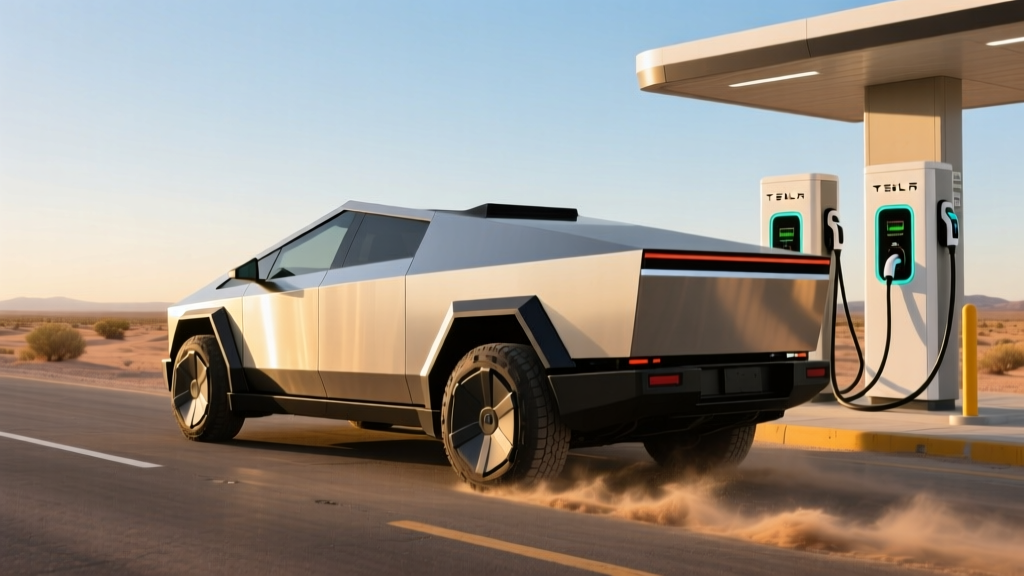
| DC Fast (V4 Supercharger) | Peak 350 kW | 10-80% in ~15 min (preconditioned) | NACS (native) |
| DC Fast (CCS station w/ adapter) | Peak ~250 kW | 10-80% in ~20-25 min | NACS-to-CCS adapter required |
Charge curve reality: The Cybertruck hits peak 350 kW only between roughly 10-30% state of charge at a V4 Supercharger with a preconditioned battery. Above 50% SoC, the rate tapers to ~150-180 kW, and above 80% it drops further to ~50-75 kW. A 10-80% session takes approximately 15 minutes under ideal conditions, but a 10-95% session stretches to 35-40 minutes. This taper is a function of battery physics—lithium-ion cells resist high-current charging at elevated SoC to prevent lithium plating and thermal damage.
Preconditioning matters: Navigate to a Supercharger using the built-in Tesla navigation, and the truck will automatically warm the battery to optimal charging temperature. Without preconditioning (arriving at a charger after the truck has been parked cold), peak rates may be limited to 150-200 kW even at a 350 kW-capable stall, extending 10-80% time to 25-30 minutes.
Cross-border charging (U.S.-Mexico): Tesla's Supercharger network in Mexico has expanded through 2026, with stations along major corridors including Mexico City–Guadalajara, Monterrey, and border-adjacent cities like Tijuana and Ciudad Juárez. However, density remains far lower than in the U.S., and many Mexican public chargers use CCS1 connectors—requiring the Tesla NACS-to-CCS adapter (sold separately, ~$250). Non-Tesla networks like Electrify America and EVgo in the U.S. now widely support NACS natively following the 2024-2025 industry adoption wave.
Performance, Efficiency, and Capability
| Specification | Value |
|---|---|
| EPA Range | 340 mi (w/ range extender) / 318 mi (standard) |
| Battery (usable) | ~123 kWh, NMC, 800V |
| MPGe (combined) | 67 MPGe (est. based on kWh/100mi ~50) |
| Efficiency | ~50 kWh/100 miles (combined) |
| 0-60 mph | 4.1 seconds |
| Horsepower | 600 hp |
| Torque | ~740 lb-ft |
| Drivetrain | Dual-motor AWD |
| Towing Capacity | 11,000 lbs |
| Payload Capacity | 2,500 lbs |
| Bed Length | 6 ft (vault-style with powered tonneau) |
| Cargo Volume (bed) | ~67 cu ft |
| Frunk Volume | ~7 cu ft (front trunk) |
| Ground Clearance | Up to 16 in (adaptive air suspension) |
| Wading Depth | ~35 in |
| Curb Weight | ~6,650 lbs |
At ~50 kWh/100 miles combined, the Cybertruck is among the least efficient EVs on the market—a direct consequence of its 6,650-pound curb weight and boxy aerodynamics. For comparison, the Rivian R1T Dual-Motor achieves roughly 45-48 kWh/100mi, and the Ford F-150 Lightning Extended Range sits at ~47 kWh/100mi. For buyers prioritizing efficiency over raw capability, these alternatives deserve consideration.
Towing at the 11,000-pound maximum will roughly halve the truck's range, yielding 150-180 real-world miles before needing a charge. The integrated trailer brake controller and tow-assist camera views are well-executed, but no EV pickup currently offers satisfactory towing range for long-distance hauling without frequent, lengthy charging stops.
Interior, Technology, and Driver Assistance
The Cybertruck's cabin is minimalist even by Tesla standards: a single 18.5-inch center touchscreen handles all infotainment, climate, and vehicle controls. There is no traditional instrument cluster; a slim strip display at the base of the windshield shows speed and range. The yoke-style steering wheel (standard on Cyberbeast, optional on Long Range) remains divisive—functional for highway cruising but awkward for low-speed maneuvers and three-point turns.
Interior space:
- Front legroom: ~41.5 inches
- Rear legroom: ~38.2 inches
- Seating: 5 passengers (3-across rear bench)
- Rear-seat fold: 60/40 split, folds nearly flat for in-cabin cargo
Driver Assistance — Autopilot and FSD (Supervised):
SAE Automation Level: Level 2
Tesla Autopilot and Full Self-Driving (Supervised) are SAE Level 2 driver-assistance systems. The driver must remain fully engaged, hands on the yoke/wheel, eyes on the road at all times. These systems do NOT make the Cybertruck self-driving. Only Level 4 services like Waymo operate without a human driver, and only in geofenced areas.
FSD (Supervised) in 2026 handles highway lane changes, on/off-ramp navigation, and city-street turns with improved fluidity over prior years, but still requires regular driver intervention—especially in construction zones, unmapped areas, and adverse weather. The $8,000 FSD purchase (or $99/month subscription) remains a personal value calculation rather than a clear capability upgrade over the included Basic Autopilot, which handles adaptive cruise and lane-centering competently.
Standout tech features:
- Steer-by-wire (no mechanical connection between yoke and wheels) — enables variable steering ratio
- Rear-wheel steering (up to 10°) — reduces turning radius to ~35 feet despite the truck's size
- Powered retractable bed cover (tonneau) with integrated bed lighting
- 120V/240V bed outlets (up to 9.6 kW vehicle-to-load output for job-site power)
- Bioweapon Defense Mode (HEPA cabin filtration)
- Over-the-air updates continuously adding features
Notable drawbacks:
- Stainless-steel body panels are fingerprint magnets and difficult/expensive to repair if dented
- No physical buttons for climate, wipers, or glovebox — all screen-dependent
- Visibility is compromised by thick A-pillars and the high, flat hood
- Bed is shorter (6 ft) than competing full-size trucks (typically 6.5-8 ft)
- Insurance premiums run 20-40% above comparable F-150 Lightning or R1T
Warranty, Ownership Costs, and Who Should Buy
| Component | Coverage |
|---|---|
| Basic Vehicle | 4 years / 50,000 miles |
| Battery & Drive Unit | 8 years / 120,000 miles (min 70% retention) |
| Roadside Assistance | 4 years / 50,000 miles |
Tesla's battery warranty guarantees at least 70% capacity retention over 8 years or 120,000 miles. A full battery pack replacement out of warranty for the Cybertruck is estimated at $18,000-$25,000 based on current 4680 pack pricing, though this cost is expected to decline as manufacturing scales. Most owners will never need a replacement—the 4680 cells are engineered for well over 200,000 miles of service.
Five-year estimated cost of ownership (Long Range AWD, 15,000 mi/yr):
- Purchase price (after credit): ~$72,490
- Insurance (5 years): ~$18,000-$22,000
- Electricity (home charging at $0.14/kWh avg): ~$5,250
- Maintenance (tires, cabin filter, wiper fluid, brake fluid check): ~$2,500
- Estimated depreciation (5 yr): ~$28,000-$35,000
- Total 5-year cost: ~$126,000-$137,000 (including depreciation)
Who Should Buy the 2026 Cybertruck?
Choose the Cybertruck if:
- You need a 11,000-lb towing EV with V2L job-site power capability
- You have home Level 2 charging and access to Tesla Superchargers for road trips
- You value the stainless-steel durability for off-road or worksite use
- Rear-wheel steering and steer-by-wire appeal for urban maneuverability
- You qualify for the §30D credit (Long Range under $80k MSRP cap)
Look elsewhere if:
- Efficiency is a priority — the R1T or F-150 Lightning use less energy per mile
- You need a full-size 8-foot bed for large cargo
- You want physical buttons and a conventional driving experience
- You drive primarily in dense urban areas where the 88-inch width is impractical
- Cross-border charging in rural Mexico is a regular need — infrastructure remains sparse
Cybertruck vs. Key Competitors: Is It Worth It?
| Spec | Tesla Cybertruck LR AWD | Rivian R1T Dual-Motor Max | Ford F-150 Lightning Ext. Range |
|---|---|---|---|
| EPA Range | 340 mi | ~410 mi | ~320 mi |
| Battery (kWh) | ~123 kWh NMC | ~149 kWh NMC | ~131 kWh NMC |
| 0-60 mph | 4.1 sec | ~4.5 sec | ~4.0 sec |
| Max DC Charge | 350 kW | ~220 kW | ~150 kW |
| Towing | 11,000 lbs | 11,000 lbs | 10,000 lbs |
| Bed Length | 6 ft | 4.5 ft (+gear tunnel) | 5.5 ft |
| Base MSRP | $79,990 | $87,900 | $73,990 |
| §30D Eligible | Yes (under $80k cap) | No (over $80k cap) | Yes (under $80k cap) |
The Cybertruck's strongest advantages are its 800V charging speed (350 kW peak crushes the Lightning's 150 kW and beats the R1T's 220 kW) and its steer-by-wire maneuverability. Its weaknesses are efficiency, bed length, and the polarizing interior. The Rivian R1T Max offers superior range and a more refined cabin but misses the tax credit. The F-150 Lightning is the most conventional and approachable option, with better dealership service infrastructure—important for buyers outside major metro areas.
Frequently Asked Questions
What is the real-world range of the 2026 Cybertruck?
The Long Range AWD achieves an EPA-estimated 340 miles with the range-extender bed insert. In real-world mixed driving, expect 280-310 miles. Sustained highway driving at 75 mph reduces this to roughly 250-270 miles. In freezing temperatures, plan for 220-250 miles. Towing at max capacity drops range to approximately 150-180 miles.
How fast does the Cybertruck charge at home and on DC fast chargers?
At home on a 240V/48A Level 2 charger, the Cybertruck adds about 34 miles of range per hour, requiring roughly 9 hours for a 10-100% charge. On a Tesla V4 Supercharger (350 kW capable), a preconditioned battery can charge from 10-80% in approximately 15 minutes. On CCS stations with the NACS adapter, expect 10-80% in 20-25 minutes at ~250 kW peak.
How much does the Cybertruck cost after federal tax credits?
The Long Range AWD at $79,990 qualifies for the full $7,500 §30D credit (it falls under the $80,000 truck MSRP cap), bringing the effective price to approximately $72,490 if you meet income requirements (≤$150k single / $300k joint AGI) and battery-sourcing thresholds. The Cyberbeast at $99,990 is ineligible due to the MSRP cap. The upcoming RWD trim (est. $60,990) should also qualify.
Does the Cybertruck qualify for the federal EV tax credit?
The Long Range AWD (and future RWD) trim qualifies for the $7,500 §30D credit, provided the buyer meets IRS income caps and the vehicle's battery sourcing satisfies critical-mineral and component requirements. Tesla's Giga Texas production and North American supply chain currently satisfy final-assembly rules. Verify current sourcing compliance on fueleconomy.gov before purchasing, as eligibility can change with supply-chain updates. The Cyberbeast does not qualify due to exceeding the $80,000 MSRP cap.
Is the Cybertruck available in Mexico?
As of 2026, Tesla does not officially sell the Cybertruck through a Mexican dealership channel. U.S.-purchased Cybertrucks can be driven in Mexico, and Tesla's Supercharger network in Mexico continues to expand along major corridors. However, importing a Cybertruck permanently into Mexico involves customs duties, homologation requirements, and potential warranty-service complications. Most cross-border owners maintain U.S. registration and charge on the Mexican Supercharger network during travel.
What are the biggest pros and cons of the Cybertruck?
Pros
- Class-leading 350 kW DC fast charging (10-80% in ~15 min)
- 11,000-lb towing + 9.6 kW V2L power output for worksite use
- Rear-wheel steering enables tight 35-ft turning radius
- Stainless-steel body resists dents and corrosion
- Long Range trim qualifies for $7,500 federal tax credit
- Access to Tesla Supercharger network (most reliable in North America)
- Over-the-air updates continuously improve functionality
Cons
- Poor efficiency (~50 kWh/100mi) means high electricity costs per mile
- Short 6-foot bed limits utility vs. conventional pickups
- Real-world highway range falls well short of 340-mi EPA sticker
- Insurance premiums significantly above competitors
- Yoke steering and screen-only controls have a steep learning curve
- Cyberbeast trim ineligible for federal tax credit
- Limited Mexican service centers and charging infrastructure for cross-border owners
Data sources: IRS §30D, fueleconomy.gov, Tesla specifications. All pricing and specs reflect 2026 model year as published; verify current figures with Tesla before purchase.