The Short Answer: Mexican Electric Cars in 2025–2026
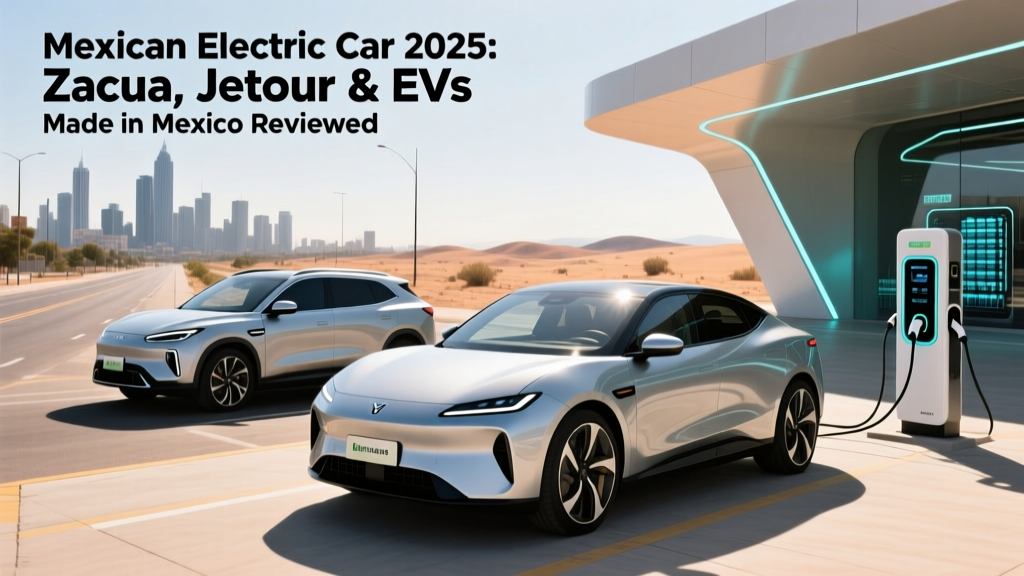
There is no single mass-market "Mexican electric car" sold in the United States. The only passenger EV designed and manufactured entirely in Mexico is the Zacua, a two-seat micro-EV built in Puebla with an EPA-equivalent range of roughly 99 miles (160 km) and a price near $30,000 USD — but it is not currently street-legal or sold in the U.S. Several global automakers (Ford, GM, Audi, Stellantis) assemble EVs or EV components at Mexican plants, and Chinese brands like Jetour and BYD sell EVs in Mexico that are manufactured in China. If you are a U.S. buyer searching for a Mexican-made EV, your closest options are vehicles assembled in Mexico with significant local parts content, such as the Ford Mustang Mach-E (Cuautitlán plant) or the upcoming next-gen EV platforms from GM's Ramos Arizpe facility.
Why "Mexican Electric Car" Is a Complicated Search
When shoppers search for a Mexican electric car, they typically mean one of three things: an EV designed by a Mexican brand, an EV manufactured in a Mexican factory, or an EV sold in the Mexican market. These are very different categories with different implications for U.S. buyers — especially regarding federal tax credit eligibility under IRS §30D, which requires final assembly in North America and imposes strict battery-sourcing and critical-mineral rules.
Mexico's auto industry is massive — it's the world's seventh-largest vehicle producer — but its EV output has historically been export-oriented, building vehicles designed by Detroit, Wolfsburg, or Tokyo automakers on Mexican soil. The domestic Mexican EV market, meanwhile, is being reshaped by an influx of affordable Chinese electric vehicles that are changing the calculus for buyers south of the border.
Zacua: Mexico's Only Homegrown Electric Car
The Zacua is the closest thing to a truly Mexican electric car. Produced by Automóviles Zacua in Puebla, Mexico, this compact two-seat city car was designed for dense urban environments. Here's what the specs look like:
| Specification | Zacua MX2 / MX3 |
|---|---|
| Battery Capacity | 18 kWh (lithium-ion) |
| Range (NEDC-equivalent) | ~99 miles (160 km) |
| Estimated Real-World Range | ~70–80 miles (mixed driving, A/C on) |
| Motor Output | ~48 HP (35 kW) |
| Top Speed | ~55 mph (89 km/h) |
| 0–30 mph | ~8.0 seconds |
| Charging (Level 2, AC) | ~3.3 kW, 0–100% in ~5.5 hours |
| DC Fast Charging | Not supported |
| Base Price (Mexico) | ~$30,000 USD equivalent |
| U.S. Availability | Not sold; not NHTSA-certified |
The Zacua fills a niche similar to the Smart EQ Fortwo or the Citroën Ami in Europe: ultra-compact urban mobility. However, at ~$30,000 USD, it faces stiff competition even in Mexico from used Nissan Leafs and imported Chinese micro-EVs at lower price points.
EVs Assembled in Mexico: What U.S. Buyers Can Actually Purchase
If "Mexican electric car" means a vehicle built on Mexican soil, several options exist that U.S. buyers can walk into a dealership and purchase today. The key distinction is that these are global platforms assembled in Mexico, not Mexican-designed vehicles.
| Vehicle | Mexican Plant | EPA Range | Battery | U.S. MSRP (2025–2026) | §30D Credit Eligible? |
|---|---|---|---|---|---|
| Ford Mustang Mach-E | Cuautitlán | 250–320 mi | 70–91 kWh (NMC) | $39,995–$59,975 | Varies by trim/year; check IRS sourcing rules |
| GM (Blazer EV, Equinox EV — future) | Ramos Arizpe | 279–319 mi (Blazer) | 85–102 kWh (NMC) | $34,995–$56,595 | Some trims eligible; battery sourcing dependent |
| Audi Q5 e-tron (China-built for some markets) | N/A — listed for context | — | — | — | — |
The Ford Mustang Mach-E has been assembled at Ford's Cuautitlán plant outside Mexico City since 2020. Despite Mexican assembly, certain trims have qualified for the §30D federal tax credit in past years because Ford met the North American final assembly requirement and, depending on the model year, the battery-component and critical-mineral sourcing thresholds. However, the IRS updates eligible vehicle lists regularly, and credit availability changes as sourcing rules tighten — always verify current eligibility before purchasing.
GM's Ramos Arizpe plant in Coahuila is being retooled for next-generation EV production, including upcoming electric models on GM's Ultium platform. These vehicles will carry significant Mexican manufacturing content but are GM products through and through.
The Chinese EV Wave Reshaping Mexico's Market
Mexico's domestic EV market is undergoing a dramatic shift thanks to Chinese automakers. Brands like BYD, Jetour, Chirey (Chery), MG (SAIC), and JAC have flooded the Mexican market with affordable EVs and plug-in hybrids that undercut legacy automakers by 30–50%. This is the context many people are referencing when they discuss "electric cars in Mexico" in 2025–2026.
| Model (Sold in Mexico) | Origin | Approx. Price (USD) | Range (km) | U.S. Available? |
|---|---|---|---|---|
| BYD Dolphin Mini (Seagull) | China | ~$18,000–$21,000 | 300–400 km (CLTC) | No |
| Jetour Dashing EV (ICE variant common) | China | ~$22,000–$28,000 | ~400 km (est.) | No |
| MG4 EV | China | ~$25,000–$30,000 | 350–450 km (WLTP) | No (not currently in U.S.) |
| JAC E10X | China | ~$12,000–$15,000 | ~250 km (NEDC) | No |
| Nissan Leaf (assembled in Mexico historically) | Japan/Mexico | ~$28,000–$36,000 | 212–226 mi (EPA) | Yes (discontinued after 2025) |
These vehicles are not available in the United States, primarily due to U.S. tariffs on Chinese-manufactured vehicles (currently 100% under Section 301 tariffs as of 2024–2025), differing safety and emissions certification requirements, and the absence of dealer networks. If you're a U.S. buyer fascinated by the BYD Seagull's $18,000 price tag, there is currently no legal pathway to import one for street use.
Cost Breakdown: Buying a Mexican-Assembled EV vs. Gas Car in the U.S.
For U.S. buyers considering a Mexican-assembled EV like the Ford Mustang Mach-E, here's how the five-year total cost of ownership compares to a similarly priced gas-powered crossover:
| Cost Category | Ford Mustang Mach-E RWD (EV) | Ford Edge AWD (Gas Baseline) |
|---|---|---|
| Base MSRP | $39,995 | $39,995 |
| §30D Federal Tax Credit | Up to $3,750–$7,500 (trim/battery dependent) | $0 |
| Effective Purchase Price | ~$32,495–$36,245 | $39,995 |
| Fuel/Energy (5 yr, 60,000 mi) | ~$3,600 (home charging at $0.14/kWh avg) | ~$9,000 (25 MPG avg, $3.75/gal) |
| Maintenance (5 yr) | ~$1,800 (no oil changes, fewer brake replacements) | ~$4,200 (oil, filters, brakes, fluids) |
| Insurance (5 yr avg) | ~$9,500 (EV premium ~15–20%) | ~$7,800 |
| Estimated 5-Year Total Cost | ~$47,395–$51,145 | ~$60,995 |
Decision Framework: Is a Mexican-Assembled EV Right for You?
- Choose a Mexican-assembled EV (Mach-E, future GM models) if: You have access to Level 2 home charging, drive under 250 miles per day, want to support North American manufacturing, and can verify §30D eligibility for your specific trim and tax situation.
- Choose a U.S.-assembled EV if: Maximizing federal tax credit certainty is your top priority, or you want to minimize supply-chain risk perception. Vehicles like the Tesla Model Y (Fremont/Austin) or GM Blazer EV (some trims from Tennessee/Michigan) may have more stable credit eligibility.
- Choose a PHEV if: You lack reliable home charging or frequently drive in rural charging-desert areas. A Toyota RAV4 Prime or Chrysler Pacifica PHEV gives you electric commuting with gas fallback.
- Avoid importing a Mexico-market Chinese EV: U.S. import laws, safety certification (NHTSA/FMVSS), and 100%+ tariffs make this economically and legally impractical for individual buyers.
Common Misconceptions About Mexican Electric Cars
| Myth | Fact |
|---|---|
| "Mexican-made EVs can't qualify for the U.S. tax credit." | The §30D credit requires North American final assembly — Mexico qualifies under USMCA. Battery component and critical-mineral sourcing are the real limiting factors, not the country of assembly. |
| "I can import a BYD or JAC EV from Mexico to the U.S." | Vehicles sold in Mexico must still meet U.S. FMVSS safety standards and EPA emissions certification to be imported. Chinese-market vehicles sold in Mexico generally do not meet these standards, and 100% tariffs apply to Chinese-origin vehicles regardless of point of purchase. |
| "The Zacua is available in the United States." | Zacua has no U.S. distribution, no NHTSA certification, and no plans for U.S. sales as of 2025–2026. It is a Mexico-only product. |
| "EVs assembled in Mexico have lower quality." | Ford's Cuautitlán plant and GM's Ramos Arizpe facility meet the same global quality standards as their U.S. counterparts. JD Power and Consumer Reports data show no systematic quality gap based on Mexican assembly. |
| "All EVs in Mexico are cheap." | While Chinese micro-EVs start under $15,000, mainstream EVs like the Mustang Mach-E and Volvo XC40 Recharge sell at prices comparable to U.S. MSRP. Mexico's charging infrastructure is also far less developed, with significant range-anxiety implications outside major cities. |
Real-World Ownership Considerations
If you're buying a Mexican-assembled EV in the U.S., your ownership experience will be identical to any other EV of the same model — the assembly location doesn't affect your daily driving. What does matter:
Home charging access: A Level 2 home charger (240V, 32–48A) is the single biggest ownership satisfaction factor. Installation costs range from $500 (simple outlet near panel) to $3,000+ (panel upgrade, long conduit runs). Without home charging, EV ownership becomes significantly less convenient and more expensive per mile.
Cold-weather range loss: If you live in northern climates, expect 20–35% range reduction in sub-freezing temperatures. A Mach-E with an EPA rating of 312 miles may deliver only 200–240 miles in January in Minnesota. Vehicles with heat pumps (standard on some trims) mitigate this somewhat.
Charging infrastructure: The U.S. has over 70,000 public charging ports as of 2025, but reliability varies widely. Tesla's Supercharger network (now opening to NACS-equipped non-Teslas) remains the gold standard. Electrify America, EVgo, and ChargePoint cover major corridors but expect occasional downtime.
Insurance premiums: EV insurance costs 15–25% more on average than comparable gas vehicles due to higher repair costs and battery-replacement risk. Get quotes before purchasing — the savings on fuel can be partially offset by higher premiums.
What First-Time EV Buyers Should Know
Whether you're considering a Mexican-assembled Mach-E or any other EV, these fundamentals apply:
- kW vs. kWh: Kilowatts (kW) measure power — how fast you charge. Kilowatt-hours (kWh) measure energy — how big your battery is. A 91 kWh battery charged at 150 kW peak will add range quickly but will taper above 80% State of Charge. Plan for 10–80% charging times, not 0–100%.
- EPA range vs. real-world: The EPA test cycle is reasonably accurate for mixed suburban driving at moderate temperatures. Highway-only driving at 75+ mph reduces range by 10–20%. Cold weather adds another 15–30% reduction. Always plan trips around 70–80% of the EPA sticker number for safety margin.
- Tax credit verification: Never assume a vehicle qualifies for the full $7,500 §30D credit. Check the fueleconomy.gov tax credit tracker, confirm your income is under the cap ($150K single / $300K joint for new vehicles), and verify the MSRP cap applies ($55,000 for cars, $80,000 for SUVs/trucks). The credit can now be transferred to the dealer as a point-of-sale discount.
- Battery warranty: Federal law mandates a minimum 8-year/100,000-mile warranty on EV batteries. Most manufacturers warrant against degradation below 60–70% of original capacity. LFP batteries (used in some Tesla and Ford models) tend to degrade more slowly but have lower energy density than NMC chemistry.
Can I buy a Zacua in the United States?
No. The Zacua micro-EV is only sold in Mexico and has not been certified by NHTSA for U.S. road use. There are no announced plans for U.S. distribution. Importing one privately would require navigating FMVSS compliance, which is cost-prohibitive for a vehicle in this price range.
Does a Mexican-assembled Ford Mustang Mach-E qualify for the $7,500 tax credit?
It depends on the model year, trim, and current IRS sourcing rules. Mexico qualifies as North American final assembly under USMCA, but the battery components and critical minerals must also meet §30D thresholds. Check the IRS clean vehicle credit page and fueleconomy.gov for the specific trim you're considering, as eligibility changes periodically.
Are Chinese EVs sold in Mexico any good?
Brands like BYD offer genuinely competitive products — the BYD Dolphin and Seal have received positive reviews globally. However, the versions sold in Mexico are tuned for Mexican regulations and infrastructure, and they lack U.S. safety certification, dealer support, and parts availability. They represent excellent value within Mexico but are not viable U.S. imports.
Will Mexico produce its own electric car brand for export?
As of 2025–2026, there is no Mexican EV startup with announced plans for U.S. market entry. Mexico's automotive strength lies in contract manufacturing for global OEMs. The Zacua remains the only indigenous Mexican EV brand, and its scale and ambitions are strictly domestic and urban-focused.
How does Mexico's EV charging infrastructure compare to the U.S.?
Mexico has roughly 2,000–3,000 public charging points as of 2025, concentrated in Mexico City, Monterrey, and Guadalajara. Outside these metros, DC fast charging is sparse, making long-distance EV travel challenging. The U.S. has roughly 70,000+ public ports by comparison. Mexico's infrastructure is growing but remains years behind.