The Quick Answer on Mercury Electric Products
If you are searching for Mercury electric products in the automotive space, here is the essential context: Mercury was a Ford Motor Company brand that was discontinued in 2011. As of 2026, there are no new Mercury-branded electric vehicles on the market. However, the term "Mercury electric products" frequently refers to Mercury Marine's electric outboard motors (such as the Avator series) or is confused with Ford's current EV lineup (Mustang Mach-E, F-150 Lightning), which shares Mercury's parent-company lineage. This guide addresses what buyers in the Mercury/Ford ecosystem need to know about going electric — with exact costs, ranges, and a practical decision framework for 2026.
Clarifying the Mercury Name in Today's EV Market
Before making any purchase decision, it is critical to understand what "Mercury electric products" actually encompasses in 2026:
- Mercury Marine (Avator electric outboards): Mercury Marine, now owned by Brunswick Corporation, produces the Avator line of electric boat motors (7.5e, 20e, 35e). These are not automobiles and fall outside our automotive coverage scope.
- Mercury (automobile brand): Ford retired the Mercury brand in 2011. No Mercury-badged EVs exist, and Ford has not announced any revival plans as of early 2026.
- Ford EVs (Mercury's parent): Buyers who would have historically shopped Mercury often cross-shop Ford's current electric lineup — the Mustang Mach-E, F-150 Lightning, and the upcoming Explorer EV.
For the remainder of this guide, we will focus on what matters to automotive buyers: whether a Ford-platform EV (the spiritual successor to Mercury's market segment) makes financial and practical sense versus a gas vehicle or hybrid in 2026.
EV vs Gas vs Hybrid: The 2026 Cost Comparison
The most common question from buyers in the mid-size SUV and sedan segment — historically Mercury's core market — is whether an EV, hybrid, or gas vehicle saves the most money over five years. Below is a data-driven comparison using the EPA's fuel economy data and 2026 average energy costs.
| Category | Ford Mustang Mach-E (EV) | Ford Escape PHEV | Ford Escape Gas (2.0T) |
|---|---|---|---|
| Base MSRP | $42,995 | $39,500 | $33,500 |
| Est. Federal Tax Credit (§30D) | Up to $7,500* | Up to $7,500* | $0 |
| Effective Purchase Price | ~$35,495 | ~$32,000 | $33,500 |
| Annual Fuel/Energy Cost | ~$620/yr (home charging) | ~$890/yr (mixed) | ~$1,950/yr |
| 5-Year Fuel/Energy Total | $3,100 | $4,450 | $9,750 |
| 5-Year Maintenance Est. | ~$1,800 | ~$2,900 | ~$3,400 |
| 5-Year Insurance Est. | ~$9,200 | ~$7,800 | ~$7,200 |
| 5-Year Total Cost of Ownership | ~$49,595 | ~$47,150 | ~$53,850 |
* Federal §30D credit eligibility depends on MSRP caps ($80,000 for SUVs), buyer income limits ($150K single / $300K joint), and battery critical-mineral sourcing requirements. Verify current-year rules at IRS.gov. Credit can be transferred at point of sale to reduce purchase price.
Real-World EV Ownership: What First-Time Buyers Must Know
Numbers on a spreadsheet only matter if they match your daily life. Here are the concrete ownership realities that determine whether an EV works for you in 2026.
Home Charging Access Is the Deciding Factor
Approximately 70-80% of EV charging happens at home. If you can install a Level 2 charger (240V, 32-48 amps), an EV becomes extraordinarily convenient — you start every morning with a full "tank." A typical Level 2 home installation costs between $800 and $2,500 depending on your electrical panel's capacity and the distance from panel to garage. Homes with a 200-amp service panel usually need no upgrade; older homes with 100-amp panels may require a $1,500-$3,000 panel upgrade.
If you cannot charge at home (apartment living, street parking, HOA restrictions), EV ownership becomes significantly harder. Public DC fast charging costs roughly 2-3x more per mile than home charging, and relying on it exclusively adds time and unpredictability to your routine.
Range: EPA Sticker vs. Reality
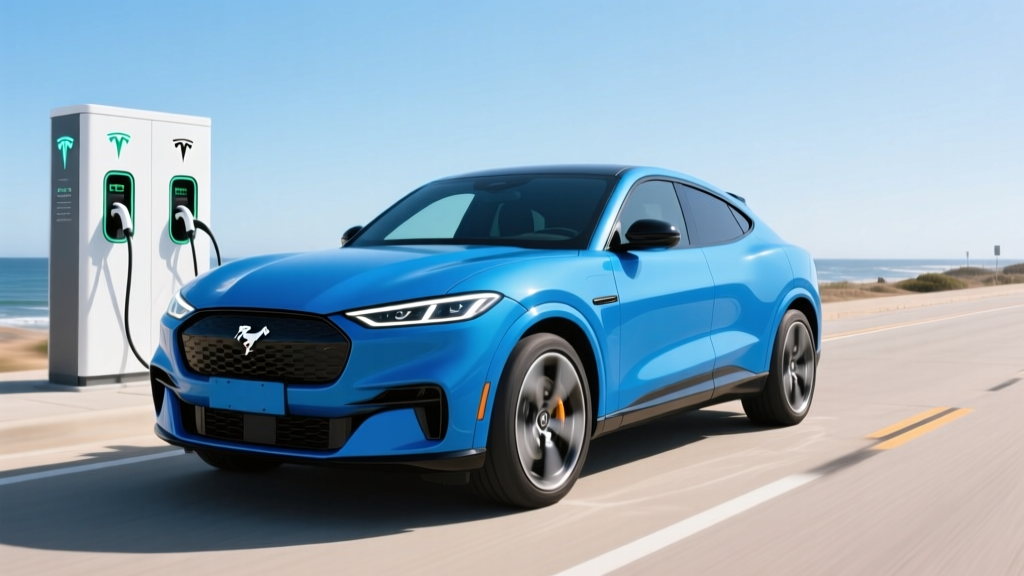
The Mustang Mach-E Premium AWD carries an EPA-estimated range of 290 miles with the extended-range battery (91 kWh usable, NMC chemistry). In real-world conditions, expect:
- Mild weather, mixed driving: 260-280 miles
- Highway-only at 75 mph: 240-260 miles
- Cold weather (below 30°F): 190-230 miles (cold reduces battery efficiency and increases cabin heating load)
This is normal for all EVs. A heat pump (standard on the 2026 Mach-E) reduces cold-weather loss by roughly 10-15% compared to resistive heating, but physics still applies.
Charging Speed: The Curve Matters More Than Peak kW
The 2026 Mach-E supports a peak DC fast-charge rate of 150 kW on CCS-equipped models (NACS-equipped models gain access to Tesla Superchargers at up to 150 kW as well). However, peak rate is not sustained rate. Here is what a typical session looks like:
- 10-80% charge: ~36 minutes at a 150 kW+ station
- 80-100% charge: An additional ~25 minutes (charge rate tapers sharply above 80% to protect battery health)
- Level 2 home charging (48A, 11.5 kW): ~9 hours for a full charge — overnight is sufficient
Always precondition the battery (via the vehicle's navigation to a charger or app-based preconditioning) before a DC fast-charge session. Cold batteries charge dramatically slower — preconditioning warms the pack to optimal temperature and can shave 10-15 minutes off a 10-80% session.
Common EV Misconceptions — Fact vs. Fiction
First-time buyers encounter a flood of conflicting information. Here are the most persistent myths with data-backed corrections.
| Myth | Fact |
|---|---|
| "EV batteries need replacing every 5 years" | Ford warrants the Mach-E battery for 8 years / 100,000 miles with a minimum 70% capacity retention. Real-world degradation data from similar NMC packs shows ~8-12% loss over 100K miles. Full replacement (rarely needed) costs $12,000-$18,000. |
| "EVs are worse in cold weather" | EVs lose 20-35% range in sub-freezing temps — a real limitation. However, they start reliably (no cold-cranking amps), and cabin heating is instant. Preconditioning while plugged in mitigates most range loss for daily driving. |
| "Public charging is broken everywhere" | Reliability varies by network. Tesla Superchargers consistently report 97%+ uptime. Electrify America and EVgo have improved to ~85-90% uptime in 2025-2026. Plan routes with apps like PlugShare and always have a backup station identified. |
| "EVs cost more to insure" | Partially true. EV insurance premiums run 15-25% higher on average due to higher repair costs and parts pricing. However, the gap has narrowed as EV market share grows. Always get quotes before purchasing. |
| "The power grid can't support EVs" | Most EV charging occurs overnight during off-peak hours when grid capacity is underutilized. Utility time-of-use rates reward overnight charging with electricity costs as low as $0.06-$0.10/kWh in many regions. |
Tax Credits and Incentives: The 2026 Rules
The federal §30D Clean Vehicle Credit remains available in 2026, but eligibility has tightened significantly since the Inflation Reduction Act's sourcing requirements phased in. Here is the current framework:
Federal §30D Credit Requirements (2026)
- MSRP Cap: Vans, SUVs, and trucks must be under $80,000; sedans under $55,000
- Buyer Income Cap: Modified AGI must not exceed $150,000 (single), $225,000 (head of household), or $300,000 (joint filing)
- Battery Sourcing: Increasing percentages of critical minerals and battery components must be sourced from the US or FTA-partner nations — this eliminates some models from full credit eligibility
- Point-of-Sale Transfer: You can transfer the credit to the dealer at purchase, reducing your out-of-pocket cost immediately rather than waiting for tax filing
- Final Assembly: Vehicle must undergo final assembly in North America
Additionally, many states offer supplementary incentives (rebates, HOV lane access, reduced registration fees). Check the AFDC state incentives database for your jurisdiction, and consult a tax professional for personal eligibility.
Your Decision Framework: EV, Hybrid, or Gas?
Use this practical framework to determine which powertrain fits your situation:
Choose an EV (like the Mustang Mach-E) if:
- You have access to home Level 2 charging (or can install it)
- Your daily commute is under 80 miles round-trip (covers ~90% of American drivers)
- You take road trips fewer than 4-5 times per year (DC fast-charging handles these with 30-min stops)
- You want the lowest per-mile energy cost (~$0.04-$0.06/mile on home electricity vs. $0.12-$0.15/mile for gas)
- You qualify for the §30D credit, closing the upfront price gap
Choose a PHEV (like the Escape PHEV) if:
- You can charge at home but have frequent long road trips or live in a charging-desert region
- You want 30-40 miles of daily electric-only driving for commutes with a gas engine as a backup
- Your household has one vehicle that must serve all use cases
Choose a Gas Vehicle if:
- You cannot charge at home and have no reliable workplace or public charging
- You regularly tow heavy loads over long distances (EV towing range drops 40-50%)
- Your budget is strictly under $30,000 and you need a new vehicle (EV options remain limited at this price point)
Frequently Asked Questions
Does Mercury make any electric vehicles in 2026?
No. The Mercury automobile brand was discontinued by Ford in 2011. There are no Mercury-badged EVs, and Ford has not announced a Mercury revival. Mercury Marine (a separate Brunswick Corporation company) produces the Avator electric outboard motor line for boats, which are not automobiles.
What Ford EV is closest to what Mercury would have offered?
The Ford Mustang Mach-E occupies the mid-size crossover segment that Mercury targeted with vehicles like the Mariner. The Mach-E offers 250-320 miles of EPA range (depending on trim and battery), starts at ~$42,995, and qualifies for up to $7,500 in federal tax credits for eligible buyers.
How much does it cost to charge an EV at home vs. buying gas?
At the US average residential electricity rate of ~$0.16/kWh (2026 EIA data), charging a Mach-E with a 91 kWh battery from empty to full costs approximately $14.50 for 290 miles of range — roughly $0.05 per mile. A comparable gas SUV at 26 MPG combined and $3.40/gallon costs ~$0.13 per mile. Over 15,000 miles per year, home EV charging saves approximately $1,200-$1,400 annually.
Will an EV battery last as long as the car?
Current NMC and LFP battery chemistries are engineered for 1,500-3,000 full charge cycles before reaching 70-80% capacity. For a 290-mile-range EV, that translates to 435,000-870,000 miles of theoretical battery life. Real-world degradation typically reaches 10-15% at 100,000-150,000 miles. Ford's battery warranty covers 8 years/100,000 miles at a minimum 70% capacity threshold.
Is a used EV a good option if new EVs are too expensive?
Yes, with caveats. The federal used-EV credit (§25E) offers up to $4,000 (30% of sale price) on qualifying pre-owned EVs priced under $25,000 from a licensed dealer, with buyer income caps of $75K single / $150K joint. Always request a battery State of Health (SoH) report before purchasing. Models 2-4 years old with under 50,000 miles often represent the best value, as the steepest depreciation has already occurred while the battery warranty remains active.