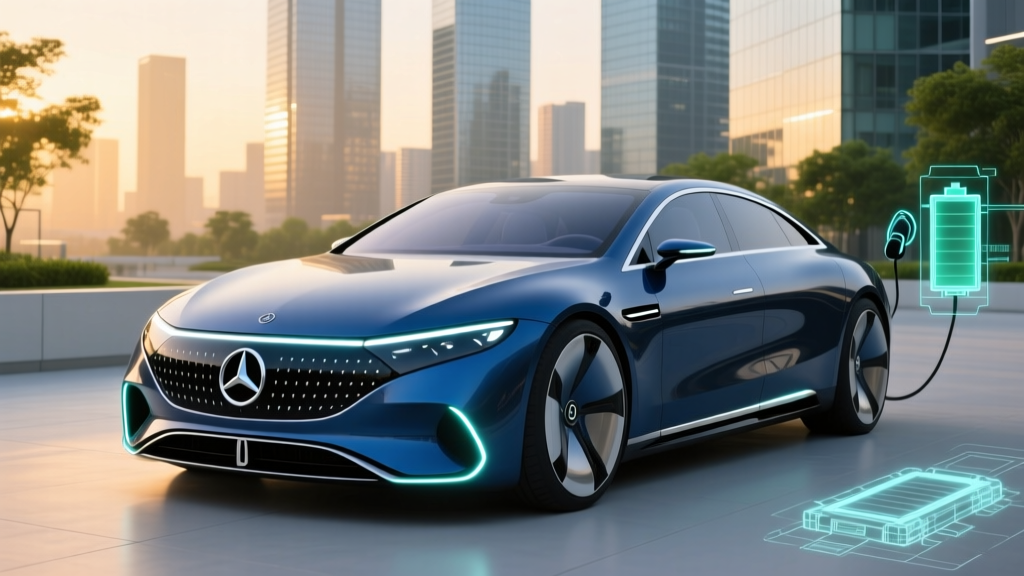
When Mercedes-Benz unveiled the Vision EQS concept, it signaled the automaker's intent to build a flagship electric luxury sedan capable of rivaling the Tesla Model S, Lucid Air, and BMW i7. The concept previewed what would eventually become the production Mercedes-Benz EQS sedan, but the Vision EQS nameplate continues to generate interest as Mercedes refines its next-generation electric architecture. Here is what we know about the Vision EQS platform, its production descendants, and where the nameplate stands in 2026.
Vision EQS: Concept Origins and Production Reality
The Mercedes-Benz Vision EQS concept debuted at the 2019 Frankfurt Motor Show (IAA) as a design and technology showcase for the brand's all-electric future. It previewed the production EQS sedan, which launched for the 2022 model year on Mercedes' dedicated EVA (Electric Vehicle Architecture) platform. The concept featured a 100 kWh battery, rear- and all-wheel-drive configurations, and a claimed WLTP range of up to 700 km (~435 miles). Mercedes stated the concept could DC fast-charge at up to 350 kW, adding roughly 186 miles of range in 15 minutes.
As of 2026, the production EQS sedan (now in its refreshed form) carries forward the Vision EQS design language and engineering philosophy. If you are researching the Vision EQS to make a purchase decision, the vehicle to evaluate is the production Mercedes-Benz EQS — available now through Mercedes-Benz dealers.
Production EQS Specs: Range, Battery, and Efficiency
| Specification | EQS 450+ (RWD) | EQS 580 4MATIC (AWD) |
|---|---|---|
| EPA Range | Up to 390 miles | Up to 371 miles |
| Battery Capacity (usable) | 108.4 kWh | 108.4 kWh |
| Battery Chemistry | NMC (Nickel Manganese Cobalt) | NMC |
| Horsepower | 355 hp | 536 hp |
| 0–60 mph | 5.9 seconds | 4.1 seconds |
| Drivetrain | Rear-Wheel Drive (single motor) | All-Wheel Drive (dual motor) |
| MPGe (combined) | 97 MPGe | 92 MPGe |
| Efficiency (kWh/100 mi) | 35 kWh/100 mi | 37 kWh/100 mi |
The production EQS uses a 108.4 kWh usable NMC lithium-ion battery pack — one of the largest in any production passenger car. NMC chemistry offers high energy density, which is critical for achieving the EQS's class-leading range, though it comes with higher raw-material costs and slightly faster long-term degradation compared to LFP (lithium iron phosphate) cells.
Charging Speed: DC Fast, Level 2, and Real-World Curves
Charging infrastructure access and speed are top concerns for luxury EV buyers planning road trips. The EQS supports the CCS1 connector standard in North America, with NACS (Tesla Supercharger) access available via Mercedes-Benz's partnership with Tesla's Supercharger network — using a CCS-to-NACS adapter or built-in NACS port on newer model years.
| Charging Level | Power (kW) | Speed / Time |
|---|---|---|
| Level 1 (120V household) | ~1.4 kW | ~4 miles per hour |
| Level 2 (240V home/public) | Up to 9.6 kW (onboard charger) | ~30 miles per hour; 0–100% in ~11.5 hours |
| DC Fast Charge (peak) | Up to 200 kW | 10–80% in ~31 minutes |
| DC Fast Charge (sustained average) | ~130–150 kW average | Varies by ambient temp and SoC |
The Vision EQS concept originally claimed 350 kW DC fast-charging capability, but the production EQS peaks at 200 kW on a CCS1 connection. This is a meaningful difference: while 200 kW is competitive with the BMW i7 and Audi e-tron GT, it falls short of the Lucid Air's 300+ kW capability and Hyundai Ioniq 5's 240 kW (on 800V architecture). The EQS's charging curve tapers significantly above 80% State of Charge (SoC), which is standard for NMC batteries to preserve longevity. Preconditioning the battery via the MBUX navigation system — routing to a DC fast charger — activates thermal management to optimize charge speed upon arrival.
Pricing, Trim Levels, and Federal Tax Credit Eligibility
The Mercedes-Benz EQS positions itself firmly in the six-figure luxury EV segment. Here is the current pricing landscape:
| Trim | Base MSRP | As-Tested (typical) | Federal Tax Credit (§30D) |
|---|---|---|---|
| EQS 450+ Sedan | ~$105,550 | $110,000–$118,000 | Not eligible (MSRP cap exceeded) |
| EQS 580 4MATIC Sedan | ~$127,350 | $135,000–$148,000 | Not eligible (MSRP cap exceeded) |
| EQS 450+ SUV | ~$105,550 | $112,000–$125,000 | Not eligible (MSRP cap exceeded) |
Tax credit reality: Under IRS §30D rules, the federal EV tax credit has an MSRP cap of $55,000 for sedans and $80,000 for SUVs/vans/pickups. Every EQS trim exceeds these thresholds, meaning no EQS variant qualifies for the $7,500 federal tax credit. Additionally, buyer income caps ($150,000 single / $300,000 joint AGI) and battery critical-mineral sourcing requirements further limit eligibility. The point-of-sale transfer option is irrelevant here since the vehicle itself is ineligible. For the latest rules, consult IRS.gov §30D guidance.
Some buyers may explore the used-EV credit (§25E), which offers up to $4,000 on pre-owned EVs priced under $25,000 — but the EQS's resale values remain far above that ceiling in 2026.
Interior Space, Cargo, and Technology
The EQS's EVA platform enables a flat floor and stretched wheelbase (126.4 inches), yielding exceptional interior volume:
- Front legroom: 41.7 inches
- Rear legroom: 42.1 inches — limousine-class space
- Cargo volume: 22.0 cu ft (trunk); 63.0 cu ft with rear seats folded
- Frunk: Not available on US-spec EQS (space used for HVAC and electronics)
The standout technology feature is the available MBUX Hyperscreen — a 56-inch curved glass panel spanning the entire dashboard, integrating three displays (driver cluster, central infotainment, and passenger screen) under a single glass surface. The system runs Mercedes' latest MBUX software with over-the-air updates, augmented-reality navigation, and natural-language voice control.
Driver assistance: The EQS offers Mercedes' Driver Assistance Package with Active Distance Assist DISTRONIC (adaptive cruise), Active Lane Keeping, Active Steering Assist, and the available DRIVE PILOT system. DRIVE PILOT is a SAE Level 3 conditional automation system approved in Nevada and California for speeds up to 40 mph in heavy traffic on suitable highways — meaning the driver can legally disengage from the driving task under specific conditions, unlike Level 2 systems such as Tesla Autopilot or GM Super Cruise, which always require driver attention.
Warranty Coverage and Battery Longevity
| Coverage | Term |
|---|---|
| New Vehicle Limited Warranty | 4 years / 50,000 miles |
| High-Voltage Battery Warranty | 10 years / 155,000 miles |
| Powertrain (e-motor, reduction gear) | 10 years / 155,000 miles |
| Battery Capacity Retention Threshold | 70% of original capacity |
Mercedes guarantees the EQS battery will retain at least 70% of its original usable capacity over the 10-year/155,000-mile warranty period. If the battery drops below this threshold under normal use, Mercedes will repair or replace it. NMC batteries in the EQS use an active liquid thermal management system that preconditions and cools the pack, which helps mitigate degradation. Real-world data from early 2022–2023 EQS owners suggests approximately 3–5% capacity loss in the first two years — in line with industry norms for liquid-cooled NMC packs. A full out-of-warranty battery replacement would likely cost $20,000–$30,000 based on current Mercedes parts pricing.
Pros, Cons, and Verdict
- Class-leading EPA range (390 mi, 450+)
- Exceptional ride quality with standard AIRMATIC air suspension
- MBUX Hyperscreen is a genuine tech showpiece
- DRIVE PILOT Level 3 capability (where approved)
- Spacious rear cabin with limousine-class legroom
- Whisper-quiet interior at highway speeds
- No federal tax credit eligibility (MSRP cap exceeded)
- 200 kW DC peak charge rate trails Lucid/Hyundai 800V rivals
- No frunk — cargo space is trunk-only
- High starting price ($105K+) with expensive options
- Regenerative braking feel can be inconsistent across modes
- Hyperscreen adds cost and potential long-term repair complexity
- Choose the EQS if you prioritize maximum range, ride comfort, and cutting-edge interior technology in a full-size luxury sedan, and tax-credit eligibility is not a factor in your budget.
- Consider the Lucid Air instead if faster DC charging (300+ kW), more rear-seat headroom, or a lower starting price (Pure trim ~$70K) matters to you.
- Consider the BMW i7 if you want a more traditionally styled luxury sedan with comparable tech and a similar price point, though with less EPA range (~318 mi).
FAQ: Mercedes Vision EQS and Production EQS
Can I buy the Mercedes Vision EQS?
No. The Vision EQS was a concept car shown in 2019. The production vehicle it previewed is the Mercedes-Benz EQS sedan, which is available now. All specs, pricing, and availability discussed above refer to the production EQS.
What is the real-world range of the EQS?
The EPA rates the EQS 450+ at 390 miles. In real-world highway driving at 70+ mph, expect 320–350 miles. In freezing temperatures, range can drop to 260–300 miles due to cabin heating and reduced battery efficiency.
How fast does the EQS charge at home and on the road?
On a 240V Level 2 home charger, the EQS adds roughly 30 miles per hour (9.6 kW onboard charger), taking about 11.5 hours for a full charge. On DC fast chargers, it peaks at 200 kW, reaching 10–80% in approximately 31 minutes under optimal conditions.
Does the Mercedes EQS qualify for the federal EV tax credit?
No. Under current IRS §30D rules, the EQS exceeds the $55,000 MSRP cap for sedans (and the $80,000 cap for SUVs). No EQS variant is eligible for the $7,500 federal credit, regardless of buyer income or battery sourcing. See IRS.gov for full eligibility details.
Is the EQS worth buying over the Tesla Model S or Lucid Air?
The EQS wins on ride comfort, interior luxury materials, and available Level 3 automation (DRIVE PILOT). The Lucid Air offers more range (up to 516 mi EPA on Grand Touring), faster DC charging, and a lower entry price. The Tesla Model S Plaid delivers vastly more performance (1,020 hp, 1.99s 0–60) and Supercharger network access, but with a less refined ride. The right choice depends on whether you value luxury comfort (EQS), efficiency and value (Lucid), or performance (Tesla).
What is the biggest drawback of the EQS?
The most common owner complaints center on the 200 kW DC fast-charge ceiling (slower than rivals on long road trips), the lack of a frunk, and the high cost of ownership with no tax-credit offset. The regenerative braking system also requires an adjustment period, as the transition between regen and friction braking can feel non-linear.
The Mercedes Vision EQS concept set the design and engineering direction for one of the most capable electric luxury sedans on the market. The production EQS delivers on the concept's core promises — exceptional range, a technology-rich cabin, and SAE Level 3 driving capability — even if its DC charging speed and six-figure pricing keep it from being a volume contender. For buyers who prioritize comfort and range over tax incentives and peak charging speed, the EQS remains a benchmark in the electric luxury sedan segment.