The G-Wagon EV in 60 Seconds
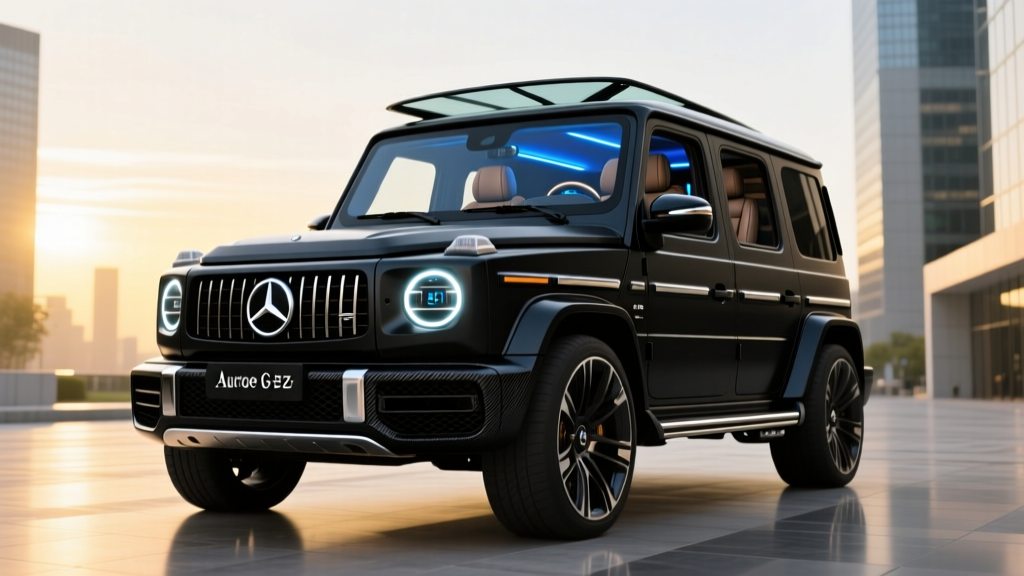
The 2026 Mercedes-Benz G 580 with EQ Technology — the electric G-Wagon — starts at $161,400 MSRP (including destination). It packs a 116 kWh usable battery, earns an EPA-estimated 239 miles of range, produces 576 hp / 840 lb-ft of torque, and can peak at 200 kW DC fast charging (10–80% in approximately 32 minutes). It does not qualify for the federal §30D tax credit due to its MSRP exceeding the $80,000 SUV cap. If you want the G-Wagon silhouette with silent torque and zero tailpipe emissions, this is the only option — but expect real-world highway range closer to 190–210 miles and annual insurance premiums north of $5,000.
Range, Battery & Real-World Efficiency
The G 580 EQ uses a 116 kWh usable lithium-ion battery (NMC chemistry) housed in a double-walled, torsionally rigid enclosure where the traditional ladder frame once lived. Four individually controlled electric motors — one per wheel — deliver all-wheel drive with torque vectoring that the old G 63 could only dream of.
| Spec | Value |
|---|---|
| EPA Range | 239 miles |
| Battery (usable) | 116 kWh, NMC |
| Efficiency | 54 MPGe combined (≈ 62 kWh/100mi) |
| Peak DC Fast Charge | 200 kW |
| 10–80% DC Charge Time | ~32 minutes |
| Level 2 AC Charge Rate | 11 kW (~10.5 hrs, 0–100%) |
| Horsepower | 576 hp |
| Torque | 840 lb-ft |
| 0–60 mph | 4.6 seconds |
| Towing Capacity | Not yet EPA-rated (est. ~4,400 lbs) |
| Base MSRP | $161,400 |
| Battery Warranty | 10 years / 150,000 miles (70% capacity retention) |
Real-World Range vs. EPA Sticker
The EPA's 239-mile figure assumes mixed driving at moderate temperatures. Here's what to actually expect:
- City / moderate climate: 230–245 miles (regen braking helps recover energy)
- Highway (70–80 mph sustained): 185–210 miles — the G 580's boxy aerodynamics (drag coefficient ~0.44) punish efficiency at speed
- Cold weather (below 30°F): 165–195 miles — battery resistance increases and cabin heating draws heavily from the pack. A heat pump is not standard on early builds; verify with your dealer.
- Off-road / low-speed trail use: Range is less relevant; G-Turn and low-range modes prioritize torque control over efficiency
Bottom line: plan road trips around ~180 miles between charges to keep a comfortable buffer, especially in winter or at highway speed.
Charging Speeds & the Curve Reality
The G 580 EQ supports up to 200 kW peak DC fast charging via CCS1 (Mercedes-Benz has committed to NACS adoption; 2026 models may ship with NACS ports or include a CCS-to-NACS adapter — confirm at purchase). At peak rate, Mercedes quotes 10–80% in about 32 minutes.
However, peak kW is not sustained kW. The charge curve looks roughly like this:
- 10–40% SoC: Near peak ~190–200 kW
- 40–60% SoC: Tapers to ~150–170 kW
- 60–80% SoC: Further taper to ~100–120 kW
- 80–100% SoC: Drops sharply to ~40–50 kW (standard lithium-ion protection behavior)
For road trips, precondition the battery using the MBUX navigation's charge-stop routing — this warms the pack to optimal temperature before you arrive at the charger, reducing taper and improving the 10–80% window by several minutes.
| Level | Power | Miles Added Per Hour | Typical Use Case |
|---|---|---|---|
| Level 1 (120V) | ~1.4 kW | ~2–3 mi/hr | Emergency trickle only |
| Level 2 (240V, 48A) | 11 kW | ~18–20 mi/hr | Home / destination overnight |
| DC Fast (peak) | 200 kW | ~150+ mi in 15 min (initial) | Road trip stops |
G-Wagon EV vs. Gas G 550: The Ownership Math
The natural comparison is the 2026 Mercedes-Benz G 550, which starts around $149,000 and runs a twin-turbo V8. Here's how they stack up on paper and at the pump (or plug).
| Metric | G 580 EQ (EV) | G 550 (Gas V8) |
|---|---|---|
| Base MSRP | $161,400 | ~$149,000 |
| Federal Tax Credit (§30D) | $0 (MSRP exceeds $80K cap) | $0 |
| Power | 576 hp / 840 lb-ft | 416 hp / 413 lb-ft |
| 0–60 mph | 4.6 sec | 5.3 sec |
| EPA Range / MPG | 239 mi / 54 MPGe | ~14 city / 17 hwy (~15 combined) |
| Energy Cost per Mile | ~$0.055 (at $0.16/kWh home) | ~$0.27 (at $4.00/gal premium) |
| Annual "Fuel" (12,000 mi) | ~$660 | ~$3,240 |
| Estimated Annual Maintenance | ~$400–600 | ~$1,200–1,800 |
| Estimated Annual Insurance | ~$5,000–6,500 | ~$4,200–5,500 |
5-Year Total Cost of Ownership Estimate (12,000 mi/year)
| Category | G 580 EQ (EV) | G 550 (Gas) |
|---|---|---|
| Purchase Price | $161,400 | $149,000 |
| Fuel / Energy (5 yrs) | $3,300 | $16,200 |
| Maintenance (5 yrs) | $2,500 | $7,500 |
| Insurance (5 yrs) | $28,750 | $24,250 |
| Estimated Depreciation | ~$72,600 (45%) | ~$59,600 (40%) |
| Total 5-Year Cost | ~$268,550 | ~$256,550 |
Note: Depreciation estimates are preliminary — the G 580 EQ is a new nameplate, and luxury EV depreciation curves remain volatile. Gas G-Wagons historically hold value well. Consult Edmunds or Kelley Blue Book for updated projections.
The takeaway: The EV saves roughly $2,600/year in energy and maintenance, but the higher purchase price, steeper insurance, and potentially greater depreciation can erase that advantage over five years. The G 580 EQ is a purchase you make for the driving experience and technology, not as a cost-saving measure.
Real-World Ownership: What First-Time EV Buyers Must Know
If this is your first electric vehicle — especially a 116 kWh flagship — there are practical realities no brochure covers.
Home Charging Is Non-Negotiable for Daily Use
The G 580's 116 kWh battery means Level 1 (120V) charging adds roughly 2–3 miles per hour — that's 30–36 miles overnight. For a vehicle with 239 miles of range, a full Level 1 recharge would take over 40 hours. You need a Level 2 home charger (240V, 48-amp circuit) for practical daily use.
| Component | Low End | High End | Notes |
|---|---|---|---|
| Level 2 Charger (hardwired, 48A) | $500 | $1,200 | ChargePoint, Wallbox, Emporia |
| Electrician (240V/60A circuit run) | $800 | $2,500 | Depends on panel proximity |
| Electrical Panel Upgrade (if needed) | $1,500 | $4,000 | Required if panel is <200A |
| Permit & Inspection | $100 | $400 | Varies by municipality |
| Total Estimated Install | $1,400 | $8,100 | Most homes: $2,000–$3,500 |
At 11 kW, a full overnight charge (0–100%) takes roughly 10.5 hours. In practice, you'll rarely charge from 0% — a typical daily top-up from 40% to 80% takes about 4 hours, which is ideal for battery longevity.
Always have a licensed electrician evaluate your panel before committing. A 200-amp service panel with available capacity is generally sufficient; older homes with 100-amp panels will likely need an upgrade.
Cold Weather Cuts Range — Plan Accordingly
The G 580's boxy shape and heavy mass (~6,700 lbs curb weight) compound cold-weather losses. Below 30°F, expect a 15–25% range reduction due to increased battery internal resistance, cabin heating demands, and reduced regenerative braking efficiency. If you live in the Upper Midwest or Northeast, budget 170–190 miles of usable winter range and precondition the cabin and battery while still plugged in.
Public Charging Reliability Varies
With a CCS1 port (or NACS with adapter), the G 580 can access Electrify America, EVgo, and Tesla Superchargers (via adapter). However, not all public chargers deliver their rated power — a station posted at 350 kW may deliver 80–120 kW to your vehicle depending on thermal conditions, concurrent usage, and cable condition. Download multiple charging network apps before a road trip.
Federal Tax Credit & Incentive Reality
The G 580 EQ does not qualify for the federal §30D Clean Vehicle Credit. The IRS caps the credit at vehicles with an MSRP of $80,000 or less for SUVs. At $161,400, the G 580 is well above that threshold. There is also a buyer income cap ($300,000 MFJ / $150,000 single) and battery critical-mineral sourcing requirements that further limit eligibility even for qualifying vehicles.
- MSRP Cap (SUVs): ≤ $80,000 — G 580 EQ fails this requirement
- Buyner Income Cap: AGI ≤ $300K (married filing jointly) / $150K (single)
- Battery Sourcing: Critical minerals and battery components must meet phased-in domestic/free-trade thresholds
- Assembly: Final assembly must be in North America
- Point-of-Sale Transfer: Available for qualifying vehicles — irrelevant here
Some state-level incentives may still apply — California's CVRP has been restructured, but states like Colorado, New York, and Massachusetts offer rebates or tax credits that sometimes have higher MSRP caps. Check your state's energy office or the Alternative Fuels Data Center for current programs.
Common Misconceptions About the Electric G-Wagon
| Myth | Fact |
|---|---|
| "It's basically a Tesla with a G-Wagon body" | The G 580 uses Mercedes' dedicated EV architecture with four individual wheel-hub-adjacent motors, a rigid double-walled battery enclosure, and genuine off-road hardware including G-Turn (tank turns) and G-Steering (tightened turning radius). It's engineered for trails, not just boulevards. |
| "239 miles of range is plenty for a luxury SUV" | For city use, yes. For road trips at highway speed, the real-world ~190–210 mile range means stops every 2.5–3 hours. The boxy aero profile makes this one of the least efficient large EVs on the market. |
| "I'll save money going electric" | Energy and maintenance savings are real (~$2,600/year), but the $12,400 price premium, higher insurance, and uncertain depreciation mean the G 580 EQ costs more over five years than the gas G 550. This is a lifestyle purchase, not an economic one. |
| "The battery will need replacing in 5 years" | Mercedes warranties the battery for 10 years / 150,000 miles at 70% capacity retention. Modern NMC packs with active thermal management typically retain 85–90% capacity at 100,000 miles based on industry-wide data. A full replacement (if ever needed) would likely cost $25,000–$35,000 out of warranty. |
| "It qualifies for the $7,500 tax credit" | It does not. The §30D credit has an $80,000 MSRP cap for SUVs. The G 580 at $161,400 is nearly double that limit. |
Decision Framework: Is the G-Wagon EV Right for You?
Choose the G 580 EQ (EV) If:
- You have reliable Level 2 home charging (or can install it)
- Your daily driving is under 120 miles round-trip and you road-trip fewer than 5 times per year
- You want instant 840 lb-ft of torque with silent off-road capability (G-Turn is genuinely useful on tight trails)
- You're willing to pay a premium for cutting-edge EV tech in an iconic design
- You live in a region with robust public DC fast-charging infrastructure
- Tax credit ineligibility doesn't change your purchasing calculus
Choose the G 550 (Gas) If:
- You regularly drive 200+ miles between stops or tow heavy loads
- You live in a charging desert (rural areas with limited DC fast-charger access)
- You want proven long-term resale value — the gas G-Wagon has decades of depreciation data
- You prefer the character of the twin-turbo V8 and don't want to adapt your refueling habits
- Total cost of ownership is a meaningful factor in your decision
Consider the G 500 / G 450e PHEV If:
- You want some electric capability (~50 miles EV-only) without range anxiety on long trips
- You're not ready for full EV ownership but want lower daily emissions
Frequently Asked Questions
What is the real-world range of the G-Wagon EV on the highway?
Expect approximately 185–210 miles at sustained 70–80 mph speeds in moderate temperatures. The G 580's upright, boxy shape creates significant aerodynamic drag (~0.44 Cd), which disproportionately reduces efficiency at highway speeds compared to sleeker EVs. In cold weather, subtract another 15–25%.
How long does it take to charge the G 580 EQ at home?
With a Level 2 (240V, 48A) home charger delivering 11 kW, a full 0–100% charge takes roughly 10.5 hours. A typical daily top-up from 30% to 80% takes about 5 hours. Level 1 (120V) is impractical for daily use on a battery this large — it would take over 80 hours for a full charge.
Can the electric G-Wagon actually go off-road?
Yes. Mercedes engineered the G 580 with genuine off-road capability: four independent motors enable G-Turn (360-degree tank turns), G-Steering (reduced turning circle by braking the inside rear wheel), and precise low-speed torque control. Ground clearance, approach/departure angles, and wading depth are competitive with the gas G-Wagon. However, remote trail use requires careful range planning — there are no DC fast chargers at most trailheads.
Does the G-Wagon EV qualify for any tax credits?
Not the federal §30D credit — the MSRP of $161,400 far exceeds the $80,000 SUV cap. Some state incentives may be available depending on your location; check the Alternative Fuels Data Center for state-specific programs. Consult a tax professional for your specific situation.
What will it cost to replace the battery out of warranty?
Mercedes has not published an official out-of-warranty replacement price for the G 580's 116 kWh pack. Based on current industry benchmarks for comparable large NMC batteries, expect a range of $25,000–$35,000 including labor. However, battery replacement at full cost is rare — most degradation issues are covered under the 10-year / 150,000-mile warranty (70% capacity retention threshold).
Is the G 580 EQ a self-driving vehicle?
No. The G 580 features Mercedes' latest driver-assistance suite (adaptive cruise, lane-keeping, automated parking), which is SAE Level 2 — meaning the driver must remain fully engaged and attentive at all times. Mercedes' Drive Pilot system (Level 3, conditional automation in specific traffic-jam scenarios) may be available in limited markets, but the driver is still responsible for the vehicle.