The Quick Answer on the Mercedes GLE Electric
If you're searching for a Mercedes GLE electric variant, here's the reality as of early 2026: Mercedes-Benz has not released a fully battery-electric GLE (BEV). The current-generation GLE lineup (GLE 350, GLE 450, AMG variants) remains powered by turbocharged inline-four and inline-six engines paired with 48-volt mild-hybrid EQ Boost systems. The plug-in hybrid GLE 350e 4MATIC is the most electrified GLE you can buy today, offering an EPA-estimated 48 miles of electric-only range on a 23.3 kWh (gross) / ~19.6 kWh usable battery pack. A fully electric GLE successor on the MB.EA-Large platform is widely anticipated for the 2027–2028 model year but remains unannounced with official specs. If you need a three-row Mercedes electric SUV today, the closest current option is the EQS SUV or the three-row EQB.
What the Current GLE Lineup Actually Offers
Let's be precise about what's on dealer lots for the 2026 model year. The GLE family uses Mercedes' 48-volt integrated starter-generator (ISG) system branded as EQ Boost. This is not a hybrid in the traditional sense — it cannot drive on electric power alone. The ISG provides a brief torque fill (up to ~21 hp / 184 lb-ft for a few seconds) during acceleration and enables smoother stop-start, but the engine is always running when the vehicle is moving.
The exception is the GLE 350e 4MATIC PHEV, which pairs a 2.0-liter turbocharged four-cylinder with a more powerful electric motor integrated into the 9G-TRONIC transmission. This is a genuine plug-in hybrid with meaningful electric-only capability.
| Model | Powertrain | Combined HP | 0–60 mph | EPA Combined | Electric-Only Range | Base MSRP |
|---|---|---|---|---|---|---|
| GLE 350 4MATIC | 2.0L Turbo I4 + 48V ISG | 255 hp | 7.0 sec | 23 MPG | N/A (mild hybrid) | $64,350 |
| GLE 450 4MATIC | 3.0L Turbo I6 + 48V ISG | 375 hp | 5.3 sec | 21 MPG | N/A (mild hybrid) | $70,550 |
| GLE 350e 4MATIC (PHEV) | 2.0L Turbo I4 + Electric Motor | 302 hp | 6.5 sec | 56 MPGe / 23 MPG (gas-only) | 48 mi (EPA) | $69,500 |
| AMG GLE 53 | 3.0L Turbo I6 + 48V ISG | 429 hp | 4.9 sec | 19 MPG | N/A (mild hybrid) | $83,000 |
GLE 350e PHEV Deep Dive: The Most Electric GLE You Can Buy
For buyers specifically seeking a Mercedes GLE with electric capability, the GLE 350e 4MATIC is the practical choice. Here's the full technical breakdown:
Battery: 23.3 kWh gross / approximately 19.6 kWh usable, lithium-ion (NMC chemistry). The battery sits beneath the cargo floor, which slightly reduces cargo volume compared to non-PHEV GLE variants (33.3 cu ft behind the second row vs. 38.2 cu ft in the GLE 350).
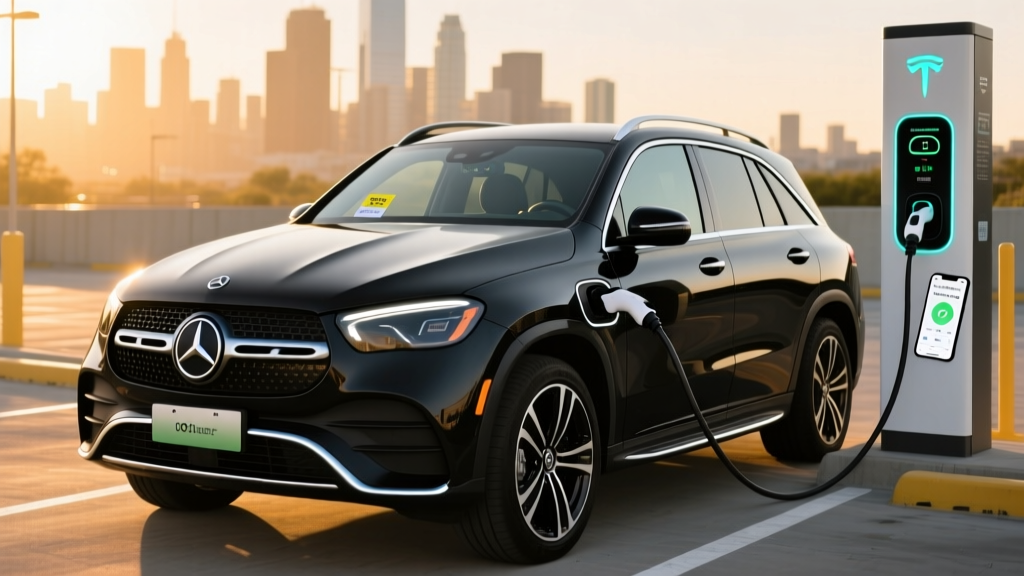
Charging: The GLE 350e supports Level 2 AC charging at up to 7.4 kW via its onboard charger. A full 0–100% Level 2 charge takes approximately 2.75 hours. Notably, the GLE 350e does not support DC fast charging — this is a limitation for road-trip flexibility but largely irrelevant for a PHEV designed for home and destination charging.
Electric motor output: 100 kW (134 hp) from the permanently excited synchronous motor integrated into the transmission housing. In EV mode, top speed is limited to 87 mph.
Real-world range caveat: The EPA-estimated 48 miles of electric range assumes moderate temperatures and mixed driving. In our experience with similar Mercedes PHEV powertrains, expect approximately 38–42 miles in cold weather (below 40°F) and 44–48 miles in mild conditions. Highway-speed electric driving at 70+ mph will reduce range to roughly 32–36 miles due to the fixed gear ratios and aerodynamic drag.
GLE 350e vs. GLE 350: 5-Year Ownership Cost Estimate
Assumptions: 15,000 miles/year, $3.50/gallon premium fuel, $0.14/kWh home electricity, 70% of PHEV miles driven on electricity.
| Cost Category | GLE 350 4MATIC (Gas) | GLE 350e 4MATIC (PHEV) | 5-Year Difference |
|---|---|---|---|
| Purchase Price (MSRP) | $64,350 | $69,500 | +$5,150 (PHEV premium) |
| Federal Tax Credit (§30D) | $0 | Up to $3,750* | –$3,750 |
| Fuel / Electricity (5 yrs) | $17,120 | $7,680 | –$9,440 (PHEV savings) |
| Maintenance (5 yrs, est.) | $4,200 | $3,800 | –$400 |
| Insurance (5 yrs, est.) | $12,500 | $13,200 | +$700 |
| Net 5-Year Cost | $98,170 | $90,430 | –$7,740 savings (PHEV) |
*Per IRS §30D rules, PHEVs must meet battery capacity (≥7 kWh), MSRP cap ($80,000 for SUVs), buyer income limits ($300K MFJ / $150K single), and critical-mineral/battery-component sourcing requirements. The GLE 350e's partial credit eligibility depends on current-year sourcing compliance — verify with your tax professional before purchase.
EV vs. Gas: What GLE Buyers Should Actually Consider
If you came here hoping for a fully electric Mercedes GLE, you're likely weighing whether to wait, choose the PHEV, or look at a competing electric SUV. Here's a practical decision framework based on real ownership patterns:
Which GLE (or Alternative) Fits Your Situation?
- Choose the GLE 350e PHEV if: You have reliable home Level 2 charging, your daily commute is under 45 miles round-trip, you want electric daily driving without sacrificing road-trip flexibility, and you don't want to wait for a future BEV model.
- Choose the GLE 350 or 450 (gas/mild hybrid) if: You lack home charging access, you drive more than 25,000 miles/year primarily on highways, or you need maximum cargo space and don't want the PHEV's reduced trunk volume.
- Look at the EQS SUV or wait for the electric GLE if: You want zero tailpipe emissions, you have home charging, your budget extends to $85,000+, and you're comfortable with DC fast charging for road trips. The EQS 450 4MATIC SUV offers an EPA-estimated 305 miles of range and 200 kW DC fast charging.
- Consider the BMW X5 xDrive50e or Volvo XC90 Recharge if: You want a PHEV luxury midsize SUV now and the GLE 350e's 48-mile electric range isn't enough. The X5 xDrive50e offers approximately 38 miles EPA electric range with a larger 25.7 kWh battery and DC fast-charge capability.
Common Misconceptions About the Mercedes GLE Electric
| Myth | Fact |
|---|---|
| "The GLE has an electric version available now." | The GLE 350e is a plug-in hybrid (PHEV), not a battery-electric vehicle (BEV). The 48V mild-hybrid GLE 350/450 cannot drive on electricity alone. |
| "EQ Boost means it's a hybrid." | EQ Boost is a 48-volt integrated starter-generator providing momentary torque assist. It does not enable electric-only driving and does not qualify for federal EV tax credits. |
| "The PHEV qualifies for the full $7,500 tax credit." | PHEVs with battery packs under 16 kWh typically qualify for a partial credit (often $3,750). Eligibility also depends on battery-component and critical-mineral sourcing rules that change annually. Always verify on fueleconomy.gov for the current model year. |
| "I can DC fast-charge the GLE 350e on road trips." | The GLE 350e only supports AC Level 2 charging (7.4 kW max). There is no DC fast-charge port. For road trips, you drive it as a conventional hybrid once the battery is depleted. |
| "Electric range doesn't matter because it's a PHEV." | Electric range is the single biggest factor in PHEV fuel savings. If your commute exceeds 48 miles, you'll burn gas daily. If it's under 40 miles, you may go weeks between fill-ups. |
Home Charging Setup: What GLE 350e Owners Need
The GLE 350e's 23.3 kWh battery makes home charging straightforward, but you need to plan for it. Here's the practical reality:
Level 1 (120V household outlet): At roughly 1.4 kW, a full charge takes approximately 14 hours. This is viable if you drive less than 30 miles daily and can plug in overnight, but it's slow for maximizing electric-range utilization.
Level 2 (240V, recommended): At the GLE 350e's maximum 7.4 kW acceptance rate, a full charge completes in under 3 hours. A typical Level 2 home charger installation (40-amp circuit, hardwired Wallbox or ChargePoint unit) costs between $800 and $2,200 depending on your electrical panel's proximity to the garage and whether a panel upgrade is needed.
Panel upgrade caveat: Many homes built before 2000 have 100-amp electrical panels. Adding a 40-amp EV circuit may require a panel upgrade to 200 amps, which typically costs $1,500–$3,500 from a licensed electrician. Always get a professional assessment before purchasing charging equipment.
Cost per mile (electric): At the US average residential rate of $0.14/kWh, charging the GLE 350e's usable 19.6 kWh battery costs approximately $2.74, yielding a cost of roughly $0.057 per electric mile. Compare that to the GLE 350 at 23 MPG combined and $3.50/gallon premium: approximately $0.152 per mile. That's a 62% per-mile fuel savings when driving on electricity.
What a First-Time PHEV Buyer Should Know
If the GLE 350e is your first electrified vehicle, these practical realities don't always appear in brochures:
- Charge discipline matters enormously. A PHEV you don't plug in is just a heavier, less efficient gas car. The GLE 350e returns only 23 MPG combined once the battery is depleted — worse than some non-hybrid competitors. If you can't commit to nightly charging, a conventional GLE 350 or a standard HEV (like the Toyota Highlander Hybrid) will serve you better.
- Cold weather cuts electric range by 15–25%. Lithium-ion batteries lose efficiency in cold temperatures, and cabin heating draws significant energy. Expect 36–40 electric miles on a 30°F morning, not the EPA-sticker 48.
- Regenerative braking is adjustable, not one-pedal. The GLE 350e offers steering-wheel paddle selectors for regen intensity (D+, D, D–, D Auto). Unlike a BEV, it won't come to a complete stop on regen alone — you still need the friction brakes for final stopping.
- Maintenance is reduced but not eliminated. You'll still need oil changes (less frequently if most miles are electric), brake fluid flushes, cabin air filters, and tire rotations. However, brake pad life extends significantly thanks to regenerative braking — many PHEV owners report 80,000+ miles on original pads.
- The battery warranty is your safety net. Mercedes covers the GLE 350e's high-voltage battery for 6 years or 62,000 miles (whichever comes first) against defects and excessive capacity loss (typically defined as dropping below 70% of original capacity). This is shorter than the 8-year/100,000-mile warranty common on full BEVs — factor this into long-term ownership planning.
Looking Ahead: The Electric GLE's Future
Mercedes-Benz has confirmed that its MB.EA (Mercedes-Benz Electric Architecture) platform will underpin future electric SUVs, including a likely GLE-class electric model. Industry reports suggest a reveal in late 2027 for the 2028 model year. Expected specifications based on the MB.EA-Large architecture include:
- 800-volt electrical architecture (enabling 300+ kW DC fast charging)
- Battery capacity: 100–120 kWh (estimated)
- EPA range target: 350–400 miles
- Dual-motor AWD with 400+ hp
- NACS charging port (Mercedes has committed to NACS for North American models starting 2025)
These are preliminary estimates based on platform announcements — not confirmed specifications. Mercedes has not officially unveiled an electric GLE or published specs. Buyers who need an electric Mercedes SUV today should evaluate the EQS SUV or EQE SUV, while those willing to wait should monitor Mercedes-Benz's future vehicles page for official announcements.
Does Mercedes make a fully electric GLE?
No. As of the 2026 model year, the GLE is available as a mild hybrid (GLE 350, 450, AMG 53/63) or plug-in hybrid (GLE 350e 4MATIC). A fully battery-electric GLE is expected around the 2028 model year on the MB.EA-Large platform but has not been officially announced with confirmed specs.
How much does the GLE 350e PHEV cost after tax credits?
The 2026 GLE 350e 4MATIC starts at $69,500 MSRP. Federal tax credit eligibility under §30D depends on battery sourcing compliance, buyer income limits ($300K married filing jointly / $150K single), and the $80,000 SUV MSRP cap. If eligible, the partial credit (typically $3,750 for PHEVs with smaller battery packs) can be transferred to the dealer at point of sale. Verify current eligibility on fueleconomy.gov before purchasing.
Can I charge the GLE 350e at Tesla Superchargers?
No. The GLE 350e uses a J1772 connector for Level 2 AC charging and does not have a DC fast-charge port. Tesla Superchargers provide DC fast charging (and Tesla's AC Destination Chargers use a proprietary or NACS connector). You would need a J1772-to-NACS adapter for Tesla Destination Chargers, but Superchargers are not compatible.
Is the GLE 350e worth it over the regular GLE 350?
It depends on your driving pattern and charging access. If you can charge at home and your daily driving is under 45 miles, the PHEV will save approximately $7,700 over five years in fuel and maintenance despite its higher purchase price. If you lack home charging or drive predominantly long highway trips, the GLE 350 is the simpler, more cost-effective choice.
What happens when the GLE 350e battery degrades?
PHEV batteries experience gradual capacity loss, but the smaller pack size means replacement is less costly than a full BEV battery. Mercedes' 6-year/62,000-mile high-voltage battery warranty covers excessive degradation (below ~70% capacity). Out-of-warranty PHEV battery replacement typically costs $8,000–$14,000 including labor. Most PHEV batteries retain 85–90% capacity after 100,000 miles based on industry data.