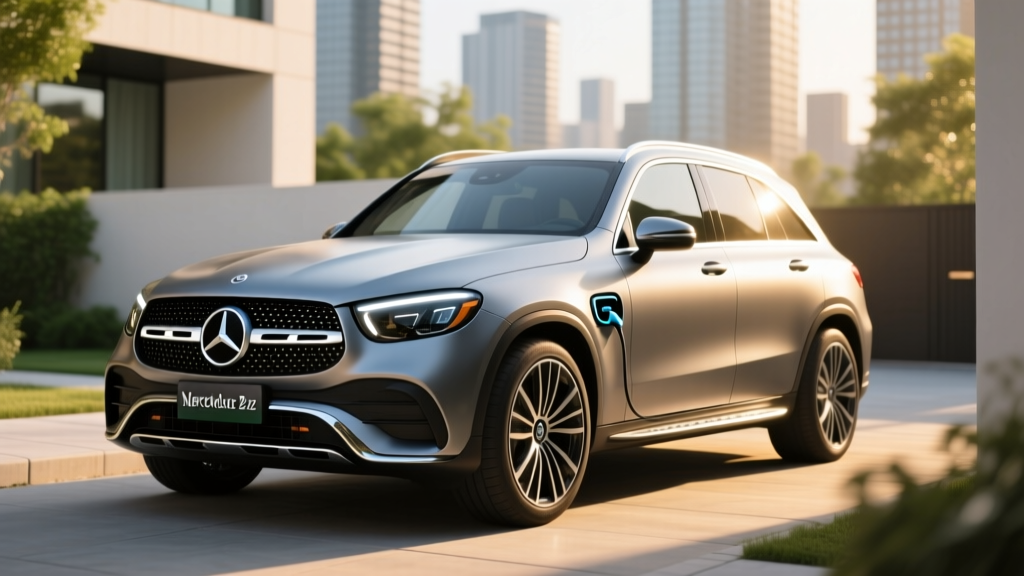
If you've searched for a GLC 300 electric, here's what you need to know right now: Mercedes-Benz does not currently sell a vehicle badged "GLC 300 Electric" in the United States. The gas-powered GLC 300 remains a turbocharged 2.0L four-cylinder luxury compact SUV, while the electric equivalent in Mercedes' lineup is the EQB 300 4MATIC — a three-row compact EV SUV built on a related platform. If you want the electric GLC experience, the EQB is the closest current option, and the fully redesigned electric GLC (X206) is announced for the 2027 model year on Mercedes' dedicated MB.EA electric architecture.
This guide breaks down what's actually available, how the electric alternatives compare to the gas GLC 300, and what real ownership costs look like so you can make an informed decision.
What "GLC 300 Electric" Actually Means in 2026
The GLC nameplate has been one of Mercedes-Benz's best-selling vehicles in the US for years, and buyer interest in an electrified version is high. But Mercedes has segmented its electric vehicles under the EQ sub-brand, which creates confusion. Here's the current landscape:
- GLC 300 (X254): Gas-powered compact luxury SUV. 258 hp turbocharged I-4, EPA-estimated 25 mpg combined. Starting MSRP ~$48,250.
- GLC 350e 4MATIC (PHEV): Plug-in hybrid variant with ~54 miles of EPA electric-only range and a combined 335 hp. Starting MSRP ~$59,900.
- EQB 300 4MATIC: The closest electric equivalent to a "GLC 300 electric." Compact EV SUV, 225 hp, 66.5 kWh battery (usable), EPA-estimated 251 miles range. Starting MSRP ~$54,350.
- Electric GLC (announced): Next-generation electric SUV on the MB.EA platform, expected as a 2027 model. Preliminary specs suggest 85+ kWh battery, 300+ mile EPA range, and 800V architecture for fast DC charging. Not yet on sale.
For buyers specifically wanting a fully electric compact Mercedes SUV today, the EQB 300 and the larger EQE SUV are the options. The EQB is the direct size-and-price analog to the GLC 300.
EQB 300 vs. Gas GLC 300: Specs and Real-World Numbers
| Specification | 2026 GLC 300 4MATIC (Gas) | 2026 EQB 300 4MATIC (Electric) |
|---|---|---|
| Powertrain | 2.0L Turbo I-4, 258 hp | Dual-motor AWD, 225 hp |
| 0–60 mph | 6.3 seconds | 7.7 seconds |
| EPA Range / Fuel Economy | 25 mpg combined (~375 mi/tank) | 251 miles (66.5 kWh battery) |
| Real-World Highway Range | ~340 miles | ~200–220 miles (70 mph, moderate temps) |
| Real-World Cold-Weather Range | ~350 miles | ~160–185 miles (30°F, highway) |
| Energy/Fuel Cost per Mile | ~$0.16 (at $3.40/gal) | ~$0.04 home / ~$0.12 DCFC |
| Max DC Fast Charge Rate | N/A | 100 kW peak (CCS1) |
| 10–80% DC Charge Time | N/A | ~32 minutes |
| Level 2 Home Charge Rate | N/A | 9.6 kW (~33 mi/hr added) |
| Cargo Volume | 21.9 cu ft (rear seats up) | 22.0 cu ft (5-seat config) |
| Starting MSRP | $48,250 | $54,350 |
| Federal Tax Credit (§30D) | Not eligible | Up to $3,750 (see eligibility) |
Total Cost of Ownership: Electric vs. Gas GLC
Price stickers don't tell the full story. Here's a 5-year cost projection assuming 15,000 miles per year, $3.40/gallon gasoline, and $0.14/kWh home electricity (national average):
| Cost Category (5 Years) | GLC 300 (Gas) | EQB 300 (Electric) |
|---|---|---|
| Purchase Price (after incentives) | $48,250 | $50,600 (est. after $3,750 credit) |
| Fuel / Electricity | $12,000 | $3,150 (home charging dominant) |
| Maintenance | $3,800 | $1,800 |
| Insurance (avg) | $9,500 | $10,800 |
| Estimated Depreciation | $22,500 | $27,000 |
| Total 5-Year Cost | $96,050 | $93,350 |
The EV edges out a modest savings over five years, primarily through dramatically lower energy costs and reduced maintenance (no oil changes, fewer brake replacements due to regenerative braking, no transmission fluid). However, higher insurance premiums and steeper depreciation on the electric model partially offset those gains.
Critical variable: Your electricity rate. If you charge exclusively on public DC fast chargers at $0.40–$0.55/kWh, your energy cost jumps to ~$8,500 over five years, erasing the fuel savings advantage. Home Level 2 charging access is the single biggest factor in EV economics.
Federal Tax Credit Eligibility: What You Actually Qualify For
The IRS §30D clean vehicle credit is not a flat $7,500 for every buyer. The EQB 300's eligibility depends on several factors that change annually based on battery sourcing requirements:
- MSRP Cap: SUVs must be under $80,000 — the EQB 300 qualifies.
- Buyer Income Cap: Modified AGI must not exceed $150,000 (single) / $300,000 (joint) / $225,000 (head of household).
- Battery Sourcing: Critical minerals and battery component requirements tighten each year. For 2026, partial credit ($3,750) is typical for vehicles with some non-qualifying supply chains. Verify current-year status on the fueleconomy.gov tax credit lookup.
- Point-of-Sale Transfer: You can transfer the credit to the dealer at purchase, reducing your out-of-pocket cost immediately rather than waiting for a tax refund.
- Assembly: Final assembly must occur in North America. The EQB is assembled in Germany, which may affect eligibility depending on current-year rules — confirm with your dealer and a tax professional.
Disclaimer: Tax credit rules are subject to change. Always verify eligibility with a qualified tax professional and consult IRS guidance before purchasing.
Charging the EQB 300: What First-Time EV Buyers Must Know
If you're transitioning from the gas GLC 300 to an electric Mercedes, charging logistics are the biggest behavioral shift. Here's what the EQB 300's charging profile actually looks like:
| Charging Level | Power (kW) | Miles Added per Hour | Typical Use Case |
|---|---|---|---|
| Level 1 (120V outlet) | 1.4 kW | ~5 mi/hr | Emergency / overnight trickle |
| Level 2 (240V home) | 9.6 kW | ~33 mi/hr | Daily home charging (full charge ~7 hrs) |
| DC Fast Charge (CCS1) | 100 kW peak | ~200+ mi/hr (peak) | Road trips; 10–80% in ~32 min |
Charge curve reality: The EQB 300 peaks at 100 kW only between roughly 10–40% state of charge. Above 60%, charging speed tapers significantly, and above 80% it slows to a trickle. This is standard lithium-ion behavior, but it means a "32-minute" 10–80% session becomes 50+ minutes if you charge to full. For road trips, plan to charge to 80% and go.
Connector note: The EQB uses CCS1. Mercedes-Benz has committed to adopting NACS (Tesla's connector) on future models, and adapters are available for Tesla Supercharger access on current CCS vehicles. Verify adapter availability with your dealer.
Home installation cost: A Level 2 home charger installation typically runs $800–$2,500 total (charger unit: $400–$700; electrician labor and panel work: $400–$1,800). If your home electrical panel needs an upgrade from 100A to 200A service, add $1,500–$3,000. Get a quote from a licensed electrician before committing to an EV purchase.
Common Misconceptions About Electric Mercedes SUVs
| Myth | Fact |
|---|---|
| "The electric GLC gets 251 miles, so I can drive 251 miles." | EPA range is a laboratory estimate. Real-world highway driving at 70+ mph yields ~200–220 miles. Cold weather drops it further to ~160–185 miles. |
| "I'll save $7,500 on taxes automatically." | The §30D credit has income caps, MSRP caps, battery-sourcing requirements, and North American assembly rules. The EQB 300 may qualify for $0–$3,750 depending on your situation and the model year. |
| "EVs need no maintenance." | EVs need less maintenance — no oil, fewer brake jobs — but still require tire rotations, cabin air filters, brake fluid checks, coolant service, and windshield wipers. Budget ~$300–$400/year. |
| "The battery will need replacing in 5 years." | Mercedes provides an 8-year/100,000-mile high-voltage battery warranty covering capacity below 70%. Modern NMC batteries typically degrade 10–15% over 10 years/150,000 miles based on current fleet data. |
| "Charging takes too long for road trips." | At 100 kW DC fast charging, a 10–80% session takes ~32 minutes — roughly the length of a meal break. Plan stops around CCS-equipped stations on your route using apps like PlugShare or A Better Routeplanner. |
Should You Buy Electric, Plug-In Hybrid, or Gas?
Choose the EQB 300 (full EV) if:
- You have reliable home Level 2 charging access (garage or driveway with 240V circuit)
- Your daily driving is under 120 miles round-trip
- You want the lowest per-mile energy cost and minimal maintenance
- You rarely drive more than 200 miles in a single day without a planned stop
- You live in a moderate or warm climate (less range loss)
Choose the GLC 350e (plug-in hybrid) if:
- You want electric commuting (~54 miles EV-only) but need gas-engine range flexibility
- You lack reliable home charging but can plug in occasionally
- You take frequent long road trips and don't want to plan around chargers
- You live in a very cold climate where EV range loss is a real concern
Choose the GLC 300 (gas) if:
- You have no access to home or workplace charging
- Your budget prioritizes the lowest purchase price
- You drive in remote areas with limited charging infrastructure
- You want maximum range consistency regardless of weather or terrain
Wait for the electric GLC (2027 model year) if:
- You specifically want the GLC design language and proportions in electric form
- You want 800V architecture for faster DC charging (projected 200+ kW)
- You need 300+ miles of EPA range and are willing to wait
Frequently Asked Questions
Is there a fully electric Mercedes-Benz GLC 300 available now?
No. Mercedes-Benz does not sell a vehicle badged "GLC 300 Electric." The closest electric equivalent is the EQB 300 4MATIC, a compact EV SUV with 251 miles of EPA range. A dedicated electric GLC on the MB.EA platform is announced for the 2027 model year.
How much does it cost to charge the EQB 300 at home vs. filling the gas GLC?
At the national average of $0.14/kWh, a full home charge of the EQB 300's 66.5 kWh battery costs roughly $9.30 for 251 miles. Filling the gas GLC 300's 17.4-gallon tank at $3.40/gallon costs ~$59 for about 375 miles. Per mile, the EV costs ~$0.04 vs. ~$0.16 for gas — a 4x savings, but only if you charge at home.
Does the EQB 300 qualify for the $7,500 federal tax credit?
Likely not the full amount. Due to battery component and critical mineral sourcing requirements under §30D, the EQB 300 may qualify for a partial credit of $3,750 — or potentially $0 depending on the model year's sourcing compliance and where the vehicle was assembled. The EQB is built in Germany, which may disqualify it from the credit entirely. Always verify on fueleconomy.gov and with a tax professional.
What happens to the EQB's battery after 10 years?
Based on current NMC lithium-ion fleet data, expect approximately 85–90% of original capacity after 10 years or 150,000 miles with normal use. Mercedes covers the high-voltage battery for 8 years or 100,000 miles against capacity falling below 70%. Replacement costs, if needed out of warranty, are estimated at $12,000–$18,000, though prices continue to decline as battery manufacturing scales.
Can I use Tesla Superchargers with the EQB 300?
With a CCS-to-NACS adapter, yes. Mercedes-Benz has confirmed Supercharger network access for its CCS-equipped vehicles using approved adapters. Verify adapter compatibility and any speed limitations with your Mercedes dealer before relying on this for road trips.
Is the EQB 300 slower than the gas GLC 300?
Yes, on paper. The EQB 300 reaches 0–60 mph in 7.7 seconds vs. 6.3 seconds for the gas GLC 300. However, the EQB delivers instant torque from a standstill, making city acceleration feel responsive. The performance gap is most noticeable at highway passing speeds above 50 mph.
Sources: EPA fuel economy data via fueleconomy.gov; Mercedes-Benz USA specifications; IRS §30D clean vehicle credit rules via irs.gov. All specifications reflect 2026 model year data where available. Confirm final pricing and eligibility with your local dealer.