The Short Answer on the Electric G-Wagon
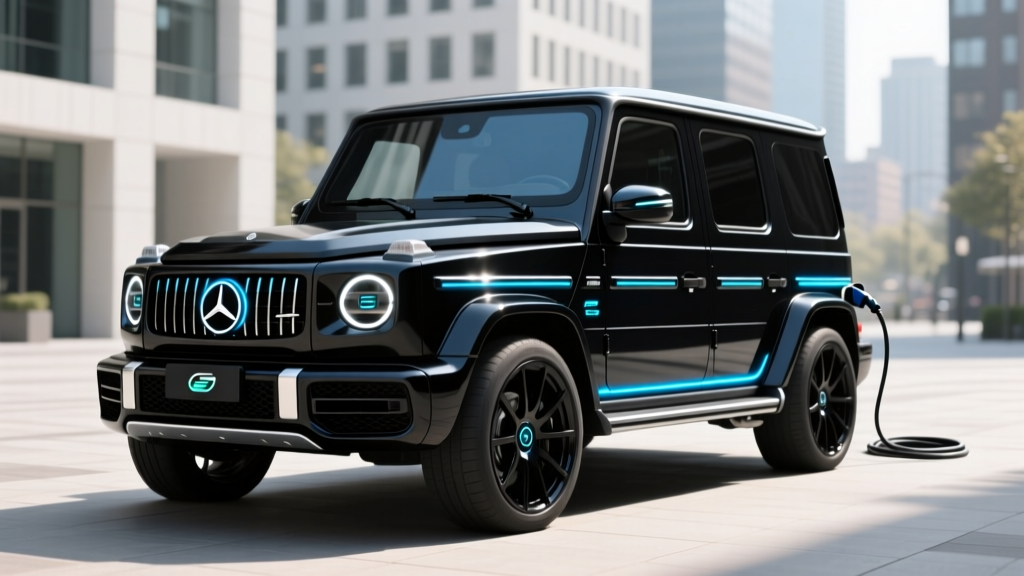
The 2026 Mercedes-Benz G580 with EQ Technology (the electric G-Wagon) starts at $164,050 and delivers an EPA-estimated 244 miles of range from a 116 kWh usable lithium-ion (NMC) battery. It produces 579 horsepower, sprints to 60 mph in 4.6 seconds, and peaks at 200 kW DC fast charging (10–80% in ~32 minutes). It does not qualify for the §30D federal tax credit due to its MSRP exceeding the $80,000 SUV cap. Compared to the gas G550 ($149,050, 14/17 MPG combined), the electric G-Wagon saves roughly $2,800/year in fuel at 12,000 miles driven, but costs significantly more upfront and carries higher insurance premiums.
Range and Efficiency: Real-World Expectations
The EPA rates the G580e at 244 miles of combined range. That number requires context. The G-Wagon's boxy aerodynamics — a drag coefficient around 0.53 — punish highway efficiency far more than a sleek sedan like the Lucid Air or even a crossover like the Tesla Model X.
Real-World Range Reconciliation
EPA Sticker: 244 miles (combined)
Highway (70–80 mph): Expect ~190–210 miles. Aerodynamic drag dominates at speed, and the G-Wagon's flat windshield and squared-off body don't help.
Cold Weather (below 30°F): Expect ~165–195 miles. The NMC battery loses capacity in cold temps, and cabin heating draws significant power despite the heat pump.
City / Moderate Climate: 230–250 miles. Regenerative braking recovers energy effectively in stop-and-go driving.
Efficiency lands at approximately 54 MPGe combined (or roughly 2.0 kWh/mile), which is poor by EV standards but expected for a 6,600-pound luxury off-roader. For comparison, the Rivian R1S achieves 69 MPGe combined with a similar footprint but better aerodynamics.
The 116 kWh usable battery uses NMC (nickel-manganese-cobalt) chemistry, chosen for energy density in a platform not designed from the ground up as an EV. Mercedes quotes a 10-year/155,000-mile battery warranty with a 70% state-of-health retention threshold — industry-standard but worth noting: if capacity drops below 70%, Mercedes replaces or refurbishes under warranty.
Charging Speed and Infrastructure
| Level | Power | Connector | Speed | Time |
|---|---|---|---|---|
| Level 1 (120V) | 1.4 kW | J1772 (NACS adapter included) | ~3 mi/hr | ~82 hours (0–100%) |
| Level 2 (240V, 48A) | 11.5 kW | NACS (native) | ~25 mi/hr | ~10 hours (0–100%) |
| DC Fast Charge | 200 kW peak | NACS (native) | ~140 mi/hr (peak) | ~32 min (10–80%) |
The G580e ships with the NACS (North American Charging Standard) port natively, meaning full access to Tesla Superchargers without an adapter. This is a significant practical advantage — the Supercharger network remains the most reliable DC fast-charging infrastructure in the U.S., with over 25,000 stalls as of early 2026.
However, the 200 kW peak charge rate deserves scrutiny. Like all EVs, the G580e follows a charging curve — it hits 200 kW only at low state-of-charge (roughly 10–30%), then tapers progressively. Expect sustained rates around 120–140 kW through the 30–60% band, dropping to ~60 kW by 75%, and ~35 kW from 80–100%. That 32-minute 10–80% figure assumes a 350 kW-capable CCS/NACS station and proper battery preconditioning.
Preconditioning matters. Navigate to a charger using the MBUX system, and the battery thermal management will warm or cool the pack to optimal temperature before arrival. Without preconditioning — especially in cold weather — peak charge rates can drop by 30–50%.
Electric G-Wagon vs Gas G550: Cost Comparison
| Category | G580e (Electric) | G550 (Gas) |
|---|---|---|
| Base MSRP | $164,050 | $149,050 |
| Federal Tax Credit (§30D) | $0 (MSRP exceeds $80K cap) | N/A |
| Fuel/Energy Cost (12K mi/yr) | ~$1,560/yr (home L2 @ $0.13/kWh) | ~$4,380/yr (premium @ $4.50/gal, 15 MPG) |
| 5-Year Fuel/Energy Total | $7,800 | $21,900 |
| Annual Maintenance | ~$400 (cabin filter, fluid checks, tires) | ~$1,200 (oil, filters, brakes, transmission) |
| 5-Year Maintenance | $2,000 | $6,000 |
| Insurance (annual est.) | ~$4,800 | ~$4,200 |
| 5-Year Insurance | $24,000 | $21,000 |
| 5-Year Total Operating Cost | $33,800 | $48,900 |
| Depreciation (est. 5yr) | ~55% (~$90,200) | ~45% (~$67,100) |
The electric G-Wagon saves roughly $15,100 in operating costs over five years — primarily from fuel and maintenance. But the $15,000 higher MSRP and steeper projected depreciation (EVs in the luxury segment have historically depreciated faster than their gas counterparts) essentially erase that advantage in total cost of ownership.
This is not a vehicle you buy to save money. It's a statement purchase, and the economics reflect that.
Source: fueleconomy.gov for G550 MPG data; electricity costs based on EIA state averages.
Performance and Driving Dynamics
Four independently controlled electric motors produce a combined 579 hp and 800 lb-ft of torque. The result is a 0–60 mph time of 4.6 seconds — quicker than the G550's 5.6 seconds and approaching AMG G63 territory. Top speed is electronically limited to 118 mph.
The quad-motor setup enables genuine off-road capability. Mercedes' G-Turn function allows 360-degree tank turns by spinning wheels on opposite sides in opposing directions — useful on trails, theatrical on pavement. G-Rocking assist oscillates the vehicle to extract itself from sand or mud, and G-Steering reduces the turning circle by braking inside wheels during tight maneuvers.
Water fording depth is 33.5 inches (the battery is sealed to IP68 standards), and the G580e retains the three locking differentials (simulated via torque vectoring) that define the G-Class off-road pedigree.
Weight is the tradeoff. At roughly 6,600 lbs, the G580e is heavier than the G550, and you feel it during directional changes. Ride quality is comfortable thanks to adaptive damping, but this is not a cornering machine. It's a luxury cruiser with absurd straight-line acceleration and genuine trail capability.
Ownership Realities: What First-Time EV Buyers Must Know
Common Misconceptions About the Electric G-Wagon
| Myth | Fact |
|---|---|
| "It qualifies for the $7,500 federal tax credit" | No. The §30D credit caps SUVs at $80,000 MSRP. At $164,050 base, the G580e is ineligible regardless of battery sourcing or buyer income. |
| "244 miles means I can drive 244 miles on the highway" | Expect 190–210 miles at highway speeds. The boxy shape causes severe aerodynamic drag above 65 mph. |
| "I'll charge it at any DC station in 15 minutes" | The 200 kW peak and large 116 kWh battery mean a realistic 10–80% stop takes ~32 minutes at a capable charger, longer at 50–150 kW stations. |
| "EVs need no maintenance" | Tires wear faster due to weight and instant torque. Cabin air filters, brake fluid, coolant, wiper fluid, and the 12V battery still require service. Budget ~$400/year. |
| "Home charging is plug-and-play" | A 48-amp Level 2 home charger requires a 60-amp dedicated circuit. If your panel is 100A, you'll likely need a $2,000–$4,000 panel upgrade to 200A. |
Home Charging Setup
Plan for a Level 2 home charger — Level 1 (standard 120V outlet) adds only ~3 miles per hour, meaning a full charge takes over 80 hours. That's impractical for daily use.
| Item | Cost Range |
|---|---|
| Level 2 Charger (ChargePoint Home Flex, WallConnector, etc.) | $400–$700 |
| Electrician labor (run 60A circuit, mount unit) | $800–$2,500 |
| Electrical panel upgrade (100A → 200A, if needed) | $2,000–$4,000 |
| Permit & inspection | $100–$400 |
| Total (no panel upgrade) | $1,300–$3,600 |
| Total (with panel upgrade) | $3,300–$7,600 |
Hire a licensed electrician — always get a load calculation before committing. If your home already has 200A service and spare breaker slots, installation is straightforward and on the lower end.
Climate Considerations
If you live where winters drop below freezing regularly, plan for 20–25% range loss. The G580e includes a heat pump (more efficient than resistive heating), but physics wins: a cold NMC battery holds less energy, and heating a large cabin requires substantial power. Garage parking and preconditioning while plugged in mitigate this significantly.
Decision Framework: Should You Buy the Electric G-Wagon?
Choose the G580e Electric G-Wagon If:
- You have reliable home Level 2 charging (or can install it)
- Your daily driving is under 150 miles, with occasional longer trips where 30-minute DC stops are acceptable
- You want instant torque, silent operation, and the G-Turn party trick
- You're in a state with high gas prices ($4.50+/gal premium) where fuel savings compound
- You value being early-adopter in a niche segment and accept steep depreciation risk
Choose the Gas G550 (or Wait) If:
- You lack home charging access and your area has sparse DC fast-charging infrastructure
- You regularly drive 300+ mile highway trips and don't want to plan charging stops
- You live in extreme cold climates where range drops to ~170 miles and charging slows further
- Total cost of ownership matters — the gas G550 depreciates less and costs $15K less upfront
- You want proven long-term reliability data (the G550 has decades of it; the G580e is brand new)
Consider the Rivian R1S Quad-Motor Instead If:
- You want electric off-road capability at ~$100,000 (still no §30D credit, but $64K less than the G580e)
- You prefer a more modern SUV interior and better efficiency (69 MPGe vs 54 MPGe)
- You want a larger charging network advantage — Rivian uses NACS with full Supercharger access
Tax Credit and Incentive Reality Check
The IRS §30D clean vehicle credit imposes an $80,000 MSRP cap for SUVs. The G580e at $164,050 is far above this threshold, making it categorically ineligible for the federal $7,500 credit. No amount of battery sourcing compliance or buyer income qualification changes this.
Some states offer their own incentives that don't follow federal MSRP caps — check your state's energy office or DMV. However, most state rebates also target more affordable EVs. A few states (California, Colorado, New York) have luxury-EV-friendly programs, but amounts and eligibility vary by jurisdiction. Consult a tax professional before counting on any incentive.
Pros and Cons
Pros
- Genuine off-road capability with quad-motor torque vectoring and G-Turn
- 579 hp and 4.6-second 0–60 in a luxury icon
- Native NACS port — full Tesla Supercharger access
- Silent, smooth daily driving with zero tailpipe emissions
- Iconic G-Class styling and build quality retained
- Lower annual fuel and maintenance costs vs gas G550
Cons
- $164,050 base price; no federal tax credit eligibility
- Only 244 miles EPA range; ~190–210 on the highway
- 54 MPGe — poor efficiency even by large-SUV standards
- 32-minute 10–80% DC charge is slow vs competitors (Hyundai Ioniq 5: ~18 min)
- 6,600-lb weight impacts tire wear and handling
- Steep projected depreciation in a new, unproven segment
Frequently Asked Questions
What is the real-world range of the electric G-Wagon?
The EPA rates it at 244 miles combined. In real-world highway driving at 70–80 mph, expect 190–210 miles. In cold weather (below 30°F), plan for 165–195 miles. City driving in moderate temperatures can reach 230–250 miles thanks to regenerative braking.
Does the electric G-Wagon qualify for any tax credits?
No federal credit. The §30D clean vehicle credit caps SUVs at $80,000 MSRP, and the G580e starts at $164,050. Some state incentives may apply — check your state's clean vehicle program. Always consult a tax professional for your specific situation.
How fast does the G580e charge?
Peak DC fast charging is 200 kW, achieving 10–80% in approximately 32 minutes at a capable station. Level 2 home charging at 11.5 kW takes about 10 hours for a full charge. The charge curve tapers significantly above 60% state-of-charge.
Can I take the electric G-Wagon off-road?
Yes. The G580e retains the G-Class's body-on-frame architecture with simulated locking differentials, 33.5 inches of water fording, and features like G-Turn (tank turns) and G-Rocking (oscillation assist). The battery is sealed to IP68 for water and dust protection.
How does insurance compare to the gas G550?
Expect to pay approximately 10–15% more for insurance on the G580e vs the G550. EVs generally carry higher premiums due to repair costs (specialized high-voltage components) and higher total-loss valuations. Get quotes from your insurer before purchasing — luxury EV insurance varies widely by provider.
What is the battery warranty?
Mercedes covers the high-voltage battery for 10 years or 155,000 miles, whichever comes first, with a 70% state-of-health retention guarantee. If the battery degrades below 70% capacity within that period, Mercedes will repair or replace it under warranty.