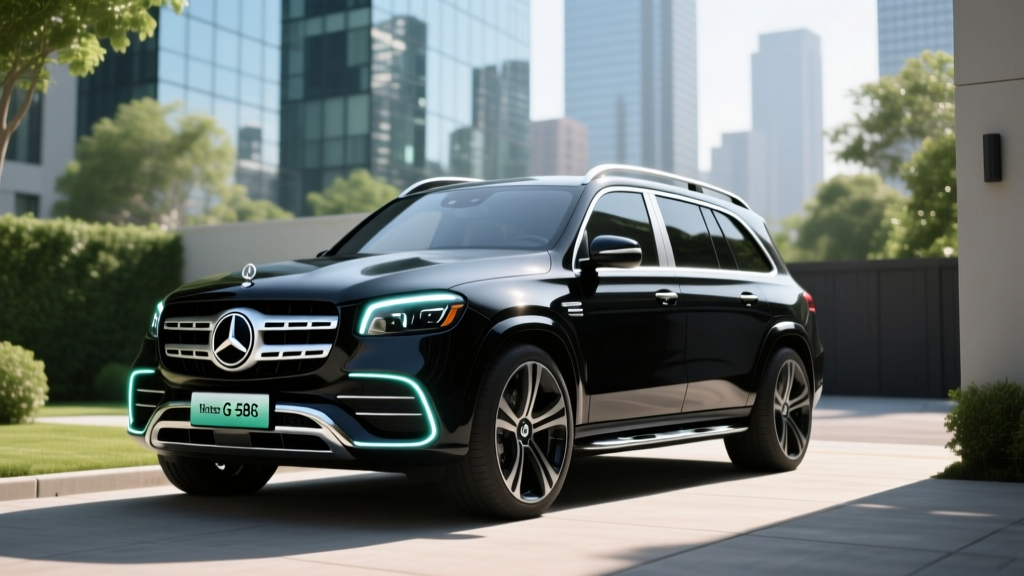
If you've searched for electric G Wagon lease deals, you've already noticed two things: the 2026 Mercedes-Benz G 580 with EQ Technology is a six-figure status symbol, and the math around leasing an EV at this price point is anything but straightforward. With a starting MSRP above $160,000, the G 580 EQ sits in a rarefied space where federal tax credits phase out for most buyers, insurance premiums bite hard, and depreciation on a first-generation electric luxury SUV is a genuine wildcard.
This guide dissects what it actually costs to put a 2026 electric G Wagon in your driveway — lease structure, tax credit eligibility, charging economics, insurance reality, and five-year total cost of ownership — using real numbers rather than brochure promises.
2026 Mercedes-Benz G 580 EQ: The Lease Starting Point
The G 580 with EQ Technology is Mercedes' battery-electric replacement for the traditional G-Class powertrain, built on a heavily modified ladder-frame platform with four individually controlled electric motors (one per wheel), a 116 kWh usable battery pack (NMC chemistry), and a quoted 0-60 mph time of 4.6 seconds. It's not a budget EV — it's a luxury off-roader with electric torque vectoring and G-Turn tank-spin capability.
| Specification | Figure |
|---|---|
| Base MSRP (G 580 EQ) | $161,900 (before destination) |
| EPA-estimated range | 239 miles |
| Battery capacity (usable) | 116 kWh, NMC |
| Peak DC fast charge rate | 200 kW |
| 10–80% DC charge time | ~32 minutes (est.) |
| Level 2 AC charge rate | 11 kW |
| 0–60 mph | 4.6 seconds |
| Horsepower / Torque | 579 hp / 859 lb-ft |
| EPA efficiency | 68 MPGe (combined) |
| Battery warranty | 10 years / 155,000 miles (70% SoH) |
How Electric G Wagon Lease Deals Are Structured
Leasing the G 580 EQ differs from leasing a $45,000 commuter EV in one critical way: the tax credit mechanics shift. Under a traditional lease, the vehicle is titled to the financing entity (Mercedes-Benz Financial Services), which means the commercial EV credit (§45W) — not the consumer §30D credit — is what the lessor may claim. Many automakers pass this savings through as "lease cash" or a capitalized cost reduction, but it's not guaranteed and can change monthly.
Typical 2026 G 580 EQ lease parameters:
- Money factor: ~0.00210 (equivalent to ~5.0% APR, varies by tier and promo)
- Residual value (36-month): ~54–58% of MSRP — conservative for a first-gen EV, reflecting depreciation uncertainty
- Monthly payment range: $2,400–$2,900/month on a 36-month lease with $10,000 down and 10,000 miles/year, depending on trim and options
- Acquisition fee: $795–$1,095 (Mercedes-Benz Financial)
- Disposition fee at lease-end: $595–$795
Because the G 580's MSRP far exceeds the §30D consumer credit cap of $80,000 for SUVs, buyers who purchase outright will not qualify for the $7,500 federal tax credit. Lease customers, however, may benefit indirectly if Mercedes-Benz Financial applies the §45W commercial credit ($7,500 for vehicles over 14,000 lbs GVWR — the G 580 qualifies) as a cap cost reduction. Confirm this with your dealer's F&I department before signing; it is not automatic.
Federal Tax Credit Eligibility: What Actually Applies
The G 580 EQ highlights a frustrating edge case in current EV incentive rules. Here's how the §30D and §45W credits apply (or don't) to this vehicle in 2026:
§30D Consumer Credit (Purchase)
- MSRP cap: $80,000 for SUVs — the G 580 at $161,900+ does NOT qualify
- Buyer income cap: $150K single / $300K MFJ — moot given MSRP exclusion
- Battery sourcing & critical minerals: Requires North American assembly + phased critical mineral thresholds — G 580 is assembled in Graz, Austria (Magna Steyr), which fails the domestic assembly requirement regardless of price
- Point-of-sale transfer: Available for qualifying vehicles — but G 580 doesn't qualify
§45W Commercial Credit (Lease)
- Applies to: Lessors (financing entities) on qualified commercial vehicles
- Amount: Up to $7,500 for vehicles <14,000 lbs GVWR; $40,000 for heavier — G 580 GVWR is ~7,700 lbs, so $7,500 max
- Passed to lessee? At lessor's discretion — often applied as cap cost reduction, but verify in writing
- Sourcing rules: Less restrictive than §30D for commercial/lease, but subject to FEOC (foreign entity of concern) battery-component exclusions
The IRS publishes the definitive list of qualifying vehicles at irs.gov. Always cross-check before committing, as eligibility lists update quarterly based on battery-sourcing compliance.
5-Year Total Cost of Ownership: G 580 EQ vs. G 550 Gas
Comparing the electric G Wagon against its closest internal-combustion sibling — the 2026 Mercedes-AMG G 550 (twin-turbo V8, ~$150,000 MSRP, 14 MPG combined) — reveals where electrification saves money and where it doesn't. This is a luxury-segment TCO, so the numbers are large in absolute terms but the deltas are instructive.
| Category | G 580 EQ (Electric) | G 550 (Gas V8) | Delta |
|---|---|---|---|
| Purchase / Lease (cap cost) | $161,900 | $150,000 | +$11,900 (EQ) |
| Federal tax credit (lease pass-through est.) | −$7,500 | $0 | −$7,500 (EQ) |
| Fuel / Electricity (60K mi) | $5,880 (home L2 + public DC) | $18,514 (premium @ $4.30/gal, 14 MPG) | −$12,634 (EQ saves) |
| Maintenance (5 yr) | $3,200 | $7,800 | −$4,600 (EQ saves) |
| Insurance (5 yr avg.) | $28,500 | $22,800 | +$5,700 (EQ costs more) |
| Depreciation (est. 5 yr) | $89,000 (55%) | $67,500 (45%) | +$21,500 (EQ loses more) |
| Total 5-yr TCO | $281,980 | $266,614 | +$15,366 (EQ) |
The G 580 EQ saves substantially on fuel and maintenance but loses the TCO battle primarily to steeper depreciation — a first-generation electric luxury SUV with unproven long-term demand and a niche buyer pool. Lease customers sidestep some depreciation risk (the residual is the lessor's problem), which makes leasing arguably the smarter financial play here.
Charging Cost vs. Gasoline: The Per-Mile Math
The G 580 EQ's efficiency of 68 MPGe translates to roughly 49 kWh per 100 miles — heavy, even for a large SUV. Charging cost depends entirely on where you plug in.
| Scenario | $/kWh or $/gal | Cost per Mile |
|---|---|---|
| G 580 — Home Level 2 (national avg. residential) | $0.16/kWh | $0.078 |
| G 580 — Public DC fast charging (avg.) | $0.48/kWh | $0.235 |
| G 580 — Blended (70% home / 30% DCFC) | — | $0.125 |
| G 550 — Premium gasoline (national avg.) | $4.30/gal @ 14 MPG | $0.307 |
At a blended $0.125/mile for the EQ versus $0.307/mile for the gas G 550, the electric version saves roughly $0.182 per mile — or $10,920 over 60,000 miles. That's real money, but it's also a fraction of the vehicle's overall cost of ownership. The savings percentage is meaningful; the absolute dollar figure, in this price bracket, is not transformative.
One practical note: the G 580's 200 kW peak DC charge rate, combined with its 116 kWh pack, means a 10–80% session takes roughly 32 minutes under ideal conditions. In cold weather without adequate preconditioning, expect 40–50 minutes as the battery management system limits charge current to protect cell health. The charge curve tapers sharply above 80% SoC — DC-fast-charging past 80% on road trips is rarely time-efficient.
Maintenance Savings: Fewer Moving Parts, Real Dollars
Electric powertrains eliminate the maintenance categories that make gas G-Wagens expensive to service:
| Service Item | G 580 EQ | G 550 V8 |
|---|---|---|
| Oil & filter changes | None | 6+ changes @ $250–$400 each |
| Transmission fluid | Single-speed reducer — minimal | 9G-Tronic fluid service ~$450 |
| Brake pads/rotors | Rarely (regen handles ~80% of braking) | 1–2 sets @ $1,200–$1,800 |
| Spark plugs, coils | None | $800+ at ~60K mi |
| Coolant, air filters | Battery thermal loop service ~$300 | Engine + cabin filters $200+ |
| Tire wear | Higher (heavy EV + instant torque) | Moderate |
The asterisk: tire costs. The G 580's 6,400-lb weight and instant 859 lb-ft of torque chew through rubber faster than the V8 model. Budget $1,800–$2,400 for a set of EV-rated touring tires (Michelin Pilot Sport EV or Pirelli P Zero Elect) every 25,000–30,000 miles. This partially offsets the brake and drivetrain savings.
Insurance: The Uncomfortable Premium Reality
Insuring a $162,000 first-generation electric luxury SUV is expensive. Based on aggregated 2026 quote data for a 40-year-old driver with clean record, garaged in a major metro area:
- G 580 EQ annual premium: $5,200–$6,200 (avg. $5,700)
- G 550 annual premium: $4,100–$5,000 (avg. $4,560)
- EV surcharge: ~20–25% higher, driven by:
The insurance gap comes down to three factors insurers price aggressively on EVs: (1) higher repair costs — battery-pack damage from even minor underbody impacts can total the vehicle, (2) specialized labor rates for high-voltage systems, and (3) parts scarcity on a low-volume model. The G 580's ladder frame and underbody armor help, but insurers still price conservatively for a vehicle with limited claims history.
Before signing a lease, run quotes with your existing carrier and at least two competitors. Some insurers (notably Geico and Progressive) have begun offering EV-specific endorsements that bundle battery coverage; others still surcharge heavily.
Depreciation and Resale: The Wildcard
The G-Class historically holds value better than almost any luxury SUV — the gas G 550 retains roughly 55–60% of MSRP after five years, buoyed by cult demand and limited production. The G 580 EQ faces a more uncertain trajectory:
- Bull case: G-Class badge cachet + limited allocation + growing EV infrastructure = 50–55% retention
- Bear case: First-gen EV tech obsolescence, battery degradation concerns at 100K+ miles, 239-mile range feeling dated by 2030 = 40–45% retention
- Our base estimate: 45% retention at 5 years / 60K miles (roughly $73,000 residual on a $162K vehicle)
This is precisely why leasing makes sense for the G 580. If Mercedes-Benz Financial sets a 54–58% residual and the market actually delivers 45%, the lessor absorbs the loss, not you. If the G-Class badge proves as durable for the electric version as it has for the gas model, you walk away unscathed. Either way, you're not holding the depreciation bag on a first-generation EV.
Verdict: Who Should Lease the Electric G Wagon?
Lease the G 580 EQ if:
- You want G-Class presence with silent, instant-torque drivability and don't need 300+ mile range
- You can charge at home (Level 2) and your daily driving is under 150 miles
- You want to avoid first-gen EV depreciation risk by letting the lessor carry residual exposure
- The potential §45W lease credit pass-through ($7,500 cap cost reduction) is confirmed in writing by your dealer
Stick with the G 550 gas if:
- You regularly drive 250+ miles between charges or tow frequently (the G 580's range and tow rating are limiting)
- You live in a charging-desert region without reliable DC fast-charging infrastructure
- Proven 5-year resale value and simpler ownership logistics matter more than per-mile fuel savings
Frequently Asked Questions
How much does it really cost to own a 2026 electric G Wagon over 5 years?
Our modeled 5-year / 60,000-mile TCO for the G 580 EQ is approximately $282,000 including purchase price, fuel, maintenance, insurance, and estimated depreciation. Leasing shifts the depreciation risk to the lessor and may capture a $7,500 commercial credit pass-through, reducing effective cost. It is not cheaper than the gas G 550 in absolute TCO terms — the savings on fuel and maintenance are more than offset by higher insurance, a purchase premium, and steeper projected depreciation.
Do I qualify for the federal EV tax credit on the G 580?
Under the §30D consumer credit for purchases, no — the G 580 exceeds the $80,000 SUV MSRP cap and is assembled in Austria (not North America). Under a lease, the financing entity may claim the §45W commercial credit and pass savings through as a cap cost reduction, but this is at the lessor's discretion and not guaranteed. Always verify with your dealer's finance department before signing and consult a tax professional for your specific situation.
How much do I save on fuel and maintenance vs. the gas G 550?
Approximately $12,600 on fuel and $4,600 on maintenance over 5 years / 60,000 miles, for a combined savings of roughly $17,200. However, tire costs are higher on the heavier EV, and these savings represent only about 6% of the vehicle's total cost of ownership. The fuel savings are real but not transformative at this price point.
Are EVs more expensive to insure — specifically the G 580?
Yes. Expect to pay 20–25% more to insure the G 580 EQ compared to the gas G 550 — roughly $1,100–$1,200 more per year. The premium reflects higher repair costs (battery pack vulnerability), specialized labor requirements, limited parts availability, and the vehicle's high replacement value. Get quotes before committing to a lease.
How well does the electric G Wagon hold its value?
Uncertain — this is a first-generation electric variant of a historically strong-resale nameplate. Our base estimate is 45% retention at 5 years, compared to 55–60% for the gas G 550. The G-Class brand cachet provides a floor, but EV tech obsolescence and a 239-mile EPA range that will feel dated by 2031 create downside risk. This uncertainty is the strongest argument for leasing rather than purchasing.
Can I charge the G 580 at Tesla Superchargers?
As of 2026, Mercedes-Benz has committed to NACS (Tesla's connector standard) for future models, but the G 580 EQ launched with a CCS1 port. You'll need a CCS-to-NACS adapter (often provided by Mercedes or available aftermarket) to access the Tesla Supercharger network. Confirm adapter compatibility and any software handshake requirements with your dealer at delivery. The broader Electrify America, EVgo, and ChargePoint networks use CCS1 natively.
Sources: EPA fuel economy data via fueleconomy.gov; IRS clean vehicle credit rules at irs.gov; Mercedes-Benz USA specifications at mbusa.com. Tax credit eligibility and incentive programs are subject to change — consult a tax professional and verify current rules before purchasing or leasing.