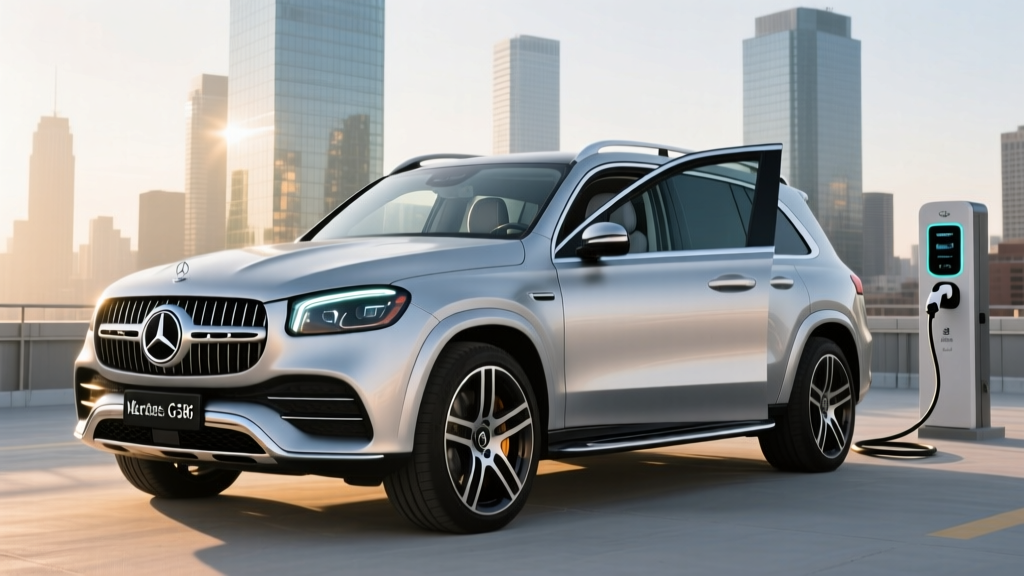
Quick Answer: The 2026 Mercedes-Benz G-Class Electric — officially the G580 with EQ Technology — is the battery-electric replacement for the iconic G-Wagen. It carries a 116 kWh usable battery, an estimated EPA range of approximately 240–260 miles, and a starting MSRP around $160,000. It does not qualify for the federal §30D tax credit due to its price exceeding the SUV MSRP cap. For most buyers, the G580 is a luxury statement and off-road technology showcase, not a cost-savings play versus the gas G550. If daily driving exceeds 200 miles or you lack reliable home Level 2 charging, the gas G550 or a plug-in hybrid alternative remains the more practical choice.
What Is the Electric G-Class (G580)?
Mercedes-Benz launched the G580 with EQ Technology as the fully electric sibling of the legendary G-Class. Rather than a clean-sheet redesign, the G580 shares the ladder-frame architecture of the latest G-Class but swaps the twin-turbo V8 for a four-motor setup — one independently controlled motor per wheel. This gives the G580 torque-vectoring capability that the gas G-Wagen could only dream of, enabling features like the 360-degree "G-Turn" tank turn and ultra-precise off-road crawling.
The result is a vehicle that retains the G-Class's boxy silhouette, three differential locks (now simulated via software), and 850 mm wading depth, while adding instant electric torque and a near-silent powertrain. For 2026, Mercedes positions the G580 as the flagship of the G-Class lineup, sitting above the G550 and AMG G63 in both price and technology.
Range, Battery, and Charging: The Real Numbers
The G580's 116 kWh usable lithium-ion battery (NMC chemistry, housed in a carbon-fiber-reinforced underbody enclosure) is one of the largest in any production passenger vehicle. But the G-Wagen's aerodynamics — essentially a rolling brick — impose a heavy efficiency penalty.
| Specification | Value |
|---|---|
| Battery Capacity (usable) | 116 kWh (NMC) |
| EPA Range (estimated) | ~240–260 miles |
| Real-World Highway Range | ~190–220 miles (70+ mph) |
| Real-World Cold-Weather Range | ~170–200 miles (below 32°F) |
| MPGe (combined, estimated) | ~58–62 MPGe |
| Efficiency | ~55–59 kWh/100 mi |
| Peak DC Fast Charge Rate | 200 kW |
| 10–80% DC Fast Charge | ~32 minutes |
| Level 2 AC Charge Rate | 11 kW (onboard charger) |
| Level 2 Full Charge Time (0–100%) | ~11 hours |
| Horsepower | 579 hp (432 kW) |
| 0–60 mph | 4.6 seconds |
| Top Speed | 118 mph (electronically limited) |
| Curb Weight | ~6,800 lbs |
| Towing Capacity | Not yet rated (estimated ~7,000 lbs) |
| Battery/Powertrain Warranty | 8 years / 100,000 miles |
| Starting MSRP | ~$160,000 |
Real-World Range Reality Check: The EPA sticker may say ~250 miles, but the G580's boxy shape and 6,800-pound mass mean highway driving at 75 mph will cut that to roughly 200 miles. In winter conditions (below freezing), expect another 15–20% reduction, putting realistic cold-weather range around 170–200 miles. This is adequate for urban and suburban use but requires planning for road trips exceeding 180 miles. The 116 kWh battery compensates somewhat for the poor efficiency — more kWh covers more miles even in a heavy, un-aerodynamic vehicle.
Charging Curve and Practical Charging
The G580 peaks at 200 kW on a DC fast charger, but like all large-battery EVs, that peak is sustained only in the lower state-of-charge window (roughly 10–35%). Above 50% SoC, the charge rate tapers progressively. A 10–80% session takes approximately 32 minutes at a 350 kW-capable station (the vehicle can only accept 200 kW, so the extra station capacity is unused). On a 150 kW charger, expect 10–80% in roughly 40–45 minutes.
For home charging, the 11 kW onboard charger means a full 0–100% charge takes about 11 hours on a Level 2 (240V / 48A) home station. Most owners will plug in nightly and wake up with a full battery — this is the ideal ownership pattern for any EV, but it requires home charging access. Without a garage or dedicated parking spot where a Level 2 charger can be installed, the G580's massive battery becomes a liability: charging from empty on Level 1 (120V) would take over 100 hours.
G580 Electric vs. G550 Gas: Cost and Capability Comparison
The most common cross-shop for the G580 is its gas-powered sibling, the G550. Here's how they stack up on the numbers that matter for ownership:
| Attribute | G580 Electric (2026) | G550 Gas (2026) |
|---|---|---|
| Powertrain | Quad-motor AWD, 579 hp | 3.0L Turbo I6 + mild-hybrid, 443 hp |
| 0–60 mph | 4.6 sec | 5.3 sec |
| EPA Range / Fuel Economy | ~250 mi / ~60 MPGe | ~14 city / 16 hwy / 15 combined MPG |
| "Fuel" Cost per Mile | ~$0.05–0.07/mi (home L2) | ~$0.28–0.32/mi ($4.50/gal premium) |
| Annual Fuel/Energy Cost (12K mi) | ~$600–$840 | ~$3,360–$3,840 |
| Starting MSRP | ~$160,000 | ~$148,000 |
| Federal Tax Credit (§30D) | $0 (exceeds MSRP cap) | $0 (not a PHEV/BEV) |
| Estimated Annual Insurance | ~$4,500–$6,000 | ~$4,000–$5,500 |
| Annual Maintenance | ~$300–$500 | ~$1,200–$1,800 |
| Off-Road Capability | Simulated diff locks, G-Turn, crawl control | 3 mechanical diff locks, low-range |
The G580 saves roughly $2,500–$3,000 per year in fuel and maintenance costs compared to the G550. However, the G580's ~$12,000 higher starting price and likely higher insurance premiums mean the total-cost-of-ownership break-even point stretches to roughly 4–5 years of typical driving (12,000 miles/year). For most G-Class buyers, fuel savings are not the purchase motivation — the G580's appeal lies in instant torque, silent operation, and technological novelty.
Total Ownership Cost Breakdown (5-Year Estimate)
| Cost Category | Estimated 5-Year Total |
|---|---|
| Purchase Price (base MSRP) | $160,000 |
| Home Level 2 Charger Install | $1,500–$3,000 (panel upgrade may add $2,000+) |
| Energy Costs (12K mi/yr, home L2) | $3,000–$4,200 |
| Insurance (5 years) | $22,500–$30,000 |
| Maintenance & Repairs (5 years) | $1,500–$2,500 |
| Tires (1 set replacement) | $1,800–$2,800 |
| Federal Tax Credit | $0 (MSRP exceeds §30D cap) |
| Estimated Depreciation (5 years) | $60,000–$80,000 |
| Total Estimated 5-Year Cost | ~$250,000–$282,000 |
Depreciation is the dominant cost. The G-Class historically holds value well — the gas versions often appreciate in the first two years due to limited supply. The G580's depreciation trajectory is less predictable because the used-EV market is still maturing, and luxury EVs from non-Tesla brands have seen steeper depreciation curves. According to data tracked by sources like Kelley Blue Book, luxury EVs can lose 50–60% of value over five years, though the G-Class badge may mitigate this.
Federal Tax Credit and Incentive Reality
The G580 does not qualify for the IRS §30D federal clean vehicle credit. The §30D credit imposes an MSRP cap of $80,000 for SUVs and vans — the G580's ~$160,000 starting price disqualifies it entirely. Additionally, buyer income limits ($300,000 joint / $150,000 single for new vehicles) and battery critical-mineral sourcing requirements further restrict credit eligibility across the EV market.
Some states offer their own luxury-EV incentives or rebates that are not MSRP-capped, but these vary widely. Check your state's energy or environmental agency for current programs. For most G580 buyers, the purchase is an out-of-pocket luxury expenditure with no federal tax offset.
Common G-Class Electric Misconceptions
| Myth | Fact |
|---|---|
| "The electric G-Wagen has 400+ miles of range." | Realistic EPA range is ~240–260 miles; highway driving drops this to ~200. The 116 kWh battery is large but the G-Wagen's aerodynamics and weight consume energy rapidly. |
| "It qualifies for the $7,500 tax credit." | It does not. The §30D MSRP cap for SUVs is $80,000. The G580 starts around $160,000. |
| "Electric means it can't off-road." | The G580 retains 850 mm wading depth, approach/departure angles comparable to the G550, and gains torque-vectoring and G-Turn. Instant electric torque is actually an off-road advantage at low speeds. |
| "Charging takes too long for road trips." | 10–80% in ~32 minutes at a 200 kW+ charger. Comparable to other large-battery EVs. Road trips require planning but are feasible along major DCFC corridors. |
| "The battery will need expensive replacement soon." | Mercedes warranties the battery for 8 years / 100,000 miles (70% capacity retention threshold). NMC batteries in thermally managed systems typically retain 85–90% capacity after 100K miles based on industry data. |
Real-World Ownership Considerations
Home Charging Is Non-Negotiable
With a 116 kWh battery, the G580 is impractical without home Level 2 charging. A standard 48A / 240V Level 2 station delivers ~11 kW to the G580, adding roughly 20 miles of range per hour of charging. An overnight session (10 hours) replenishes about 200 miles — sufficient for most daily needs. If your home electrical panel is older or maxed out, a panel upgrade (200A service) can add $2,000–$4,000 to your installation cost, per licensed electrician estimates.
Public Charging on Road Trips
The G580 uses the NACS (Tesla-style) connector in North America for 2026, granting access to the Tesla Supercharger network plus third-party networks like Electrify America and EVgo via adapters. On road trips, expect to stop every 180–200 miles (real-world highway) for a 30–35 minute fast-charge session. This is a meaningful lifestyle consideration compared to the G550's ~400-mile gas range and 5-minute fill-ups.
Cold-Weather Performance
The G580 includes a heat pump for cabin heating, which reduces the winter range penalty compared to resistive heaters. However, any EV loses 15–30% range in sustained sub-freezing temperatures due to battery chemistry and cabin heating demands. Expect ~170–200 miles of real-world range in cold climates. The G580's battery preconditioning feature warms the pack before fast-charging sessions, which is essential for achieving anywhere near the 200 kW peak rate in cold weather.
Insurance Costs
Luxury EVs carry higher insurance premiums than their gas counterparts due to higher repair costs, specialized parts, and elevated MSRP. G580 owners should budget $4,500–$6,000 annually for comprehensive coverage, depending on location, driving record, and insurer. Always get quotes before purchasing.
Decision Framework: Should You Buy the Electric G-Class?
Choose the G580 Electric if:
- You have reliable home Level 2 charging (garage or dedicated parking with 240V access)
- Your daily driving is under 150 miles and you road-trip fewer than 5 times per year
- You value instant torque, silent operation, and cutting-edge off-road tech (G-Turn, torque vectoring)
- You are not relying on federal tax credits to justify the purchase
- You want the latest G-Class technology and can absorb the ~$12K premium over the G550
Choose the G550 Gas (or wait) if:
- You lack home charging access or cannot install a Level 2 station
- You regularly drive 250+ miles in a single day or tow frequently
- You live in an area with sparse DC fast-charging infrastructure
- You prioritize proven long-term resale value and mechanical simplicity
- You want the traditional G-Wagen sound and character of a V8 (or turbo I6)
Frequently Asked Questions
What is the real-world range of the Mercedes G-Class Electric (G580)?
The EPA-estimated range is approximately 240–260 miles under mixed driving. Real-world highway driving at 70–80 mph reduces this to roughly 190–220 miles. In cold weather (below 32°F), expect 170–200 miles. The 116 kWh battery provides a large energy buffer, but the G-Wagen's weight (~6,800 lbs) and poor aerodynamics consume energy faster than sleeker EVs.
How long does it take to charge the G580?
On a DC fast charger capable of 200 kW+, a 10–80% session takes approximately 32 minutes. At home on a Level 2 (240V, 48A) charger, a full 0–100% charge takes about 11 hours. Level 1 (120V) charging is impractical for daily use — it would take over 100 hours for a full charge.
Does the G580 qualify for the federal EV tax credit?
No. The IRS §30D credit caps eligible SUVs at $80,000 MSRP. The G580 starts around $160,000, disqualifying it. State-level incentives may apply depending on your jurisdiction — check your local energy agency.
Can the electric G-Class actually go off-road?
Yes. The G580 retains the G-Class's core off-road geometry (approach, departure, and breakover angles), 850 mm wading depth, and adds four independent motors with software-simulated differential locks. The G-Turn feature (360-degree tank turns) and precise low-speed torque control are genuine off-road advantages unique to the electric powertrain. It is not a dedicated rock crawler, but it is highly capable for overlanding and challenging terrain.
How does the G580 compare to the Rivian R1S or Tesla Model X?
The G580 occupies a different niche. The Rivian R1S (starting ~$79,900) offers comparable off-road capability, up to ~400 miles of EPA range (with the Max Pack), and qualifies for the §30D credit on eligible trims. The Tesla Model X (starting ~$82,000) offers more range (~330 miles EPA) and Supercharger convenience but less off-road credibility. The G580's appeal is heritage, luxury materials, and exclusivity — not efficiency or value.
What is the battery warranty on the G580?
Mercedes-Benz warranties the high-voltage battery for 8 years or 100,000 miles, whichever comes first, with a capacity retention threshold of 70%. If the battery degrades below 70% of its original capacity within that period, Mercedes will repair or replace it. This is consistent with industry-standard EV battery warranties.
What should a first-time EV buyer know before purchasing the G580?
Understand the difference between kW (power — how fast you charge) and kWh (energy — how much the battery holds). The G580 has a 116 kWh battery and accepts up to 200 kW of charging power. Plan for home Level 2 installation as your primary charging method. Expect real-world range to be 15–25% lower than the EPA sticker on highway trips. Download charging-network apps (Tesla Supercharger, Electrify America, EVgo) and plan road trips around DCFC stations. Finally, budget for higher insurance premiums and understand that luxury EV depreciation is still an evolving market.