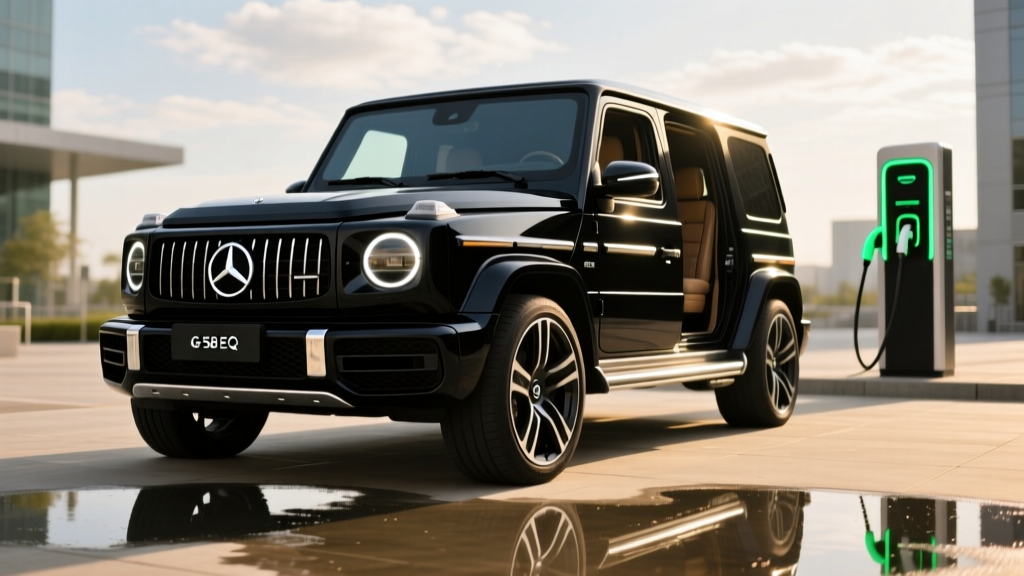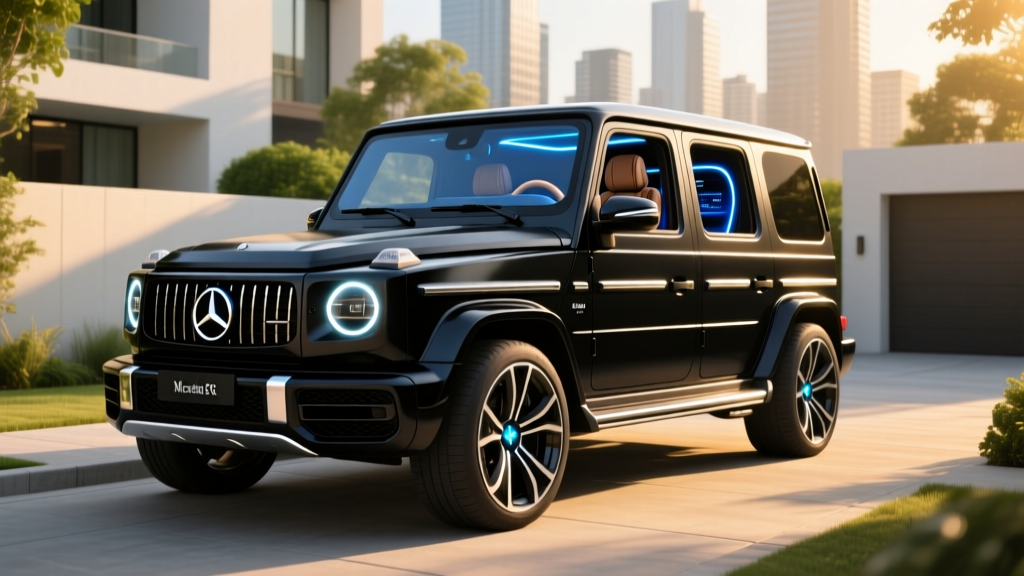
Quick Answer: The 2026 Mercedes-Benz G 580 with EQ Technology (the electric G Wagon) starts at approximately $164,900 before destination. It pairs a 116 kWh (usable) lithium-ion battery with four independent electric motors producing 579 hp and 859 lb-ft of torque. EPA-estimated range is 239 miles, with real-world highway driving yielding approximately 190–210 miles and cold-weather conditions potentially dropping that to 160–180 miles. DC fast charging peaks at 200 kW, reaching 10–80% in about 32 minutes. The G 580 does not qualify for the federal §30D tax credit due to its MSRP exceeding the $80,000 SUV cap and battery-sourcing requirements. It is best suited for buyers who want iconic G-Class styling and off-road capability with daily electric commuting under 150 miles and reliable home Level 2 charging access.
What Is the Electric G Wagon, Exactly?
Mercedes-Benz officially calls it the "G 580 with EQ Technology." It retains the ladder-frame chassis, boxy silhouette, and three differential-lock equivalents of the internal-combustion G 550, but replaces the twin-turbo V8 with four individually controlled electric motors — one near each wheel. This architecture enables torque vectoring at each corner, a feature Mercedes brands as "G-Turn" (tank turns) and "G-Steering" (tightening the turning radius by braking the inside wheels). The result is a vehicle that is simultaneously a luxury EV and a serious off-road machine.
The G 580 sits on a 116 kWh usable battery pack mounted low in the frame rails. The pack uses NMC (nickel manganese cobalt) chemistry, chosen for its energy density — a necessary trade-off given the G-Class's aerodynamic profile (essentially a brick) and 6,100-pound curb weight. Mercedes quotes an EPA-estimated range of 239 miles, though efficiency is rated at approximately 53 kWh/100mi, making it one of the least efficient EVs on the market by energy consumption.
| Spec | Value |
|---|---|
| Base MSRP | $164,900 (before destination) |
| EPA Range | 239 miles |
| Real-World Highway Range | ~190–210 miles |
| Real-World Cold-Weather Range | ~160–180 miles |
| Battery (Usable) | 116 kWh, NMC chemistry |
| Peak DC Fast Charge | 200 kW |
| 10–80% DC Charge Time | ~32 minutes |
| Level 2 AC Charge Rate | 11 kW (~3.5 hrs 10–100%) |
| Motor Output | 579 hp / 859 lb-ft |
| 0–60 mph | 4.6 seconds |
| Curb Weight | ~6,100 lbs |
| EPA Efficiency | ~53 kWh/100mi (63 MPGe) |
| Battery Warranty | 10 years / 155,000 miles |
| Federal §30D Tax Credit | Not eligible (MSRP & sourcing) |
Electric G Wagon vs. Gas G 550: Real Cost Comparison
The most common cross-shop for the G 580 is its stablemate, the gas-powered G 550. The G 550 starts around $149,000 and uses a 3.0L inline-six turbo with mild-hybrid assist, rated at 15/19/17 MPG city/highway/combined per fueleconomy.gov. Let's model five years of ownership at 12,000 miles annually.
| Category | G 580 Electric | G 550 Gas |
|---|---|---|
| Purchase Price (base) | $164,900 | $149,000 |
| Federal Tax Credit | $0 | $0 |
| Fuel/Energy (5 yrs) | $6,240* | $22,050** |
| Maintenance (5 yrs est.) | $2,500 | $5,500 |
| Insurance (5 yrs est.) | $18,000 | $15,500 |
| 5-Year Total (excl. depreciation) | $191,640 | $192,050 |
*Based on $0.13/kWh national average, 53 kWh/100mi. **Based on $3.50/gal premium, 17 MPG combined. Your actual costs will vary by local electricity rates and gas prices.
The takeaway: the G 580's higher purchase price is nearly offset by five years of fuel and maintenance savings. However, depreciation on a $165K luxury EV is the wildcard — early G 580 models may lose value faster than the proven G 550 until long-term reliability data is established. Insurance premiums for the G 580 run 15–20% higher due to repair-cost complexity around the four-motor setup and battery.
Real-World Range Reality Check: The 239-mile EPA figure is achieved under mixed driving conditions. On a sustained 75-mph highway run in 70°F weather, expect approximately 190–210 miles before needing a charge. In sub-30°F winter conditions, the G-Class's poor aerodynamics and heavy cabin-heating demand can push range down to 160–180 miles. The G 580 includes a heat pump, which mitigates but does not eliminate cold-weather losses. Plan road trips around 150-mile charging intervals in winter to maintain a safety buffer.
Charging the G 580: What You Actually Need at Home
With a 116 kWh battery, the G 580 demands serious home charging infrastructure. Here's what each charging level looks like in practice:
| Level | Power | Miles Added/Hour | Full Charge Time | Use Case |
|---|---|---|---|---|
| Level 1 (120V) | ~1.4 kW | ~2.5 mi/hr | ~80+ hours | Emergency only — not practical |
| Level 2 (240V, 48A) | 11 kW | ~21 mi/hr | ~10.5 hours (0–100%) | Daily overnight charging |
| DC Fast Charge | 200 kW peak | ~190 mi/hr (peak) | 10–80% in ~32 min | Road trips |
Home installation reality: A Level 2 charger capable of delivering the G 580's full 11 kW requires a 60-amp dedicated circuit on a 240V line. Most homes with a 200-amp electrical panel can accommodate this, but older homes with 100-amp service will likely need a panel upgrade ($1,500–$3,500) before the charger circuit can be installed. Expect total Level 2 installation costs of $800–$2,500 for the charger unit and electrician labor if your panel is adequate.
Charging curve note: The G 580's peak 200 kW rate is not sustained across the entire session. Like all EVs, charge speed tapers significantly above 80% state of charge. The 10–80% time of ~32 minutes is the practical metric; charging from 80–100% can add another 25–30 minutes. For road trips, plan stops around the 10–80% window to minimize time at chargers.
The G 580 uses the CCS1 connector standard. As Mercedes-Benz transitions to NACS (the Tesla-style connector) across its lineup, 2026 models may ship with NACS or include a CCS-to-NACS adapter. Confirm your vehicle's native connector before selecting a home charger — or choose a dual-compatible unit.
Federal Tax Credit and Incentives: The Hard Truth
The G 580 does not qualify for the federal §30D new clean vehicle credit. There are two reasons under current IRS rules:
- MSRP Cap: The §30D credit limits new SUVs to a maximum MSRP of $80,000. At $164,900, the G 580 exceeds this cap by over 100%.
- Battery Sourcing: Even if the MSRP were within range, the G 580's battery critical minerals and component sourcing must meet phased-in thresholds. Many Mercedes-Benz EVs have struggled to meet these requirements.
- Buyer Income Cap: Modified AGI limits ($300K joint / $225K head of household / $150K single) further restrict eligibility — though this is moot given the MSRP disqualification.
Some state and local incentives may still apply (check your state's EV rebate program), and certain commercial fleet buyers may qualify under §45W. Consult a tax professional for your specific situation — incentive rules change frequently.
Myths vs. Facts: Common Misconceptions About the Electric G Wagon
| Myth | Fact |
|---|---|
| "The electric G Wagon can't off-road." | The G 580 retains the ladder frame, locking differential equivalents (via individual motor torque control), and 33.7° approach / 30.7° departure angles. It can ford 33.5 inches of water. The low-mounted battery actually lowers the center of gravity. |
| "You'll save a fortune on fuel." | At 53 kWh/100mi, the G 580 is one of the least efficient EVs sold. At $0.13/kWh, you'll spend ~$1,250/year on electricity — far less than the G 550's ~$4,400/year on gas, but more than twice what a Tesla Model Y costs per mile. |
| "The battery will need replacing in 5 years." | Mercedes warranties the battery for 10 years / 155,000 miles against degradation below 70% capacity. NMC batteries in liquid-cooled systems typically retain 85–90% capacity at 100,000 miles based on industry data. |
| "It charges as fast as a Tesla." | The G 580 peaks at 200 kW. A Tesla Model X can peak at 250 kW on V3 Superchargers. The G 580's 10–80% time of ~32 minutes is adequate but not class-leading. |
| "I can charge on any public charger." | The G 580 uses CCS1. Tesla Superchargers (the largest US fast-charging network) require a NACS connector or approved adapter. Confirm your vehicle's connector and plan routes around Electrify America, EVgo, and ChargePoint networks, which support CCS natively. |
Who Should Buy the G 580 — And Who Shouldn't
Choose the G 580 Electric if:
- You have reliable Level 2 home charging (garage or driveway with 240V access)
- Your daily driving is under 150 miles round-trip
- You want G-Class presence and off-road capability with silent, instant-torque electric driving
- You live in a region with moderate winters or have a heated garage (mitigates cold-weather range loss)
- You value the G-Turn and G-Steering features that are only possible with four independent motors
- You accept that the $7,500 federal tax credit is not available at this price point
Choose the gas G 550 or a different EV if:
- You lack home charging access and rely on public infrastructure (the G 580's 53 kWh/100mi consumption makes public charging expensive and frequent)
- You regularly drive more than 200 miles between charging stops (road-tripping requires careful planning given ~190-mile real-world highway range)
- You live in extreme cold climates (sustained sub-10°F winters will compress range to 150–170 miles)
- Total cost of ownership and efficiency are priorities (a Rivian R1S Quad-Motor offers similar capability at ~$100K with better range and tax credit eligibility)
- You want the proven long-term resale value of the ICE G-Class
First-Time EV Buyer Checklist for the G 580
If the G 580 is your first EV, these are the ownership realities that differ from a gas G Wagon:
- Install Level 2 charging before delivery. A 116 kWh battery on a 120V outlet adds roughly 2.5 miles per hour — essentially unusable. Schedule an electrician consultation at least 4–6 weeks before your delivery date.
- Understand preconditioning. When you set a departure time in the MBUX system, the G 580 will warm or cool the battery to optimal temperature before you drive. This preserves range and enables faster DC charging. Use it every time.
- Download charging network apps. Electrify America, EVgo, and ChargePoint are your primary DC fast-charging networks. Create accounts, link a payment method, and familiarize yourself with their coverage maps before your first road trip.
- Plan for higher insurance. Get quotes before signing the purchase agreement. EV insurance premiums on luxury vehicles typically run 15–25% higher than equivalent ICE models due to battery replacement cost and specialized repair requirements.
- Maintenance is minimal but not zero. You'll eliminate oil changes, transmission fluid, and spark plugs. Expect cabin air filter replacements, brake fluid checks (regen braking reduces pad wear dramatically), tire rotations, and wiper fluid. Budget ~$500/year.
- Monitor State of Health (SoH). The MBUX system displays battery health metrics. Track capacity retention over time — if it drops below 70% within the 10-year/155,000-mile warranty window, Mercedes will address it under warranty.
Frequently Asked Questions
How much does it cost to charge the G 580 at home?
At the national average of $0.13/kWh, a full 0–100% charge of the 116 kWh battery costs approximately $15.08. For a typical 20–80% daily charge cycle (the recommended range for battery longevity), you'll spend about $9 per session. Over 12,000 miles of annual driving at 53 kWh/100mi, expect roughly $1,250/year in home electricity costs.
Can the electric G Wagon tow?
Yes. The G 580 is rated to tow up to 7,700 pounds, comparable to the gas G 550. However, towing will significantly reduce range — expect a 30–50% reduction depending on trailer weight and aerodynamics. Plan for 100–130 miles of range when towing near max capacity.
Is the G 580 eligible for any tax credits?
Not the federal §30D credit, due to the MSRP cap ($80,000 for SUVs). Some state-level incentives may apply — check your state's energy office or the AFDC state law database. Commercial buyers may qualify under §45W. Consult a tax professional for current-year eligibility.
What happens if the battery fails out of warranty?
Out-of-warranty battery replacement for a 116 kWh pack is estimated at $25,000–$35,000 based on current luxury EV battery pricing. However, NMC battery packs with active liquid cooling rarely fail catastrophically — degradation is gradual. Industry data suggests 85–90% capacity retention at 100,000 miles, meaning most owners will never need a full replacement.
How does the G 580 compare to the Rivian R1S or Tesla Model X?
The G 580 is a luxury-and-heritage play, not an efficiency leader. The Rivian R1S Quad-Motor (~$100K) offers similar off-road capability, more range (~320 mi EPA), and potential tax credit eligibility. The Tesla Model X (~$80K) delivers far better efficiency, 330+ miles of range, Supercharger access, and significantly lower cost. The G 580's value proposition is exclusively about G-Class design, build quality, and the four-motor torque-vectoring experience — not spec-sheet dominance.
Does the G 580 have Autopilot or self-driving capability?
No. The G 580 includes Mercedes' Driver Assistance Package with adaptive cruise control, lane-keeping assist, and automatic emergency braking. This is an SAE Level 2 driver-assistance system — you must remain fully engaged with hands on the wheel and eyes on the road at all times. It is not self-driving. No consumer vehicle currently sold in the US offers autonomous driving; only Level 4 robotaxi services like Waymo operate without a human driver in geofenced areas.