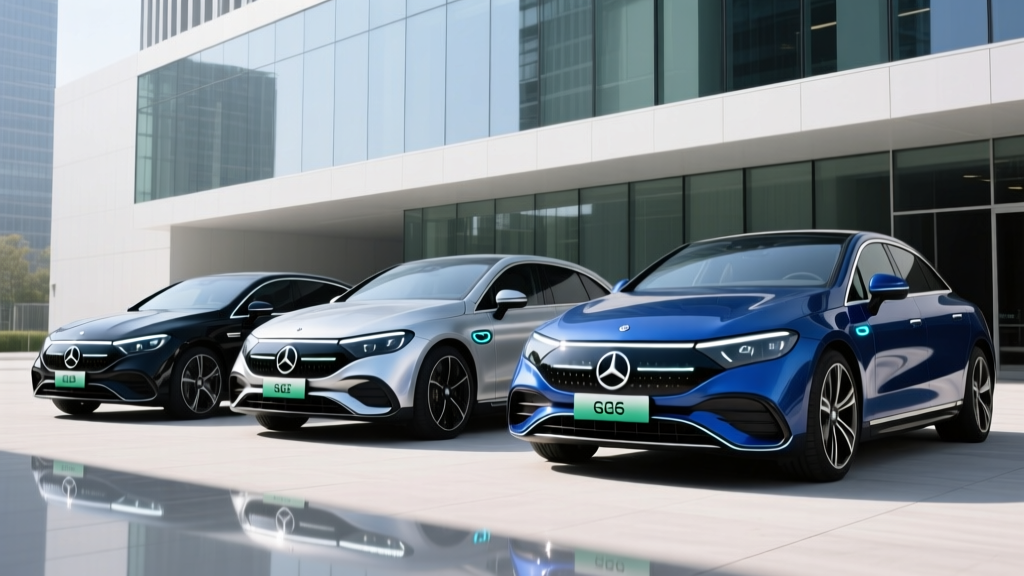
Quick Answer: Mercedes-Benz offers a growing lineup of battery-electric vehicles under the EQ brand, ranging from the compact EQB SUV (starting around $54,000, EPA ~245 miles) to the flagship EQS sedan (starting ~$105,000, EPA ~352 miles). In 2026, the brand is transitioning to its new MMA platform with models like the all-electric CLA, targeting 400+ mile range and 800V architecture. However, Mercedes EVs currently do not qualify for the $7,500 federal §30D tax credit due to battery sourcing and MSRP cap restrictions — a significant factor for buyers comparing total cost of ownership against gas-powered Mercedes models or competing EVs from Tesla, BMW, and Hyundai.
What Does the 2026 Mercedes EV Lineup Look Like?
Mercedes-Benz has restructured its electric strategy heading into 2026, moving away from the "EQ" sub-brand naming convention for newer models and integrating electrification directly into core model lines. The current lineup spans several vehicle classes, each with distinct battery chemistry, charging architecture, and real-world usability profiles.
| Model | Body Style | Battery (kWh Usable) | EPA Range | Peak DC Charge (kW) | 10–80% Time | 0–60 mph | Starting MSRP |
|---|---|---|---|---|---|---|---|
| EQB 300 4MATIC | Compact SUV | 66.5 (NMC) | ~245 mi | 100 kW | ~32 min | 7.7 sec | $54,050 |
| EQE 350+ | Mid-Size Sedan | 90.6 (NMC) | ~305 mi | 170 kW | ~28 min | 6.2 sec | $75,050 |
| EQE SUV 350 4MATIC | Mid-Size SUV | 90.6 (NMC) | ~279 mi | 170 kW | ~28 min | 6.4 sec | $78,050 |
| EQS 450+ | Full-Size Sedan | 118 (NMC) | ~352 mi | 200 kW | ~31 min | 5.9 sec | $105,550 |
| EQS SUV 450+ | Full-Size SUV | 108.4 (NMC) | ~330 mi | 200 kW | ~31 min | 6.5 sec | $105,550 |
| CLA EV (MMA Platform) | Compact Sedan | ~85 (NMC, 800V) | ~400 mi (est.) | ~250 kW (est.) | ~18 min (est.) | TBD | ~$45,000 (est.) |
Sources: fueleconomy.gov, Mercedes-Benz USA. CLA EV figures are preliminary estimates for the upcoming MMA-platform model.
Real-World Range Reality Check: EPA estimates assume mixed city/highway driving at moderate temperatures. Expect 15–25% range reduction on sustained highway driving above 70 mph, and 20–35% loss in sub-freezing winter conditions. For example, the EQS 450+ rated at 352 miles EPA may deliver closer to 265–290 miles on a cold-weather highway trip. The EQB, with its smaller battery and boxier profile, is best suited for urban and suburban use where its 245-mile rating holds up well.
Mercedes EV vs Gas Mercedes: What Does Ownership Actually Cost?
The most common question from buyers considering a Mercedes EV is whether the electric premium pays for itself. Let's compare the EQE 350+ against its closest internal-combustion sibling, the E 350 sedan, over a 5-year / 60,000-mile ownership period.
| Cost Category | EQE 350+ (EV) | E 350 (Gas) |
|---|---|---|
| Purchase Price (MSRP) | $75,050 | $58,950 |
| Federal Tax Credit (§30D) | $0 (does not qualify) | $0 |
| Fuel / Energy (5 yr, 60k mi) | $4,200 (home L2, $0.14/kWh avg) | $10,500 ($3.50/gal, 26 MPG combined) |
| Maintenance (5 yr) | $1,800 (cabin filter, wipers, fluid top-off) | $4,200 (oil, filters, brakes, spark plugs) |
| Insurance (5 yr avg) | $12,600 ($2,520/yr avg) | $10,500 ($2,100/yr avg) |
| Estimated Depreciation (5 yr) | $38,000 (~51%) | $28,000 (~47%) |
| Total 5-Year Cost | ~$93,650 | ~$76,150 |
Energy costs assume 70% home Level 2 charging at $0.14/kWh national average and 30% public DC fast charging at $0.40/kWh. Insurance averages based on national luxury-EV data; actual premiums vary significantly by state, driver profile, and insurer. Depreciation estimates based on current luxury EV resale trends. Source: fueleconomy.gov, Kelley Blue Book.
The numbers tell a clear story: despite saving roughly $6,300 on energy and $2,400 on maintenance over five years, the EQE's higher purchase price, steeper depreciation, elevated insurance premiums, and lack of federal tax credit eligibility result in a roughly $17,500 higher total cost of ownership compared to the gas E 350. This gap narrows if you charge exclusively at home on cheap electricity, live in a state with additional EV rebates (such as California, Colorado, or Massachusetts), or plan to keep the vehicle well beyond five years.
Charging the Mercedes EV Lineup: Speeds, Connectors, and Home Setup
Mercedes-Benz EVs sold in the US through the 2025 model year use the CCS1 (Combined Charging System) connector. Starting with 2026 models, Mercedes is adopting the NACS (North American Charging Standard / Tesla-style) connector, which grants native access to the Tesla Supercharger network — currently the most reliable public charging infrastructure in the country.
| Charging Level | Power (kW) | Miles Added per Hour | Typical Use Case | Equipment Cost |
|---|---|---|---|---|
| Level 1 (120V) | ~1.4 kW | 3–5 mi/hr | Emergency / overnight trickle | Included (portable cord) |
| Level 2 (240V, 48A) | ~11.5 kW | 28–35 mi/hr | Daily home charging | $500–$1,200 (unit) + $800–$2,500 (install) |
| DC Fast (CCS/NACS) | 100–200 kW peak | 200–450 mi/hr (peak) | Road trips, public stations | Pay per kWh ($0.30–$0.55) |
Charging curve reality: Mercedes EVs, like all lithium-ion battery packs, do not sustain peak charge rates throughout the session. The EQS 450+ may peak at 200 kW around 15–20% State of Charge (SoC), but by 60% SoC it tapers to roughly 100 kW, and above 80% it drops further to protect battery longevity. This is why manufacturers quote 10–80% times rather than 0–100% — charging the final 20% can take as long as the first 70%.
Home charging is essential. Level 1 (standard 120V outlet) adds only 3–5 miles per hour — inadequate for any Mercedes EV with a battery larger than 66 kWh. A Level 2 home charger on a 240V / 60A circuit (delivering ~48A continuous) is practically mandatory. Installation costs vary widely: a straightforward install near the electrical panel may run $800–$1,200, while a panel upgrade from 100A to 200A service can add $2,000–$4,000. Always get a quote from a licensed electrician before purchasing.
Federal Tax Credit Eligibility: Why Most Mercedes EVs Don't Qualify
The IRS §30D Clean Vehicle Credit offers up to $7,500 for qualifying new EVs, but the rules are strict and most Mercedes EVs fail on multiple criteria as of 2026:
- MSRP Cap: Sedans must be under $55,000; SUVs, vans, and trucks under $80,000. The EQE sedan ($75,050) exceeds the sedan cap. The EQS ($105,550+) exceeds all caps.
- Battery Sourcing: A percentage of critical minerals must be sourced from the US or free-trade-agreement partners, and battery components must be manufactured or assembled in North America. Mercedes' current NMC supply chain relies heavily on non-qualifying sources.
- Buyer Income Limits: AGI must not exceed $150,000 (single), $225,000 (head of household), or $300,000 (joint).
- Point-of-Sale Transfer: If eligible, the credit can be applied at the dealership as an immediate price reduction rather than a tax-year rebate.
The EQB 350 4MATIC (MSRP ~$54,050) technically falls under the SUV MSRP cap, but as of 2026 it still does not meet the battery component and critical mineral sourcing requirements. The upcoming CLA EV on the MMA platform, if priced near $45,000, could potentially qualify depending on final battery sourcing — but this is unconfirmed. Always verify current eligibility at fueleconomy.gov before purchasing, as the qualifying list updates frequently.
Common Misconceptions About Mercedes EVs
| Myth | Fact |
|---|---|
| "Mercedes EVs are just as fast to charge as a Tesla." | Most current Mercedes EVs peak at 100–200 kW on DC fast charging, while Tesla's V3/V4 Superchargers and vehicles like the Hyundai Ioniq 5 (which supports 800V / 350 kW) charge significantly faster. The upcoming MMA-platform models with 800V architecture aim to close this gap. |
| "The battery will need replacing in 5–8 years." | Mercedes provides an 8-year / 100,000-mile high-voltage battery warranty guaranteeing minimum 70% State of Health (SoH). Real-world data from similar NMC packs shows typical degradation of 10–15% over 8 years with normal use. Full replacement, if ever needed, ranges from $15,000–$30,000 depending on model. |
| "All Mercedes EVs get $7,500 in tax credits." | As of 2026, no Mercedes EV currently qualifies for the full federal §30D credit due to MSRP caps and battery sourcing rules. State-level incentives may still apply — check your state's energy office. |
| "The Drive Pilot system is self-driving." | Mercedes Drive Pilot is a certified SAE Level 3 system — but only under very specific conditions (limited-access highways, under 40 mph, clear weather, mapped roads in Nevada and California). The driver can disengage attention but must be ready to resume control within ~10 seconds when prompted. This is not Level 4/5 autonomy. |
| "I don't need a home charger if there are public stations nearby." | Public DC fast charging costs 2–4x more per kWh than home Level 2, and exclusive DCFC use accelerates battery degradation. Without home charging, EV ownership becomes significantly more expensive and less convenient than a gas vehicle. |
SAE Automation Level — Mercedes Drive Pilot: Mercedes-Benz Drive Pilot is one of the few commercially available SAE Level 3 systems in the US. At Level 3, the vehicle handles all driving tasks under defined conditions, and the driver may look away from the road but must be prepared to take over. This is fundamentally different from Level 2 systems (Tesla Autopilot, GM Super Cruise) where the driver must remain actively engaged. Drive Pilot is an optional add-on (~$2,500) available only on the EQS and S-Class in approved jurisdictions.
Decision Framework: Is a Mercedes EV Right for You?
Choose a Mercedes EV if:
- You prioritize ride quality, cabin materials, and brand prestige over value-per-dollar metrics
- You have reliable home Level 2 charging access (garage or dedicated parking with 240V circuit)
- Your daily driving is under 150 miles and you take road trips fewer than 6 times per year
- You're considering the EQS or EQE for their class-leading range and quiet powertrain refinement
- You can absorb the higher total cost of ownership relative to gas alternatives without financial strain
Look elsewhere if:
- Federal tax credit eligibility is a dealbreaker — consider the Tesla Model S, BMW i5 (if qualifying trims exist), Hyundai Ioniq 6, or Chevrolet Blazer EV
- You rely exclusively on apartment/condo living without charging access — a PHEV or HEV may be more practical
- Fast public charging speed is a top priority — the Hyundai/Kia 800V E-GMP platform (Ioniq 5, EV6) charges 30–40% faster at DCFC stations
- You live in a region with extreme cold (regularly below 10°F) and cannot garage the vehicle — expect 30%+ range loss in winter, and consider a heat-pump-equipped model
- You plan to sell within 3 years — luxury EV depreciation currently outpaces comparable gas models
First-Time Mercedes EV Buyer Checklist
If you're transitioning from a gas Mercedes to one of their electric models, here's what to prepare for:
- Electrical assessment: Before ordering, have a licensed electrician evaluate your panel capacity. Most Mercedes EVs benefit from a 48A continuous charge rate, which requires a 60A breaker and 6-gauge wire minimum.
- Charging app setup: Download Mercedes me Charge, Electrify America, EVgo, and ChargePoint apps before your first road trip. The Mercedes me system integrates routing with charging stops, but public charger reliability varies — having backup network apps is essential.
- Preconditioning habit: Use the Mercedes me app to precondition the battery and cabin while plugged in at home. This warms the battery to optimal temperature for efficiency and reduces range loss in cold weather.
- Regen braking adjustment: Mercedes EVs offer adjustable regenerative braking via steering-wheel paddles. The "D Auto" mode uses navigation and sensor data to modulate regen intelligently — most owners find this the best daily setting after a brief adaptation period.
- Insurance quotes: Get quotes before purchasing. Luxury EVs carry 15–25% higher premiums on average due to repair costs and battery replacement exposure. Some insurers (like Geico and Progressive) have improved EV-specific rating models.
- Tire budget: EVs are heavier and deliver instant torque, wearing tires 20–30% faster than gas equivalents. Budget $1,200–$2,000 for a set of premium touring tires every 25,000–35,000 miles.
Frequently Asked Questions
How long does a Mercedes EV battery last?
Mercedes warranties its high-voltage batteries for 8 years or 100,000 miles, whichever comes first, guaranteeing at least 70% of original capacity (State of Health). Industry data from similar NMC lithium-ion packs suggests most will retain 80–85% capacity at the 8-year mark under normal use patterns. Extreme heat, frequent DC fast charging above 80% SoC, and regular deep discharges to 0% accelerate degradation.
Can I charge a Mercedes EV at a Tesla Supercharger?
For 2025 and earlier models with CCS1 connectors, you need Mercedes' official CCS-to-NACS adapter (approximately $200–$250) to access Tesla Superchargers. Starting with 2026 model-year vehicles, Mercedes is transitioning to the native NACS connector, eliminating the adapter requirement.
What is the cheapest Mercedes EV available?
As of 2026, the EQB 300 4MATIC is the most affordable Mercedes EV at a starting MSRP of approximately $54,050. The upcoming CLA EV on the MMA platform is expected to start near $45,000, which would make it the entry point to the Mercedes electric lineup — but it is not yet available for purchase.
Does Mercedes have a hybrid option if I'm not ready for full electric?
Mercedes offers plug-in hybrid (PHEV) variants of the S-Class (S 580e) and GLC (GLC 350e) in the US market. The GLC 350e provides approximately 35 miles of electric-only range and starts around $59,000. PHEVs are a practical bridge for buyers without reliable home charging or those who frequently drive long distances in areas with sparse charging infrastructure.
Is the Mercedes EQS worth the $100,000+ price tag?
The EQS 450+ offers the longest EPA-rated range of any Mercedes EV (352 miles), an exceptionally quiet cabin, and available Level 3 Drive Pilot. However, its steep depreciation (~50% over 5 years based on current luxury EV trends), lack of federal tax credit eligibility, and competition from the Tesla Model S (which is faster, charges quicker, and costs less) make it a purchase driven by comfort and prestige rather than financial logic.
What happens if my Mercedes EV runs out of charge on the road?
Mercedes-Benz roadside assistance includes EV-specific towing to the nearest charging station within the warranty period. However, prevention is straightforward: the MBUX navigation system proactively routes through charging stations when the battery is projected to drop below a threshold, and the Mercedes me app allows remote monitoring of SoC. Running an EV to 0% is rare with modern route planning — treat it like you'd treat running out of gas.