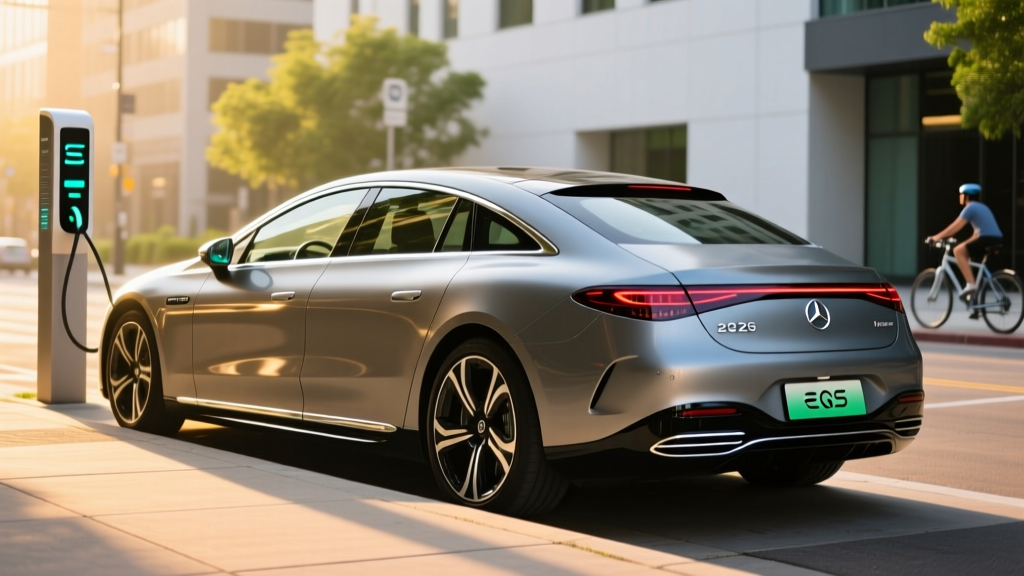
The Mercedes-Benz EQS sedan has occupied a polarizing position in the luxury EV market since its launch. With its radical one-bow silhouette, hyperscreen dashboard, and flagship pricing, it promises to redefine electric luxury. But does the ownership experience match the showroom allure? In this 2026 EQS survey, we combine manufacturer data, EPA figures, and aggregated owner feedback to deliver an unfiltered profile of Mercedes' electric flagship — covering real-world range, charging behavior, tax-credit realities, and the practical trade-offs buyers should weigh before signing a six-figure purchase order.
2026 Mercedes EQS at a Glance: Core Specifications
| Spec | EQS 450+ (RWD) | EQS 580 4MATIC (AWD) |
|---|---|---|
| EPA Range | 390 miles | 371 miles |
| Battery (usable) | 118.0 kWh (NMC) | 118.0 kWh (NMC) |
| Horsepower | 355 hp / 419 lb-ft | 536 hp / 633 lb-ft |
| 0–60 mph | 5.9 sec | 4.1 sec |
| Peak DC Fast Charge | 200 kW | 200 kW |
| 10–80% DC Time | ~31 min | ~31 min |
| Level 2 (11.5 kW) Rate | ~30 mi/hr | ~30 mi/hr |
| MPGe (city/hwy/combined) | 97 / 97 / 97 | 92 / 92 / 92 |
| Efficiency | 35 kWh/100 mi | 37 kWh/100 mi |
| Base MSRP | $104,400 | $125,950 |
| Federal Tax Credit (§30D) | Not eligible (MSRP cap) | Not eligible (MSRP cap) |
| Battery Warranty | 10 yr / 155,000 mi | 10 yr / 155,000 mi |
Range Reality: EPA Sticker vs. What Owners Report
The EQS 450+ carries a 390-mile EPA estimate, placing it among the longest-range luxury sedans on the market. The dual-motor EQS 580 4MATIC drops to 371 miles. Both figures are credible on paper, thanks to the EQS's slippery 0.20 drag coefficient — the lowest of any current production car — and its massive 118.0 kWh usable battery pack (120 kWh gross), which uses nickel-manganese-cobalt (NMC) chemistry for high energy density.
- Mixed suburban driving (EQS 450+): 360–380 miles achievable in mild weather.
- Highway cruising at 75 mph: Expect 310–340 miles; the one-bow shape helps, but sustained high speeds still consume energy faster than the EPA cycle.
- Cold weather (below 32°F / 0°C): Owners report 260–300 miles, a 25–30% reduction — typical for NMC packs without preconditioning. The EQS does include a heat pump, which mitigates cabin-heating losses.
- Best-case (city, regen-heavy, 65°F): Some owners have exceeded 400 miles, though this requires disciplined regenerative braking use and low HVAC demand.
According to fueleconomy.gov, the EQS 450+ achieves 97 MPGe combined (35 kWh per 100 miles). That efficiency figure is genuinely impressive for a 5,700-pound sedan and reflects Mercedes' engineering focus on aerodynamics and powertrain efficiency. However, real-world highway drivers should budget for roughly 15% less than the EPA sticker — a pattern consistent across nearly every EV we've tested.
Charging Speed: 200 kW Peak, but the Curve Matters
The 2026 EQS supports a 200 kW peak DC fast-charge rate via CCS1 (with NACS adapter availability expanding through Mercedes' partnership with Tesla Supercharger access). On an Electrify America or EVgo 350 kW cabinet, the EQS can add roughly 180 miles of range in 15 minutes under ideal thermal conditions.
But peak kW is not sustained kW. Here's what the charging curve actually looks like:
- 10–40% SoC: Holds near 200 kW — this is where the EQS shines.
- 40–60% SoC: Tapers to ~150 kW.
- 60–80% SoC: Drops to ~100 kW.
- 80–100% SoC: Slows dramatically to protect the NMC cells; expect 30+ additional minutes for the final 20%.
The 10–80% charge takes approximately 31 minutes at a capable DC station. For home charging, the onboard 11.5 kW Level 2 charger adds roughly 30 miles of range per hour, meaning a full overnight charge from 20% to 100% takes about 10–11 hours on a hardwired 48-amp Level 2 station (such as a ChargePoint Home Flex or Wallbox Pulsar Max).
Preconditioning note: The EQS will automatically precondition its battery when a DC fast charger is set as the navigation destination, warming the pack to optimize charge acceptance. Skipping this step in cold weather can add 5–10 minutes to your 10–80% session.
Performance and Driving Character
The rear-wheel-drive EQS 450+ delivers 355 horsepower and reaches 60 mph in 5.9 seconds — brisk, not brutal. The EQS 580 4MATIC, with its dual-motor all-wheel-drive setup, produces 536 horsepower and hits 60 mph in 4.1 seconds. Both variants feature adaptive air suspension, rear-axle steering (up to 10 degrees, reducing the turning circle to a compact-car-like 35.4 feet), and Mercedes' 4MATIC torque distribution.
Owner feedback consistently praises the EQS's ride quality. The air suspension absorbs road impermissions with a floating sensation that rivals — and some argue exceeds — the S-Class. However, the regenerative braking feel draws mixed reviews. The EQS offers three regen levels (D+, D, D−) selected via steering-wheel paddles, plus an "intelligent" D-Auto mode that uses radar and navigation data to modulate regen. Some owners find D-Auto intuitive; others prefer the predictability of manual selection. True one-pedal driving is available but not as aggressive as Tesla or Hyundai/Kia implementations.
Interior, Technology, and the Hyperscreen Question
The EQS cabin is dominated by the optional MBUX Hyperscreen — a 56-inch curved glass panel spanning the entire dashboard, combining a 12.3-inch instrument cluster, 17.7-inch central OLED, and 12.3-inch passenger display. It's visually arresting. Whether it's functionally superior to a simpler layout is debatable, and owner opinions split sharply.
Standard and notable technology includes:
- MBUX infotainment with "zero-layer" interface and over-the-air updates
- Burmester 4D surround sound (15 speakers standard, 31-speaker optional)
- Heated, ventilated, and massaging front seats (standard on 580, optional on 450+)
- Rear-seat entertainment tablets (optional Executive Rear Seat Package)
- Active ambient lighting with 64 colors and energy-flow visualization
- HEPA-grade Energized Air filtration system
On the driver-assistance front, the EQS ships with Mercedes-Benz Driver Assist Package, which includes adaptive cruise, lane-centering, automatic lane-change, and evasive steering assist. This is an SAE Level 2 system — the driver must remain engaged with hands on or near the wheel at all times. Mercedes' Drive Pilot system, which is a certified Level 3 system approved for hands-off driving at speeds up to 40 mph on suitable highways, is available in select markets (currently approved in Nevada and California for specific highway corridors). Level 3 means the car assumes driving responsibility under defined conditions, but the driver must be ready to resume control when prompted.
Pricing, Trims, and the Federal Tax Credit Situation
The 2026 EQS lineup starts at $104,400 for the 450+ Sedan and climbs to $125,950 for the 580 4MATIC. The high-performance AMG EQS variant (not profiled here) exceeds $150,000. A well-equipped 450+ with the Hyperscreen, Executive Package, and Premium Package typically lands between $115,000 and $122,000 before destination.
| Requirement | EQS Status |
|---|---|
| Sedan MSRP cap: ≤ $55,000 | ❌ EQS starts at $104,400 — exceeds cap |
| Buyer AGI cap: $150K single / $300K joint | Varies by buyer |
| Battery critical-mineral sourcing | Partial compliance (varies by build date) |
| North American final assembly | ❌ Built in Sindelfingen, Germany |
| Result | Not eligible for the $7,500 §30D credit |
Source: IRS.gov — Clean Vehicle Credits. The EQS fails both the MSRP cap and the North American assembly requirement. Buyers should not factor the federal credit into their purchase decision for this model. Some state-level incentives (e.g., California's CVRP, though currently paused/restructured, or utility rebates) may still apply — check your local jurisdiction.
Cargo, Passenger Space, and Daily Practicality
The EQS's one-bow design creates a spacious cabin but introduces compromises. Rear headroom is adequate but not generous for passengers over 6'2", due to the sloping roofline. Legroom, however, is excellent at 42.4 inches in the rear — more than the BMW i7 and competitive with the S-Class.
- Front headroom: 40.4 inches
- Rear headroom: 38.1 inches
- Rear legroom: 42.4 inches
- Cargo volume (trunk): 22.0 cu ft (sedan liftback design allows larger-item loading than a traditional trunk)
- Frunk: None — the EQS does not offer a front trunk, a consequence of its HEPA filtration system packaging and HVAC hardware
The 22.0 cu ft trunk is generous for a luxury sedan and expands with 40/20/40 split-folding rear seats. However, the absence of a frunk means less total storage than a Tesla Model S (28 cu ft trunk + 5 cu ft frunk) or the Lucid Air.
Ownership Costs, Warranty, and Depreciation
Mercedes backs the EQS with a 4-year/50,000-mile new-vehicle warranty and a 10-year/155,000-mile battery warranty covering capacity loss below 70% of original. That battery warranty is among the more generous in the luxury segment and reflects confidence in the NMC pack's thermal management system.
Depreciation is a genuine concern. The EQS has experienced steeper-than-average value loss in its first two model years — a pattern common to luxury EVs as battery technology advances and new competitors enter. Third-party residual forecasts suggest 45–55% value retention at 36 months, compared to roughly 60% for the BMW i7. Buyers planning to trade in within three years should factor this into their total cost of ownership. Leasing may be the financially superior path for many EQS buyers, as Mercedes frequently offers lease incentives that absorb depreciation risk.
Insurance premiums for the EQS are elevated — expect $3,500–$5,000 annually depending on location, driving record, and coverage level. This is roughly 20–30% higher than a comparable S-Class, driven by the EV's repair costs and battery-replacement exposure.
Pros, Cons, and Owner Satisfaction Verdict
- Class-leading EPA range (390 mi on 450+)
- Exceptional ride comfort with air suspension and rear-axle steering
- Ultra-quiet cabin — among the lowest NVH readings in any production car
- Available Level 3 Drive Pilot in select markets
- Strong 10-year/155,000-mile battery warranty
- Impressive 0.20 Cd aerodynamics aid real-world efficiency
- No federal §30D tax credit eligibility (MSRP + assembly)
- Hyperscreen interface divides opinion — some find it overwhelming
- No frunk reduces total cargo versatility
- Steep depreciation curve in early ownership years
- 200 kW peak DC charge rate trails 800V rivals (Lucid Air, Porsche Taycan at 270–350 kW)
- Rear headroom limited for tall passengers due to one-bow roof
Who the EQS suits best: The EQS is ideal for luxury sedan buyers who prioritize ride comfort, cabin silence, and long range over sporty dynamics or maximum charging speed. It works well as a daily commuter for executives with home Level 2 charging, and its 390-mile range makes it viable for road trips with planned DC fast-charge stops. It is less suited for buyers who want Level 2+ hands-free driving on par with GM's Super Cruise, or those who need frunk storage and aggressive one-pedal regen. Families with tall teenagers may find rear headroom tight.
EQS vs. Key Competitors: Where It Stands
The EQS competes in a narrow but growing segment:
- BMW i7: More conventional sedan styling, slightly shorter range (318 mi EPA), starts at $119,300. Offers more traditional luxury cues and better rear headroom. Also ineligible for §30D credit.
- Lucid Air Pure: 419-mile EPA range, starts at $69,900 (eligible for §30D credit), faster DC charging at ~200+ kW sustained. Less brand cachet, smaller service network.
- Tesla Model S: 402-mile EPA range, starts at $74,990, 250 kW Supercharging access. Dated interior compared to EQS, but unmatched charging infrastructure.
The EQS wins on ride comfort, cabin quietness, and build quality. It loses on price, charging speed (vs. 800V platforms), and tax-credit eligibility. For buyers cross-shopping the Lucid Air Grand Touring, the $40,000+ price gap is difficult to justify on luxury features alone.
Frequently Asked Questions
What is the real-world range of the 2026 Mercedes EQS?
The EQS 450+ carries a 390-mile EPA estimate. In real-world mixed driving, owners report 340–380 miles in mild weather, 310–340 miles on sustained highway trips, and 260–300 miles in freezing temperatures. The heat pump and aerodynamic efficiency help, but cold weather and high speeds reduce range as they do in every EV.
How fast does the EQS charge at home and on DC fast chargers?
On DC fast chargers, the EQS peaks at 200 kW and reaches 10–80% in approximately 31 minutes, though the charge curve tapers significantly above 60% SoC. At home on a Level 2 (11.5 kW / 48-amp) station, it adds roughly 30 miles of range per hour, with a full charge taking 10–11 hours from 20%.
Does the 2026 EQS qualify for the $7,500 federal EV tax credit?
No. Under current IRS §30D rules, the EQS fails two key requirements: its MSRP ($104,400+) exceeds the $55,000 sedan cap, and it is assembled in Sindelfingen, Germany rather than in North America. See IRS.gov for full eligibility details. Some state or utility incentives may still apply.
Is the Mercedes EQS worth buying over the BMW i7 or Lucid Air?
If ride comfort, cabin silence, and brand prestige are your top priorities, the EQS is arguably the best in its class. If range-per-dollar, DC charging speed, or tax-credit eligibility matter more, the Lucid Air offers compelling value. The BMW i7 suits buyers who prefer traditional sedan proportions and iDrive familiarity over the EQS's one-bow design.
What is the battery warranty on the EQS?
Mercedes provides a 10-year / 155,000-mile battery warranty covering capacity degradation below 70% of original. The standard new-vehicle warranty is 4 years / 50,000 miles. Battery replacement costs, if out of warranty, are estimated at $25,000–$35,000 based on current NMC pack pricing for this capacity class.
Does the EQS have self-driving capability?
The standard Driver Assist Package is an SAE Level 2 system requiring continuous driver supervision. Mercedes' Drive Pilot, available in limited markets (Nevada and California highways, up to 40 mph), is a certified SAE Level 3 system that assumes driving responsibility under specific conditions. It is not a full self-driving system and does not operate on all roads or at all speeds.