The Mercedes-Benz EQS sits at the apex of the brand's electric vehicle lineup — a full-size luxury sedan engineered around a dedicated EV architecture rather than a converted combustion platform. For 2026, the EQS program continues to evolve with updated software, refined thermal management, and a broader trim strategy. But at a six-figure entry price, buyers need hard data on range, charging, and ownership economics before signing. This review breaks down every spec that matters.
2026 EQS Program: Quick Verdict
The 2026 Mercedes-Benz EQS remains one of the most aerodynamically efficient production sedans ever built (Cd 0.20), and that slipperiness translates directly into highway range. The 108.4 kWh usable battery delivers genuine 300+ mile capability in mixed driving, and the 200 kW DC fast-charging peak keeps road-trip stops reasonable. Where the EQS program stumbles is in federal tax credit eligibility — the MSRP cap disqualifies most trims — and in rear-seat headroom compromised by the swooping roofline. If you want a tech-forward, whisper-quiet luxury EV sedan and can absorb the premium, the EQS delivers. If you need maximum rear space or tax-credit savings, competitors like the BMW i7 or Lucid Air deserve a look.
Range, Battery, and Real-World Efficiency
The 2026 EQS 450+ (rear-wheel drive) carries an EPA-estimated range of 390 miles on its 108.4 kWh (usable) lithium-ion battery pack. The dual-motor EQS 450 4MATIC drops to an EPA-estimated 371 miles, while the performance-oriented EQS 580 4MATIC settles at 352 miles. All trims use NMC (nickel manganese cobalt) chemistry, which offers higher energy density than LFP at the cost of slightly faster long-term degradation and a recommendation to charge to 80% for daily use.
EPA 390 mi (EQS 450+): Expect approximately 320–350 miles in predominantly highway driving at 70–75 mph. In cold weather (below 32°F), plan for a 20–30% reduction, dropping effective range to roughly 270–310 miles. City driving with regenerative braking recovers more energy and can match or slightly exceed the EPA sticker. The EQS's heat pump (standard on 2026 models) mitigates some cold-weather loss compared to resistance-heated competitors.
Efficiency is rated at 97 MPGe combined (EQS 450+), which translates to roughly 34 kWh per 100 miles. That's respectable for a 5,600-pound luxury sedan, and a direct result of the 0.20 drag coefficient. For context, the BMW i7 xDrive60 achieves 82 MPGe combined, and the Lucid Air Pure reaches 146 MPGe — though the Air is significantly lighter.
| Spec | EQS 450+ (RWD) | EQS 450 4MATIC (AWD) | EQS 580 4MATIC (AWD) |
|---|---|---|---|
| EPA Range | 390 mi | 371 mi | 352 mi |
| Battery (usable) | 108.4 kWh NMC | 108.4 kWh NMC | 108.4 kWh NMC |
| Horsepower | 355 hp | 355 hp | 536 hp |
| 0–60 mph | 5.9 sec | 5.3 sec | 4.1 sec |
| MPGe (combined) | 97 MPGe | 94 MPGe | 91 MPGe |
| Base MSRP | $104,400 | $107,850 | $125,950 |
Charging Speed: DC Fast and Level 2 Home Charging
The EQS program supports a peak DC fast-charge rate of 200 kW via CCS1 connector (NACS adapter available for Tesla Supercharger access). On a compatible 350 kW charger with proper battery preconditioning, the EQS can add approximately 185 miles of range in 15 minutes. The 10–80% charge takes roughly 31 minutes under ideal thermal conditions.
Here's the charging-curve reality that spec sheets omit: the EQS sustains its 200 kW peak only between roughly 10% and 25% state of charge. From 25% to 50%, the rate tapers to approximately 150 kW, and above 80%, it drops sharply to protect the NMC cells — typical of the chemistry. If you're road-tripping and charge to 90% or higher, expect that last 10% to add 12–15 minutes to your stop.
| Level | Power (kW) | Miles of Range Added per Hour | Notes |
|---|---|---|---|
| Level 1 (120V) | ~1.4 kW | ~3–4 mi/hr | Emergency/trickle only |
| Level 2 (240V, 48A) | 11.5 kW | ~32 mi/hr | Full charge in ~10 hrs |
| DC Fast (peak) | 200 kW | ~740 mi/hr (peak) | 10–80% in ~31 min |
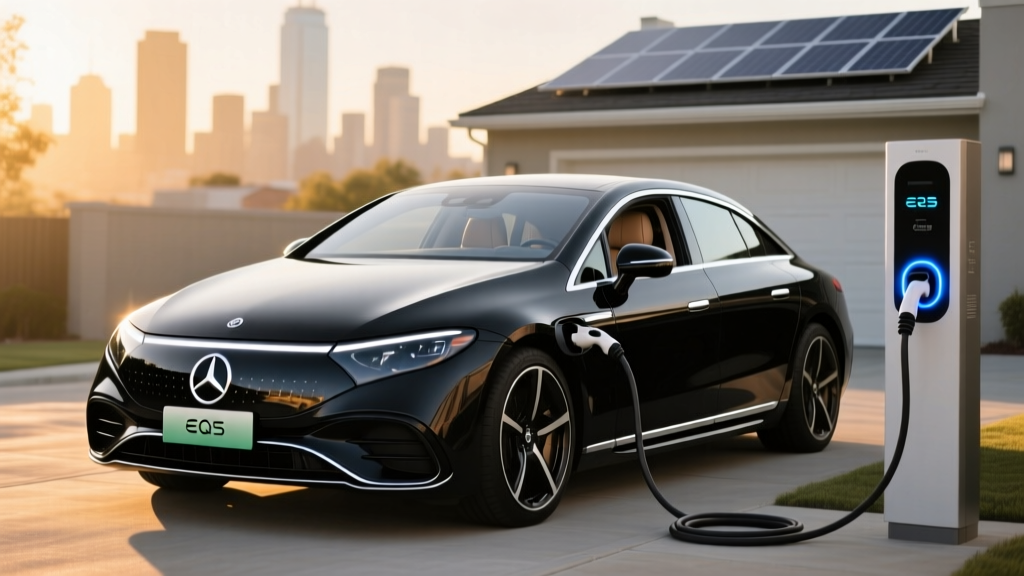
For home charging, the EQS's onboard charger accepts up to 11.5 kW on a 48-amp Level 2 circuit (hardwired 60-amp breaker recommended). That delivers roughly 32 miles of range per hour of charging, meaning an overnight session from 20% to full takes about 10 hours. A licensed electrician should verify your panel can support a 60-amp dedicated circuit — older homes with 100-amp service may need a panel upgrade ($1,500–$3,000).
Performance and Driving Dynamics
The EQS 450+ sends 355 horsepower to the rear wheels via a single permanent-magnet synchronous motor, achieving 0–60 mph in 5.9 seconds. That's adequate for merging and passing but won't pin you to the seat. The 450 4MATIC adds a front induction motor for all-wheel grip and the same 355 hp output (0–60 in 5.3 seconds). The EQS 580 4MATIC is the performance play: 536 hp, 0–60 in 4.1 seconds, and a noticeably more urgent throttle response.
All trims feature standard rear-axle steering (up to 4.5 degrees standard; 10 degrees available as an option), which shrinks the turning circle to a surprisingly compact 35.8 feet — rivaling a compact hatchback. Air suspension is standard across the lineup, delivering a compliant ride that absorbs highway imperfections without floatiness. The steering is precise but light, and the 5,600-pound curb weight is well-masked at cruising speeds but noticeable during aggressive cornering.
Interior Space, Cargo, and Standout Technology
The EQS rides on a 126.4-inch wheelbase, and that length pays dividends in front-seat space: 41.7 inches of front legroom and generous shoulder room. Rear legroom measures 41.0 inches, which is excellent, but the fastback roofline cuts rear headroom to 37.8 inches — tall passengers will notice. For comparison, the BMW i7 offers 40.0 inches of rear headroom thanks to a more traditional sedan profile.
Cargo volume behind the rear seats is 22.0 cubic feet (hatchback-style liftgate), expanding to 63.0 cu ft with the rear seats folded. There is no front trunk (frunk) — the space is occupied by HVAC and power electronics.
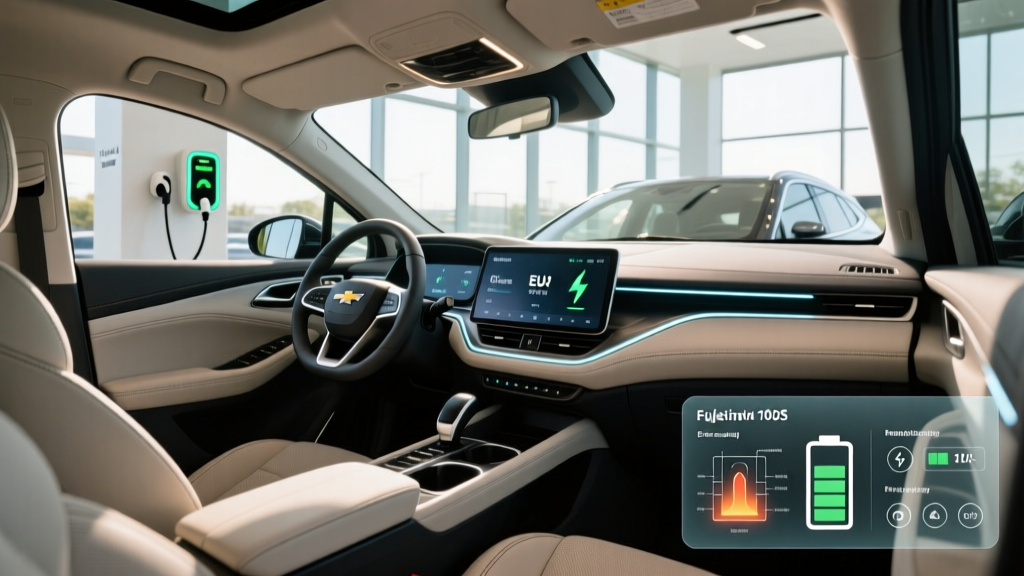
The centerpiece of the interior is the MBUX Hyperscreen: a 56-inch curved glass panel spanning the full dashboard, housing three displays (12.3-inch driver cluster, 17.7-inch central OLED, 12.3-inch passenger screen). It runs Mercedes' latest MBUX generation with wireless Apple CarPlay/Android Auto, over-the-air updates, and an AI-driven navigation system that factors in charging stops, elevation changes, and battery temperature. The system is visually stunning but can be distracting — the sheer number of submenus and touch-sensitive surfaces demands a learning curve.
Driver assistance comes via Mercedes' Drive Pilot system, which is an SAE Level 2 driver-assist suite (not self-driving — the driver must remain engaged at all times). Features include adaptive cruise with stop-and-go, active lane centering, automatic lane changes on highways, and evasive steering assist. On select pre-mapped highway sections in approved states, Drive Pilot can operate at up to 40 mph in heavy traffic, but the driver must remain ready to take over within seconds.
Mercedes Drive Pilot is an SAE Level 2 system. Despite marketing language around "conditional automation," the driver must remain attentive, keep hands near the wheel, and be prepared to take over immediately. It is not a Level 4 driverless system like Waymo. Always verify your state's regulations regarding hands-off operation.
Pricing, Trims, and Federal Tax Credit Eligibility
The 2026 EQS program starts at $104,400 for the EQS 450+ (including destination). Key trims and pricing:
| Trim | Base MSRP | §30D Credit Eligible? | Effective Price (if eligible) |
|---|---|---|---|
| EQS 450+ | $104,400 | No (exceeds $55k sedan cap) | $104,400 |
| EQS 450 4MATIC | $107,850 | No (exceeds $55k sedan cap) | $107,850 |
| EQS 580 4MATIC | $125,950 | No (exceeds $55k sedan cap) | $125,950 |
Under current IRS §30D rules, the federal EV tax credit provides up to $7,500 for qualifying new EVs. However, sedans must have an MSRP at or below $55,000 to qualify. Every EQS trim far exceeds this threshold, making the entire program ineligible for the federal credit regardless of buyer income or battery sourcing. This is a significant ownership-cost consideration versus competitors that may qualify or versus leasing (where the lessor may capture a commercial credit and pass savings to the lessee — check with your dealer on current lease incentives).
- MSRP cap for sedans: $55,000 (EQS exceeds — not eligible)
- MSRP cap for SUVs/trucks/vans: $80,000 (does not apply to EQS sedan)
- Buyer income cap: $150k single / $300k joint (would apply if MSRP qualified)
- Battery sourcing: Critical minerals and battery component requirements (moot for EQS due to MSRP)
- Point-of-sale transfer: Available for eligible vehicles — not applicable to EQS
Warranty Coverage
Mercedes backs the EQS with a 4-year/50,000-mile limited vehicle warranty and an 8-year/100,000-mile high-voltage battery warranty. The battery warranty guarantees the pack will retain at least 70% of its original capacity over the coverage period. This is in line with industry norms (BMW, Audi) but falls short of Hyundai/Kia's 10-year/100,000-mile coverage. Scheduled maintenance is included for the first 2 years/20,000 miles.
Pros and Cons
- Class-leading aerodynamics (Cd 0.20) yield strong highway range
- 108.4 kWh battery provides genuine 300+ mi real-world range
- MBUX Hyperscreen is visually impressive and feature-rich
- Rear-axle steering delivers a remarkably tight turning circle
- Whisper-quiet cabin with excellent ride isolation
- 200 kW DC fast charging with proper preconditioning
- No federal §30D tax credit (MSRP far exceeds $55k sedan cap)
- Sloping roofline compromises rear headroom for tall passengers
- No front trunk (frunk) — lost cargo opportunity
- Hyperscreen can be distracting and menu-heavy
- 200 kW peak DC rate trails Hyundai/Kia E-GMP (240 kW) and Lucid (~300 kW)
- Heavy at 5,600+ lbs — noticeable in aggressive handling
Who Should Buy the 2026 EQS?
- You want a tech-forward luxury sedan with genuine 300+ mile real-world range
- Highway commuting and long-distance road trips are your primary use cases
- You value cabin quietness and ride comfort over sporty handling
- You have access to reliable Level 2 home charging
- The $100k+ price point (without tax credit) fits your budget
- You need maximum rear headroom for tall passengers (consider BMW i7)
- Federal tax credit eligibility is important to your purchase math
- You prioritize the fastest DC charging in the segment (consider Lucid Air or Hyundai Ioniq 6)
- You want a frunk for additional cargo flexibility
Frequently Asked Questions
What is the real-world range of the 2026 Mercedes EQS?
The EQS 450+ carries an EPA estimate of 390 miles. In real-world highway driving at 70–75 mph, expect approximately 320–350 miles. Cold weather (below freezing) can reduce this by 20–30%, yielding roughly 270–310 miles. City driving with regenerative braking may match or slightly exceed the EPA figure.
How fast does the EQS charge at home and on DC fast chargers?
On a 48-amp Level 2 home charger (11.5 kW), the EQS adds about 32 miles of range per hour, with a full charge taking roughly 10 hours. On a DC fast charger, it peaks at 200 kW, achieving 10–80% in approximately 31 minutes under ideal conditions. The charge rate tapers significantly above 80%.
Does the 2026 EQS qualify for the federal EV tax credit?
No. Under current IRS §30D rules, sedans must have an MSRP at or below $55,000 to qualify for the up-to-$7,500 federal tax credit. Every EQS trim starts above $104,000, making the entire lineup ineligible. Lease customers should ask dealers whether commercial credit savings are passed through.
How much does the 2026 EQS cost?
The EQS 450+ starts at $104,400, the 450 4MATIC at $107,850, and the 580 4MATIC at $125,950 (all including destination). Options like the 10-degree rear-axle steering, AMG Line package, and Executive Rear Seat package can add $10,000–$20,000 to the final price.
Is the EQS worth buying versus the BMW i7 or Lucid Air?
The EQS wins on aerodynamic efficiency and cabin technology. The BMW i7 offers a more traditional luxury sedan experience with better rear headroom and a similarly premium interior. The Lucid Air delivers superior range (up to EPA 516 mi), faster DC charging, and a lower starting price, though its service network is smaller. Your choice depends on whether you prioritize tech and efficiency (EQS), traditional luxury (i7), or range and value (Air).
What battery chemistry does the EQS use?
The 2026 EQS uses NMC (nickel manganese cobalt) lithium-ion cells. NMC provides high energy density, enabling the 108.4 kWh usable pack in a manageable footprint. Mercedes recommends charging to 80% for daily use and 100% only before long trips to maximize long-term battery health.
Sources: EPA Fuel Economy – Mercedes-Benz EQS, IRS §30D Clean Vehicle Credits, Mercedes-Benz USA EQS.