What Does 'EQS' Actually Mean?
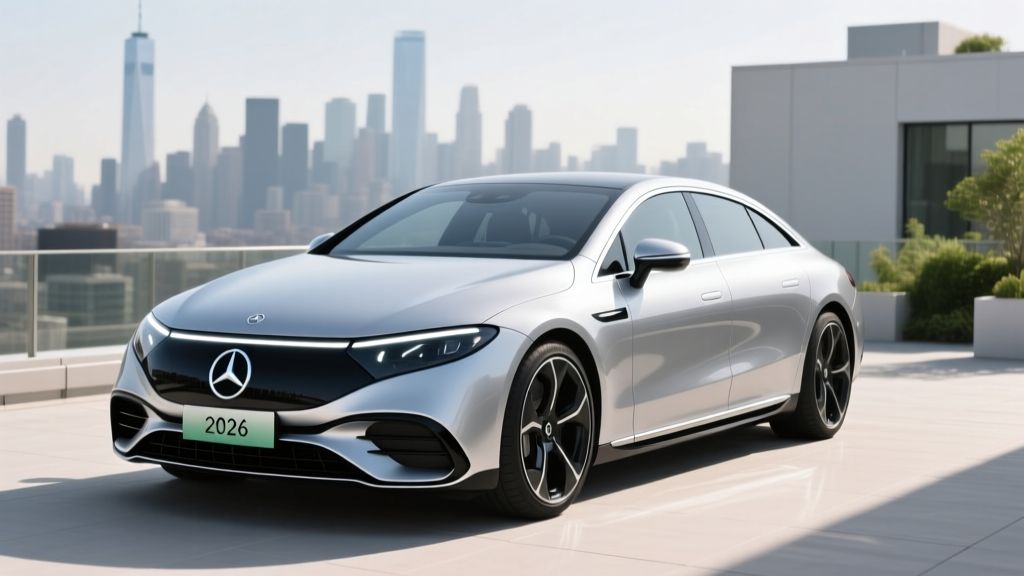
If you've been searching for the EQS meaning, you're not alone — Mercedes-Benz's naming convention for its electric lineup isn't immediately obvious. Here's the breakdown: EQ stands for "Electric Intelligence" (Mercedes' EV sub-brand), and S designates the S-Class tier — the flagship, full-size luxury sedan. Put together, the EQS is the electric equivalent of the S-Class, sitting at the top of Mercedes' battery-powered hierarchy.
The 2026 Mercedes-Benz EQS sedan carries that flagship mandate into its latest model year with revised battery chemistry, improved efficiency, and the unmistakable Hyperscreen dashboard. But does the luxury-EV benchmark still hold up against fresher rivals from Lucid, Tesla, and BMW? Let's get into the numbers.
2026 EQS Sedan: Core Specifications at a Glance
| Spec | EQS 450+ (RWD) | EQS 450 4MATIC (AWD) | EQS 580 4MATIC (AWD) | AMG EQS (Performance) |
|---|---|---|---|---|
| EPA Range | 390 mi | 365 mi | 345 mi | 315 mi |
| Battery (Usable) | 118 kWh (NMC) | 118 kWh (NMC) | 118 kWh (NMC) | 118 kWh (NMC) |
| Horsepower | 355 hp | 355 hp | 536 hp | 649 hp (751 w/ Race Start) |
| 0–60 mph | 5.9 sec | 5.3 sec | 4.1 sec | 3.4 sec |
| Drivetrain | RWD (single motor) | AWD (dual motor) | AWD (dual motor) | AWD (dual motor, AMG-tuned) |
| Efficiency (MPGe) | 97 MPGe combined | 91 MPGe combined | 87 MPGe combined | 79 MPGe combined |
| kWh/100 mi | 34 | 37 | 39 | 43 |
| Base MSRP | $105,550 | $108,550 | $127,350 | $152,000 |
Sources: EPA fueleconomy.gov, Mercedes-Benz USA press specs.
Range and Efficiency: Sticker vs. Reality
EPA Estimate: 390 miles
Real-World Highway (70–75 mph): ~310–330 miles
Real-World Cold Weather (below 32°F): ~260–290 miles
Best-Case City/Mixed (mild temps, moderate speeds): ~370–390 miles
The EQS 450+ posts an EPA-estimated 390 miles — one of the highest figures in the luxury EV sedan segment, trailing only the Lucid Air Grand Touring. That number is achievable in mixed suburban driving at moderate speeds in temperate conditions. The 118 kWh usable battery (nickel-manganese-cobalt / NMC chemistry) provides genuine long-distance capability.
However, physics matters. At sustained highway speeds of 75 mph, expect roughly 310–330 miles before you're hunting for a charger. The EQS is a large, heavy sedan (curb weight exceeds 5,600 lbs), and aerodynamic drag scales with the square of velocity. In sub-freezing temperatures, battery thermal management draws additional energy, and cabin heating (the EQS uses a heat pump, which helps) still cuts range by 20–30%. If your commute involves high-speed interstate driving in winter, plan around 260–280 miles of practical range.
Efficiency for the 450+ comes in at 97 MPGe combined (34 kWh/100 mi) per fueleconomy.gov. That's competitive with the BMW i7 xDrive60 (89 MPGe) but below the more aero-optimized Lucid Air (131 MPGe). The EQS trades some efficiency for its substantial mass and luxury insulation.
Charging Speed: DC Fast Charge and Home Level 2
| Charging Method | Power / Rate | Time / Miles Added |
|---|---|---|
| DC Fast Charge (Peak) | 200 kW | 10–80% in ~31 minutes |
| DC Fast Charge (Sustained Avg) | ~140–160 kW (10–80%) | ~180 mi in 20 min |
| Level 2 Home (240V, 48A) | 11.5 kW | ~33 mi/hr of charging |
| Level 2 Home (240V, 32A) | 7.7 kW | ~22 mi/hr of charging |
| Level 1 (120V, 12A) | 1.4 kW | ~4 mi/hr of charging |
The EQS supports a peak DC fast-charge rate of 200 kW via its CCS1 connector (a NACS adapter is available from Mercedes for Tesla Supercharger access). At peak rate, you'll add roughly 180 miles in about 20 minutes — enough for most highway rest stops. The 10–80% charge takes approximately 31 minutes under ideal battery-temperature conditions.
Charging-curve reality: The 200 kW peak is not sustained across the full session. The EQS holds strong power from roughly 10% to 40% SoC, then tapers progressively. Above 80%, the rate drops sharply — this is standard lithium-ion behavior to protect cell longevity. If you're road-tripping, plan stops around the 10–80% window for maximum throughput. Charging from 80–100% can add another 25+ minutes.
For home Level 2 charging, the onboard charger accepts up to 11.5 kW (48 amps at 240V). A full charge from near-empty takes about 11–12 hours. Most owners will plug in overnight and wake to a full battery every morning. A 48-amp hardwired Level 2 station (such as a ChargePoint Home Flex or Wallbox Pulsar Plus) is recommended. Installation typically runs $800–$2,000 depending on panel proximity and local permitting — budget extra if your home needs a 200-amp panel upgrade.
The EQS also supports preconditioning: when you set a DC fast-charge destination in the navigation system, the car warms or cools the battery to optimal temperature before arrival, maximizing charge speed. Always use this feature — skipping preconditioning in cold weather can cut peak charge rate by 30–50%.
Performance and Driving Dynamics
The EQS lineup spans a wide performance envelope:
- EQS 450+ (RWD): 355 hp, 0–60 in 5.9 seconds. Smooth, effortless acceleration — the single rear motor provides satisfying thrust without urgency. This is the efficiency-focused pick.
- EQS 450 4MATIC (AWD): 355 hp, 0–60 in 5.3 seconds. The dual-motor setup adds all-weather traction and slightly quicker off-the-line response.
- EQS 580 4MATIC: 536 hp, 0–60 in 4.1 seconds. Genuinely quick for a 5,600-lb sedan — this is where the EQS starts to feel like a performance car disguised as a limousine.
- AMG EQS: 649 hp (751 hp with Race Start), 0–60 in 3.4 seconds. Ferocious, but the range penalty is steep (315 mi EPA).
All trims feature air suspension with adaptive damping, rear-axle steering (up to 10 degrees, shrinking the turning circle to a compact-car-like 35.4 feet), and one-pedal driving with adjustable regen levels. The EQS isn't a sports sedan — it's a luxury cruiser that happens to be fast. Body control is excellent, but steering feel is deliberately muted. If you want engagement, look at the Porsche Taycan; if you want serenity, the EQS delivers.
Interior, Cargo, and Technology
The EQS cabin is dominated by the optional MBUX Hyperscreen — a 56-inch curved glass panel spanning the entire dashboard, housing three displays (12.3-inch driver cluster, 17.7-inch central OLED, 12.3-inch passenger screen). It's visually stunning, though some drivers find the touch-heavy interface distracting compared to physical controls. A more traditional dual-screen layout is standard on base trims.
Passenger space:
- Front headroom: 40.4 in | Front legroom: 41.7 in
- Rear headroom: 38.1 in | Rear legroom: 42.1 in
- Rear seats offer limousine-grade legroom — this is a chauffeur-friendly cabin
Cargo volume: 22.0 cu ft (trunk) — generous for a full-size sedan, aided by the hatchback-style liftback design. The EQS also includes a small front trunk (frunk), though it's best suited for charging cables rather than luggage.
Driver-assistance tech: The EQS comes equipped with Mercedes' latest Drive Pilot system (where approved). Drive Pilot is a SAE Level 3 system — meaning the car can handle all driving tasks under specific conditions (mapped highways, below 40 mph, clear weather) while the driver disengages. This is a significant step above Level 2 systems like Autopilot or BlueCruise, where driver supervision is continuously required. Drive Pilot availability remains limited to approved highway segments in Nevada and California as of 2026.
Drive Pilot operates at SAE Level 3 (conditional automation) under strict operational design domains: pre-mapped divided highways, speeds below 40 mph, good weather, and daylight. Outside these conditions, the EQS reverts to Level 2 driver-assist (Distronic adaptive cruise + active steering), which requires continuous driver attention and hands-on or eyes-on engagement. This is not a "self-driving" car — it is a highly capable driver-assist system with a narrow Level 3 envelope.
Pricing, Trims, and Federal Tax Credit Eligibility
| Trim | Base MSRP | As-Tested (Typical Options) | Federal §30D Credit | Effective Price After Credit |
|---|---|---|---|---|
| EQS 450+ Sedan | $105,550 | $112,000–$118,000 | $0 (MSRP cap exceeded*) | $105,550+ |
| EQS 450 4MATIC | $108,550 | $115,000–$122,000 | $0 (MSRP cap exceeded*) | $108,550+ |
| EQS 580 4MATIC | $127,350 | $138,000–$148,000 | $0 (MSRP cap exceeded*) | $127,350+ |
| AMG EQS | $152,000 | $165,000+ | $0 (MSRP cap exceeded*) | $152,000+ |
*Critical tax credit note: Under current IRS §30D rules, new clean vehicle credits are capped at $80,000 MSRP for sedans. Every EQS sedan trim exceeds this cap, meaning no 2026 EQS qualifies for the federal $7,500 new-vehicle tax credit. Additionally, buyer income caps apply ($150K single / $300K joint for new vehicles), and battery critical-mineral and component sourcing requirements further restrict eligibility for many luxury imports.
If you're considering the EQS, budget for the full MSRP. The point-of-sale transfer option (which lets buyers apply the credit as a purchase-price discount at the dealer) does not change the MSRP-cap disqualification.
State incentives may still apply — some states offer rebates or HOV-lane access for EVs regardless of MSRP. Check your state's energy office or DMV for current programs.
Warranty and Battery Longevity
- New Vehicle Warranty: 4 years / 50,000 miles
- Powertrain Warranty: 6 years / 62,000 miles
- High-Voltage Battery Warranty: 8 years / 100,000 miles (capacity retention above 70% of original)
- Corrosion Warranty: 6 years / unlimited miles
The 8-year/100,000-mile battery warranty is standard for the luxury EV segment and aligns with federal requirements. Mercedes guarantees the battery will retain at least 70% of its original capacity during this period. NMC chemistry in the EQS has shown modest degradation in early model-year data — most owners report 3–5% loss after 30,000 miles, which is typical. The 118 kWh usable capacity provides a large buffer: even at 70% retention, you'd still have ~83 kWh and roughly 270+ miles of range.
For long-term ownership beyond the warranty window, high-voltage battery replacement for the EQS is estimated at $20,000–$30,000 based on current parts pricing — a figure to consider if you plan to keep the vehicle past 100,000 miles.
Pros and Cons
✅ Pros
- Class-leading 390-mile EPA range (450+)
- Exceptionally quiet, refined ride quality
- Rear-axle steering makes it surprisingly maneuverable
- Genuine Level 3 Drive Pilot capability (where approved)
- Massive 118 kWh battery with strong highway reserve
- Heat pump standard — better cold-weather efficiency
❌ Cons
- MSRP exceeds §30D cap — no federal tax credit
- 200 kW peak charge rate trails Hyundai/Kia 800V rivals
- Hyperscreen can be distracting; limited physical controls
- Heavy (5,600+ lbs) — tires and brakes wear faster
- Styling is polarizing (one-bow silhouette reduces trunk opening)
- High insurance premiums typical of six-figure EVs
How the EQS Compares to Key Rivals
| Attribute | Mercedes EQS 450+ | Lucid Air Pure | BMW i7 xDrive60 | Tesla Model S LR |
|---|---|---|---|---|
| EPA Range | 390 mi | 419 mi | 318 mi | 402 mi |
| Battery (kWh) | 118 (NMC) | 88 (NMC) | 101.7 (NMC) | 100 (est.) |
| Peak DC Charge | 200 kW | 220 kW | 195 kW | 250 kW |
| 0–60 mph | 5.9 sec | 5.2 sec | 4.5 sec | 3.1 sec |
| Base MSRP | $105,550 | $75,000 | $120,650 | $79,990 |
| §30D Credit | ❌ (MSRP cap) | ❌ (sourcing) | ❌ (MSRP cap) | ❌ (MSRP cap) |
| Efficiency (MPGe) | 97 | 131 | 89 | 120 |
Decision Framework: Who Should Buy the EQS?
Choose the EQS if: You prioritize ride comfort, cabin silence, and brand prestige above all else. You want S-Class luxury with electric powertrain smoothness. You value Level 3 Drive Pilot availability and don't mind paying full MSRP without a federal credit. You drive a mix of city and highway and want genuine 350+ mile real-world range.
Look elsewhere if: You want maximum efficiency per kWh (Lucid Air is 35% more efficient). You need the fastest charging for frequent road trips (Tesla's 250 kW Supercharger network advantage). You want the lowest entry price in a luxury EV sedan (Tesla Model S, Lucid Air Pure). Performance driving matters more than comfort (Porsche Taycan, Tesla Model S Plaid).
Frequently Asked Questions
What does EQS mean in Mercedes-Benz naming?
EQS stands for "Electric Intelligence, S-Class" — it's Mercedes' battery-electric flagship sedan, positioned as the EV equivalent of the S-Class. The "EQ" prefix applies across Mercedes' EV lineup (EQA, EQB, EQC, EQE, EQS), with the letter indicating the size/tier, mirroring the A-through-S hierarchy of their combustion models.
What is the real-world range of the 2026 EQS?
The EQS 450+ is EPA-rated at 390 miles. In real-world highway driving at 70–75 mph, expect 310–330 miles. In cold weather (below freezing), that drops to roughly 260–290 miles. City driving in mild conditions can approach the EPA figure. AWD and AMG trims sacrifice 25–75 miles of range for added power and traction.
How fast does the EQS charge at home and on the road?
On a DC fast charger, the EQS peaks at 200 kW, completing a 10–80% charge in about 31 minutes. At home on a 48-amp Level 2 charger (240V), it charges at 11.5 kW, adding roughly 33 miles of range per hour — a full overnight charge from near-empty takes 11–12 hours.
Does the 2026 EQS qualify for the $7,500 federal EV tax credit?
No. Under current IRS §30D rules, the federal new-vehicle EV tax credit is capped at $80,000 MSRP for sedans. Every EQS trim starts well above that threshold, so none qualify. Buyer income limits and battery-sourcing requirements would further restrict eligibility even if the price cap weren't an issue. Always verify current rules at IRS.gov.
Is the EQS worth buying over the Lucid Air or Tesla Model S?
It depends on your priorities. The EQS wins on ride refinement, cabin quietness, and S-Class luxury ambiance. The Lucid Air offers superior range (419 mi) and efficiency at a lower price. The Tesla Model S delivers far more performance at a fraction of the cost, plus Supercharger network access. If brand prestige and ride comfort are paramount, the EQS justifies its price. If value or efficiency matter more, the Lucid or Tesla are stronger choices.
What battery chemistry does the EQS use?
The 2026 EQS uses NMC (nickel-manganese-cobalt) lithium-ion cells with 118 kWh of usable capacity. NMC offers high energy density, which is why the EQS achieves its 390-mile range in a physically manageable battery pack. The trade-off versus LFP (lithium iron phosphate) chemistry is slightly faster long-term degradation and a lower cycle-life ceiling, though Mercedes' 8-year/100,000-mile battery warranty provides a strong backstop.
How much does it cost to charge an EQS at home?
At the US average residential electricity rate of ~$0.17/kWh, a full 118 kWh charge costs approximately $20. That's roughly $0.05 per mile — compared to $0.12–$0.16 per mile for a comparable gas-powered S-Class at $3.50/gallon and 22 MPG. Over 15,000 miles per year, home charging saves roughly $1,000–$1,500 versus gasoline.