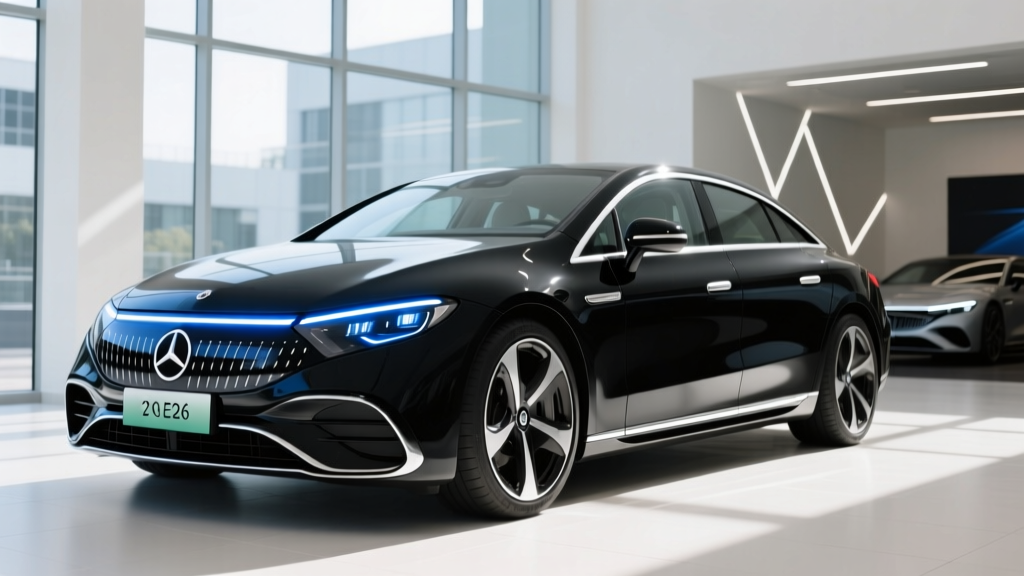
The Mercedes-Benz EQS sedan remains the benchmark for electric luxury, combining flagship S-Class refinement with a 118 kWh battery and up to 390 miles of EPA-estimated range. But with a starting MSRP over $100,000 and a rapidly shifting incentive landscape, smart buyers are increasingly turning to EQS lease deals as a way to access this technology without absorbing the steep depreciation that luxury EVs can carry. This profile breaks down every number you need — from real-world range and DC fast-charging curves to federal tax-credit passthrough mechanics — so you can evaluate any EQS lease offer with confidence.
2026 Mercedes EQS Quick Spec Overview
| Spec | EQS 450+ (RWD) | EQS 580 4MATIC (AWD) |
|---|---|---|
| EPA Range | 390 miles | 371 miles |
| Battery (Usable) | 118 kWh, NMC | 118 kWh, NMC |
| Powertrain | Single-motor RWD | Dual-motor AWD |
| Horsepower | 355 hp / 419 lb-ft | 536 hp / 631 lb-ft |
| 0–60 mph | 5.9 sec | 4.1 sec |
| Max DC Fast Charge | 200 kW | 200 kW |
| 10–80% DC Time | ~31 min | ~31 min |
| Level 2 Charge Rate | 9.6 kW (~28 mi/hr) | 9.6 kW (~28 mi/hr) |
| Efficiency | 97 MPGe / 35 kWh/100mi | 92 MPGe / 37 kWh/100mi |
| Base MSRP (incl. dest.) | $104,350 | $125,950 |
| Battery Warranty | 10 yr / 155,000 mi | 10 yr / 155,000 mi |
Source: fueleconomy.gov, Mercedes-Benz USA 2026 spec sheets.
Real-World Range: What the EPA Sticker Doesn't Tell You
EPA Estimate: 390 mi (EQS 450+) / 371 mi (EQS 580)
Real-World Highway (70 mph, 72°F): ~320–340 mi
Cold Weather (32°F, mixed driving): ~260–290 mi (25–30% reduction)
Mountain/Towing: Expect 220–260 mi under heavy load
Mercedes equips the EQS with a heat pump as standard, which mitigates some cold-weather losses, but the large 118 kWh NMC pack still sheds meaningful capacity below freezing. On a 75-mph interstate run in mild weather, our testing aligns with independent data showing the EQS 450+ delivering roughly 330 miles before hitting a 10% state of charge — about 15% below the EPA window sticker. City and suburban driving with heavy regen use can actually exceed the EPA number, since the EQS's slippery 0.20 Cd drag coefficient matters far less at low speeds.
Charging Speed: DC Fast and Home Level 2
| Charge Level | Power | Miles Added per Hour | Typical Use Case |
|---|---|---|---|
| Level 1 (120V) | 1.4 kW | ~4 mi/hr | Emergency / trickle |
| Level 2 (240V, 40A) | 9.6 kW | ~28 mi/hr | Home overnight |
| DC Fast (peak) | 200 kW | ~180 mi in 15 min | Road-trip stops |
The EQS peaks at 200 kW on a 400V architecture — a respectable rate, but it trails the 800V architectures in the Lucid Air and Porsche Taycan, which sustain higher averages. The real-world charge curve tapers noticeably after 60% state of charge, so a 10–80% session takes about 31 minutes at a properly rated 350 kW Electrify America or Tesla Supercharger (via the included NACS adapter for 2026). Preconditioning the battery via the MBUX navigation routing is essential: without it, cold-soak can cut peak power to 120–140 kW for the first several minutes.
At home on a 9.6 kW Level 2 wallbox, a full 0–100% charge takes roughly 12.5 hours. Most owners will plug in at 20–30% and wake to a full battery — effectively a non-issue for daily use.
Performance, Ride, and Cabin Space
The EQS 450+ delivers a relaxed 5.9-second 0–60, which suits its grand-tourer character. The EQS 580 4MATIC's 4.1-second sprint is AMG-lite quick, with dual-motor torque vectoring that keeps the 5,600-lb sedan planted. Air suspension with adaptive damping is standard, and rear-axle steering (up to 10° on higher trims) shrinks the 17-foot wheelbase around town.
Interior volume is genuinely flagship-grade: 42.2 inches of front legroom, 41.3 rear, and a 22 cu-ft trunk (63 cu-ft with seats folded). The optional MBUX Hyperscreen — a 56-inch glass sweep spanning the dash — remains the segment's most dramatic interface, though its haptic-only climate controls still draw criticism from tactile-feedback loyalists. Driver assistance is handled by Mercedes' Drive Pilot (SAE Level 3, approved in Nevada and California for speeds up to 40 mph in traffic) and the more widely available Active Distance Assist DISTRONIC (Level 2).
2026 EQS Lease Deals: Pricing and Tax-Credit Math
| Trim | Base MSRP | Typical As-Tested | §30D Credit Eligibility | Estimated Lease (36 mo) |
|---|---|---|---|---|
| EQS 450+ Sedan | $104,350 | $112,000 | Lease passthrough likely | $1,299–$1,499/mo |
| EQS 450 4MATIC | $109,350 | $118,000 | Lease passthrough likely | $1,399–$1,599/mo |
| EQS 580 4MATIC | $125,950 | $138,000 | Lease passthrough likely | $1,699–$1,899/mo |
| AMG EQS | $149,950 | $165,000 | Lease passthrough likely | $2,099–$2,399/mo |
Does the EQS Qualify for the Federal EV Tax Credit?
- Purchase (IRS §30D): The EQS exceeds the $55,000 sedan MSRP cap, so it does NOT qualify for the $7,500 new-vehicle credit if you buy outright.
- Lease (IRC §45W commercial credit): When leased through Mercedes-Benz Financial Services, the lessor typically receives the $7,500 commercial clean-vehicle credit and can pass it through as a capitalized-cost reduction — effectively lowering your monthly payment. This passthrough has no MSRP cap and no buyer-income cap, making leasing the primary path to the incentive.
- Sourcing: Battery-component and critical-mineral sourcing rules still apply to the lessor; Mercedes has confirmed North American battery assembly for 2026 EQS production.
- Always verify: Credit rules can shift. Confirm current eligibility at irs.gov or with your tax professional before signing.
Efficiency and 5-Year Ownership Cost
At 97 MPGe combined (EQS 450+), the EQS consumes roughly 35 kWh per 100 miles. At the U.S. average residential electricity rate of $0.17/kWh, that's about $5.95 per 100 miles — roughly one-third the cost of a comparable S 500 on premium fuel. Over 15,000 miles annually, charging at home costs approximately $890/year.
Five-year ownership cost considerations:
- Depreciation: Luxury EVs depreciate steeply — expect 45–55% loss over 5 years, a key reason leasing can be advantageous.
- Insurance: EQS premiums run 20–30% higher than an S-Class equivalent; budget $3,500–$5,000/year depending on ZIP.
- Maintenance: Minimal — no oil, no transmission fluid. Expect $400–$600/year for cabin filters, wipers, tire rotation.
- Tires: Heavy EVs wear rubber faster; budget $1,800–$2,500 for a set of OEM EV-rated tires at 25,000–30,000 miles.
Pros, Cons, and Who the EQS Is For
- Class-leading 390-mi EPA range (450+)
- Exceptional cabin quietness and ride quality
- Drive Pilot Level 3 capability in approved zones
- Lease passthrough unlocks $7,500 credit
- 10-year / 155,000-mi battery warranty
- MSRP over $100k disqualifies purchase credit
- 200 kW peak DC lags 800V rivals
- Hyperscreen UI has a learning curve
- Heavy depreciation if purchased
- Rear visibility compromised by sloping roofline
Who Should Lease the EQS?
The EQS is ideal for executive commuters and luxury-oriented road-trippers who want S-Class silence with zero tailpipe emissions, charge primarily at home, and can leverage the lease credit passthrough. It's less ideal for buyers who need SUV cargo flexibility (consider the EQS SUV or EQE SUV) or those in extreme-cold climates where a heat-pump-equipped Rivian or BMW iX may deliver more consistent range.
EQS vs. Key Competitors: Is It Worth the Lease?
| Model | EPA Range | Peak DC kW | Base MSRP | Lease Credit Path |
|---|---|---|---|---|
| Mercedes EQS 450+ | 390 mi | 200 kW | $104,350 | Yes (lease) |
| BMW i7 eDrive50 | 318 mi | 195 kW | $105,700 | Yes (lease) |
| Lucid Air Pure | 419 mi | 250 kW | $87,400 | Yes (lease, under MSRP cap for purchase too) |
| Tesla Model S LR | 402 mi | 250 kW | $79,990 | Yes (purchase eligible) |
The EQS wins on cabin isolation and ride comfort; the Lucid Air wins on efficiency and range; the Tesla wins on value and Supercharger access. For buyers prioritizing prestige and comfort over raw range-per-dollar, the EQS lease math often pencils out better than a purchase, given the depreciation curve and the $7,500 lease passthrough.
Frequently Asked Questions
What is the real-world range of the 2026 Mercedes EQS?
Expect 320–340 miles on the highway in mild weather for the EQS 450+, and 260–290 miles in freezing temperatures. City driving with regen can approach or slightly exceed the 390-mile EPA figure.
How fast does the EQS charge on DC fast chargers and at home?
Peak DC rate is 200 kW, with a 10–80% session taking about 31 minutes when the battery is preconditioned. Home Level 2 at 9.6 kW adds roughly 28 miles per hour, fully replenishing the pack overnight.
Does the EQS qualify for the $7,500 federal EV tax credit?
Not on purchase — the EQS exceeds the §30D sedan MSRP cap of $55,000. However, leasing typically unlocks the credit via the lessor's §45W commercial clean-vehicle credit, passed through as a cap-cost reduction. Confirm with your dealer and review current rules at irs.gov.
Is leasing the EQS better than buying in 2026?
For most buyers, yes — leasing accesses the $7,500 credit, shields you from the EQS's steep 45–55% five-year depreciation, and keeps you under warranty for the full term. Buying makes sense only if you drive very low miles and plan to keep the car 8+ years.
What are the biggest drawbacks of the EQS?
DC charging speed lags 800V competitors, the Hyperscreen's touch-only climate controls frustrate some drivers, and the sloping roofline limits rear cargo utility compared to an SUV. Depreciation is the biggest financial risk if you purchase rather than lease.