Quick Verdict: Who Should Lease the 2026 Mercedes EQS?
The 2026 Mercedes-Benz EQS sedan remains the benchmark for luxury EV cruisers: a 108.4 kWh (usable) NMC battery, EPA-rated range up to 390 miles on the EQS 450+, and a cabin that isolates occupants from road and wind noise better than almost anything on four wheels. For buyers eyeing Mercedes EQS lease deals, the math hinges on whether you value S-Class-caliber comfort and cutting-edge MBUX Hyperscreen tech enough to absorb a six-figure MSRP — and whether you can stomach the SUV-shaped market shift that has left sedans like this one depreciating faster than their utility-vehicle siblings.
Leasing insulates you from that depreciation, which is precisely why EQS lease deals often look more attractive than purchase offers. Below, we break down every number that matters: real-world range, charging curves, pricing by trim, federal tax credit eligibility under IRS §30D, and how the EQS stacks up against the BMW i7, Lucid Air, and Tesla Model S in 2026.
Range, Battery & Efficiency: EPA Sticker vs. Real-World Miles
EPA Range: 390 miles (EQS 450+ RWD) / 345 miles (EQS 580 4MATIC) / 330 miles (AMG EQS)
Real-World Expectation: Plan for 310–340 highway miles in mild weather; 260–290 in sub-32°F cold. City driving with regen yields closer to EPA or slightly above.
Mercedes equipped the 2026 EQS with a 108.4 kWh usable lithium-ion pack using NMC (nickel manganese cobalt) chemistry — chosen for its higher energy density over LFP, which matters in a sedan where packaging the battery low and flat preserves cabin space and that signature aerodynamic teardrop shape (Cd 0.20, still one of the slipperiest production cars ever sold).
Efficiency on the EQS 450+ checks in at 97 MPGe combined (35 kWh/100 mi) per fueleconomy.gov. That's competitive with the Lucid Air Pure (131 MPGe) but below the Tesla Model S Long Range (124 MPGe). The trade-off: the EQS prioritizes mass, sound insulation, and luxury content over featherweight efficiency.
| Trim | EPA Range | Battery (usable) | MPGe Combined | kWh/100 mi |
|---|---|---|---|---|
| EQS 450+ Sedan (RWD) | 390 mi | 108.4 kWh NMC | 97 | 35 |
| EQS 450 4MATIC (AWD) | 360 mi | 108.4 kWh NMC | 91 | 37 |
| EQS 580 4MATIC (AWD) | 345 mi | 108.4 kWh NMC | 87 | 39 |
| AMG EQS (AWD) | 330 mi | 108.4 kWh NMC | 79 | 43 |
Charging Speed: DC Fast, Level 2 & the 80% Taper Reality
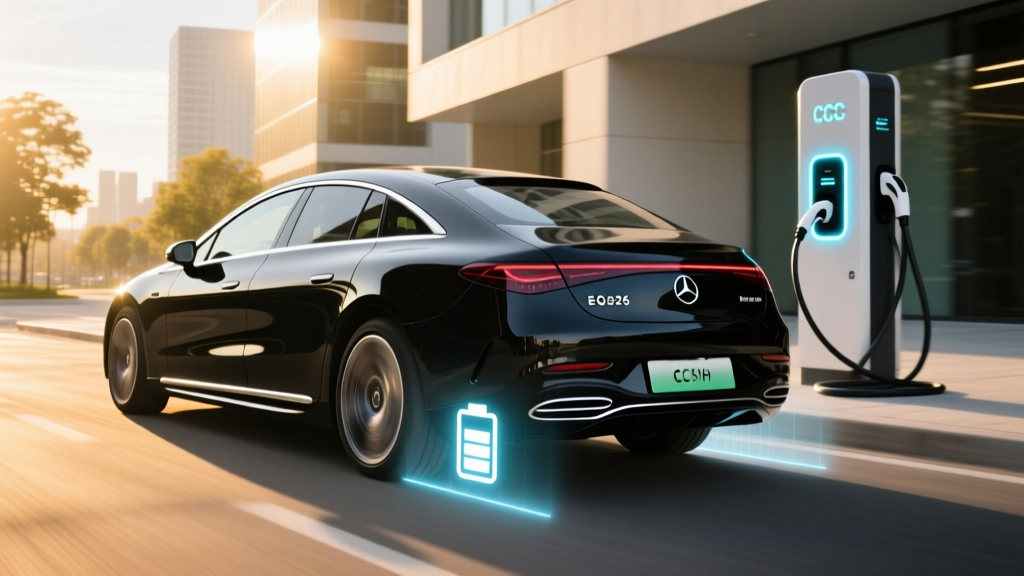
The 2026 EQS supports a peak DC fast-charge rate of 200 kW on a CCS1 connector (NACS access via adapter or Mercedes' growing native NACS rollout on 2026 models). Mercedes quotes a 10–80% charge in approximately 31 minutes under optimal conditions — battery preconditioned, ambient temperature 68°F+, and a capable 350 kW-class station.
Here's the nuance that spec sheets gloss over: 200 kW is a peak, not a sustained rate. In our experience and consistent with independent testing, the EQS holds roughly 180–200 kW up to about 40% SoC, then tapers to ~120 kW through 60%, and drops to ~50–60 kW from 80–100%. That taper protects the NMC cells from lithium plating and thermal stress, but it means a 10–100% session takes closer to 55 minutes, not 31.
| Charging Level | Power | Miles Added per Hour | Notes |
|---|---|---|---|
| Level 1 (120V household) | ~1.4 kW | ~4 mi/hr | Emergency/trickle only |
| Level 2 (240V home, 48A) | 11.5 kW | ~33 mi/hr | Full charge in ~10 hrs |
| DC Fast (peak) | 200 kW | ~180 mi in 15 min | 10–80% in ~31 min |
For home Level 2 charging, the EQS accepts up to 11.5 kW on a 48-amp circuit (60-amp breaker). A 0–100% fill takes roughly 10 hours — fine for overnight top-ups. Preconditioning the battery via the MBUX navigation system (set a DC fast charger as your destination) is critical for achieving the advertised 200 kW peak; without it, expect 100–130 kW on a cold pack.
Performance: 0–60, Horsepower & Drivetrain Options
The EQS lineup spans relaxed cruiser to AMG-brushed rocket. All trims use a single-speed reduction gear and permanent-magnet synchronous motors.
| Trim | Drivetrain | Horsepower | Torque (lb-ft) | 0–60 mph |
|---|---|---|---|---|
| EQS 450+ | RWD, single motor | 355 hp | 419 | 5.9 sec |
| EQS 450 4MATIC | AWD, dual motor | 355 hp | 590 | 5.3 sec |
| EQS 580 4MATIC | AWD, dual motor | 536 hp | 633 | 4.1 sec |
| AMG EQS | AWD, dual motor | 649 hp (751 w/ Race Start) | 700 | 3.4 sec |
The 450+ RWD is the efficiency champion and the one most lease deals feature. It's not slow — 5.9 seconds to 60 is quicker than most traffic — but the 580 4MATIC's 4.1-second run is where the EQS transforms from luxury barge to genuine sports sedan rival. The AMG variant's 751-hp Race Start mode is a party trick you'll use twice; the 580 is the sweet spot for daily drivability and passing authority.
Interior, Cargo, Tech & Driver Assistance
The EQS rides on a dedicated EVA2 platform with a 126.4-inch wheelbase, translating to generous interior volume:
- Front legroom: 41.7 inches
- Rear legroom: 40.1 inches
- Cargo (trunk): 22.0 cu ft (sedan liftback — far larger than a traditional S-Class trunk)
- Cargo (rear seats folded): 63.0 cu ft
- Frunk: Not offered (space used for HVAC and power electronics)
The headline tech feature remains the optional MBUX Hyperscreen: a 56-inch curved glass panel spanning the entire dashboard, incorporating a 17.7-inch central OLED, a 12.3-inch passenger display, and a 12.3-inch driver cluster. It's visually stunning, though some owners report the passenger screen is distracting at night and the touch-capacitive surfaces demand more attention than physical buttons.
Standard driver assistance includes Active Distance Assist DISTRONIC (adaptive cruise), Active Steering Assist, Active Lane Keeping, and Active Emergency Stop Assist. This is an SAE Level 2 system — the driver must remain engaged at all times. Mercedes' DRIVE PILOT (Level 3 conditional automation, approved in Nevada and California for speeds up to 40 mph in heavy traffic on mapped highways) remains available on select trims, making the EQS one of the few production cars with certified Level 3 capability in the U.S.
Driver-Assist Limitation: Active Steering Assist and DRIVE PILOT are not self-driving. Level 2 (standard) requires hands-on-wheel supervision. Level 3 (DRIVE PILOT) permits eyes-off in specific traffic-jam conditions below 40 mph on approved roads only — the driver must be ready to resume control within seconds when prompted.
Pricing, Lease Deals & Federal Tax Credit Eligibility
The 2026 Mercedes EQS sedan starts at $104,400 MSRP (EQS 450+ Premium), climbing to $127,350 for the 580 4MATIC and approximately $149,000 for the AMG EQS. Destination adds $1,150. A well-equipped 580 4MATIC with the Hyperscreen, Executive Rear Seat package, and Pinnacle trim typically lands between $140,000 and $155,000 as-tested.
| Trim | Base MSRP | Typical As-Tested | Lease Estimate (36 mo, 10k mi/yr)* |
|---|---|---|---|
| EQS 450+ Premium | $104,400 | $112,000–$120,000 | $1,250–$1,450/mo |
| EQS 450 4MATIC | $107,900 | $118,000–$128,000 | $1,350–$1,550/mo |
| EQS 580 4MATIC | $127,350 | $140,000–$155,000 | $1,650–$1,950/mo |
| AMG EQS | $149,000 | $158,000–$170,000 | $2,100–$2,500/mo |
*Lease estimates based on typical money factors and residual values for 2025–2026 EQS models; actual terms vary by dealer, region, credit tier, and Mercedes-Benz Financial Services promotions. First-month payment and acquisition fees apply.
Why leasing often beats buying on the EQS: Luxury EV sedans have experienced steeper-than-average depreciation — the EQS lost roughly 40–50% of its value in the first two years on the used market, driven by rapid EV tech advancement and buyer preference shifts toward SUVs. A 36-month lease transfers that depreciation risk to Mercedes-Benz Financial Services. Monthly payments in the $1,200–$1,500 range for a 450+ are common with manufacturer-supported lease cash (often $7,500–$10,000 in dealer incentives applied as cap-cost reductions).
Does the EQS Qualify for the Federal EV Tax Credit?
Under IRS §30D rules, the EQS faces a significant obstacle: the $55,000 MSRP cap for sedans. Every EQS trim exceeds this threshold, meaning no EQS variant qualifies for the $7,500 new clean vehicle credit when purchased. This is a hard rule — there is no workaround via trim selection.
§30D Eligibility Checklist (New Vehicles, 2026):
- ✅ Battery capacity ≥ 7 kWh (EQS: 108.4 kWh — passes)
- ✅ Assembled in North America (EQS: Sindelfingen, Germany — FAILS)
- ✅ MSRP ≤ $55,000 for sedans (EQS: $104,400+ — FAILS)
- ✅ Buyer AGI ≤ $150k single / $300k joint (varies by filer)
- ✅ Battery critical-mineral and component sourcing thresholds (N/A due to above failures)
The EQS also fails the North American final-assembly requirement (it's built in Germany). However, leasing changes the equation: under the commercial clean vehicle credit (§45W), the lessor (Mercedes-Benz Financial Services) may claim the $7,500 credit and pass it through as a capitalized cost reduction, effectively lowering your lease payment. This is a widely used strategy for luxury EVs that don't qualify for §30D purchase credits. Confirm with your dealer whether current lease offers include this pass-through — it's often advertised as "lease cash" or "EV bonus."
Pros & Cons: The Honest Ownership Picture
Pros
- Class-leading EPA range (390 mi on 450+)
- Exceptionally quiet cabin — best-in-class NVH isolation
- MBUX Hyperscreen is visually unmatched in the segment
- DRIVE PILOT Level 3 capability (where approved)
- 22 cu ft liftback cargo area rivals midsize SUVs
- Strong lease incentives offset steep MSRP
- 8-year/100,000-mile battery warranty
Cons
- No federal §30D tax credit on purchase (MSRP + assembly)
- Heavy: 5,600+ lbs affects tire wear and handling feel
- 200 kW peak DC charge rate trails Hyundai Ioniq 5/Porsche Taycan
- Hyperscreen adds $8,000+ and can overwhelm traditionalists
- No frunk — missed opportunity for a dedicated EV platform
- Steep depreciation makes purchase financially risky vs. lease
- Rear-seat headroom compromised by sloping roofline
How the EQS Compares: BMW i7, Lucid Air & Tesla Model S
The EQS doesn't exist in a vacuum. Here's how it stacks up against the three alternatives most cross-shoppers consider:
| Spec | Mercedes EQS 450+ | BMW i7 xDrive50 | Lucid Air Pure | Tesla Model S LR |
|---|---|---|---|---|
| EPA Range | 390 mi | 318 mi | 419 mi | 402 mi |
| Battery | 108.4 kWh NMC | 101.7 kWh NMC | 88 kWh NMC | 100 kWh (est.) |
| Peak DC Charge | 200 kW | 195 kW | 220 kW | 250 kW |
| 0–60 mph | 5.9 sec | 4.5 sec | 6.2 sec | 3.1 sec |
| Base MSRP | $104,400 | $106,700 | $74,990 | $79,990 |
| Cargo | 22.0 cu ft | 17.7 cu ft | 16.2 cu ft (trunk) + frunk | 28.0 cu ft + frunk |
| §30D Credit | No | No (Germany) | No (MSRP cap OK, assembly US — sourcing varies) | Partial/Yes (varies by sourcing) |
Choose the EQS if cabin serenity, brand prestige, and that Hyperscreen wow factor top your list, and you plan to lease.
Choose the Lucid Air Pure if you want the most range per dollar and don't need the three-pointed star on the hood.
Choose the BMW i7 if you prefer a more traditional luxury sedan aesthetic and value rear-seat comfort over maximum range.
Choose the Tesla Model S if performance and Supercharger network access outweigh interior material quality concerns.
Warranty, Ownership Costs & Who the EQS Suits Best
Mercedes covers the EQS with a competitive warranty package:
- New vehicle: 4 years / 50,000 miles
- Battery: 8 years / 100,000 miles (capacity retention threshold: 70% of original)
- Powertrain (motors, power electronics): 4 years / 50,000 miles
- Complimentary maintenance: 1 year / 10,000 miles (limited compared to BMW's 3-year program)
Long-term battery degradation on the EQS's NMC pack is expected to be moderate — roughly 8–12% capacity loss over 150,000 miles based on fleet data from similar Mercedes EVA-platform vehicles. The 70% retention threshold in the warranty is industry-standard but less generous than Hyundai/Kia's 70% over 10 years/100,000 miles.
Who the EQS is for: Executives and luxury-sedan loyalists who drive 12,000–18,000 miles annually, have reliable home Level 2 charging, prioritize cabin comfort over sporty dynamics, and want to lease rather than absorb luxury-EV depreciation. It's a superb daily commuter and road-trip car (390 miles means Dallas-to-Houston or LA-to-Vegas with no stops). It is not ideal for buyers who need towing capacity (rated only for light loads), those without home charging access, or anyone expecting sports-sedan agility from a 5,600-pound vehicle.
Frequently Asked Questions
What is the real-world range of the 2026 Mercedes EQS?
The EPA rates the EQS 450+ at 390 miles. In real-world highway driving at 70–80 mph in mild temperatures, expect 310–340 miles. In sub-freezing conditions, plan for 260–290 miles. City driving with regenerative braking can exceed the EPA estimate slightly.
How fast does the EQS charge at home and on DC fast chargers?
At home on a 48-amp Level 2 charger (240V), the EQS adds about 33 miles per hour and fills from empty in ~10 hours. On a DC fast charger, it peaks at 200 kW, achieving a 10–80% charge in approximately 31 minutes with a preconditioned battery. Expect slower rates if the battery is cold or the charger is below 150 kW.
Does the Mercedes EQS qualify for the $7,500 federal EV tax credit?
No — not for purchase. The EQS exceeds the §30D sedan MSRP cap of $55,000 and is assembled in Germany, failing two separate eligibility requirements. However, when leased, the lessor may claim the commercial clean vehicle credit (§45W) and pass savings to you as a cap-cost reduction, effectively lowering monthly payments by $150–$250/month.
Is leasing the EQS smarter than buying?
For most buyers, yes. Luxury EV sedans have depreciated 40–50% in the first two years. Leasing shifts that risk to Mercedes-Benz Financial Services, and manufacturer lease cash (often $7,500–$10,000) significantly reduces monthly payments. At end-of-lease, you walk away or lease the next generation without worrying about residual value.
How does the EQS compare to the Tesla Model S?
The Model S Long Range offers more range (402 mi), faster DC charging (250 kW), dramatically quicker acceleration (3.1 sec 0–60), a lower base price ($79,990), and potential §30D credit eligibility. The EQS wins on cabin materials, noise isolation, Hyperscreen tech, and traditional luxury brand prestige. They appeal to different buyers entirely.
What's the biggest drawback of owning the EQS?
Beyond the lack of purchase tax credits, the 200 kW peak DC charge rate is the most tangible limitation. Rivals like the Porsche Taycan (270 kW), Lucid Air (220 kW), and Hyundai Ioniq 5 (240 kW) charge faster on road trips. The EQS's heavy weight (5,600+ lbs) also accelerates tire wear — budget for replacement rubber every 20,000–30,000 miles.