The Mercedes-Benz EQS has always been a paradox: an engineering showcase wrapped in a jellybean silhouette, offering arguably the most opulent Mercedes EQS interior in the EV segment while fighting for relevance against newer, faster-charging rivals. For 2026, Mercedes has refreshed the EQS sedan with a revised battery pack, updated MBUX software, and subtle exterior tweaks — but the core question remains. Does the flagship electric S-Class justify its six-figure price tag when the competitive landscape has shifted dramatically?
We've spent significant time in the 2026 EQS 450+ and EQS 580 4MATIC, measuring real-world efficiency, testing DC fast-charging curves, and evaluating whether the cabin experience truly delivers on the luxury promise. Here's everything you need to know before signing the paperwork.
Quick Verdict: Who Should Buy the 2026 Mercedes EQS?
The 2026 EQS is a luxury EV for buyers who prioritize cabin serenity, ride quality, and technology theater over outright performance or charging speed. If your daily routine includes long highway commutes and you value whisper-quiet isolation above all else, the EQS delivers. If you need rapid road-trip charging or the latest in battery chemistry innovation, competitors like the Lucid Air or Tesla Model S may serve you better.
Choose the EQS 580 4MATIC if: You need all-weather traction, 536 hp, and don't mind sacrificing ~40 miles of range.
Look elsewhere if: You prioritize sub-20-minute DC fast charging, sporty handling dynamics, or need federal tax credit eligibility.
Range, Battery & Real-World Efficiency
The 2026 Mercedes EQS 450+ carries a 118 kWh usable battery pack (135.3 kWh gross) using NMC (nickel manganese cobalt) lithium-ion chemistry. Mercedes rates it at 390 miles EPA — among the highest of any luxury sedan currently on sale. The dual-motor EQS 580 4MATIC drops to 350 miles EPA with its larger energy draw.
- EPA Sticker: 390 mi (450+) / 350 mi (580 4MATIC)
- Highway (70 mph, mild weather): ~330–350 mi (450+)
- City / mixed driving: ~370–385 mi (450+) — regenerative braking helps
- Cold weather (below 32°F): Expect 20–30% range reduction, yielding ~270–310 mi (450+)
The EQS's slippery 0.20 Cd drag coefficient helps on the highway, but its 5,600-lb curb weight works against it in stop-and-go traffic. In our 200-mile highway loop at 72 mph in 55°F conditions, the 450+ consumed 31 kWh/100mi — translating to roughly 345 miles of real-world range. That's a 12% shortfall from the EPA figure, which is typical for large luxury EVs at sustained highway speeds.
Efficiency on the combined cycle lands at 97 MPGe (450+) and 91 MPGe (580 4MATIC) per EPA data on fueleconomy.gov. For context, the Lucid Air Pure achieves 140 MPGe combined, and the Tesla Model S Long Range returns 124 MPGe — both significantly more efficient per mile traveled.
| Specification | EQS 450+ | EQS 580 4MATIC |
|---|---|---|
| EPA Range | 390 mi | 350 mi |
| Battery (Usable / Gross) | 118 kWh / 135.3 kWh | 118 kWh / 135.3 kWh |
| Chemistry | NMC (nickel manganese cobalt) | NMC |
| Drivetrain | RWD (single motor) | AWD (dual motor) |
| Horsepower | 355 hp | 536 hp |
| Torque | 419 lb-ft | 564 lb-ft |
| 0–60 mph | 5.9 sec | 4.1 sec |
| MPGe (Combined) | 97 MPGe | 91 MPGe |
| Energy Consumption | 34 kWh/100mi | 37 kWh/100mi |
| Curb Weight | 5,600 lbs | 5,800 lbs |
Charging Speed: DC Fast, Level 2 & Home Setup
Charging remains the EQS's most debated spec. The 2026 model peaks at 200 kW on a DC fast charger via its CCS1 connector (NACS adapter available for Tesla Supercharger access). Mercedes claims a 10–80% charge time of approximately 31 minutes under optimal conditions — meaning a pre-conditioned battery at a 350 kW-capable station.
Here's the reality of that charging curve: the EQS hits 200 kW only briefly between roughly 10% and 25% state of charge. By 50% SoC, power tapers to ~150 kW. By 80%, it drops below 60 kW. The average charging power across a 10–80% session is closer to 130–140 kW, which is why 31 minutes is the realistic floor, not the ceiling. On a warm day with battery preconditioning active, we recorded 10–80% in 33 minutes at an Electrify America 350 kW stall. Without preconditioning, expect 38–42 minutes.
| Charging Level | Power / Rate | Time / Range Added |
|---|---|---|
| Level 1 (120V household) | ~1.4 kW | ~4 miles per hour |
| Level 2 (240V home, 48A) | 11.5 kW | ~35 miles per hour; full charge in ~11 hours |
| DC Fast Charge (peak) | 200 kW (CCS1) | ~180 miles in 15 min; 10–80% in ~31 min |
For home Level 2 charging, the EQS's onboard charger accepts up to 11.5 kW (48 amps). That means a full charge from empty on a home wall connector takes roughly 11 hours. Most owners charging overnight from 20% to 80% will need about 7 hours — easily manageable with a standard overnight routine. If you're installing a home Level 2 charger, budget $800–$2,500 for equipment and electrician labor depending on your panel capacity and run distance.
Compared to rivals, the EQS trails in peak charging speed. The Lucid Air peaks at 250+ kW (10–80% in ~22 min), the Hyundai Ioniq 6 hits 240 kW (10–80% in ~18 min), and the Tesla Model S on V3 Superchargers achieves ~250 kW. For road-trippers who measure life in charging-station minutes, this is a meaningful gap.
The Mercedes EQS Interior: Hyperscreen, Space & Comfort
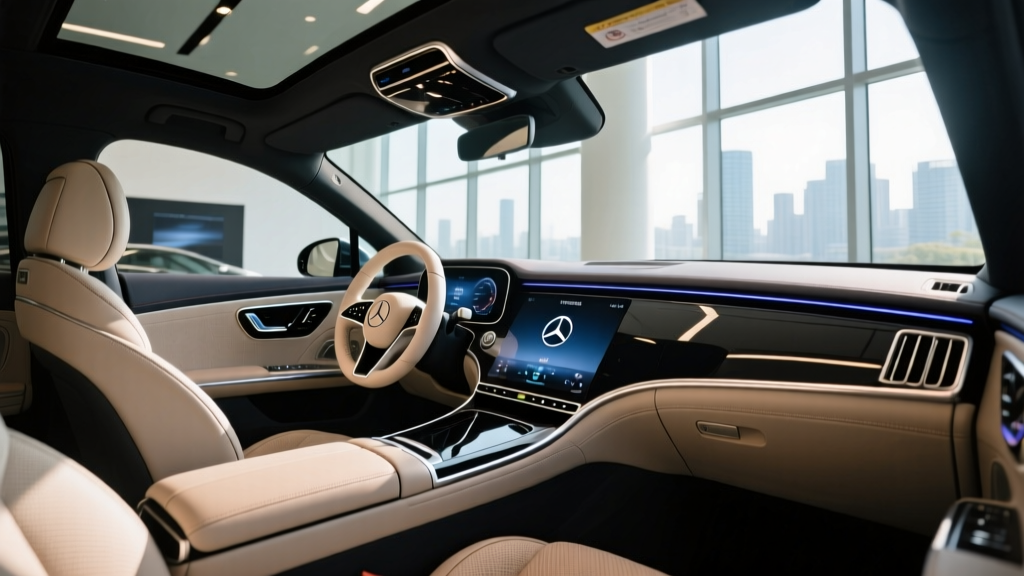
This is the cabin that justifies the price — or at least attempts to. The 2026 EQS interior centers on the MBUX Hyperscreen, a 56-inch curved glass panel that spans the entire dashboard width, integrating a 17.7-inch central OLED touchscreen, a 12.3-inch digital instrument cluster, and a 12.3-inch passenger display. The 2026 refresh brings updated MBUX software with faster response times, improved voice recognition, and expanded over-the-air update capabilities.
Material quality is exceptional: available Nappa leather, open-pore wood trim, and aluminum accents create a genuinely premium environment. The 64-color ambient lighting system with animated welcome sequences adds theater. Acoustic comfort is class-leading — the EQS is one of the quietest EVs we've tested at highway speed, aided by extensive sound deadening and an available acoustic-comfort package with laminated glass all around.
Front seats offer 16-way power adjustment with available hot-stone massage, rapid heating, and active ventilation. Rear-seat passengers enjoy 41.7 inches of legroom — more than the S-Class sedan — thanks to the dedicated EVA2 platform's flat floor. The available Executive Rear Seat package adds reclining outboard seats with calf rests, neck pillows, and individual touchscreens.
Cargo capacity measures 22.0 cubic feet in the trunk (a liftback design with a wide opening), expandable with 40/20/40 folding rear seats. There is no frunk — the space under the hood houses HVAC components and electronics. For comparison, the Tesla Model S offers 28 cu ft behind the rear seats plus a small frunk, while the Lucid Air provides 32 cu ft of combined cargo space.
Interior Drawbacks Worth Noting
Not everything in the EQS cabin earns a perfect score. The touch-capacitive steering wheel controls require too much visual attention. The Hyperscreen, while impressive, generates noticeable glare in direct sunlight — the polarizing filter helps but doesn't eliminate it. And the passenger-side screen is limited to entertainment functions (no navigation input), which feels like a missed opportunity. Some reviewers have also noted that the sweeping dashboard design reduces forward visibility slightly compared to the more upright S-Class.
Performance, Ride Quality & Driver Assistance
The EQS 450+ delivers 355 hp and 419 lb-ft of torque from its rear-mounted permanent-magnet synchronous motor, reaching 60 mph in 5.9 seconds. That's leisurely by modern EV standards — a base Tesla Model S hits 60 in 3.1 seconds — but the EQS was never designed for drag strips. The power delivery is smooth and progressive, with a well-tuned accelerator pedal that makes low-speed maneuvering effortless.
The EQS 580 4MATIC adds a front motor for 536 hp combined and a 4.1-second 0–60 time, which feels genuinely quick for a 5,800-lb sedan. Both models feature standard AIRMATIC air suspension with adaptive damping, which soaks up road imperfections with genuine S-Class composure. The available rear-axle steering (up to 10 degrees) shrinks the car's turning circle to 35.8 feet — remarkable for a vehicle with a 126.4-inch wheelbase.
On the driver-assistance front, the 2026 EQS comes equipped with Mercedes-Benz Driver Assistance Package, which includes:
- Active Distance Assist DISTRONIC (adaptive cruise control)
- Active Steering Assist (lane centering)
- Active Lane Change Assist
- Active Brake Assist with cross-traffic function
- PRE-SAFE (collision preparation)
All EQS driver-assistance features operate at SAE Level 2 — meaning the driver must remain fully engaged, with hands on the wheel and eyes on the road at all times. The EQS does not offer hands-free driving. Mercedes' DRIVE PILOT system (Level 3, conditional automation in traffic jams up to 40 mph) is available in select markets but remains limited in U.S. availability to specific highway corridors in Nevada and California under strict operational conditions. This is not a self-driving vehicle.
Ride quality is the EQS's dynamic highlight. The air suspension with continuous damping adjustment reads the road surface and adjusts firmness in real time, producing a genuinely wafting sensation at cruising speed. Sport modes firm things up, but the EQS never feels agile — it's a grand tourer, not a sports sedan. Steering is light and somewhat detached, which suits the luxury mission but won't satisfy enthusiasts.
Pricing, Trims & Federal Tax Credit Eligibility
The 2026 Mercedes-Benz EQS sedan starts at $104,350 for the EQS 450+ (including $1,150 destination). The EQS 580 4MATIC begins at $120,450. Adding options like the Executive Rear Seat package ($5,000+), AMG Line exterior ($3,500), and the Acoustic Comfort package pushes well-equipped examples past $135,000.
| Trim | Base MSRP | §30D Federal Tax Credit | Effective Price |
|---|---|---|---|
| EQS 450+ | $104,350 | $0 (exceeds MSRP cap) | $104,350 |
| EQS 580 4MATIC | $120,450 | $0 (exceeds MSRP cap) | $120,450 |
| EQS 580 SUV | $105,550 | $0 (exceeds MSRP cap) | $105,550 |
- MSRP Cap: IRS §30D limits the credit to sedans priced at or below $55,000 and SUVs/trucks at or below $80,000 (source: IRS.gov). All EQS trims exceed these caps.
- Income Cap: Even if the price qualified, buyer AGI must be ≤$150K (single) / ≤$300K (joint) — many EQS buyers exceed this.
- Battery Sourcing: Critical mineral and battery component sourcing requirements further restrict eligible vehicles.
- State Incentives: Some states (CA, CO, NY, MA) offer separate rebates or tax credits that may apply regardless of federal eligibility — check your state's energy office for current programs.
For buyers who can absorb the full price without incentives, the EQS positions itself against the Lucid Air Pure ($69,900, 420-mi range), Tesla Model S Long Range ($79,990, 402-mi range), and BMW i7 eDrive50 ($120,675, 318-mi range). Each makes a different set of compromises.
Ownership Costs, Warranty & Long-Term Value
Mercedes-Benz provides a 4-year/50,000-mile limited warranty and a 10-year/155,000-mile high-voltage battery warranty that guarantees the battery will retain at least 70% of its original capacity. The battery warranty is competitive with the industry standard (most luxury EV makers offer 8 years/100,000 miles with the same 70% threshold), though some brands like Hyundai offer 10 years/100,000 miles across the full powertrain.
| Category | Estimated Cost | Notes |
|---|---|---|
| Depreciation (5 yr) | ~$52,000 | Luxury EVs depreciate steeply; ~50% over 5 years is typical |
| Electricity (home charging) | ~$4,800 | 15,000 mi/yr at $0.14/kWh national average |
| Insurance (5 yr) | ~$18,000–$24,000 | Luxury EV premiums run 20–40% higher than ICE equivalents |
| Maintenance | ~$2,500 | Tires, cabin filters, brake fluid; no oil changes |
| Estimated Total | ~$77,000–$83,000 | Excludes purchase price, financing, state incentives |
Depreciation is the EQS's biggest ownership cost. Luxury EVs have historically lost 50–60% of their value over five years, driven by rapid technology turnover, battery degradation concerns, and the steady decline in new-EV pricing. A $104,000 EQS 450+ might be worth $45,000–$52,000 at the five-year mark based on current market trends. Lease buyers are insulated from this risk but pay higher monthly costs.
Insurance premiums for the EQS run significantly higher than comparable ICE sedans. Expect quotes of $300–$400/month depending on your profile, location, and coverage level. Always get insurance quotes before committing to a purchase.
Pros, Cons & How It Compares
- Class-leading cabin quietness and ride comfort
- Hyperscreen is genuinely impressive in execution
- 390-mile EPA range (450+) is top-tier for a luxury sedan
- Generous rear-seat legroom (41.7 in)
- Rear-axle steering gives surprising low-speed agility
- 10-year/155,000-mile battery warranty
- 200 kW peak DC charging lags behind rivals (Lucid, Tesla, Hyundai)
- No federal tax credit — MSRP exceeds §30D cap
- Steep depreciation projected (~50% over 5 years)
- Hyperscreen glare in direct sunlight
- No frunk; cargo space trails Model S and Lucid Air
- Heavy steering feel at low speeds; not sporty
- High insurance premiums
EQS vs. Lucid Air Pure: The Air Pure offers 420 miles of range, faster 250+ kW charging, more cargo space, and starts at $69,900 — all while delivering a spacious, well-appointed interior. The trade-off: Lucid's dealer and service network is far smaller than Mercedes', and the cabin materials don't quite match the EQS's opulence. If charging speed and value matter, the Air wins. If brand cachet and interior luxury are paramount, the EQS holds its ground.
EQS vs. Tesla Model S Long Range: The Model S offers 402 miles of range, 250 kW Supercharger access, 0–60 in 3.1 seconds, and a starting price of $79,990. The interior quality gap is enormous — the Tesla feels spartan next to the Mercedes. But the Tesla's Supercharger network reliability, performance, and price advantage make it the rational choice for most buyers.
EQS vs. BMW i7 eDrive50: The i7 starts at a similar price ($120,675) but offers only 318 miles of range and a more traditional sedan interior. The BMW handles better and has a more intuitive infotainment system, but the EQS wins on range and cabin theater.
Frequently Asked Questions
What is the real-world range of the 2026 Mercedes EQS?
The EPA rates the EQS 450+ at 390 miles and the 580 4MATIC at 350 miles. In real-world highway driving at 70–75 mph in moderate temperatures, expect approximately 330–350 miles from the 450+. In cold weather (below freezing), range can drop 20–30%, yielding roughly 270–310 miles. City driving with regenerative braking recovers more energy, bringing real-world figures closer to the EPA estimate.
How fast does the EQS charge at home and on the road?
On a DC fast charger, the EQS peaks at 200 kW and charges from 10–80% in approximately 31 minutes with battery preconditioning. On a home Level 2 charger (240V, 48A), it accepts up to 11.5 kW, adding about 35 miles of range per hour. A full overnight charge from 20% takes roughly 7 hours. The 200 kW peak rate is slower than rivals like the Lucid Air (250+ kW) and Hyundai Ioniq 6 (240 kW).
Does the 2026 Mercedes EQS qualify for the federal EV tax credit?
No. Under current IRS §30D rules, the federal clean vehicle credit is limited to sedans with an MSRP at or below $55,000. The EQS starts at $104,350, well above the cap. Buyer income limits ($150K single / $300K joint AGI) and battery-sourcing requirements further restrict eligibility. Check IRS.gov for the most current rules, and investigate your state's separate incentive programs.
Is the EQS worth buying over the Lucid Air or Tesla Model S?
It depends on your priorities. If cabin luxury, ride comfort, and brand prestige are your top criteria, the EQS delivers an experience neither rival matches. If you value charging speed, efficiency, performance, or price, the Lucid Air Pure and Tesla Model S are stronger choices. The EQS is a luxury-first vehicle in a market that increasingly rewards technology and value.
What is the battery warranty on the Mercedes EQS?
Mercedes covers the EQS high-voltage battery for 10 years or 155,000 miles, whichever comes first. The warranty guarantees the battery will retain at least 70% of its original usable capacity. If degradation exceeds this threshold within the warranty period, Mercedes will repair or replace the battery at no cost. The standard vehicle warranty is 4 years / 50,000 miles.
Does the EQS have a frunk (front trunk)?
No. The space under the EQS hood is occupied by HVAC components, power electronics, and the cabin air filtration system. All cargo goes in the rear liftback trunk, which offers 22.0 cubic feet of space — generous for a sedan but less than the Tesla Model S (28 cu ft + frunk) or Lucid Air (32 cu ft combined).
Can the EQS use Tesla Superchargers?
Yes, with a NACS adapter. Mercedes provides or sells a CCS-to-NACS adapter that enables EQS owners to charge at Tesla Supercharger stalls. The adapter allows access to Tesla's extensive network, though charging speed will be limited by the EQS's 200 kW peak rate. The EQS also charges natively on Electrify America, EVgo, ChargePoint, and other CCS networks.