Quick Verdict: The Mercedes EQS Hyperscreen Experience
The Mercedes-Benz EQS sedan remains the brand's flagship electric statement, and its defining interior feature — the 56-inch Hyperscreen — is the single most ambitious piece of in-car technology in the luxury EV segment. But beyond the glass, the EQS delivers genuine long-range capability, refined ride quality, and DC fast-charging speeds that make road trips practical. For 2026, the EQS lineup continues with the EQS 450+ (rear-wheel drive) and EQS 580 4MATIC (dual-motor all-wheel drive), both sharing a 108.4 kWh usable battery pack built on NMC chemistry.
This review breaks down the real numbers — EPA range versus what you'll actually see on the highway, charging-curve behavior at public DC stations, total cost after federal tax credits, and whether the EQS justifies its six-figure price against the Tesla Model S, BMW i7, and Lucid Air.
Range, Efficiency, and Real-World Expectations
The EPA rates the 2026 EQS 450+ at up to 390 miles of range on a full charge, while the dual-motor EQS 580 4MATIC comes in at approximately 345 miles. Efficiency for the 450+ lands around 97 MPGe combined (roughly 34 kWh per 100 miles), making it one of the most efficient large luxury sedans on the market.
| Trim | EPA Range | Real-World Highway (70 mph) | Cold Weather (20°F, highway) |
|---|---|---|---|
| EQS 450+ | 390 mi | ~310–330 mi | ~250–280 mi |
| EQS 580 4MATIC | 345 mi | ~275–300 mi | ~220–250 mi |
Real-world figures based on sustained highway driving at 70+ mph. Cold-weather estimates account for cabin heating demand and reduced battery efficiency. City driving with regenerative braking can exceed EPA estimates. Source: fueleconomy.gov
The EQS benefits from an exceptionally low drag coefficient (Cd 0.20), which helps highway efficiency compared to boxier EVs. However, the large NMC battery pack is heavy, and that mass shows up in stop-and-go consumption. Owners who primarily commute in moderate climates will find the 450+ easily clears 350 miles between charges. Cross-country road trippers should plan for 280–300 miles of usable range between DC fast-charge stops to maintain a comfortable buffer.
Battery Chemistry and Long-Term Degradation
Both EQS variants use a 108.4 kWh usable (120 kWh gross) lithium-ion pack with NMC (nickel-manganese-cobalt) chemistry. NMC offers higher energy density than LFP (lithium iron phosphate), which is why Mercedes can fit this much capacity into a sedan platform. The trade-off: NMC cells are more sensitive to sustained high states of charge and extreme heat over long periods.
Mercedes recommends setting the daily charge limit to 80% for routine use — the car's onboard system enforces this with a configurable SoC ceiling. For road trips, charging to 100% occasionally won't cause meaningful harm, but daily 100% fills will accelerate degradation over a 5–8 year ownership horizon.
Mercedes backs the EQS battery with an 8-year/100,000-mile warranty covering defects and capacity loss below 70% of original capacity. This aligns with industry standards but trails Hyundai's 10-year/100,000-mile coverage. Independent fleet data suggests modern NMC packs with active thermal management (which the EQS has) typically retain 88–92% capacity after 100,000 miles under normal use.
Charging Speed: DC Fast and Home Level 2
The EQS supports up to 200 kW peak DC fast charging via CCS1 (or NACS with adapter on newer builds). On a compatible 350 kW station like Electrify America or EVgo, the EQS can add 186 miles of range in approximately 15 minutes under ideal conditions, with a 10–80% charge taking roughly 31 minutes.
| Charging Level | Power / Rate | Time / Miles Added |
|---|---|---|
| Level 1 (120V household) | ~1.4 kW | ~3–4 miles per hour |
| Level 2 (240V, 48A home charger) | 11.5 kW | ~30 miles per hour; full charge ~11 hours |
| DC Fast Charge (peak) | 200 kW | 10–80% in ~31 minutes |
| DC Fast Charge (150 kW station) | ~150 kW sustained | 10–80% in ~40 minutes |
Charging curve reality: The EQS hits its 200 kW peak only between roughly 10–35% state of charge. From 35–60%, power tapers to approximately 150 kW, and above 80%, it drops sharply to under 50 kW to protect the NMC cells. This means the published 10–80% time is accurate, but charging from 80–100% at a DC station adds another 30+ minutes. Plan your road-trip stops to charge from 10–80% and move on.
For home charging, the onboard 11.5 kW AC charger means a full Level 2 session (10–100%) takes about 11 hours. Most owners charging overnight on a 240V/48A circuit will wake up to a full battery every morning. Mercedes offers its Wallbox Home charger, but any quality J1772 Level 2 unit (ChargePoint Home Flex, Emporia Level 2) works identically.
Performance and Drivetrain
The EQS 450+ sends 355 horsepower to the rear wheels through a single permanent-magnet motor, delivering a 0–60 mph time of 5.9 seconds. It's quick but not sports-sedan quick — Mercedes tunes the EQS for effortless, silent acceleration rather than aggressive thrust.
The EQS 580 4MATIC adds a front motor for dual-motor all-wheel drive and a combined 536 horsepower. The 0–60 time drops to 4.1 seconds, which is genuinely fast for a 5,800-pound luxury sedan. Both variants feature adaptive air suspension and rear-axle steering (up to 10 degrees on higher trims), giving the EQS a turning circle that defies its 207-inch length.
| Specification | EQS 450+ | EQS 580 4MATIC |
|---|---|---|
| Drivetrain | RWD (single motor) | AWD (dual motor) |
| Horsepower | 355 hp | 536 hp |
| 0–60 mph | 5.9 seconds | 4.1 seconds |
| Battery (usable) | 108.4 kWh, NMC | 108.4 kWh, NMC |
| EPA Range | 390 miles | 345 miles |
| MPGe (combined) | 97 MPGe | 87 MPGe |
| Max DC Charge Rate | 200 kW | 200 kW |
| Level 2 Charge Rate | 11.5 kW | 11.5 kW |
| Cargo Volume | 22 cu ft (trunk) | 22 cu ft (trunk) |
| Rear Legroom | 41.5 inches | 41.5 inches |
| Battery Warranty | 8 yr / 100,000 mi | 8 yr / 100,000 mi |
The Hyperscreen: Tech That Defines the Cabin
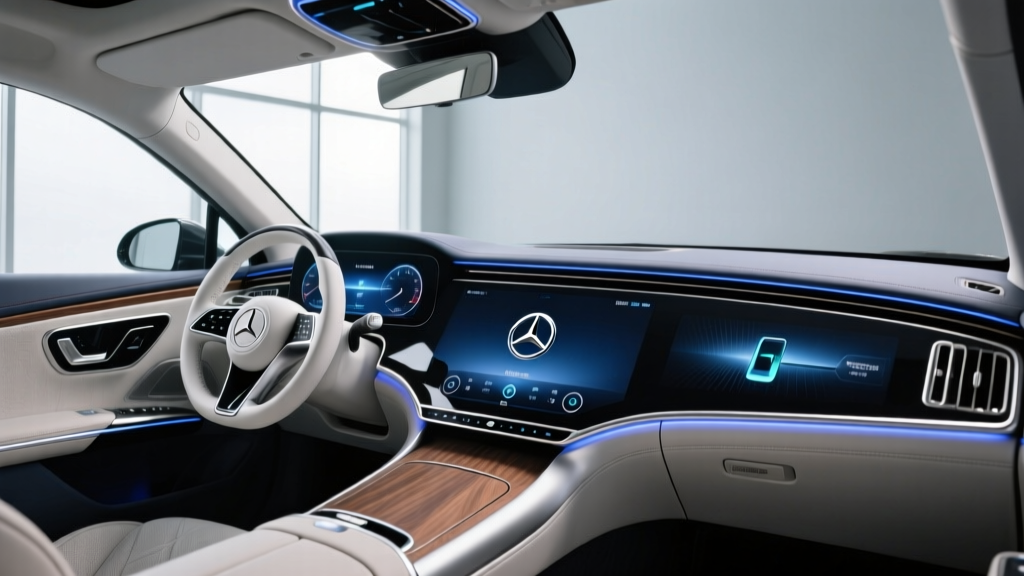
The 56-inch MBUX Hyperscreen spans the entire dashboard width, merging the instrument cluster, central infotainment display, and a dedicated passenger screen under a single curved glass panel. It runs Mercedes' latest MBUX generation with over-the-air update capability, native navigation with EV route planning (including automatic preconditioning for DC chargers along your route), and wireless Apple CarPlay and Android Auto.
The Hyperscreen is standard on the EQS 580 and available as part of a premium package on the 450+. It replaces the standard 12.8-inch central touchscreen with a dramatically wider interface. In practice, the passenger display is useful for media streaming, but the central screen's "zero-layer" menu system — where frequently used functions sit on the home screen rather than buried in submenus — is the real usability win.
Driver assistance: The EQS includes Mercedes' Driver Assistance Package with adaptive cruise control, lane-keeping assist, automated lane changes, and Active Distance Assist DISTRONIC. This is an SAE Level 2 system — the driver must keep hands on or near the wheel and remain fully engaged. Mercedes has demonstrated Level 3 (Drive Pilot) capability in Germany on limited highways, but as of 2026, Level 3 remains unavailable in the United States due to regulatory approval timelines. The EQS driver-assist suite is competitive with BMW's Driving Assistant Professional but falls short of Tesla's Autopilot in terms of hands-off duration tolerance and lane-change decisiveness.
Pricing, Trims, and Federal Tax Credit Eligibility
The 2026 Mercedes EQS starts at approximately $105,550 for the EQS 450+ (including destination), with the EQS 580 4MATIC beginning around $127,350. Adding the Hyperscreen, Executive Rear Seat package, AMG Line exterior, and premium audio can push a well-equipped 580 above $145,000.
| Trim | Base MSRP | Federal Tax Credit (§30D) | Effective Price (if eligible) |
|---|---|---|---|
| EQS 450+ | ~$105,550 | Up to $7,500 (see caveats) | ~$98,050 |
| EQS 580 4MATIC | ~$127,350 | Up to $7,500 (see caveats) | ~$119,850 |
Federal tax credit — critical caveats: Under IRS §30D rules, the EQS may qualify for up to $7,500 in federal EV tax credits, but eligibility depends on several conditions:
- MSRP cap: Sedans must be priced at or below $55,000 to qualify. The EQS exceeds this cap, which means it does not qualify for the new-vehicle §30D credit as a sedan.
- Income limits: Even if MSRP were under the cap, buyer adjusted gross income must not exceed $150,000 (single) / $300,000 (joint filing).
- Battery sourcing: The credit is split into two halves — $3,750 for critical minerals and $3,750 for battery component sourcing — both with escalating domestic-content requirements through 2026.
- Point-of-sale transfer: If eligible, the credit can be applied at the dealer as an instant rebate rather than waiting for tax filing.
Bottom line on credits: As a sedan priced well above $55,000, the EQS does not qualify for the new-vehicle federal tax credit under current §30D rules. Buyers should consult the IRS clean vehicle credit page and a tax professional to confirm eligibility. Some states offer additional rebates that are not MSRP-capped — check your local energy authority.
Cargo, Passenger Space, and Daily Practicality
The EQS sedan offers 22 cubic feet of trunk space — generous for a luxury sedan but less versatile than a hatchback or SUV. The trunk opening is relatively narrow, which limits loading bulky items. There is no front trunk (frunk), as Mercedes uses that space for HVAC components and the HEPA filtration system.
Interior passenger space is excellent: 41.5 inches of rear legroom puts the EQS in S-Class territory, and the available Executive Rear Seat package adds heated, ventilated, and massaging rear seats with a tablet-style controller. The cabin is one of the quietest in any production vehicle, aided by acoustic glass and extensive sound deadening.
Pros
- Class-leading 390-mile EPA range (450+)
- Hyperscreen is genuinely impressive, not a gimmick
- Exceptionally quiet and smooth ride quality
- 200 kW DC fast charging with route preconditioning
- Generous rear-seat legroom and luxury amenities
- Rear-axle steering makes parking manageable
Cons
- Exceeds $55K MSRP cap — no federal tax credit
- Trunk is sedan-style, no hatch or frunk
- Heavy — 5,800+ lbs affects tire wear and handling limits
- Hyperscreen can be distracting for some drivers
- Level 2 driver assist is conservative vs. competitors
- Depreciation risk in the luxury EV sedan segment
Competitor Comparison: EQS vs. Model S vs. i7 vs. Lucid Air
The EQS competes in a narrow but fierce segment. Here's how the key numbers stack up:
| Attribute | Mercedes EQS 450+ | Tesla Model S LR | BMW i7 xDrive50 | Lucid Air Pure |
|---|---|---|---|---|
| EPA Range | 390 mi | 402 mi | 318 mi | 419 mi |
| Battery (usable) | 108.4 kWh | ~95 kWh | 101.7 kWh | 88 kWh |
| Max DC Charge | 200 kW | 250 kW | 195 kW | 220 kW |
| 0–60 mph | 5.9 sec | 3.1 sec | 4.5 sec | 5.2 sec |
| Base MSRP | ~$105,550 | ~$79,990 | ~$120,295 | ~$77,400 |
| Hyperscreen-style Display | Yes (56") | No (17" center) | Yes (31" theater) | No (34" curved glass cockpit) |
The Lucid Air Pure offers more range at a dramatically lower price, though its service network and interior finish don't match Mercedes. The Tesla Model S wins on performance and Supercharger access but trails on cabin luxury and noise isolation. The BMW i7 is the closest rival in philosophy — big, comfortable, tech-forward — but gives up significant range to the EQS.
Who Should Buy the Mercedes EQS?
Choose the EQS 450+ if: You want a long-range luxury sedan for daily commuting and regular road trips, value cabin silence and technology above outright performance, and can charge at home. The 390-mile range and 200 kW DC charging make it one of the most capable road-trip EVs in the luxury segment.
Choose the EQS 580 4MATIC if: You need all-wheel drive for snow-belt climates, want sub-4.5-second acceleration, and budget isn't the primary constraint. The Hyperscreen comes standard, and the dual-motor setup adds confidence in adverse conditions.
Look elsewhere if: You need a federal tax credit (the EQS is priced out of eligibility), require hatchback cargo versatility (consider the EQS SUV or Lucid Air), or prioritize sporty handling over comfort (the Porsche Taycan or Tesla Model S Plaid are better choices).
Frequently Asked Questions
What is the real-world range of the Mercedes EQS?
The EPA rates the EQS 450+ at 390 miles, but real-world highway driving at 70 mph typically yields 310–330 miles. In cold weather (below freezing), expect 250–280 miles due to battery chemistry limitations and cabin heating demand. City driving with regenerative braking can approach or exceed the EPA number.
How fast does the EQS charge at home and on the road?
At home on a 240V Level 2 charger (48A), the EQS charges at 11.5 kW, adding about 30 miles per hour — a full charge takes roughly 11 hours. On a DC fast charger, it peaks at 200 kW and can go from 10–80% in about 31 minutes under optimal conditions. Expect 40+ minutes on 150 kW stations.
Does the Mercedes EQS qualify for the federal EV tax credit?
No. Under current IRS §30D rules, new EV sedans must have an MSRP at or below $55,000 to qualify. The EQS starts at approximately $105,550, well above this cap. Some state-level incentives may still apply. Always verify with a tax professional and the IRS website.
Is the Hyperscreen standard on all EQS trims?
The Hyperscreen is standard on the EQS 580 4MATIC and available as part of a premium package on the EQS 450+. The base 450+ comes with a 12.8-inch central touchscreen and a separate 12.3-inch instrument cluster.
How does the EQS compare to the Tesla Model S?
The EQS offers a quieter, more traditionally luxurious cabin with the Hyperscreen and superior rear-seat comfort. The Model S is significantly faster, less expensive, and has access to Tesla's Supercharger network. Range is comparable (390 vs. 402 miles EPA). The EQS is the comfort choice; the Model S is the performance and value choice.
What is the EQS battery warranty?
Mercedes provides an 8-year/100,000-mile battery warranty covering defects and capacity degradation below 70% of original capacity. The general vehicle warranty is 4 years/50,000 miles.