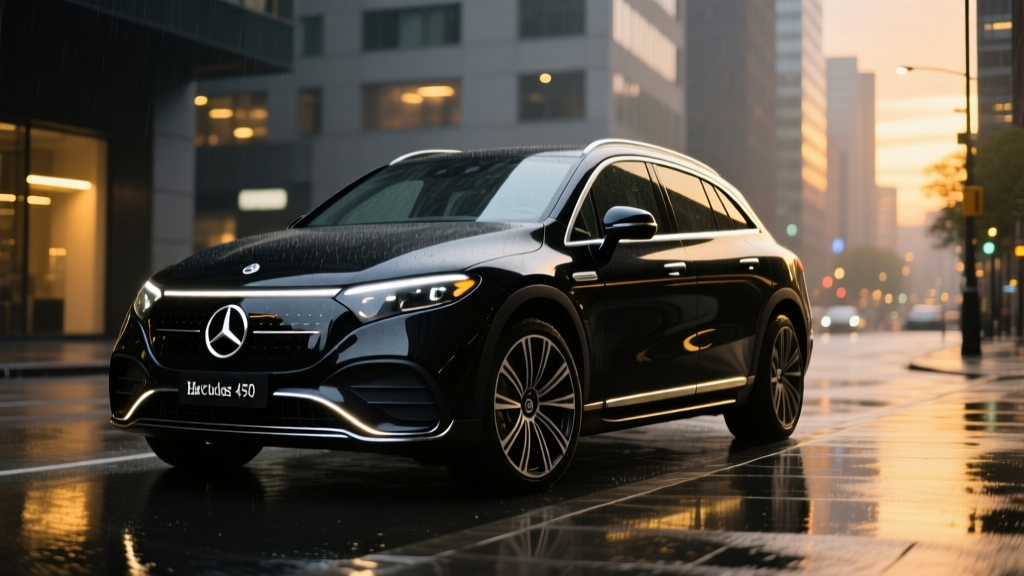
The Mercedes-Benz EQS SUV lineup sits at the apex of the brand's electric ambitions, and the EQS 450 4MATIC serves as the volume-oriented entry point into that three-row, full-size luxury EV experience. For buyers cross-shopping the BMW iX, Audi Q8 e-tron, and Tesla Model X, the EQS 450 SUV presents a distinct value proposition: S-Class-level isolation, a usable third row, and a battery pack large enough to make road trips genuinely viable. But at a six-figure starting price, the question isn't just whether this SUV is impressive — it's whether the numbers justify the premium.
We've analyzed the EPA data, real-world driving dynamics, charging behavior, and ownership economics to give you the complete picture of what the Mercedes EQS 450 SUV delivers in 2026.
Range, Efficiency, and the Real-World Reality
The EQS 450 4MATIC SUV is EPA-rated at 305 miles of range on a full charge of its 118 kWh usable battery (122 kWh gross capacity). That battery uses NMC (nickel-manganese-cobalt) lithium-ion chemistry, which prioritizes energy density and cold-weather performance over the cycle-life advantages of LFP cells found in some lower-cost EVs.
- EPA sticker: 305 miles (combined city/highway)
- Highway cruising (70-75 mph): Expect ~250–275 miles; the EQS SUV's 5,800+ lb curb weight and tall frontal area hit efficiency at sustained speed
- City/suburban driving: 290–310 miles readily achievable thanks to aggressive regen and lower average speeds
- Cold weather (below 32°F): Plan for 20–30% range reduction (~210–245 miles) without preconditioning; the standard heat pump mitigates some cabin-heating loss
The EPA figure is legitimate for mixed driving, but road-trippers should plan charging stops at ~220-mile intervals for a comfortable buffer.
Efficiency lands at 82 MPGe combined (approximately 41 kWh/100 miles) according to fueleconomy.gov. That's respectable for a vehicle of this mass, though the lighter BMW iX xDrive50 achieves slightly better efficiency at 86 MPGe combined. The EQS SUV's 0.20 drag coefficient — one of the lowest of any production SUV — does heavy lifting here.
Charging Speed: DC Fast and Level 2 at Home
Mercedes equips the EQS 450 SUV with a 200 kW peak DC fast-charging capability on CCS1-compatible stations (or NACS via adapter on newer model-year builds equipped with the North American Charging Standard port). Here's what that translates to in practice:
| Charge Level | Power / Rate | Speed (mi/hr added) | Notes |
|---|---|---|---|
| Level 1 (120V) | ~1.4 kW | ~3–4 mi/hr | Emergency/trickle only; ~80+ hrs for full charge |
| Level 2 (240V, 48A) | 11.5 kW | ~28–32 mi/hr | Full charge in ~10.5 hrs; standard home setup |
| Level 2 (240V, 80A) | 19.2 kW (optional onboard) | ~48–52 mi/hr | Requires 100A circuit; full charge in ~6.5 hrs |
| DC Fast Charge | 200 kW peak | 10–80% in ~31 min | Peak sustained to ~40% SoC, then tapers progressively |
The DC fast-charging curve is the critical detail most spec sheets gloss over. The EQS 450 SUV sustains near-peak 200 kW throughput from roughly 10% to 40% state of charge, then tapers to ~150 kW through 60%, and further to ~80–100 kW above 80%. On a 350 kW Electrify America or Tesla Supercharger (with adapter) station, you'll recover approximately 180 miles of range in that 31-minute 10–80% session. Above 80%, charging slows substantially — plan your stops to stay in the 10–80% sweet spot.
For home charging, the standard 11.5 kW onboard charger is adequate for overnight replenishment. Most owners driving 40–60 miles daily will recover their daily use in under two hours on a Level 2 wallbox. The optional 19.2 kW onboard charger is worth considering if your electrical panel supports a 100-amp dedicated circuit — it nearly halves total charge time and adds meaningful flexibility for high-mileage days.
Performance and Drivetrain
The EQS 450 4MATIC SUV uses a dual-motor all-wheel-drive powertrain producing 355 horsepower and 590 lb-ft of torque. Mercedes quotes a 0–60 mph time of 5.6 seconds — quick for a three-row luxury SUV, though not in the territory of the 536-hp EQS 580 4MATIC (4.3 seconds) or the Tesla Model X Plaid.
| EPA Range | 305 miles |
| Battery (usable / gross) | 118 kWh / 122 kWh (NMC) |
| Drivetrain | Dual-motor AWD (4MATIC) |
| Horsepower / Torque | 355 hp / 590 lb-ft |
| 0–60 mph | 5.6 seconds |
| DC Fast Charge (peak) | 200 kW; 10–80% in ~31 min |
| Level 2 Charge Rate | 11.5 kW (std) / 19.2 kW (opt) |
| Efficiency | 82 MPGe / 41 kWh/100 mi |
| Towing Capacity | 3,500 lbs (with factory hitch) |
| Cargo Volume (behind 3rd / 2nd / 1st row) | 14.0 / 35.0 / 74.0 cu ft |
| Base MSRP (2026) | $104,400 (+ $1,150 dest.) |
| Battery Warranty | 10 years / 155,000 miles |
Ride quality is where the EQS 450 SUV distinguishes itself from sportier competitors. Standard AIRMATIC air suspension delivers a genuinely serene ride, with adaptive damping that reads road surfaces and adjusts in real time. Rear-axle steering (standard, up to 10 degrees) shrinks the turning circle to a remarkably compact 36.1 feet — useful in parking structures despite the vehicle's 207-inch length.
Interior, Tech, and Cargo Practicality
The cabin centers on the MBUX Hyperscreen — a 56-inch curved glass panel spanning the full dashboard width, incorporating a 17.7-inch central OLED display, a 12.3-inch passenger screen, and a 12.3-inch driver cluster. The system runs Mercedes' latest MBUX generation with wireless Apple CarPlay/Android Auto, over-the-air updates, and an AI-driven voice assistant that handles natural-language navigation and climate commands.
Driver assistance falls under the SAE Level 2 umbrella with the Driver Assistance Package: adaptive cruise control with stop-and-go, active lane-keeping, automatic lane changes on highways, and evasive steering assist. Mercedes' DRIVE PILOT system — a conditional Level 3 feature approved in limited jurisdictions — is available on select trims but restricted to specific highway corridors at speeds under 40 mph in heavy traffic. The driver must remain engaged and ready to resume control at all times outside those narrow operational boundaries.
Passenger space is generous across all three rows. Front-row legroom measures 40.3 inches; the second row offers 39.5 inches with fore/aft adjustment; the third row provides 29.1 inches — adequate for children or short-trip adult use. Cargo volume behind the third row is 14.0 cubic feet, expanding to 35.0 cu ft with the third row folded and 74.0 cu ft with both rear rows down. A small front trunk (frunk) adds approximately 2.0 cu ft for charging cables or a small bag.
Pricing, Trims, and Federal Tax Credit Eligibility
The 2026 Mercedes EQS 450 4MATIC SUV starts at $104,400 (plus $1,150 destination), placing it squarely in the six-figure luxury EV segment. Key trim and option considerations:
| Configuration | Approximate MSRP | Federal §30D Credit | Effective Price |
|---|---|---|---|
| EQS 450 4MATIC (base) | $104,400 | Subject to eligibility* | Varies |
| EQS 450 + Premium Package | ~$110,000 | Subject to eligibility* | Varies |
| EQS 450 + Pinnacle Trim / AMG Line | ~$118,000–$125,000 | Subject to eligibility* | Varies |
*Federal tax credit (IRS §30D) critical caveats for the EQS 450 SUV:
- MSRP cap: SUVs must have an MSRP at or below $80,000 to qualify for the new-vehicle §30D credit. The EQS 450 SUV's base price of $104,400 exceeds this cap, making it ineligible for the $7,500 new-vehicle federal credit.
- Income limits: Even for eligible vehicles, modified AGI must not exceed $300,000 (joint), $225,000 (head of household), or $150,000 (single).
- Battery sourcing: The credit splits into two $3,750 halves based on critical-mineral and battery-component sourcing requirements — moot here due to the MSRP cap.
- Point-of-sale transfer: Eligible credits can be transferred to the dealer at purchase for an immediate price reduction — but again, the EQS 450 SUV does not qualify.
- Lease loophole: Vehicles leased through Mercedes-Benz Financial may qualify for the commercial clean vehicle credit (§45W), which has no MSRP or income caps. Lease incentives may reflect this savings — check current dealer offers. Consult a tax professional for your specific situation.
Per IRS §30D guidelines, the MSRP cap is the binding constraint here. Buyers should not expect the federal credit to offset the purchase price, though state-level incentives (California's CVRP, Colorado's tax credit, and others) may still apply — check your local program for current availability and amounts.
Who the EQS 450 SUV Is For — and Who Should Look Elsewhere
Choose the Mercedes EQS 450 SUV if:
- You prioritize ride comfort and cabin isolation above sporty handling dynamics
- You need a usable third row for occasional passengers without stepping to a minivan or full-size ICE SUV
- You value cutting-edge infotainment (Hyperscreen) and SAE Level 2/conditional Level 3 driver assist
- Your daily commute is under 200 miles and you have reliable home Level 2 charging
- You want a luxury badge with strong dealer service infrastructure and a 10-year/155,000-mile battery warranty
Look elsewhere if:
- You want the fastest-accelerating EV SUV (Tesla Model X Plaid, EQS 580)
- Federal tax credit eligibility is a dealbreaker — the MSRP cap disqualifies this vehicle
- You need maximum cargo volume (the Rivian R1S offers more usable space at a lower price)
- You tow more than 3,500 lbs regularly (the Rivian R1S and Cadillac Escalade IQ offer higher capacity)
- You want the lowest cost per mile — the EQS SUV's weight and premium tire costs drive higher operating expenses
Pros and Cons at a Glance
- Class-leading ride comfort with AIRMATIC air suspension and rear-axle steering
- Massive 118 kWh usable battery delivers genuine 250+ mile highway range
- MBUX Hyperscreen is visually stunning and functionally responsive
- 10-year / 155,000-mile battery warranty exceeds the 8-year federal minimum
- Whisper-quiet cabin with exceptional NVH isolation at highway speeds
- Standard dual-motor AWD with confident all-weather traction
- Base MSRP of $104,400 exceeds the $80K federal tax credit cap — no §30D eligibility
- Third-row legroom (29.1 in) is tight for adults on longer trips
- 355 hp feels adequate, not thrilling, in a 5,800-lb vehicle — the EQS 580 is the performance pick
- Regenerative braking modulation takes adaptation; one-pedal mode is not as aggressive as Tesla/Rivian
- High insurance premiums typical of six-figure luxury EVs
- DC fast charging at 200 kW peak is outpaced by competitors like the Lucid Gravity and Porsche Cayenne EV
Ownership Costs and Warranty Coverage
Mercedes backs the EQS 450 SUV with a 4-year / 50,000-mile limited warranty and a 10-year / 155,000-mile high-voltage battery warranty that guarantees the battery will retain at least 70% of its original capacity during that period. This battery warranty is notably more generous in mileage than the standard 100,000-mile coverage many competitors offer, and it reflects confidence in the NMC cell chemistry's long-term degradation profile.
Estimated annual charging costs depend heavily on your electricity rate and driving mix. At the U.S. average residential rate of ~$0.16/kWh and 12,000 miles driven annually, home charging costs approximately $660/year. Public DC fast charging at $0.40–$0.50/kWh would push that to ~$1,800–$2,200/year for the same mileage. Compare this to a gasoline equivalent achieving 20 MPG at $3.50/gallon (~$2,100/year), and the savings are meaningful but not dramatic at this price point — the value proposition here is refinement, not fuel-cost arbitrage.
According to IIHS and industry data, luxury EV insurance premiums run 15–25% higher than comparable ICE vehicles. Budget accordingly — get quotes before purchase.
Frequently Asked Questions
What is the real-world range of the Mercedes EQS 450 SUV?
The EPA rates the EQS 450 4MATIC SUV at 305 miles combined. In real-world highway driving at 70–75 mph, expect 250–275 miles. City driving with regenerative braking can approach or slightly exceed the EPA figure. In freezing temperatures without preconditioning, plan for 210–245 miles.
How fast does the EQS 450 SUV charge?
On a DC fast charger, it peaks at 200 kW and charges from 10–80% in approximately 31 minutes. At home on a Level 2 (240V, 48A) charger, it adds roughly 30 miles per hour, reaching a full charge overnight in about 10.5 hours. An optional 19.2 kW onboard charger cuts that to ~6.5 hours.
Does the Mercedes EQS 450 SUV qualify for the federal EV tax credit?
No. The IRS §30D new clean vehicle credit caps SUV eligibility at $80,000 MSRP. The EQS 450 SUV starts at $104,400, disqualifying it. However, leasing may unlock savings through the commercial clean vehicle credit (§45W), which has no MSRP or income cap — consult your dealer and a tax professional.
How much does it cost after incentives?
With the federal purchase credit unavailable, the effective starting price remains $105,550 including destination. State incentives vary — some states offer rebates or tax credits independent of the federal program. Lease deals may reflect manufacturer incentives or the §45W pass-through. Always confirm current offers with your local Mercedes-Benz dealer.
Is the EQS 450 SUV worth buying vs. the BMW iX or Tesla Model X?
It depends on your priorities. The EQS 450 SUV wins on ride comfort, cabin quietness, and third-row usability. The BMW iX xDrive50 is lighter, more efficient (86 MPGe), and starts lower (~$87,000), but lacks a third row. The Tesla Model X offers more range (EPA 335 mi), faster charging, and Supercharger access, but its interior finish and service experience lag Mercedes. For pure luxury and isolation, the EQS 450 SUV is the segment benchmark.
What are the biggest pros and cons?
Top pros: exceptional ride quality, large 118 kWh battery with genuine range, stunning Hyperscreen tech, and a 10-year/155,000-mile battery warranty. Top cons: no federal tax credit eligibility due to the MSRP cap, modest 355 hp for the weight, tight third-row legroom for adults, and 200 kW peak DC charging that trails newer competitors.
How does the battery warranty compare to competitors?
Mercedes covers the EQS 450 SUV's battery for 10 years or 155,000 miles (whichever comes first) against degradation below 70% capacity. That mileage threshold exceeds the 100,000-mile battery warranties from BMW, Audi, and Tesla, giving long-term owners additional peace of mind.
Sources: fueleconomy.gov (EPA range and efficiency data), IRS.gov (§30D credit rules), Mercedes-Benz USA press and specification pages. Specifications reflect the 2025–2026 model year; always verify with your dealer for the latest pricing and feature availability.