Quick Answer: Mercedes-Benz's "Electric Drive 2" refers to the second-generation modular e-drive platform (eATS 2.0) powering the EQS sedan and SUV lineup. In the 2026 EQS 450+, this means a permanently excited synchronous motor (PMSM) on the rear axle producing 355 hp and 419 lb-ft of torque, paired with a 118 kWh usable NMC battery delivering an EPA-estimated 390 miles of range. Real-world highway driving yields approximately 310–340 miles; cold-weather (below 30°F) drops that to roughly 270–300 miles. DC fast charging peaks at 200 kW, reaching 10–80% in about 31 minutes.
What Electric Drive 2 Actually Is
Mercedes-Benz introduced its second-generation electric drive unit — internally designated eATS 2.0 — as the backbone of its full-size EV platform. Unlike the first-generation EQC's adapted powertrain, Electric Drive 2 was designed from scratch for dedicated EV architecture, with three key engineering improvements:
- Higher power density: The PMSM motor is more compact yet produces more torque per kilogram than the prior induction-based units.
- Improved thermal management: An integrated heat pump and advanced coolant routing allow sustained high-power output without aggressive thermal derating — critical for both highway efficiency and repeated fast-charging sessions.
- Modular scalability: The same eATS 2.0 unit can be deployed on front, rear, or dual-motor configurations across the EQS, EQE, and EQG platforms.
For buyers, the practical significance is efficiency. The EQS 450+ achieves an EPA-rated 97 MPGe combined (roughly 35 kWh/100 miles), which is competitive with the BMW i7 eDrive50 (99 MPGe) and significantly better than the older-generation Audi e-tron GT (82 MPGe). That efficiency directly translates to lower charging costs and more usable range from the same battery size.
Range, Efficiency, and Real-World Expectations
EPA Range: 390 miles (EQS 450+ sedan)
Real-World Highway (70 mph, 75°F): ~310–340 miles
Cold Weather (20°F, mixed driving): ~270–300 miles
Mountain/Towing Scenario: ~250–280 miles
The EQS 450+'s 390-mile EPA figure places it among the longest-range luxury sedans on the market, trailing only the Lucid Air Grand Touring (516 miles EPA). But EPA testing favors low-speed urban cycles with generous regenerative braking recovery. On a sustained 70-mph highway run — the scenario that actually matters for road trips — expect to use roughly 35–38 kWh/100 miles, bringing realistic range to the low-to-mid 300s.
Cold weather is the equalizer no EV escapes. The EQS's standard heat pump recovers waste heat from the drivetrain to warm the cabin, reducing the HVAC energy penalty compared to resistive heaters. Even so, lithium-ion internal resistance increases in freezing temperatures, and cabin heating still draws 3–5 kW continuously. Plan for a 20–25% range reduction in sustained sub-30°F driving.
One ownership advantage of the Electric Drive 2 platform: preconditioning. When you set a navigation destination to a DC fast charger, the car's thermal management system pre-warms the battery to its optimal charging temperature (roughly 95–105°F). This is not optional — skipping preconditioning in cold weather can cut your peak charge rate from 200 kW down to 80–100 kW, adding 15–20 minutes to a charging stop.
| Specification | Value |
|---|---|
| EPA Range | 390 miles |
| Battery (Usable) | 118 kWh, NMC chemistry |
| Motor Type | PMSM (rear axle, Electric Drive 2 / eATS 2.0) |
| Horsepower | 355 hp |
| Torque | 419 lb-ft |
| 0–60 mph | 5.9 seconds |
| Peak DC Fast Charge | 200 kW |
| 10–80% DC Charge Time | ~31 minutes |
| Level 2 Charge Rate | 9.6 kW (48A) |
| Efficiency (Combined) | 97 MPGe / 35 kWh/100mi |
| Base MSRP | $105,550 (incl. destination) |
| Battery/Powertrain Warranty | 10 years / 155,000 miles |
Charging: Speeds, Connectors, and Infrastructure
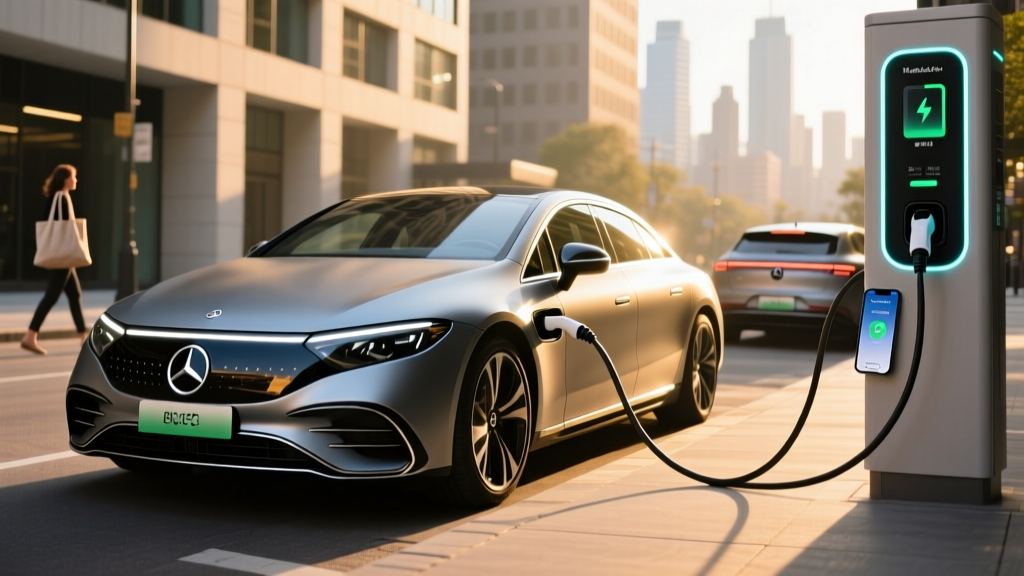
The EQS 450+ ships in North America with a NACS (Tesla-style) charge port as standard for the 2026 model year, following Mercedes-Benz's transition away from CCS1. This grants native access to Tesla's Supercharger network — over 25,000 stalls in the U.S. — without an adapter, alongside Electrify America, EVgo, and other NACS-equipped networks.
| Level | Power | Miles Added per Hour | Typical Use Case |
|---|---|---|---|
| Level 1 (120V) | 1.4 kW | ~4 mi/hr | Emergency/trickle only |
| Level 2 (240V, 48A) | 9.6 kW | ~27 mi/hr | Home overnight / workplace |
| DC Fast (peak) | 200 kW | ~200 mi in 15 min (10–50%) | Road trips |
The 200 kW peak charge rate is competitive but not class-leading — the Hyundai Ioniq 5 N and Porsche Taycan (2025+ models with 320 kW and 350 kW peaks respectively) charge faster. More importantly, the EQS sustains roughly 150–170 kW through the 20–60% SoC window before tapering to ~100 kW near 70% and dropping sharply above 85%. This charge curve shape means the published 10–80% time of 31 minutes is realistic, but charging from 80–100% adds another 25+ minutes. For road trips, the practical strategy is to charge to 80% and drive on.
Home charging at 9.6 kW fully replenishes the 118 kWh battery in roughly 12–13 hours. Most owners who drive 40–60 miles daily will need only 3–4 hours of Level 2 charging overnight to recover daily consumption — a standard 48-amp Level 2 station on a 60-amp circuit is sufficient. Installation costs for a hardwired Level 2 home station typically range from $800–$2,200 depending on panel proximity and local permitting, according to U.S. Department of Energy guidance.
EV vs. Gas: The Cost Comparison That Matters
The EQS 450+ competes with the Mercedes S 500 (gas), BMW 740i, and Audi A8. Here's how the numbers stack up over five years and 75,000 miles of ownership:
| Category | EQS 450+ (EV) | S 500 (Gas, 25 MPG) |
|---|---|---|
| Purchase Price (base MSRP) | $105,550 | $118,900 |
| Federal Tax Credit (§30D) | $0 (MSRP exceeds $55K sedan cap)* | $0 |
| Fuel/Energy (75,000 mi) | $3,940 (home L2 @ $0.13/kWh) | $10,500 (gas @ $3.50/gal) |
| Maintenance (5 yr) | ~$1,800 | ~$4,200 |
| Insurance (5 yr est.) | ~$14,500 | ~$12,000 |
| Estimated Depreciation | ~$47,000 | ~$52,000 |
| Total 5-Year Cost | ~$125,790 | ~$185,600 |
*The IRS §30D credit caps sedan eligibility at $55,000 MSRP. The EQS does not qualify. Some buyers may access state-level incentives — check your local DMV or energy office for current programs.
The EQS wins on operating costs by a wide margin: roughly $6,500 less in fuel and $2,400 less in maintenance over five years. No oil changes, no transmission fluid, no spark plugs, and brake pad life extended dramatically by regenerative braking (expect 100,000+ miles on original pads under normal use). However, EV insurance premiums run 15–25% higher than comparable gas vehicles due to repair-cost complexity and battery replacement exposure. The depreciation advantage for EVs has also narrowed as the used-EV market has corrected from 2022 peaks.
First-Time EV Buyer: What You Need to Know
If the EQS 450+ is your first EV, several ownership realities differ fundamentally from gas-car life:
Home Charging Access Is Non-Negotiable for Convenience
Public DC fast charging costs $0.35–$0.55/kWh at most networks — comparable to or exceeding gasoline on a per-mile basis. The economic case for an EV collapses if you cannot charge at home. Before purchasing, confirm you can install a Level 2 station: renters and condo-dwellers without dedicated parking face real obstacles. A licensed electrician should assess your panel capacity; a 200-amp service panel is generally sufficient for a 48-amp EV circuit, but older homes with 100-amp panels may need a $2,000–$4,000 upgrade.
Battery Degradation Is Real but Manageable
The EQS's NMC battery will lose capacity over time. Industry-wide data from fleet operators and Geotab's longitudinal battery study suggests average annual degradation of 1.5–2.5% for liquid-cooled packs under normal use. After 8 years, expect roughly 85–90% of original capacity — still within Mercedes' warranty threshold of 70% retention at 10 years/155,000 miles. Best practices: avoid routinely charging to 100% (set a daily limit of 80–90%), minimize repeated DC fast charging in extreme heat, and use preconditioning for all fast-charge sessions.
The Charging Curve Is Not Linear
A "200 kW" charger does not deliver 200 kW for the entire session. Peak rate applies only in the 10–50% SoC window; above 80%, the rate drops to 40–60 kW to protect battery longevity. This is physics, not a flaw. Plan road-trip stops around the 10–80% window and accept that the final 20% takes as long as the first 70%.
| Myth | Fact |
|---|---|
| "EV batteries need replacing every 5 years" | Modern liquid-cooled NMC packs routinely last 150,000+ miles with <15% degradation. The EQS warranty covers 10 years/155,000 miles. |
| "EVs are worse for the environment because of battery mining" | Lifecycle analyses by the ICCT show EVs produce 60–68% fewer emissions than gas cars over their full lifespan, even accounting for battery production and grid mix. |
| "You can't take an EV on a road trip" | With 390 miles EPA and 200 kW charging, the EQS adds ~15 minutes of charging per 250 miles of highway driving — comparable to gas-car rest stops. |
| "Level 2 systems like Distronic are self-driving" | Mercedes' Distronic with Active Steering is SAE Level 2 — you must keep hands on or near the wheel and remain fully engaged at all times. |
Decision Framework: Is the EQS 450+ Right for You?
Choose the EQS 450+ with Electric Drive 2 if:
- You want a 350+ mile real-world range luxury sedan for frequent road trips
- You have home Level 2 charging access (garage or dedicated parking with 240V)
- You prioritize cabin quietness and ride comfort over sport handling (the EQS is a cruiser, not a corner-carver)
- You drive 15,000+ miles/year and want to capture the fuel/maintenance savings vs. a gas S-Class
- You value Mercedes' 10-year/155,000-mile battery warranty as long-term protection
Look elsewhere if:
- You cannot install home charging — public-only charging at $0.40+/kWh erases the cost advantage
- You need a sport-sedan driving experience — the Porsche Taycan or BMW i7 offer sharper dynamics
- You want maximum fast-charging speed — the 800V-architecture Hyundai Ioniq 5 or Porsche Taycan charge 40–60% faster
- Your budget is under $80,000 — consider the BMW i5 eDrive40 ($72,000) or Mercedes EQE 350+ ($76,000)
- You live in a region with extreme cold (<0°F regularly) and no garage — range loss and charging slowdowns are significant without battery preconditioning shelter
How Electric Drive 2 Compares to Hybrid Alternatives
Some luxury sedan shoppers cross-shop the EQS against the BMW 750e xDrive (PHEV) or the Mercedes S 580e (PHEV). The trade-offs are structural:
| Attribute | EQS 450+ (BEV) | S 580e (PHEV) |
|---|---|---|
| Electric-Only Range | 390 miles | ~33 miles (EPA) |
| Total Range (elec + gas) | 390 miles | ~440 miles |
| MPGe / MPG Combined | 97 MPGe | 56 MPGe (elec) / 25 MPG (gas) |
| Home Charging Needed | Yes — essential | Beneficial but not essential |
| Maintenance Complexity | Low (no ICE components) | High (dual powertrain) |
| Base MSRP | $105,550 | $121,500 |
The PHEV makes sense if you lack home charging, regularly drive 400+ miles between stops, or want gas-engine redundancy for remote travel. The BEV wins on operating cost, maintenance simplicity, and daily driving refinement — the Electric Drive 2 motor is virtually silent, and one-pedal driving with regen eliminates most brake use in city traffic.
Does the EQS 450+ qualify for any federal tax credit in 2026?
No. Under IRS §30D rules, sedans must have an MSRP at or below $55,000 to qualify for the new clean vehicle credit. The EQS 450+ starts at $105,550 and is ineligible. State incentives may apply — check fueleconomy.gov and your state energy office for current programs.
How much does it cost to charge an EQS at home per month?
At the U.S. average residential rate of $0.16/kWh and 1,250 miles/month (35 kWh/100mi efficiency), expect roughly $70/month in electricity. That compares to approximately $175/month in gasoline for an equivalently driven S 500 at 25 MPG and $3.50/gallon.
What happens if the battery fails out of warranty?
A full battery replacement for the EQS's 118 kWh pack currently costs $25,000–$35,000 at dealer rates. However, catastrophic failure of liquid-cooled NMC packs within 150,000 miles is rare. Module-level repairs (replacing individual degraded cells rather than the full pack) are increasingly available through specialized EV shops for $5,000–$12,000.
Is Electric Drive 2 the same as Mercedes' 4MATIC dual-motor system?
No. Electric Drive 2 (eATS 2.0) is the motor/gearbox/inverter module itself. In the EQS 450+ (rear-wheel drive), one eATS 2.0 unit powers the rear axle. In the EQS 580 4MATIC, two eATS 2.0 units — one front, one rear — provide all-wheel drive with 536 hp combined. The platform is modular; the motor unit is the same.
Can I tow with the EQS 450+?
The EQS sedan is not rated for towing in the U.S. market. If you need towing capacity, the EQS SUV (580 4MATIC) is rated for up to 3,500 pounds, though towing reduces range by 30–40% at highway speeds.