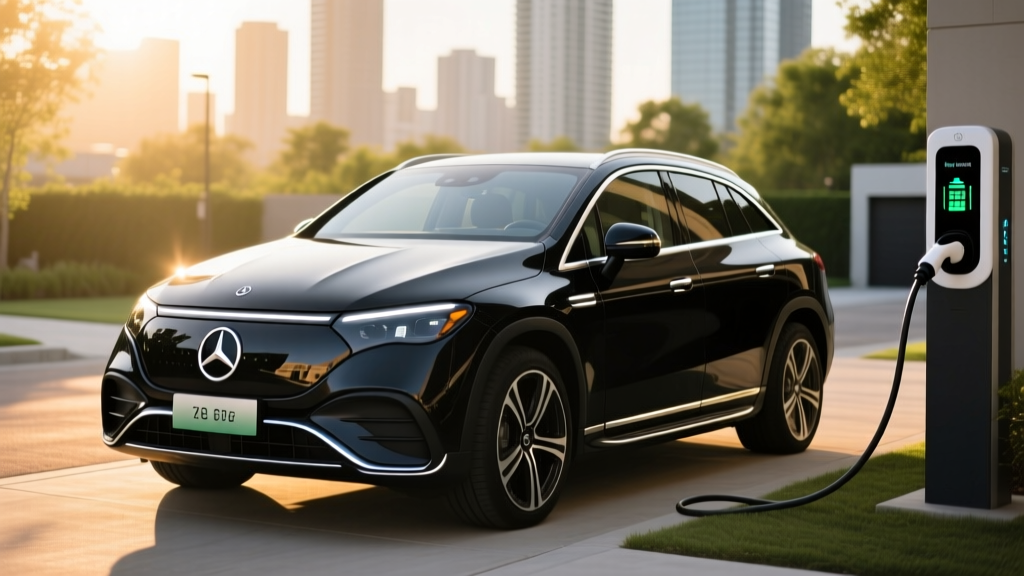
The 2023 Mercedes-Benz EQE SUV arrived as the automaker's midsize electric luxury contender — a lifted, roomier counterpart to the EQE sedan sitting on the same EVA2 platform. With a starting price near $78,000 and a dual-motor AWD layout across every U.S. trim, it targets buyers who want three-pointed-star prestige, a quiet cabin, and the practicality of an SUV silhouette. But in a segment crowded by the BMW iX, Audi Q8 e-tron, and Tesla Model X, does the EQE SUV deliver enough range and charging speed to justify its badge?
After spending time with the specs, EPA data, and real-world driving variables, here's everything you need to know before signing a lease or purchase agreement on a new or remaining-certified-pre-owned 2023 EQE SUV.
2023 Mercedes-Benz EQE SUV: Core Specifications at a Glance
| Specification | EQE 350 4MATIC | EQE 350+ (RWD) | AMG EQE (Performance) |
|---|---|---|---|
| EPA Range | 279 mi | 303 mi | 235 mi |
| Battery (Usable) | 90.6 kWh | 90.6 kWh | 90.6 kWh |
| Battery Chemistry | NMC (nickel manganese cobalt) | NMC | NMC |
| Drivetrain | Dual-motor AWD | Single-motor RWD | Dual-motor AWD (AMG-tuned) |
| Horsepower | 288 hp | 288 hp | 617 hp (677 w/ Race Start) |
| 0–60 mph | 6.4 sec | 6.5 sec | 3.4 sec |
| Max DC Fast Charge | 170 kW | 170 kW | 170 kW |
| 10–80% DC Charge | ~32 min | ~32 min | ~32 min |
| Level 2 Charge Rate | 9.6 kW (~30 mi/hr) | 9.6 kW (~30 mi/hr) | 9.6 kW (~30 mi/hr) |
| MPGe (Combined) | 82 MPGe | 89 MPGe | 74 MPGe |
| Base MSRP | $77,900 | $74,900 | $108,550 |
Note: The EQE 350+ RWD was added for the 2024 model year in most markets. For 2023, the U.S. lineup was primarily the 350 4MATIC and the AMG variant. We include the 350+ here for buyers cross-shopping remaining inventory and CPO listings.
Real-World Range: What to Actually Expect
Real-World Highway (70–80 mph, moderate temps): ~230–250 miles (350 4MATIC)
Cold-Weather (below 32°F, mixed driving): ~195–220 miles (350 4MATIC)
City/Commuter (mild weather, regen-heavy): ~270–290 miles (350 4MATIC)
The EQE 350 4MATIC's 279-mile EPA rating sits in the middle of the luxury midsize EV pack. It trails the BMW iX xDrive50 (324 mi EPA) and the Tesla Model X Long Range (348 mi EPA), but it's competitive with the Audi Q8 e-tron (285 mi EPA). According to fueleconomy.gov, the EQE 350 4MATIC achieves 82 MPGe combined, translating to roughly 39 kWh per 100 miles.
In practice, the 90.6 kWh usable battery (NMC chemistry) gives you a usable buffer that handles most daily commutes and moderate road trips. However, highway driving at sustained 75+ mph reduces efficiency noticeably — expect to see the range estimator drop to around 230–250 miles on a long interstate run. Cold weather compounds this: lithium-ion NMC cells lose efficiency below freezing, and cabin heating draws significant power. If you live in the upper Midwest or Northeast, budget for a 25–30% range reduction in winter.
The EQE SUV does come equipped with a standard heat pump, which helps mitigate cold-weather losses compared to resistive heating systems. Preconditioning the cabin and battery while still plugged in (via the Mercedes me app) is strongly recommended to preserve range on cold mornings.
Charging Performance: DC Fast Charging and Home Setup
| Charging Level | Power / Rate | Miles Added Per Hour | Notes |
|---|---|---|---|
| Level 1 (120V household) | ~1.4 kW | ~4 mi/hr | Emergency/top-up only |
| Level 2 (240V home/public) | 9.6 kW | ~30 mi/hr | Full charge in ~10 hrs |
| DC Fast Charge (peak) | 170 kW | ~170 mi in 30 min | 10–80% in ~32 min |
The EQE SUV's peak DC fast-charging rate of 170 kW is adequate but not class-leading. The BMW iX peaks at roughly 200 kW (10–80% in ~31 min on optimized chargers), while Hyundai/Kia's E-GMP platform hits 240 kW and 10–80% in about 18 minutes. The EQE's ~32-minute 10–80% time means road trips require slightly longer stops than the fastest-charging competitors.
The charge curve on the EQE SUV is relatively flat through the mid-range — you'll see sustained rates near 150–160 kW between 20% and 60% SoC before tapering more aggressively above 80%. This is typical NMC behavior, and Mercedes manages the taper to protect long-term cell health. If you're planning frequent road trips, preconditioning the battery (navigating to a DC fast charger in the MBUX system triggers this automatically) is essential to hit peak rates, especially in cooler weather.
For home charging, the onboard 9.6 kW AC charger is standard. On a 48-amp Level 2 circuit (the most common home installation), you'll add roughly 30 miles of range per hour, meaning an overnight session easily replenishes a full day's driving. A full charge from near-empty takes about 10 hours. Most EQE owners will rarely need a full 0–100% charge — setting a daily limit of 80–90% via the Mercedes me app is recommended for NMC battery longevity.
The EQE SUV uses the CCS1 connector standard. Mercedes-Benz has announced NACS (Tesla-style) adoption for future models, but the 2023 EQE SUV ships with CCS1 and will require an adapter for Tesla Supercharger access as networks open up. Check current adapter availability through Mercedes-Benz or certified third-party suppliers before relying on Supercharger routing.
Performance and Driving Dynamics
The 2023 EQE 350 4MATIC delivers 288 horsepower and 564 lb-ft of torque from its dual-motor all-wheel-drive setup. The 0–60 mph sprint takes 6.4 seconds — respectable for a 5,500-pound luxury SUV but not thrilling by EV standards. The power delivery is smooth and linear, with strong low-end torque that makes city merging effortless.
The AMG EQE is a different animal entirely: 617 hp standard (677 hp with Race Start overboost) and a 3.4-second 0–60 time. It's genuinely quick, though the EQE SUV's weight is more apparent in corners than in the lower-slung EQE sedan. The AMG variant also carries a steep $108,550 starting price and sacrifices 44 miles of EPA range compared to the 350 4MATIC.
Ride quality in the standard 350 4MATIC is a strong point. The available AIRMATIC air suspension (standard on higher trims, optional on base) delivers a supple, composed ride that isolates occupants from road imperfections. Steering is light and precise if not particularly communicative — this is a grand-touring SUV, not a sports car. Cabin noise levels are among the lowest in the segment, aided by acoustic glass and extensive sound deadening.
Regenerative braking offers multiple modes selectable via steering-wheel paddles: D+ (coasting), D (mild regen), D− (moderate), and D Auto (adaptive, using radar and navigation data to modulate regen). D Auto is excellent for daily driving — it slows the vehicle when approaching traffic or intersections but coasts freely on open roads. True one-pedal driving (bringing the car to a full stop) is available but not as aggressively tuned as Tesla or Hyundai systems.
Interior Space, Cargo, and Technology
The EQE SUV's cabin is a showcase of Mercedes' current design language. The standard MBUX infotainment system runs on a 12.8-inch central OLED touchscreen with a 12.3-inch digital instrument cluster. The available Hyperscreen (a 56-inch curved glass panel spanning the dashboard) adds a 12.3-inch passenger display and creates a visually stunning — if occasionally distracting — interface. MBUX supports wireless Apple CarPlay and Android Auto, natural-language voice control ("Hey Mercedes"), and over-the-air updates.
Passenger space:
- Front headroom: 40.1 inches
- Front legroom: 41.5 inches
- Rear headroom: 39.4 inches
- Rear legroom: 38.0 inches
Rear-seat comfort is good for two adults, though the center position is compromised by a raised floor section. The 38.0 inches of rear legroom trails the BMW iX (40.2 inches) noticeably, and taller passengers may find the EQE SUV's roofline less airy than expected for an SUV.
Cargo volume:
- Behind second row: 14.0 cu ft (525 liters)
- With second row folded: 59.2 cu ft (1,677 liters)
- Frunk: None (the EQE SUV does not have a front trunk)
The 14.0 cu ft of rear cargo space with seats up is modest — the BMW iX offers 35.5 cu ft, and even the Audi Q8 e-tron provides 27.3 cu ft. This is a genuine limitation for families who regularly haul strollers, sports gear, or luggage for four. The lack of a frunk further reduces utility. If cargo capacity is a priority, the EQE SUV falls short of its key rivals.
Driver Assistance and Safety
The 2023 EQE SUV comes standard with Mercedes' Driver Assistance Package, which includes:
- Active Distance Assist DISTRONIC (adaptive cruise control with stop-and-go)
- Active Steering Assist (lane centering)
- Active Lane Keeping Assist
- Active Blind Spot Assist with exit warning
- Pre-Safe Plus (collision preparation)
- Surround-view camera with 360° view
Available upgrades include Active Lane Change Assist (automatic lane changes when the turn signal is activated on highways) and DRIVE PILOT, Mercedes' conditional Level 3 system — though DRIVE PILOT availability in the U.S. remains limited to specific highways in Nevada and California as of 2024, and requires a subscription. The standard Level 2 suite is competent and smooth, with gentle steering corrections and well-calibrated following distances. It's competitive with BMW's Driving Assistant Professional but less aggressive in lane-change execution than Tesla's Autopilot.
NHTSA has not published a full crash-test rating for the EQE SUV as of this writing. The related EQE sedan received a Top Safety Pick evaluation from IIHS, and the SUV variant shares the same EVA2 platform structure, suggesting strong crashworthiness, but buyers should verify current ratings before purchase.
Pricing, Trims, and Federal Tax Credit Eligibility
| Trim | Base MSRP | Destination | Typical As-Tested | Federal §30D Credit Eligibility |
|---|---|---|---|---|
| EQE 350 4MATIC (Base) | $77,900 | $1,150 | $82,000–$88,000 | See eligibility notes below |
| EQE 350 4MATIC (Premium) | $81,900 | $1,150 | $87,000–$95,000 | See eligibility notes below |
| EQE 350 4MATIC (Exclusive) | $85,900 | $1,150 | $92,000–$102,000 | See eligibility notes below |
| AMG EQE | $108,550 | $1,150 | $115,000–$130,000 | Exceeds MSRP cap — NOT eligible |
- MSRP Cap: SUVs/vans/pickups must be ≤ $80,000 MSRP. The EQE SUV qualifies as an SUV per IRS classification, so the $80,000 cap applies. Only the base 350 4MATIC ($77,900) clears this threshold before options.
- Buyer Income Cap: AGI must not exceed $150,000 (single), $225,000 (head of household), or $300,000 (joint filing).
- Battery Sourcing: Critical minerals and battery component requirements phase in annually. Mercedes-Benz sources battery cells from multiple suppliers; the EQE's eligibility for the full $7,500 vs. partial $3,750 depends on model year and production date. Check the IRS clean vehicle credit page and the manufacturer's VIN-specific eligibility tool.
- Point-of-Sale Transfer: As of 2024, eligible buyers can transfer the credit to the dealer for an immediate price reduction at purchase rather than claiming it at tax time.
- Assembly: Final assembly must occur in North America. The EQE SUV is assembled in Bremen, Germany — this disqualifies it from the new-vehicle §30D credit. It may qualify under the commercial clean vehicle credit (§45W) if leased through a qualifying entity, which some lessors pass through as a lease incentive.
This is a critical point: the 2023 Mercedes-Benz EQE SUV is built in Germany and does not meet the North American final-assembly requirement for the standard §30D new clean vehicle credit. Buyers who purchase outright cannot claim the $7,500 federal tax credit. However, leasing the EQE SUV through Mercedes-Benz Financial Services may allow the lessor to claim the §45W commercial clean vehicle credit and pass savings to the lessee in the form of reduced monthly payments or a capitalized-cost reduction. Many luxury EV lessees have used this "lease loophole" effectively. Consult a tax professional and your dealer for current lease incentive details.
The AMG EQE, with its $108,550 base MSRP, exceeds the $80,000 SUV MSRP cap regardless of assembly location and is not eligible for any consumer-facing federal EV credit.
Ownership Costs and Warranty
Mercedes-Benz provides the following warranty coverage for the 2023 EQE SUV:
- New Vehicle Limited Warranty: 4 years / 50,000 miles
- High-Voltage Battery Warranty: 10 years / 155,000 miles (capacity retention above 70% of original)
- Powertrain (e-motors, reduction gear): 4 years / 50,000 miles
- Corrosion Perforation: 4 years / 50,000 miles
- Roadside Assistance: 4 years / 50,000 miles
The 10-year/155,000-mile battery warranty is competitive and aligns with BMW, Audi, and Tesla's coverage. The 70% capacity-retention threshold is standard for the industry — if the battery degrades below 70% of its original 90.6 kWh capacity within the warranty period, Mercedes will repair or replace it. NMC batteries in Mercedes EVA2-platform vehicles have shown moderate degradation in early fleet data, typically losing 5–8% capacity over the first 50,000 miles before stabilizing. Long-term data beyond 100,000 miles is still limited for this specific pack.
Estimated annual operating costs:
- Electricity (12,000 mi/yr at $0.16/kWh national average): ~$730/year (at 39 kWh/100mi)
- Comparable gas SUV (22 MPG combined at $3.50/gal): ~$1,910/year
- Annual fuel savings vs. gas: ~$1,180/year
Insurance premiums for the EQE SUV tend to run 15–25% higher than equivalent gas-powered Mercedes GLE models, reflecting the higher repair costs and battery-replacement risk common to all EVs. Expect annual premiums in the $2,200–$3,500 range depending on your profile and state. Maintenance costs are significantly lower than ICE vehicles — no oil changes, fewer brake replacements (thanks to regenerative braking), and cabin-air-filter swaps are the primary service items. Mercedes offers two complimentary scheduled maintenance visits in the first two years.
How the 2023 EQE SUV Compares to Key Rivals
| Attribute | Mercedes EQE 350 4MATIC | BMW iX xDrive50 | Audi Q8 55 e-tron | Tesla Model X LR |
|---|---|---|---|---|
| EPA Range | 279 mi | 324 mi | 285 mi | 348 mi |
| Battery (Usable) | 90.6 kWh | 105.2 kWh | 106 kWh | 100 kWh |
| Peak DC Charge | 170 kW | 200 kW | 170 kW | 250 kW |
| 10–80% DC Time | ~32 min | ~31 min | ~31 min | ~25 min |
| 0–60 mph | 6.4 sec | 4.4 sec | 5.4 sec | 3.8 sec |
| Cargo (Seats Up) | 14.0 cu ft | 35.5 cu ft | 27.3 cu ft | 40.0 cu ft |
| Base MSRP | $77,900 | $87,100 | $75,595 | $79,990 |
| Federal Credit Eligible | No (Germany-built) | No (Germany-built) | No (Belgium-built) | Yes (U.S.-built, check sourcing) |
The EQE SUV's most glaring competitive weakness is cargo space. At 14.0 cu ft with the rear seats up, it offers less utility than some compact crossovers. The BMW iX nearly triples that figure. If you regularly carry cargo for a family of four, the EQE SUV will feel cramped. The iX also outperforms on range (324 vs. 279 miles) and acceleration, though it costs roughly $9,200 more at base.
The Audi Q8 e-tron undercuts the EQE on price ($75,595 base), offers nearly double the cargo volume, and matches its charging speed. It's the pragmatic choice in this segment, though the Mercedes cabin materials and MBUX technology feel a step above the Audi's interior.
The Tesla Model X dominates on range, charging speed, and cargo volume, and is the only rival that may qualify for the federal tax credit (verify current battery-sourcing eligibility on the IRS site). However, its interior quality, panel-gap consistency, and service-center wait times remain common owner complaints. If luxury ambiance matters more than raw specs, the Mercedes wins; if specs and value dominate your decision, the Tesla or Audi are stronger picks.
- You prioritize cabin luxury, quietness, and brand prestige over maximum range and cargo
- Your daily driving is under 200 miles and you charge at home nightly
- You value the MBUX ecosystem and Mercedes dealer/service network
- You plan to lease (to capture the §45W commercial credit pass-through)
- You need maximum cargo volume for family gear (BMW iX or Tesla Model X)
- You want the longest possible range for road trips (Tesla Model X or BMW iX)
- Federal tax credit eligibility on a purchase (not lease) is essential to your math
- Fast DC charging is a top priority (Tesla's 250 kW or Hyundai/Kia's 800V platforms)
Pros and Cons
- Exceptionally quiet, well-appointed cabin with premium materials
- Smooth, composed ride quality (especially with AIRMATIC)
- MBUX infotainment is feature-rich with OTA updates
- Heat pump standard for cold-weather efficiency
- Strong 10-year/155,000-mile battery warranty
- Competitive base MSRP for the luxury badge
- Adaptive regen (D Auto) is well-calibrated
- Cargo space (14.0 cu ft) is severely limited for an SUV
- No front trunk (frunk) for additional storage
- 170 kW peak DC charging trails class leaders
- Built in Germany — ineligible for §30D purchase credit
- Rear legroom (38.0 in) trails the BMW iX
- AMG variant sacrifices significant range for performance
- Hyperscreen can be distracting and adds cost
- Higher insurance premiums than ICE equivalents
Frequently Asked Questions
What is the real-world range of the 2023 Mercedes-Benz EQE SUV?
The EPA rates the EQE 350 4MATIC at 279 miles. In real-world highway driving at 70–80 mph in moderate temperatures, expect 230–250 miles. In cold weather below freezing, range can drop to 195–220 miles. City driving with regenerative braking can approach or slightly exceed the EPA estimate.
How fast does the EQE SUV charge at home and on the road?
On a Level 2 home charger (9.6 kW / 48 amps), the EQE SUV adds roughly 30 miles of range per hour, with a full charge taking about 10 hours. On a DC fast charger, it peaks at 170 kW and charges from 10–80% in approximately 32 minutes. Battery preconditioning (triggered automatically when navigating to a charger) is important for achieving peak rates.
Does the 2023 EQE SUV qualify for the $7,500 federal EV tax credit?
Not on a standard purchase. The EQE SUV is assembled in Bremen, Germany, and the §30D credit requires North American final assembly. However, leasing may allow the lessor to claim the §45W commercial clean vehicle credit and pass savings to you. Consult the IRS clean vehicle credit page and a tax professional for your specific situation.
Is the EQE SUV worth buying over the BMW iX or Tesla Model X?
It depends on your priorities. The EQE SUV wins on cabin luxury and ride comfort. The BMW iX offers more range (324 mi), more cargo space (35.5 cu ft), and faster acceleration, but at a higher price. The Tesla Model X dominates on range (348 mi), charging speed (250 kW), and cargo volume (40 cu ft), but its interior quality and service experience lag behind Mercedes. If daily luxury matters most, the EQE SUV is compelling; if utility and road-trip capability are paramount, the iX or Model X are stronger choices.
What battery does the EQE SUV use and how long will it last?
The EQE SUV uses a 90.6 kWh usable NMC (nickel manganese cobalt) lithium-ion battery pack. It's covered by a 10-year/155,000-mile warranty guaranteeing at least 70% capacity retention. Early fleet data suggests 5–8% degradation over the first 50,000 miles, which is typical for NMC packs. Charging to 80–90% daily and avoiding frequent 100% charges will help maximize long-term battery health.
Does the EQE SUV have a frunk?
No. The 2023 EQE SUV does not have a front trunk. The space under the hood houses power electronics and HVAC components. All cargo must go in the rear compartment (14.0 cu ft with seats up, 59.2 cu ft folded).
Can I tow with the EQE SUV?
The 2023 EQE SUV is not rated for towing in the U.S. market. If towing is a requirement, look at the Tesla Model X (up to 5,000 lbs) or the Rivian R1S (up to 7,700 lbs).