2026 Mercedes EQE: The Executive EV Sedan at a Crossroads
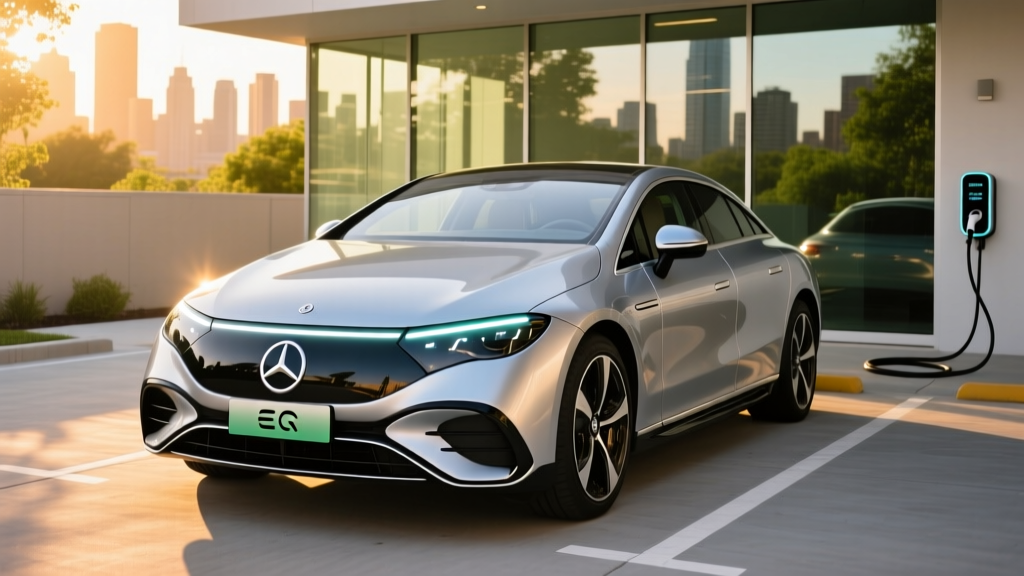
The Mercedes-Benz EQE sedan enters the 2026 model year in an unusual position: it's one of the most refined, tech-dense electric luxury sedans on the market, yet aggressive lease incentives have become the primary way buyers get into one. If you've been searching for EQE lease deals, you're likely weighing Mercedes' monthly specials against competitors like the BMW i5, Audi e-tron GT, and Tesla Model S — and trying to figure out whether the sticker price reflects real value or whether the lease subsidy is doing the heavy lifting.
This review covers the full ownership picture: EPA and real-world range, DC fast-charging performance, battery chemistry, §30D federal tax credit eligibility, and who should seriously consider the EQE versus shopping elsewhere.
Range, Battery, and Real-World Efficiency
The 2026 EQE lineup is anchored by a 90.6 kWh usable lithium-ion battery pack using NMC (nickel manganese cobalt) chemistry — Mercedes has not switched the EQE to LFP, preserving the energy density needed for a large luxury sedan. The pack sits low in the chassis as a structural element, contributing to the car's planted ride.
| Spec | EQE 350+ | EQE 350 4MATIC | EQE 500 4MATIC | AMG EQE |
|---|---|---|---|---|
| EPA Range | 305 mi | 270 mi | 265 mi | 230 mi |
| Battery (usable) | 90.6 kWh, NMC chemistry | |||
| Drivetrain | RWD | AWD (dual-motor) | AWD (dual-motor) | AWD (dual-motor) |
| Horsepower | 288 hp | 288 hp | 402 hp | 617 hp (677 w/ RACE START) |
| 0–60 mph | 6.2 sec | 6.0 sec | 4.5 sec | 3.3 sec |
| MPGe (combined) | 94 MPGe | 86 MPGe | 84 MPGe | 73 MPGe |
| Efficiency | 36 kWh/100mi | 39 kWh/100mi | 40 kWh/100mi | 46 kWh/100mi |
The EQE 350+ (RWD) is the efficiency sweet spot. Adding a front motor for 4MATIC AWD drops range by roughly 35 miles on the EPA cycle — a meaningful hit if you live in a mild climate and don't need the traction. The AMG variant trades range for performance, and 230 miles EPA is tight for road-trip duty.
Charging Speed: DC Fast, Level 2, and the Curve
Charging remains a nuanced story for the EQE. Mercedes quotes a peak DC fast-charge rate of 170 kW on a CCS1 connector (NACS adapter available for Tesla Supercharger access). That peak is real but brief — the EQE's charge curve tapers noticeably past 50% state of charge, which is typical for NMC packs managed conservatively for longevity.
| Charging Level | Power / Rate | Time or Miles Added |
|---|---|---|
| Level 1 (120V household) | ~1.4 kW | ~3–4 miles per hour |
| Level 2 (240V home, 48A) | 9.6 kW | ~25–28 miles per hour; full charge in ~10.5 hr |
| DC Fast Charge (CCS1 peak) | 170 kW peak | 10–80% in ~32 minutes |
| DC Fast Charge (sustained avg) | ~110 kW avg (10–80%) | Average reflects taper above 50% SoC |
The 10–80% time of roughly 32 minutes puts the EQE behind the Hyundai Ioniq 6 (~18 minutes on 800V architecture) and the Porsche Taycan (~22 minutes at 270 kW peak). It's adequate for highway rest stops but not class-leading. Preconditioning is essential: use the MBUX navigation to route to a DC charger and the battery will warm to optimal temperature, which can shave 5–8 minutes off your session in cold weather.
At home, a 48-amp Level 2 wallbox (Hardwired, NEMA 14-50 not recommended at this amperage) recovers the full pack overnight. Plan on $800–$1,800 for a professional Level 2 installation depending on panel proximity — and a potential $2,000–$4,000 panel upgrade if your home still runs a 100-amp service.
Pricing, Trim Levels, and the Lease-Deal Math
The 2026 EQE lineup carries premium pricing, which is exactly why lease deals matter. Here's where each trim lands before incentives:
| Trim | Base MSRP | As-Tested (Typical Options) | §30D Federal Credit |
|---|---|---|---|
| EQE 350+ Sedan | $76,050 | $82,000–$88,000 | Not eligible (MSRP cap $55k sedan) |
| EQE 350 4MATIC | $79,050 | $85,000–$92,000 | Not eligible |
| EQE 500 4MATIC | $91,050 | $98,000–$108,000 | Not eligible |
| AMG EQE Sedan | $108,550 | $115,000+ | Not eligible |
Critical tax credit note: The IRS §30D clean vehicle credit has a $55,000 MSRP cap for sedans (SUVs/pickups get an $80,000 cap). The EQE sedan, in every trim, exceeds this threshold and does not qualify for the up-to-$7,500 federal purchase credit. See the IRS §30D guidelines for current income caps ($150k single / $300k joint) and battery-sourcing rules that apply to eligible vehicles.
This is precisely why EQE lease deals dominate the conversation. Under the separate §45W commercial clean vehicle credit, the leasing dealer (the legal owner in a lease) can receive a $7,500 credit and pass it through as a capitalized-cost reduction — effectively lowering your monthly payment. Mercedes-Benz Financial Services has periodically offered lease cash in the $7,500–$12,500 range on the EQE, which dramatically reshapes the math. Always confirm current incentives on the Mercedes-Benz offers page or with a local dealer, as these rotate monthly.
A realistic 36-month EQE 350+ lease with $7,500 in pass-through credit and $5,000 down can land in the $850–$1,050/month range depending on money factor and residual — still a luxury payment, but meaningfully below the ~$1,300/month a purchase would require at current APRs.
Interior, Cargo, and Standout Technology
The EQE's cabin is where Mercedes justifies its positioning. The available MBUX Hyperscreen (a 56-inch glass panel spanning the dash) remains one of the most visually dramatic EV interiors, with OLED displays for the driver, a central 17.7-inch touchscreen, and a dedicated passenger display. Standard equipment includes a 12.3-inch driver cluster and 12.8-inch central screen.
Practical dimensions matter for daily use:
- Cargo volume: 15.2 cu ft trunk (no frunk — the EQE's HEV-platform-derived architecture uses that space for HVAC components)
- Rear legroom: 38.2 inches — generous for two adults, competitive with the BMW i5
- Front headroom: 40.1 inches (with panoramic roof, drops slightly)
- Rear-seat fold: 40/20/40 split, expanding trunk for longer items
The missing frunk is a legitimate drawback versus the Tesla Model S (which offers a small front trunk) and dedicated EV platforms. Trunk space is adequate but not class-leading; the Lucid Air offers 22.1 cu ft total enclosed cargo.
Driver assistance: The EQE ships with Mercedes' latest Driver Assistance Package including Active Distance Assist DISTRONIC (adaptive cruise), Active Steering Assist, and Active Lane Change Assist. This is SAE Level 2 — hands can briefly leave the wheel in approved highway conditions, but eyes must stay on the road and the driver remains legally responsible. Mercedes' DRIVE PILOT (Level 3, hands-off/eyes-off in specific traffic-jam conditions up to 40 mph) is available in select markets (California, Nevada) as a subscription, making the EQE one of very few consumer vehicles with certified Level 3 capability in defined scenarios.
Other tech highlights include rear-axle steering (up to 10 degrees, shrinking the turning circle to a compact-car-like 32.5 feet), DIGITAL LIGHT headlamps with projection capability, and over-the-air updates that have added features like improved regen profiles post-delivery.
Warranty, Ownership Costs, and Longevity
Mercedes backs the EQE with:
- New-vehicle limited warranty: 4 years / 50,000 miles
- Battery & drive-unit warranty: 8 years / 100,000 miles (with a capacity-retention threshold of 70%)
- Corrosion perforation: 4 years / 50,000 miles
- Complimentary maintenance: None standard — Mercedes does not bundle free service like BMW or Hyundai
The 8-year/100,000-mile battery warranty meets the industry standard for luxury EVs. The 70% capacity threshold means Mercedes will repair or replace the pack if it degrades below that level within the warranty window. Real-world NMC degradation data from EQS owners (which share similar chemistry and thermal management) suggests most packs retain 90–94% capacity after 60,000 miles when DC fast-charging is kept to a moderate share of total charging.
Insurance is a real cost factor. Expect annual premiums in the $2,800–$4,200 range depending on state, driving record, and trim — the AMG variant sits at the high end. Get quotes before signing.
How the EQE Compares to Key Rivals
The EQE doesn't exist in a vacuum. Here's how it stacks against the luxury electric sedans it actually cross-shops against:
- BMW i5 eDrive40: Starting around $71,000, the i5 is slightly cheaper, slightly shorter on range (295 mi EPA on the Long Range variant), and has a more conventional sedan feel. BMW's iDrive 8.5 is snappier than MBUX in daily use. The i5 also fails the §30D sedan MSRP cap.
- Tesla Model S Long Range: 402 miles EPA, 17-inch touchscreen, access to the Supercharger network natively, and a lower starting MSRP (~$72,990). The Model S wins on range and charging infrastructure but trails the EQE decisively on interior material quality, noise isolation, and ride comfort.
- Lucid Air Pure: Starting around $72,000, the Air Pure delivers a stunning 419 miles EPA and a roomier interior. Build quality has improved but still shows inconsistencies versus Mercedes. Dealer/service footprint is far smaller.
- Porsche Taycan (2025+ 800V refresh): Faster charging (~22 min 10–80%), sharper driving dynamics, but range is weaker (283 mi EPA on the base) and pricing starts higher. A driver's car; the EQE is a cruiser.
Look elsewhere if: You want maximum EPA range (Lucid Air, Tesla Model S), the fastest DC charging (Porsche Taycan, Ioniq 6), or the lowest monthly payment in the segment.
Pros and Cons at a Glance
Pros
- Class-leading cabin quietness and ride refinement
- Available Level 3 DRIVE PILOT in approved regions
- Rear-axle steering gives a large sedan city-car agility
- MBUX Hyperscreen is visually stunning
- Aggressive lease incentives can offset the premium MSRP
- 8-year/100,000-mile battery warranty
Cons
- Does NOT qualify for §30D federal purchase credit (MSRP cap)
- 170 kW peak DC charging trails rivals (Taycan, Ioniq 6)
- No front trunk (frunk) — lost cargo versatility
- AWD variants sacrifice 35+ miles of range
- High insurance premiums ($2,800–$4,200/yr)
- No complimentary scheduled maintenance
Who Should Lease the 2026 EQE?
The 2026 Mercedes-Benz EQE is best suited for executive commuters and luxury-focused drivers who lease rather than buy, drive 10,000–14,000 miles annually, and value isolation and technology over outright range or charging speed. If your daily route is a 60-mile round trip with a home Level 2 charger, the EQE 350+ will rarely need DC fast charging and its efficiency is strong.
It's a weaker fit for high-mileage road-trippers who need 350+ mile range, buyers who want to purchase outright and claim the §30D credit, or anyone prioritizing the lowest possible cost-per-mile. For those use cases, the Tesla Model S, Lucid Air Pure, or a well-equipped BMW i5 are sharper tools.
The lease-deal angle is the EQE's strongest argument in 2026. With the pass-through commercial credit and periodic Mercedes-Benz lease cash stacking, the monthly payment gap between the EQE and its rivals narrows enough to let the car's genuine strengths — refinement, Level 3 capability, and rear-axle agility — close the sale.
Frequently Asked Questions
What is the real-world range of the 2026 Mercedes EQE?
The EQE 350+ (RWD) is EPA-rated at 305 miles. Real-world mixed highway driving at 70–75 mph typically yields 260–280 miles. In sustained sub-freezing temperatures with cabin heat, expect 210–230 miles. AWD trims lose roughly 35 EPA miles.
How fast does the EQE charge at home and on the road?
On a 48-amp Level 2 home charger (9.6 kW), the EQE adds about 25–28 miles per hour and fully charges in roughly 10.5 hours. On a DC fast charger, it peaks at 170 kW and reaches 10–80% in approximately 32 minutes, though the charge curve tapers noticeably above 50% state of charge.
How much does the EQE cost after incentives and lease credits?
The EQE 350+ starts at $76,050 MSRP. It does not qualify for the §30D federal purchase credit because it exceeds the $55,000 sedan MSRP cap. However, lessees can often benefit from a pass-through of the $7,500 commercial clean vehicle credit plus Mercedes-Benz lease cash (historically $7,500–$12,500), which together can reduce monthly lease payments by $200–$400 versus an unsubsidized lease.
Does the Mercedes EQE qualify for the federal EV tax credit?
Not for purchase. The §30D credit caps sedan MSRP at $55,000, and every EQE trim exceeds that. If you lease, the dealer (as legal owner) may claim the §45W commercial credit and pass savings through as a cap-cost reduction — confirm current incentives with your dealer. Always verify rules at IRS.gov.
Is the EQE worth it versus the BMW i5 or Tesla Model S?
The EQE wins on cabin quietness, ride comfort, and available Level 3 DRIVE PILOT. The Tesla Model S wins on range (402 mi EPA) and Supercharger access. The BMW i5 is slightly more affordable with a more intuitive infotainment system. If you lease and value luxury isolation, the EQE makes a compelling case; if you buy and prioritize range, look at the Model S or Lucid Air.
What are the biggest drawbacks of the EQE?
The main compromises are a 170 kW peak DC charge rate that trails competitors, no front trunk, AWD range penalties, high insurance costs, and ineligibility for the §30D purchase credit. It's a refinement-first EV, not an efficiency-first one.