The Mercedes-Benz EQE sedan has always staked its claim on one thing above all else: interior execution. While competitors chase 0-60 records or maximum range, the EQE's cabin is where Mercedes engineers spent the most effort — and where buyers spend 100% of their driving time. For 2026, the EQE lineup continues with the EQE 350+ and EQE 350 4MATIC trims alongside the high-performance AMG EQE variants, and the interior remains the defining reason to choose this sedan over a Tesla Model S, BMW i5, or Lucid Air.
This review dissects the EQE interior — materials, MBUX Hyperscreen usability, passenger and cargo dimensions, ambient lighting, and ride refinement — while also covering the powertrain numbers that matter: real-world range, DC fast-charging speed, and whether the EQE qualifies for the federal EV tax credit.
2026 EQE at a Glance: Key Specs
| Spec | EQE 350+ (RWD) | EQE 350 4MATIC (AWD) |
|---|---|---|
| EPA Range | 303 miles | 277 miles |
| Battery (usable) | 90.6 kWh (NMC) | 90.6 kWh (NMC) |
| Horsepower | 288 hp | 288 hp |
| 0-60 mph | 6.2 sec | 5.8 sec |
| Max DC Fast Charge | 170 kW | 170 kW |
| 10-80% DC Time | ~32 min | ~32 min |
| Level 2 Charge Rate | 9.6 kW (~30 mi/hr) | 9.6 kW (~30 mi/hr) |
| MPGe (combined) | 94 MPGe | 86 MPGe |
| Base MSRP | $74,900 | $77,900 |
Source: fueleconomy.gov and Mercedes-Benz USA.
The EQE Interior: Materials, Layout, and First Impressions
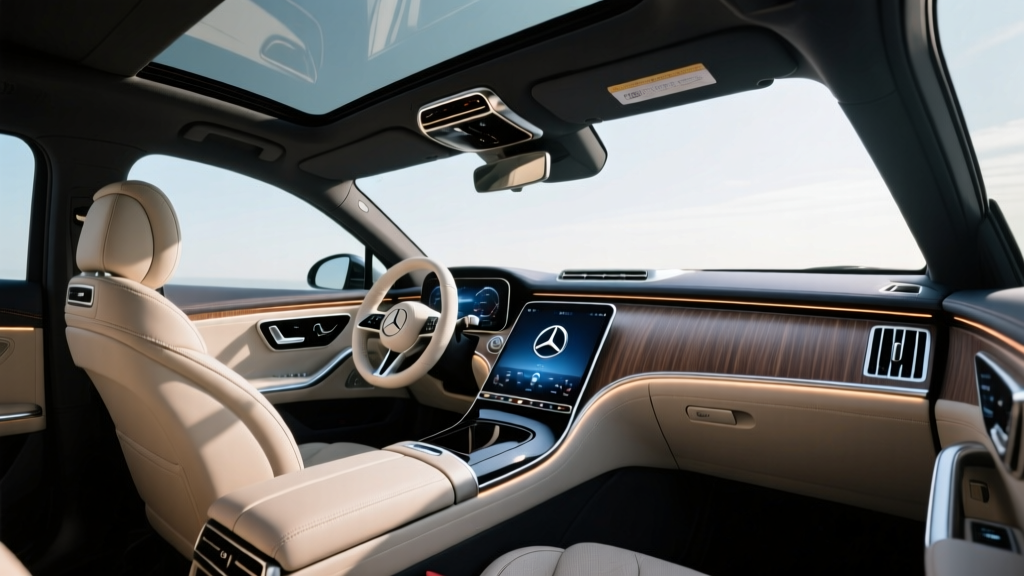
Slide into the EQE and the immediate impression is density — not clutter, but layered luxury. Mercedes uses open-pore wood, aluminum-look trim, or the available AMG carbon-fiber weave across the dashboard, all stitched and fitted with the precision the brand is known for. The standard MBUX infotainment system uses a 12.8-inch OLED center touchscreen flanked by a 12.3-inch digital instrument cluster. Upgrade to the available MBUX Hyperscreen and the entire dashboard becomes a single 56-inch curved glass surface spanning pillar to pillar, incorporating a dedicated 12.3-inch passenger display.
The Hyperscreen is visually arresting but demands a learning curve. Mercedes' "zero-layer" interface places navigation, media, and climate controls at the top level without nested menus — a genuine usability win over the submenu-heavy systems in some rivals. However, the touch-sensitive steering wheel controls remain a frustration: they're imprecise compared to physical buttons, and accidental inputs during maneuvering are common. This is the single most consistent interior complaint among EQE owners.
Seat comfort is outstanding. The standard multi-contour front seats offer 14-way power adjustment with heating (ventilation and massage are optional or included in higher packages). Rear-seat passengers get generous legroom — 38.2 inches — and a slightly reclined seatback angle that suits long highway stretches. Headroom is adequate at 39.6 inches up front, though the EQE's aerodynamic "one-bow" roofline trims rear headroom to 37.8 inches, which may feel snug for passengers over 6'2".
Cabin Space and Cargo: Real-World Dimensions
The EQE is classified as a midsize luxury sedan, and its interior volume reflects that positioning. Here's how the space breaks down:
- Front headroom: 39.6 inches
- Front legroom: 41.7 inches
- Rear headroom: 37.8 inches
- Rear legroom: 38.2 inches
- Trunk volume: 15.0 cubic feet
- Frunk: None (no front trunk on the EQE sedan)
The 15.0 cu-ft trunk is competitive with the BMW i5 (17.3 cu ft) but smaller than the Tesla Model S (28.0 cu ft with the rear hatch). The EQE uses a conventional trunk lid rather than a liftback, which limits the size of items you can load — a notable practicality gap for a vehicle in this price range. The rear seats do fold in a 40/20/40 split, helping with longer cargo, but the pass-through is narrow.
The absence of a frunk is a missed opportunity. Mercedes routes HVAC and power electronics under the hood, and while this simplifies service access, it means you lose the 2-3 cu ft of secure, weatherproof storage that EVs like the Lucid Air and Model S provide.
Range, Efficiency, and Real-World Expectations
Real-World Expectation: Expect 250-270 miles on highway-heavy trips at 70-80 mph. In cold weather (below 30°F), plan for 20-30% range reduction — roughly 210-240 miles from the 350+. City driving with regenerative braking recovers more energy and can push range slightly above the EPA estimate.
The EQE 350+ uses a 90.6 kWh usable battery pack with NMC (nickel manganese cobalt) chemistry — chosen for its higher energy density, which helps the EQE achieve its 303-mile EPA figure despite a curb weight over 5,400 lbs. The 94 MPGe combined rating translates to roughly 34 kWh per 100 miles, which is less efficient than the BMW i5 eDrive40 (104 MPGe) or Tesla Model S (124 MPGe). The EQE's weight and aerodynamic drag are the primary culprits.
For daily commuting under 60 miles round-trip, range is a non-issue — you'll charge at home every other night and never think about it. For road trips, the 303-mile EPA range means stops every 200-230 miles in practice, which aligns reasonably well with DC fast-charger spacing on major interstate corridors.
Charging Speed: DC Fast and Home Level 2
Charging speed is where the EQE draws legitimate criticism. Its peak DC fast-charging rate of 170 kW trails the 200+ kW peaks of the BMW i5, Hyundai Ioniq 6, and Tesla Model S. Here's what that means in practice:
| Charging Level | Power / Rate | Speed / Time |
|---|---|---|
| Level 1 (120V) | ~1.4 kW | ~4 miles per hour |
| Level 2 (240V, 40A) | 9.6 kW | ~30 miles per hour; full charge ~10 hrs |
| DC Fast Charge | Peak 170 kW | 10-80% in ~32 minutes |
The 10-80% DC fast-charge time of roughly 32 minutes is acceptable for highway rest stops — grab food, stretch, and you're back on the road. But the charge curve matters: the EQE sustains close to its 170 kW peak from roughly 10-40% state of charge, then tapers progressively. From 80-100%, charging slows dramatically, so avoid topping off at DC fast chargers unless you have time to wait.
At home on a Level 2 charger (240V, 40-amp circuit), the EQE adds about 30 miles of range per hour. A full overnight session from 20% to 100% takes approximately 9-10 hours, which is standard for a 90+ kWh battery. Mercedes includes a CCS1 charge port; NACS adapters are available for Tesla Supercharger access, though at reduced peak speeds due to the adapter's current limitations.
One positive: the EQE supports battery preconditioning. When you navigate to a DC fast charger via the MBUX system, the car warms the battery to optimal temperature before you arrive, which helps you hit peak charge rates faster — especially important in cold weather when a cold battery can cut charge speeds in half.
Performance and Driving Impressions
The EQE 350+ delivers 288 horsepower from a single rear-mounted motor, reaching 60 mph in 6.2 seconds. That's brisk but not thrilling — the BMW i5 eDrive40 does it in 5.7 seconds, and the Tesla Model S Dual Motor demolishes it at 3.1 seconds. The EQE 350 4MATIC adds a front motor for all-wheel drive and the same 288 hp, cutting the 0-60 to 5.8 seconds.
Where the EQE shines dynamically is ride quality. The standard steel suspension with adaptive damping delivers a plush, isolated ride that absorbs highway expansion joints and potholes with barely a shudder. The available AIRMATIC air suspension (standard on some trims, optional on others) elevates this further, offering adjustable ride height and a genuinely serene highway demeanor. This is the EQE's dynamic signature: effortless, quiet, and composed rather than sporty.
Steering feel is light and vague — a deliberate choice for luxury comfort, but it limits engagement on back roads. If driving excitement is a priority, the BMW i5 or Porsche Taycan are better choices. If isolation and comfort are paramount, the EQE delivers.
Tech, Driver Assistance, and the Hyperscreen
The MBUX system in the EQE runs Mercedes' latest-generation software with over-the-air update capability. Standard features include:
- Wireless Apple CarPlay and Android Auto
- Natural-language voice assistant ("Hey Mercedes")
- Augmented-reality navigation overlay (with Hyperscreen)
- Fingerprint reader for driver profile switching
- Burmester 3D surround sound (15 speakers standard, 14-speaker system on base)
On the driver-assistance front, the EQE comes standard with Mercedes' suite of Level 2 (SAE) systems: adaptive cruise control with stop-and-go, active lane-keeping assist, blind-spot monitoring, and automatic emergency braking. The available Driver Assistance Package adds active lane-change assist and route-based speed adaptation. The optional DRIVE PILOT system (where approved) offers Level 3 conditional automation at speeds up to 40 mph in heavy traffic on divided highways — but availability is limited to select states and requires specific infrastructure conditions.
Pricing, Trims, and Federal Tax Credit Eligibility
The 2026 EQE lineup starts at $74,900 for the EQE 350+ and $77,900 for the EQE 350 4MATIC. A well-equipped 350+ with the Hyperscreen, AIRMATIC suspension, Driver Assistance Package, and AMG Line exterior typically lands in the $85,000-$92,000 range before incentives.
| Trim | Base MSRP | Federal Tax Credit (§30D) | Effective Starting Price |
|---|---|---|---|
| EQE 350+ | $74,900 | Not eligible (MSRP cap + sourcing) | $74,900 |
| EQE 350 4MATIC | $77,900 | Not eligible | $77,900 |
| AMG EQE (sedan) | $106,900+ | Not eligible (exceeds MSRP cap) | $106,900+ |
Federal tax credit reality: The EQE sedan does not qualify for the $7,500 IRS §30D federal EV tax credit. There are two reasons: first, the sedan's MSRP exceeds the $55,000 cap for sedans under current rules; second, the EQE's battery cell sourcing does not meet the critical-minerals and battery-component requirements established under the Inflation Reduction Act. Buyers should not factor a federal credit into their EQE purchase budget. State and local incentives may still apply — check IRS.gov and your state energy office for details.
The EQE is also eligible for Mercedes' own leasing incentives, which have historically included $5,000-$7,500 in lease cash that can effectively reduce monthly payments. If federal credit eligibility is a dealbreaker, consider the EQE SUV (which may have different eligibility depending on MSRP classification) or competitors like the Tesla Model S or certain BMW i5 configurations.
EQE vs. Key Competitors: Is It Worth Buying?
The EQE sedan competes in a crowded midsize luxury EV segment. Here's how it stacks up against three main rivals:
- vs. BMW i5 eDrive40 ($70,200): The i5 is more efficient (104 MPGe vs 94), charges faster (205 kW peak), and offers a more engaging drive. The EQE counters with a quieter cabin, plusher ride, and the Hyperscreen's wow factor. Choose the i5 for efficiency and engagement; choose the EQE for comfort and interior spectacle.
- vs. Tesla Model S Dual Motor ($79,990): The Model S offers vastly more cargo space (hatchback), longer range (402 mi EPA), and far faster charging (250 kW). The EQE counters with superior interior materials, a quieter cabin, and more traditional luxury aesthetics. Choose the Model S for performance and practicality; choose the EQE for build quality and refinement.
- vs. Lucid Air Pure ($69,900): The Air Pure delivers 419 miles of EPA range, a massive rear seat, and a stunning glass canopy roof at a lower starting price. The EQE counters with broader dealer/service network access, more proven MBUX tech, and available Level 3 DRIVE PILOT. Choose the Air for range and value; choose the EQE for service infrastructure and interior tech.
Look elsewhere if: Maximum range, fast DC charging, cargo versatility, or federal tax credit eligibility are dealbreakers.
Pros and Cons
- Exceptional cabin quietness and ride comfort
- MBUX Hyperscreen is visually stunning and functional
- Generous rear-seat legroom (38.2 in)
- Available Level 3 DRIVE PILOT (limited areas)
- Strong build quality and material selection
- Battery preconditioning for optimized DC charging
- 170 kW peak DC charge rate trails rivals
- No front trunk (frunk)
- Conventional trunk lid limits cargo versatility
- Does not qualify for $7,500 federal tax credit
- Touch-sensitive steering wheel controls are imprecise
- Lower efficiency (94 MPGe) than key competitors
- Rear headroom tight for tall passengers
Battery Warranty and Long-Term Ownership
Mercedes backs the EQE's high-voltage battery with an 8-year/100,000-mile warranty covering defects and capacity loss below 70% of original capacity. The powertrain (electric motors, power electronics) carries the same 8-year/100,000-mile coverage. The basic vehicle warranty is 4 years/50,000 miles.
NMC battery chemistry in the EQE has proven durable in early fleet data, with typical degradation of 5-8% over the first 60,000 miles — consistent with industry norms for liquid-cooled NMC packs. Mercedes recommends charging to 80% for daily use and reserving 100% charges for road trips to maximize long-term battery health. The MBUX system includes a configurable charge-limit setting to automate this.
For buyers concerned about long-term service, Mercedes' dealer network remains one of the most extensive among luxury brands, with EV-certified service centers in most major metro areas. However, EQE-specific parts availability (body panels, Hyperscreen components) can involve longer lead times than conventional Mercedes models.
Who Is the EQE For?
The 2026 Mercedes-Benz EQE is best suited for:
- Luxury commuters who prioritize cabin serenity over performance numbers and charge at home nightly
- Brand-loyal Mercedes owners transitioning from an E-Class or S-Class who want familiar ergonomics and dealer relationships
- Tech-forward buyers who value the Hyperscreen's integrated display experience and MBUX voice control
- Two-adult households where rear-seat space is used occasionally rather than daily
It is not ideal for families needing maximum cargo flexibility (look at the EQE SUV or Model S), road-trip-heavy drivers who need faster charging, or budget-conscious buyers who want to maximize federal incentive savings.
Frequently Asked Questions
What is the real-world range of the Mercedes-Benz EQE?
The EPA rates the EQE 350+ at 303 miles and the 350 4MATIC at 277 miles. In real-world highway driving at 70-80 mph, expect 250-270 miles from the 350+. Cold weather (below 30°F) can reduce range by 20-30%, bringing effective range to roughly 210-240 miles. City driving with regenerative braking often matches or slightly exceeds the EPA estimate.
How fast does the EQE charge at home and on DC fast chargers?
On a Level 2 home charger (240V, 9.6 kW), the EQE adds about 30 miles of range per hour, with a full charge taking roughly 10 hours. On DC fast chargers, it peaks at 170 kW and charges from 10-80% in approximately 32 minutes. Battery preconditioning helps achieve peak rates faster when navigating to a charger via MBUX.
Does the EQE qualify for the $7,500 federal EV tax credit?
No. The 2026 EQE sedan does not qualify for the IRS §30D federal tax credit. Its MSRP exceeds the $55,000 sedan cap, and its battery sourcing does not meet the critical-minerals and component requirements. Check IRS.gov for current rules and consult a tax professional. State incentives and Mercedes lease cash may partially offset this.
Is the MBUX Hyperscreen worth the upgrade?
If you value cutting-edge interior technology, yes — the 56-inch Hyperscreen transforms the EQE's cabin into a showcase. The zero-layer interface is genuinely usable, and the passenger display keeps front-seat occupants entertained. However, it adds several thousand dollars to the price and can be distracting at night if not dimmed properly. The standard 12.8-inch center screen is already excellent.
How does the EQE interior compare to the Tesla Model S?
The EQE offers substantially higher material quality — real wood, aluminum, and stitched leather vs. the Model S's more minimalist, synthetic-heavy approach. The EQE is also significantly quieter at highway speeds. The Model S counters with more cargo space (hatchback trunk + frunk), a larger center touchscreen, and a more spacious rear seat. It comes down to whether you prioritize traditional luxury craftsmanship (EQE) or practicality and performance (Model S).
What is the EQE's battery warranty?
Mercedes covers the EQE's high-voltage battery for 8 years or 100,000 miles, whichever comes first. The warranty covers defects and capacity degradation below 70% of original capacity. The powertrain (motors and power electronics) carries the same coverage period.