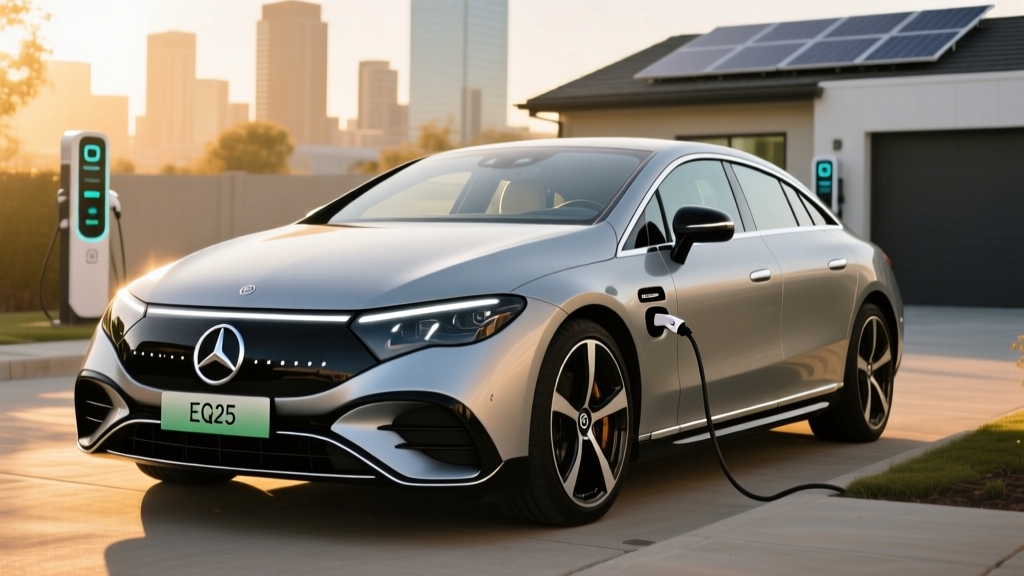
The Mercedes-Benz EQE sedan occupies a peculiar space in the luxury EV market. It is neither a flagship halo car nor an entry-level electric offering — it is the electrified equivalent of the E-Class, aimed at executives and professionals who want premium comfort without stepping up to the EQS. For 2025, the EQE lineup continues with the EQE 350+ (rear-wheel drive), EQE 350 4MATIC (all-wheel drive), and the performance-oriented AMG EQE. This review focuses primarily on the volume-selling EQE 350+ and 350 4MATIC, with AMG notes where relevant.
After spending time with the EQE platform across multiple model years, the verdict is clear: this is a supremely comfortable, technologically dense electric sedan that sacrifices some cargo practicality and charging speed to competitors. It excels as a highway cruiser and daily luxury commuter but requires buyers to understand its trade-offs before signing a lease or purchase agreement.
Range, Battery, and Real-World Efficiency
The EQE 350+ is equipped with a 90.6 kWh usable lithium-ion battery pack using NMC (nickel manganese cobalt) chemistry. Mercedes-Benz does not offer an LFP (lithium iron phosphate) variant, which means buyers get higher energy density but should plan for typical NMC degradation patterns — roughly 10-12% capacity loss over the first 100,000 miles based on industry averages for similar chemistries.
| Specification | EQE 350+ (RWD) | EQE 350 4MATIC (AWD) | AMG EQE |
|---|---|---|---|
| EPA Range | 305 miles | 277 miles | 230 miles (est.) |
| Battery (usable) | 90.6 kWh NMC | 90.6 kWh NMC | 90.6 kWh NMC |
| MPGe (combined) | 93 MPGe | 86 MPGe | 73 MPGe (est.) |
| kWh/100 mi | 36 kWh | 39 kWh | 46 kWh (est.) |
| Horsepower | 288 hp | 288 hp | 617 hp |
| 0-60 mph | 6.2 sec | 5.8 sec | 3.2 sec |
| Drivetrain | RWD single motor | AWD dual motor | AWD dual motor |
The EQE's efficiency is middling for its class. At 36 kWh/100 miles for the 350+, it trails the Tesla Model S (30 kWh/100 mi) and BMW i5 eDrive40 (32 kWh/100 mi). The aerodynamic "one-bow" design helps, but the vehicle's 5,400-pound curb weight works against it in stop-and-go and high-speed scenarios.
Charging Speed and Infrastructure
Charging is where the EQE reveals one of its most significant competitive weaknesses. The sedan peaks at 170 kW on a DC fast charger — adequate by 2022 standards but outpaced by the Hyundai Ioniq 6 (350 kW on 800V architecture), Porsche Taycan (270 kW), and even the BMW i5 (205 kW).
| Charging Level | Power / Rate | Time / Miles Added |
|---|---|---|
| Level 1 (120V household) | ~1.4 kW | ~4 miles per hour |
| Level 2 (240V home, 48A) | 11.5 kW | ~35 miles per hour; full charge in ~9 hours |
| DC Fast Charge (peak) | 170 kW | 10-80% in ~32 minutes |
| DC Fast Charge (sustained avg) | ~120 kW | 10-80% realistic average |
The 10-80% DC fast charge takes approximately 32 minutes under ideal conditions (battery preconditioned, ambient temperature 65-80°F, connected to a 350 kW-capable charger). However, the EQE's charge curve tapers aggressively above 60% state of charge. In real-world road-trip testing, expect 35-40 minutes for a 10-80% session when accounting for taper and station variability.
Home charging on a Level 2 wallbox at 11.5 kW (48 amps, 240V) replenishes the battery from empty in roughly 9 hours — overnight charging is straightforward. Mercedes includes a portable Level 1/Level 2 charging cord with the vehicle, though most owners will want a dedicated wallbox installation (typically $800-$2,000 installed, depending on panel proximity).
The EQE uses a CCS1 connector for DC fast charging in North America. As of 2025, Mercedes-Benz has not adopted the Tesla NACS connector natively, though adapters are available for Supercharger access on some Mercedes models. EQE owners should verify current adapter compatibility with their dealer.
Pricing, Trims, and Federal Tax Credit Eligibility
The 2025 Mercedes-Benz EQE lineup starts at $76,050 for the EQE 350+ (including destination). The EQE 350 4MATIC steps up to $79,050, and the AMG EQE commands $108,550. These are base MSRPs — well-equipped examples with Premium Package, AMG Line exterior, and Driver Assistance Package Plus routinely exceed $85,000 for the non-AMG models.
| Trim | Base MSRP | Federal Tax Credit | Effective Price (if eligible) |
|---|---|---|---|
| EQE 350+ | $76,050 | $0 (MSRP cap exceeded) | $76,050 |
| EQE 350 4MATIC | $79,050 | $0 (MSRP cap exceeded) | $79,050 |
| AMG EQE | $108,550 | $0 (MSRP cap exceeded) | $108,550 |
Without the federal credit, the EQE's value proposition rests entirely on its luxury credentials, ride quality, and technology. Lease deals from Mercedes-Benz Financial Services occasionally offer attractive money factors that effectively discount the vehicle, and some lessors pass through manufacturer incentives.
Interior, Cargo, and Technology
The EQE's cabin is a showcase of Mercedes-Benz's current design language — available with the Hyperscreen (a 56-inch curved glass panel spanning the dashboard), 12.3-inch digital instrument cluster, and 17.7-inch central OLED touchscreen. The MBUX infotainment system is responsive and feature-rich, though the reliance on touch-capacitive controls for climate and volume draws criticism from drivers who prefer physical buttons.
Passenger space is generous in the front (42.2 inches of legroom) but the rear seat, while comfortable for two adults, offers 38.2 inches of legroom — competitive with the BMW i5 but less than the Tesla Model S (41.9 inches rear). The cabin is whisper-quiet at highway speeds, aided by acoustic glass and careful aerodynamic sealing.
Cargo capacity is the EQE sedan's most notable practicality shortcoming: just 15.2 cubic feet of trunk space. The trunk opening is narrow, and unlike the Tesla Model S or Lucid Air, there is no hatchback or liftgate design. The EQE does not offer a frunk (front trunk), which is a missed opportunity given the packaging advantages of a dedicated EV platform. Buyers who need cargo versatility should consider the EQE SUV variant (which offers 52.1 cu ft behind the second row) or a competitor with hatchback utility.
Standard and available technology includes:
- MBUX with augmented-reality navigation
- Burmester 3D surround sound (15 speakers standard, optional 14-speaker Dolby Atmos)
- Wireless Apple CarPlay and Android Auto
- 64-color ambient lighting
- HEPA air filtration system
- Available rear-axle steering (up to 10 degrees, reducing turning radius to 34.8 feet)
Driver Assistance and Safety
The EQE comes standard with Mercedes-Benz's latest driver-assistance suite: Active Brake Assist, Active Lane Keeping Assist, Blind Spot Assist, and Pre-Safe. The available Driver Assistance Package Plus adds Active Distance Assist DISTRONIC (adaptive cruise with stop-and-go), Active Steering Assist, and Active Lane Change Assist.
The EQE earned a TOP SAFETY PICK+ rating from the IIHS (when equipped with specific headlight packages) and a 5-star overall rating from NHTSA. Safety is a genuine strength of this platform.
Driving Dynamics and Ownership Experience
On the road, the EQE 350+ delivers the composed, isolated ride quality that Mercedes-Benz buyers expect. The air suspension (standard on most trims) absorbs road imperfections with composure, and the rear-axle steering option makes this 195-inch sedan surprisingly maneuverable in parking structures and tight city streets. The steering is light and precise, though it offers minimal feedback — a deliberate choice for comfort over sportiness.
The 288-horsepower single-motor powertrain in the 350+ provides adequate acceleration (6.2 seconds to 60 mph) but will not satisfy enthusiasts. The dual-motor 350 4MATIC adds all-weather traction and a marginally quicker 5.8-second 0-60 time. For genuine performance, the AMG EQE's 617 hp and 3.2-second sprint are thrilling but come at a steep price and range penalty.
Regenerative braking offers multiple modes (D+, D, D-, and D Auto) selectable via steering-wheel paddles. D Auto uses navigation and sensor data to modulate regen intelligently — it works well in practice and reduces brake wear significantly. One-pedal driving is achievable in D- mode but is not as aggressive as Tesla or BMW implementations.
Warranty and Long-Term Ownership
| Coverage | Term |
|---|---|
| New Vehicle Limited Warranty | 4 years / 50,000 miles |
| Powertrain Warranty | 4 years / 50,000 miles |
| High-Voltage Battery Warranty | 8 years / 100,000 miles (capacity retention ≥70%) |
| Corrosion Perforation | 4 years / 50,000 miles |
| Roadside Assistance | 4 years / 50,000 miles |
Mercedes-Benz's battery warranty guarantees that the high-voltage pack will retain at least 70% of its original capacity over 8 years or 100,000 miles, whichever comes first. This is industry-standard and matches BMW, Audi, and Tesla. If the battery falls below 70% state of health within the warranty period, Mercedes will repair or replace it at no cost. Out-of-warranty battery replacement for the EQE is estimated at $15,000-$22,000 based on current NMC pack pricing, though this cost is expected to decline through the decade.
Maintenance costs are lower than the gasoline E-Class (no oil changes, fewer brake replacements due to regen), but Mercedes-Benz dealership labor rates remain premium. Expect annual maintenance of $300-$600 for cabin air filters, brake fluid checks, and tire rotation. Insurance premiums for the EQE average 15-25% higher than a comparably priced gasoline sedan, according to industry data — get quotes before purchasing.
- Exceptionally quiet and comfortable ride quality
- Available Hyperscreen and premium interior materials
- Strong safety ratings (IIHS TSP+, NHTSA 5-star)
- Rear-axle steering for impressive maneuverability
- 305-mile EPA range (350+) is competitive for the class
- MBUX with AR navigation is well-executed
- 170 kW DC fast charging is slow for 2025
- Only 15.2 cu ft of trunk space; no frunk, no hatchback
- Does not qualify for the $7,500 federal EV tax credit
- Rear-seat legroom trails Tesla Model S
- Touch-capacitive controls frustrate some drivers
- Base price exceeds $76,000 with no credit offset
Who Should Buy the Mercedes-Benz EQE?
The EQE is best suited for luxury sedan buyers who prioritize ride comfort, cabin quietness, and brand prestige over maximum cargo space and fastest charging. It works exceptionally well as:
- A daily executive commuter: The serene cabin, excellent NVH (noise/vibration/harshness), and 305-mile range handle commutes of 40-80 miles round trip with ease.
- A luxury garage addition: For households that already own an SUV or truck for cargo-heavy needs, the EQE serves as the premium daily driver.
- A lease candidate: Without the federal tax credit, leasing often provides better economics through manufacturer subvention and residual guarantees.
The EQE is less ideal for road-trip-heavy drivers (the 170 kW charge rate adds 10-15 minutes per stop versus an Ioniq 6 or Taycan), families needing cargo versatility (the trunk is limiting), or budget-conscious buyers who need the federal credit to justify EV economics.
Choose the BMW i5 instead if: You want hatchback-like cargo access (the i5 offers a liftgate), faster 205 kW DC charging, and a starting price closer to $67,000.
Choose the Tesla Model S instead if: You need 400+ miles of range, Supercharger network access, hatchback cargo space, and faster 0-60 performance — and can tolerate Tesla's minimalist interior approach.
Choose the Lucid Air Pure instead if: You want 419 miles of EPA range, 420 hp, and class-leading efficiency — and can find a service center near you.
Frequently Asked Questions
What is the real-world range of the Mercedes-Benz EQE 350+?
The EPA rates the EQE 350+ at 305 miles. In real-world highway driving at 70-80 mph, expect 250-270 miles. Cold weather (below freezing) reduces range by 20-30%, yielding roughly 190-220 miles. City driving with regenerative braking can approach the EPA figure.
How fast does the EQE charge at home and on DC fast chargers?
At home on a Level 2 wallbox (11.5 kW / 48A), the EQE gains approximately 35 miles of range per hour, fully charging in about 9 hours. On a DC fast charger, it peaks at 170 kW and charges from 10-80% in roughly 32 minutes under ideal conditions. The charge curve tapers significantly above 60%, so realistic 10-80% times are 35-40 minutes.
Does the Mercedes-Benz EQE qualify for the $7,500 federal EV tax credit?
No. Under current IRS §30D rules, the federal EV tax credit caps eligible sedans at an MSRP of $55,000. All EQE trims start above $76,000, making them ineligible. Additionally, battery sourcing requirements may further disqualify European-assembled EVs. State-level incentives and used-EV credits may still apply.
Is the EQE worth buying versus the BMW i5 or Tesla Model S?
The EQE wins on ride comfort, cabin quietness, and interior luxury materials. The BMW i5 offers better cargo versatility (liftgate design), faster DC charging (205 kW), and a lower starting price. The Tesla Model S dominates on range (402 mi), charging speed (250 kW), and cargo space. The right choice depends on your priorities — if comfort is paramount and you charge at home, the EQE is compelling. If road-trip charging speed matters, look elsewhere.
What are the biggest drawbacks of the EQE?
The three most significant drawbacks are: (1) 170 kW DC fast charging is slow for a 2025 luxury EV, adding time on road trips; (2) only 15.2 cubic feet of trunk space with no frunk and no hatchback design; (3) the base price of $76,050 with no federal tax credit eligibility makes it expensive relative to competitors that qualify for the $7,500 credit.
How does the EQE battery warranty compare?
Mercedes-Benz covers the EQE's high-voltage battery for 8 years or 100,000 miles with a 70% capacity retention guarantee. This matches the industry standard set by BMW, Audi, Tesla, and Hyundai/Kia. Out-of-warranty replacement is estimated at $15,000-$22,000, though NMC battery costs continue to decline.
Sources: fueleconomy.gov (EPA range and efficiency data), Mercedes-Benz USA (manufacturer specifications), IRS.gov (§30D tax credit rules).