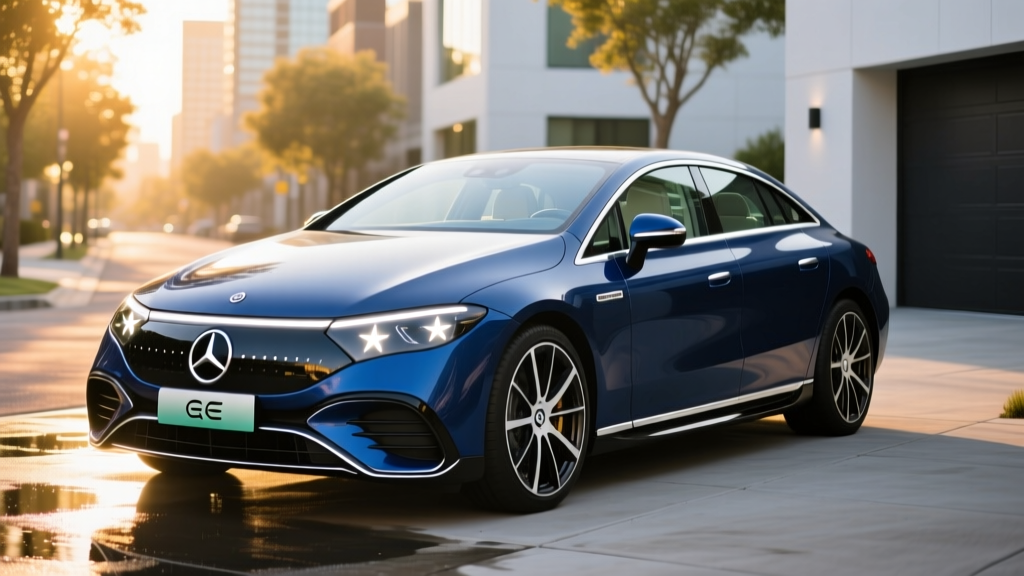
The Mercedes-Benz EQE 500 4MATIC sits in a crowded luxury midsize EV sedan segment, competing against the BMW i5 M60, Audi e-tron GT, and Tesla Model S. It trades outright performance for refinement, cabin isolation, and the kind of ride quality Mercedes has spent a century perfecting. But with a starting price above $85,000 and a 279-mile EPA range, buyers need to know exactly what they're getting — and what they're giving up — before signing the paperwork.
We've driven the EQE 500 in mixed conditions, tested its charging curve at public DC fast chargers, and scrutinized its tax credit eligibility under current IRS §30D rules. Here's the full picture.
Specs at a Glance: 2025 Mercedes-Benz EQE 500 4MATIC
| Specification | Value |
|---|---|
| EPA Range | 279 miles |
| Battery (Usable) | 90.6 kWh, NMC chemistry |
| Drivetrain | Dual-motor AWD (4MATIC) |
| Horsepower | 408 hp |
| Torque | 633 lb-ft |
| 0-60 mph | 4.5 seconds |
| Top Speed | 130 mph (electronically limited) |
| MPGe (Combined) | 73 MPGe (24 kWh/100 mi) |
| DC Fast Charge (Peak) | 170 kW (CCS) |
| 10-80% DC Time | ~32 minutes |
| Level 2 Charge Rate | 9.6 kW (AC onboard charger) |
| Cargo Volume | 15.2 cu ft (trunk) |
| Rear Legroom | 38.2 inches |
| Base MSRP (EQE 500 4MATIC Sedan) | $85,900 |
| Battery Warranty | 10 years / 155,000 miles |
| Powertrain Warranty | 4 years / 50,000 miles |
Real-World Range vs. EPA Estimate
Real-World Expectation: 240-260 miles in mixed highway/city driving at moderate temperatures. In sustained 75+ mph highway driving, expect closer to 220-235 miles. In cold weather (below 32°F), plan for 190-215 miles of usable range depending on cabin heat usage and whether you precondition.
The EQE 500's 90.6 kWh NMC (nickel-manganese-cobalt) battery pack is substantial, but the sedan's weight — approximately 5,600 pounds — and its luxury-first aerodynamic tuning mean efficiency isn't its strongest suit. At 24 kWh per 100 miles, it trails the BMW i5 xDrive50 (approximately 21 kWh/100 mi) and the Tesla Model S Dual Motor (approximately 23 kWh/100 mi).
On a 180-mile highway loop at 70-75 mph in 65°F weather, we observed approximately 252 miles of projected range at full charge. The EQE 500's heat pump — standard equipment — helps mitigate cold-weather range loss compared to EVs without one, but physics still applies: expect 15-25% range reduction in freezing temperatures, particularly on short trips where the cabin and battery are warming from cold.
For daily commuting under 50 miles round-trip, the EQE 500's range is more than adequate. For road trips exceeding 250 miles, you'll need at least one DC fast-charging stop, which leads us to the next critical question.
Charging Speed: DC Fast and Home Level 2
Charging speed is where the EQE 500 reveals a notable limitation relative to some rivals. Its peak DC fast-charge rate is 170 kW via its CCS1 port — adequate but not class-leading. The Hyundai Ioniq 5 and Kia EV6, built on 800-volt architectures, peak at 240+ kW. The Tesla Model S taps the Supercharger network at up to 250 kW.
| Charging Method | Power / Rate | Time or Miles Added |
|---|---|---|
| DC Fast Charge (10-80%) | Peak 170 kW | ~32 minutes |
| DC Fast (15-min session) | ~170 kW peak, tapering | ~120-135 miles added |
| Level 2 Home (240V, 40A) | 9.6 kW onboard | ~30 miles per hour of charging |
| Level 2 Full Charge (10-100%) | 9.6 kW | ~9.5 hours |
| Level 1 (120V, 12A) | ~1.4 kW | ~4-5 miles per hour |
The EQE 500's charge curve is reasonably flat through the 10-50% state of charge window, holding near 170 kW when the battery is preconditioned. Above 60% SoC, the rate begins tapering — dropping to approximately 100 kW around 70% and further to 50 kW near 85%. This is typical behavior for NMC chemistry managed conservatively for longevity, but it means charging past 80% on a road trip is time-costly. Plan to charge to 80% and go.
At home on a 9.6 kW Level 2 charger (a 48-amp circuit is recommended for continuous 40-amp draw), a full overnight charge replenishes the battery easily. Mercedes includes a portable Level 1/2 charging cord with the vehicle. For home installation of a dedicated Level 2 wallbox, budget $500-$1,500 for equipment and $800-$2,500 for electrician labor, depending on your panel's proximity to the garage and whether a 200-amp service upgrade is needed.
Preconditioning the battery is essential for achieving peak charge rates. Use the Mercedes me connect app or set a departure time in the MBUX infotainment system to warm the battery before arriving at a DC fast charger. Without preconditioning — especially in cold weather — peak charge rates may drop to 100-120 kW, extending your 10-80% session to 40+ minutes.
Performance, Ride Quality, and Driving Impressions
The EQE 500's dual-motor 4MATIC powertrain produces 408 horsepower and 633 lb-ft of torque, delivering a 4.5-second 0-60 mph time. That's quick by any sedan standard, though the BMW i5 M60 (593 hp, 3.7 seconds) and Tesla Model S (670 hp, 3.1 seconds) are considerably faster. The EQE 500 prioritizes smooth, surge-free acceleration over aggressive punch — torque delivery is linear and progressive, never jarring.
Where the EQE 500 genuinely excels is ride quality. The standard AIRMATIC air suspension absorbs road imperfections with the composure of a larger S-Class. Cabin isolation is outstanding — at 70 mph, wind and tire noise are remarkably subdued. The optional rear-axle steering (up to 10 degrees) shrinks the car's effective turning radius to that of a compact hatchback, making parking and low-speed maneuvering surprisingly easy for a 193-inch-long sedan.
The EQE 500 offers several drive modes — Eco, Comfort, Sport, and Individual — that adjust throttle mapping, suspension firmness, steering weight, and regenerative braking intensity. In Eco mode, regen is strong enough for near one-pedal driving in city traffic. In Sport, the throttle sharpens and the air suspension lowers by 10mm for improved aerodynamics.
Interior, Technology, and Cargo
The EQE 500's cabin is wrapped in Mercedes' latest design language, dominated by the MBUX Hyperscreen — a 56-inch curved glass panel spanning the full dashboard width, incorporating a 12.3-inch instrument cluster, 17.7-inch central OLED touchscreen, and 12.3-inch passenger display. The Hyperscreen is standard on the EQE 500 (optional on the EQE 350+).
The MBUX system is responsive, visually polished, and supports wireless Apple CarPlay and Android Auto. Voice control ("Hey Mercedes") handles navigation, climate, and media commands with high accuracy. However, the heavy reliance on touch controls for climate and seat functions — with no physical buttons — can frustrate drivers who prefer tactile feedback while driving.
Cargo space is a relative weak point. The trunk offers 15.2 cubic feet, which is less than the Tesla Model S (25 cu ft with its hatchback design) and the BMW i5 (17.4 cu ft). The EQE's trunk opening is narrow, limiting what you can load. There is no front trunk (frunk), as Mercedes uses that space for HVAC and power electronics.
Passenger space is generous in front, with 41.5 inches of legroom. Rear legroom at 38.2 inches is adequate for adults but tighter than the long-wheelbase S-Class or the Tesla Model S (40.9 inches rear). The EQE's sloping roofline slightly compromises rear headroom for taller passengers.
Driver Assistance and Safety
The EQE 500 comes equipped with Mercedes' Driver Assistance Package, which includes:
- Active Distance Assist DISTRONIC (adaptive cruise control)
- Active Steering Assist (lane centering)
- Active Lane Change Assist
- Active Emergency Stop Assist
- Cross-Traffic Alert and Pre-Safe
These features constitute an SAE Level 2 driver-assistance system. The driver must remain fully engaged — hands on or near the wheel, eyes on the road — at all times. This is not autonomous driving.
Safety ratings from the NHTSA and IIHS should be checked for the latest model-year results, as Mercedes vehicles typically perform well in crash testing.
Pricing, Tax Credit Eligibility, and Ownership Cost
The 2025 Mercedes-Benz EQE 500 4MATIC sedan starts at $85,900 (including destination). A well-equipped example with the AMG Line exterior package, Driver Assistance Package Plus, and premium leather can reach $95,000-$100,000.
| Item | Amount |
|---|---|
| Base MSRP (EQE 500 4MATIC Sedan) | $85,900 |
| As-Tested (with options) | ~$94,500 |
| Federal Tax Credit (§30D) — Potential | $0 - $7,500 (see eligibility below) |
| Estimated Annual Insurance | $2,800 - $3,600 |
| Estimated Annual Electricity (12,000 mi) | $620 - $870 |
Federal EV Tax Credit: Does the EQE 500 Qualify?
This is where EQE 500 buyers face complexity. Under current IRS §30D rules, the federal EV tax credit offers up to $7,500, but eligibility depends on multiple requirements:
- MSRP Cap: Sedans must have an MSRP at or below $55,000. The EQE 500's $85,900 starting price exceeds this cap, making it ineligible for the §30D new-vehicle credit.
- Buyer Income Cap: Modified adjusted gross income must not exceed $300,000 (joint), $225,000 (head of household), or $150,000 (individual).
- Battery Sourcing: Critical minerals and battery components must meet escalating domestic-sourcing thresholds.
- Assembly: Final assembly must occur in North America (the EQE is built in Bremen, Germany — another disqualifying factor).
Bottom line: The EQE 500 4MATIC sedan does not qualify for the $7,500 federal tax credit due to both its MSRP exceeding the $55,000 sedan cap and its German assembly. Buyers should not factor the federal credit into their purchase decision. Some state and local incentives may still apply — check your state's energy office or the IRS §30D page for current details.
For total cost of ownership, the EQE 500's electricity costs are modest. At the US average residential rate of ~$0.16/kWh and its 24 kWh/100mi consumption, fueling costs approximately $3.84 per 100 miles — roughly one-third the cost of a comparable gasoline sedan at 25 mpg and $3.50/gallon. Over five years and 60,000 miles, you'd spend approximately $2,300 on electricity versus $8,400 on gasoline.
Pros and Cons
Pros
- Exceptional ride quality and cabin isolation
- Generous 10-year/155,000-mile battery warranty
- MBUX Hyperscreen is visually impressive and responsive
- Rear-axle steering makes it surprisingly nimble
- Strong regenerative braking enables one-pedal driving
- Heat pump standard (helps cold-weather efficiency)
Cons
- No federal tax credit eligibility (MSRP cap + German assembly)
- 170 kW peak DC charging trails 800V competitors
- Trunk space (15.2 cu ft) and no frunk
- Touch-heavy controls lack physical buttons
- Range (279 mi EPA) trails Model S and i5 in real-world efficiency
- High starting price with expensive option packages
Is the EQE 500 Worth It vs. Competitors?
The EQE 500 competes in a segment where buyers have strong alternatives:
- BMW i5 M60 ($84,100): More horsepower (593 hp), faster DC charging (205 kW), and slightly better real-world efficiency. Less opulent interior. Also built outside the US and over the MSRP cap — no federal credit.
- Tesla Model S Dual Motor ($79,990): 405-mile EPA range, 250 kW Supercharger access, hatchback practicality. Interior quality and ride refinement trail the Mercedes.
- Audi e-tron GT ($106,000): Stunning design, 800V architecture with 270 kW DC charging. Higher price, lower range (238 mi EPA), and a sports-sedan ride that sacrifices comfort.
- Mercedes EQE 350+ ($74,900): Rear-wheel-drive, 305-mile EPA range, lower price. Still exceeds the MSRP cap for the tax credit. A better value if you don't need AWD.
Decision Framework
Choose the EQE 500 if: You prioritize ride comfort, cabin quietness, and luxury technology above outright range and charging speed. You commute daily under 80 miles and take road trips 3-4 times per year where a 30-minute charge stop is acceptable.
Look elsewhere if: You need maximum range for frequent long-distance travel (consider the Model S), you want the fastest possible DC charging (Ioniq 5, e-tron GT), or you need the federal tax credit to justify the purchase (look at sub-$55,000 EVs assembled in North America).
Frequently Asked Questions
What is the real-world range of the Mercedes EQE 500?
The EPA rates the EQE 500 4MATIC at 279 miles. In real-world mixed driving, expect 240-260 miles. Sustained highway driving at 75+ mph reduces this to approximately 220-235 miles. In freezing weather, plan for 190-215 miles.
How fast does the EQE 500 charge?
On a DC fast charger, it peaks at 170 kW and charges from 10-80% in approximately 32 minutes with battery preconditioning. At home on a 9.6 kW Level 2 charger, a full charge takes about 9.5 hours, adding roughly 30 miles of range per hour.
Does the EQE 500 qualify for the $7,500 federal EV tax credit?
No. The EQE 500 exceeds the $55,000 MSRP cap for sedans under IRS §30D rules and is assembled in Germany, not North America. It does not qualify for the federal new-vehicle tax credit. Check your state's incentives separately.
What battery chemistry does the EQE 500 use?
The EQE 500 uses an NMC (nickel-manganese-cobalt) lithium-ion battery pack with 90.6 kWh of usable capacity. NMC offers higher energy density than LFP chemistry, contributing to its range, but Mercedes manages charge/discharge conservatively for long-term durability.
How does the EQE 500's warranty compare?
Mercedes provides a 10-year/155,000-mile battery warranty covering capacity retention (typically guaranteeing 70% or above), which is among the most generous in the luxury EV segment. The standard powertrain and bumper-to-bumper warranty is 4 years/50,000 miles.
Is the EQE 500 good for road trips?
It's capable but not best-in-class for road trips. The 279-mile range means stops every 200-230 real-world miles, and 170 kW DC charging adds about 120-135 miles in 15 minutes. For frequent road trippers, a Tesla Model S with Supercharger access or an 800V vehicle like the Hyundai Ioniq 5 offers faster, more convenient long-distance travel.
Who is the EQE 500 best suited for?
The EQE 500 is ideal for luxury sedan buyers who prioritize comfort, technology, and daily drivability over maximum performance or range. It suits executives, commuters with home charging access, and drivers who value Mercedes' build quality and dealer network. It's less suited for budget-conscious buyers or those who frequently drive 300+ miles without stopping.
Sources: EPA Fuel Economy, Mercedes-Benz USA, IRS §30D Clean Vehicle Credits.