The Mercedes-Benz EQC occupies an unusual position in the luxury electric SUV segment. It's a vehicle where the cabin experience arguably outshines the powertrain specs — which makes a deep look at the Mercedes EQC SUV interior essential for anyone cross-shopping it against the BMW iX, Audi Q8 e-tron, or Genesis Electrified GV70. But a premium cabin alone doesn't settle the purchase decision. Range, charging speed, efficiency, and federal tax-credit eligibility all matter just as much. This review covers every number you need.
Range Reality Check
EPA Estimated Range: 220 miles (combined city/highway)
Real-World Expectation: Plan for ~185–200 miles on sustained highway driving at 70+ mph. In freezing temperatures (below 30°F), expect a 20–30% reduction, dropping effective range to roughly 155–175 miles unless you precondition the battery while plugged in.
Mercedes EQC SUV Interior: Materials, Space, and MBUX Tech
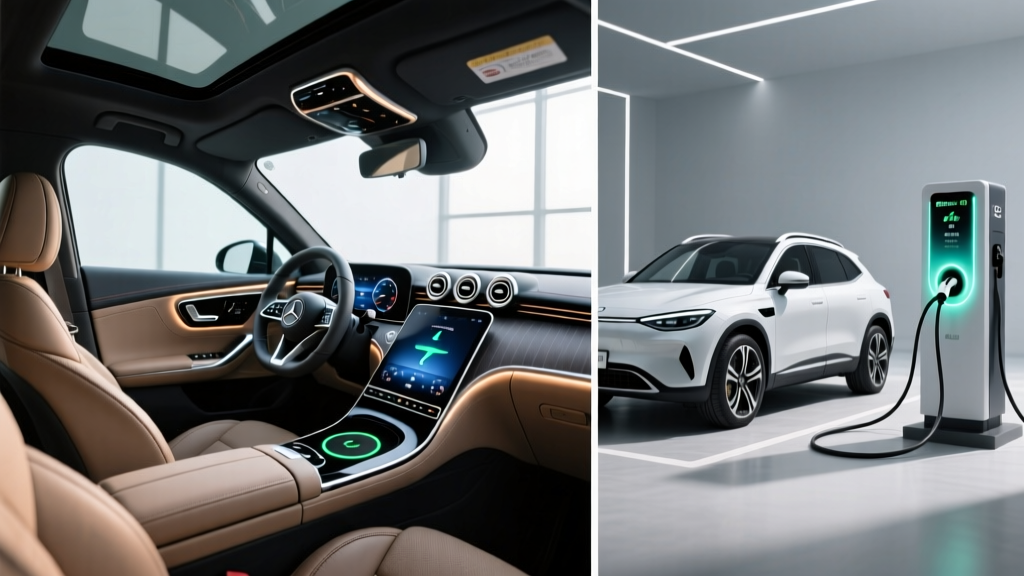
The EQC's interior is where Mercedes justifies its premium positioning. The dashboard is dominated by the dual 12.3-inch MBUX (Mercedes-Benz User Experience) display cluster — one for the instrument panel, one for infotainment — housed under a single glass pane. The system supports natural-language voice control ("Hey Mercedes"), wireless Apple CarPlay and Android Auto, and over-the-air updates.
Material quality is a step above competitors in this price bracket. Standard equipment includes leatherette (Artico) upholstery, open-pore wood trim, and 64-color ambient lighting. The optional AMG Line package adds Nappa leather, aluminum trim, and sport-contour seats with heating and ventilation.
Passenger space is adequate but not class-leading:
- Front legroom: 40.9 inches
- Rear legroom: 36.5 inches
- Front headroom: 38.8 inches
- Rear headroom: 37.9 inches
- Cargo volume (rear seats up): 17.7 cu ft
- Cargo volume (rear seats folded): 53.4 cu ft
The cargo area is notably smaller than the Audi Q8 e-tron (28.5 cu ft behind the second row) and the BMW iX (35.5 cu ft). There is no front trunk (frunk) — the space under the hood houses the electric drivetrain components. If cargo capacity is a priority, the EQC falls short of rivals.
Driver Assistance and Safety Tech
The EQC comes standard with Active Brake Assist, Active Lane Keeping Assist, Blind Spot Assist, and Attention Assist. The optional Driver Assistance Package adds Active Distance Assist DISTRONIC (adaptive cruise with stop-and-go), Active Steering Assist, and Active Lane Change Assist. This is a SAE Level 2 system — the driver must remain fully engaged with hands on the wheel at all times. It is not autonomous driving.
Battery, Drivetrain, and Performance Specs
The EQC uses an 80 kWh lithium-ion battery pack (NMC — nickel manganese cobalt chemistry). Usable capacity is approximately 76 kWh, with the remainder held as a buffer to protect long-term battery health. Dual electric motors provide standard all-wheel drive (4MATIC).
| Specification | Value |
|---|---|
| Battery Capacity (gross / usable) | 80 kWh / ~76 kWh |
| Battery Chemistry | NMC (Nickel Manganese Cobalt) |
| Drivetrain | Dual-motor AWD (4MATIC) |
| Horsepower | 402 hp (combined) |
| Torque | 564 lb-ft |
| 0–60 mph | 4.8 seconds |
| EPA Range | 220 miles |
| Efficiency | 74 MPGe / 46 kWh/100 mi |
| Curb Weight | ~5,350 lbs |
The 402 hp and 4.8-second 0–60 time put the EQC in a comfortable performance middle ground. It's quicker than the Audi Q8 55 e-tron (5.4 sec) but trails the BMW iX xDrive50 (4.4 sec). Throttle response is immediate, as expected from dual motors, and the ride quality benefits from standard adaptive damping.
Charging Speed: DC Fast Charge and Home Level 2
Charging is where the EQC shows its age relative to newer platforms. Its peak DC fast-charge rate of 110 kW is significantly behind the 200+ kW capabilities of Hyundai's E-GMP vehicles and the BMW iX.
| Charging Level | Power / Rate | Time / Recovery |
|---|---|---|
| Level 1 (120V household) | ~1.4 kW | ~3–4 miles per hour of charging |
| Level 2 (240V home/public) | 7.4 kW | ~22 miles per hour; full charge in ~11 hours |
| DC Fast Charge (CCS) | 110 kW peak | 10–80% in ~40 minutes |
The 10–80% DC fast-charge time of approximately 40 minutes is workable for road trips but noticeably slower than the ~18–25 minute times offered by 800V-architecture competitors. On a 150 kW Electrify America or EVgo station, the EQC will cap at its 110 kW ceiling — you won't benefit from higher-output stalls. Charge-curve tapering begins noticeably above 60% SoC, and charging from 80–100% adds another 25–30 minutes.
Home charging tip: A Level 2 home charger (240V, 32A or 48A circuit) is strongly recommended. At 7.4 kW, an overnight session of 8–10 hours restores the full battery. Installation costs typically range from $800–$2,000 depending on your electrical panel capacity and the distance from panel to charger location. Always have a licensed electrician evaluate your panel before installation.
Pricing, Trims, and Federal Tax Credit Eligibility
The EQC is offered in a single well-equipped trim in the U.S. market, with option packages adding cost.
| Item | Amount |
|---|---|
| Base MSRP (EQC 400 4MATIC) | $68,750 |
| Destination charge | $1,150 |
| As-tested (with AMG Line + Driver Assist Pkg) | ~$76,000–$78,500 |
| Federal §30D Tax Credit (if eligible) | Up to $7,500 |
| Effective price after max credit | ~$61,250–$71,000 |
Federal Tax Credit: §30D Eligibility Checklist
Under current IRS §30D rules, the EQC's eligibility for the full $7,500 federal tax credit depends on several requirements that must all be met simultaneously:
- MSRP cap: SUVs must be at or below $80,000 MSRP — the base EQC qualifies, but heavily optioned units exceeding $80,000 do not.
- Buyer income cap: Modified AGI must not exceed $150,000 (single), $225,000 (head of household), or $300,000 (married filing jointly).
- Battery sourcing: Critical minerals and battery components must meet phased-in domestic/free-trade-partner sourcing thresholds that tighten annually. Verify the specific VIN's compliance on the manufacturer's compliance letter or the DOE's fueleconomy.gov listing.
- Point-of-sale transfer: Eligible buyers may transfer the credit to the dealer at purchase for an immediate price reduction rather than claiming it at tax filing.
Credit rules are subject to legislative change. Confirm eligibility with your tax professional and the IRS before purchase.
Efficiency, Ownership Costs, and Warranty
At 74 MPGe combined (46 kWh per 100 miles), the EQC is less efficient than lighter competitors. For comparison, the BMW iX xDrive50 achieves 86 MPGe, and the Tesla Model Y Long Range hits 122 MPGe. The EQC's heavier curb weight and less aerodynamic profile contribute to this gap.
At the U.S. average electricity rate of ~$0.17/kWh (EIA), charging the EQC costs roughly $0.078 per mile — compared to $0.14–$0.16 per mile for a comparable gas-powered luxury SUV at 22 MPG and $3.50/gallon.
Warranty Coverage
- New vehicle limited warranty: 4 years / 50,000 miles
- High-voltage battery warranty: 8 years / 100,000 miles (covers capacity falling below 70% of original)
- Powertrain (electric motors, reducer): 8 years / 100,000 miles
- Roadside assistance: 4 years / 50,000 miles
The 70% capacity retention threshold is standard for the industry. Real-world NMC degradation data from fleet studies suggests most EV batteries retain 85–92% capacity after 100,000 miles under normal use — well above the warranty trigger. To maximize longevity, avoid routinely charging to 100% or draining below 10%; a daily 20–80% SoC window is optimal for NMC chemistry.
How the EQC Compares to Key Rivals
The EQC competes directly with several luxury electric SUVs. Here's how the critical numbers stack up:
| Spec | Mercedes EQC | BMW iX xDrive50 | Audi Q8 55 e-tron | Genesis Electrified GV70 |
|---|---|---|---|---|
| EPA Range | 220 mi | 324 mi | 285 mi | 236 mi |
| Battery (usable) | ~76 kWh | 105.2 kWh | 106 kWh | 74 kWh |
| DC Fast Charge (peak) | 110 kW | 195 kW | 170 kW | 350 kW |
| 10–80% DC time | ~40 min | ~31 min | ~31 min | ~18 min |
| 0–60 mph | 4.8 sec | 4.4 sec | 5.4 sec | 4.5 sec |
| Horsepower | 402 hp | 516 hp | 402 hp | 429 hp |
| Cargo (rear up) | 17.7 cu ft | 35.5 cu ft | 28.5 cu ft | 28.7 cu ft |
| Base MSRP | $68,750 | $87,250 | $74,400 | $66,450 |
The BMW iX dominates on range and cargo space but costs substantially more. The Audi Q8 e-tron offers a strong balance of range, charging speed, and practicality. The Genesis Electrified GV70 is the closest value rival with 350 kW charging capability, though its range is similarly modest.
Who Should Buy the Mercedes EQC?
Choose the EQC if: Interior luxury and cabin refinement are your top priorities, your daily commute is under 100 miles round-trip, you have reliable home charging, and you rarely take road trips exceeding 200 miles without a planned stop.
Look elsewhere if: You need maximum range for frequent long-distance travel (BMW iX), you need serious cargo room (iX or Q8 e-tron), or you want the fastest possible DC charging (Genesis GV70 or Hyundai/Kia E-GMP vehicles).
Pros and Cons
Pros
- Class-leading interior material quality and cabin quietness
- Smooth, compliant ride with adaptive damping standard
- Strong 402 hp / 564 lb-ft dual-motor performance
- MBUX infotainment is responsive with excellent voice control
- Comprehensive standard driver-assistance suite
- 8-year/100,000-mile battery warranty with 70% retention guarantee
Cons
- 220-mile EPA range trails most competitors by 60–100+ miles
- 110 kW peak DC charging is slow for the segment
- 17.7 cu ft cargo space is the smallest in class
- No front trunk (frunk) for additional storage
- 74 MPGe efficiency lags behind lighter, more aero-efficient rivals
- Heavy optioning can push MSRP above the $80,000 tax-credit cap
Frequently Asked Questions
What is the real-world range of the Mercedes EQC?
The EPA rates the EQC at 220 miles combined. In real-world highway driving at 70–75 mph, expect 185–200 miles. In cold weather below freezing, effective range can drop to 155–175 miles. Preconditioning the battery while plugged in mitigates some cold-weather loss.
How fast does the EQC charge at home and on the road?
On a Level 2 home charger (240V), the EQC charges at 7.4 kW, adding about 22 miles of range per hour — a full charge takes roughly 11 hours. On a DC fast charger, it peaks at 110 kW, reaching 10–80% in about 40 minutes. This is slower than rivals with 800V architectures.
Does the Mercedes EQC qualify for the federal EV tax credit?
It may qualify for up to $7,500 under IRS §30D, but only if the MSRP stays at or below $80,000 (SUV cap), the buyer's income is within limits ($150K single / $300K joint), and the battery meets current critical-mineral and component sourcing thresholds. Always verify VIN-specific eligibility via the IRS and your tax professional before purchasing.
Is the EQC worth buying over the BMW iX or Audi Q8 e-tron?
If interior quality and ride comfort outweigh range and cargo needs, the EQC delivers a refined experience at a lower base price than the iX. However, the BMW iX offers 324 miles of range and double the cargo space for ~$18,500 more, while the Audi Q8 e-tron provides 285 miles and faster charging at a comparable price. For most buyers prioritizing practicality, the Q8 e-tron or iX are stronger overall packages.
What is the biggest drawback of the Mercedes EQC?
Range and charging speed. At 220 miles EPA and 110 kW peak DC charging, the EQC requires more frequent and longer stops on road trips than nearly every competitor. Combined with the small 17.7 cu ft cargo area, these limitations make it best suited as a luxury commuter vehicle rather than a primary road-trip SUV.
How long will the EQC battery last?
Mercedes warranties the high-voltage battery for 8 years or 100,000 miles against capacity loss below 70%. Industry data on NMC chemistry suggests most packs retain 85–92% capacity at 100,000 miles under normal charging habits. Keeping daily charge between 20–80% SoC and using DC fast charging sparingly will maximize lifespan.