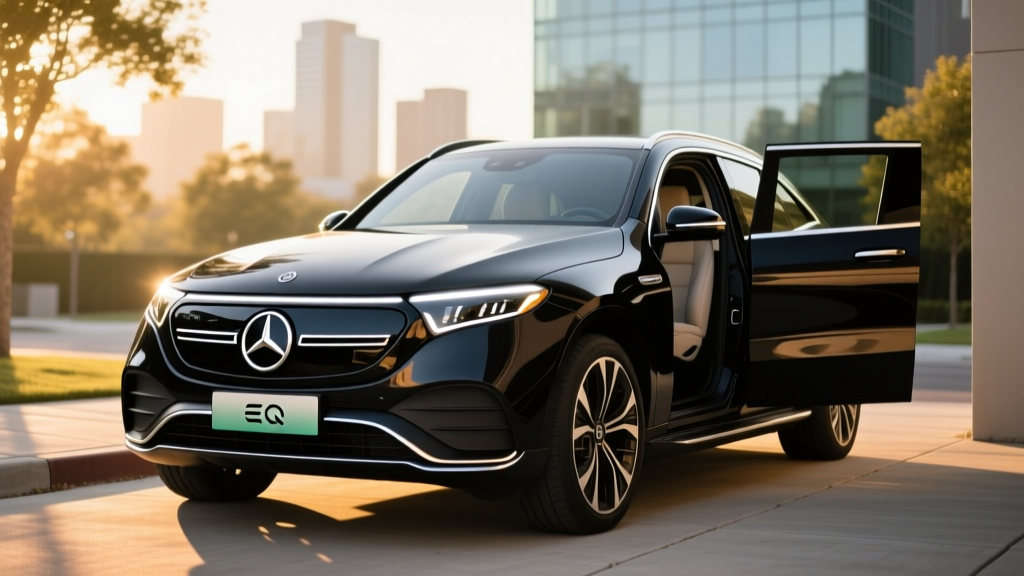
The Mercedes-Benz EQC was the brand's first ground-up electric SUV, launched globally in 2019 and positioned as a luxury rival to the Audi e-tron and Jaguar I-Pace. Despite strong initial interest, EQC sales never reached the volumes Mercedes hoped for — and the automaker discontinued the model after the 2023 model year in most markets and fully wound down global production by early 2024. If you're researching EQC sales today, you're almost certainly looking at the used or certified pre-owned (CPO) market, where this compact electric crossover still has a compelling story to tell — with significant caveats.
This review covers the EQC's final U.S.-available specs (the 2022–2023 EQC 400 4MATIC), its real-world range and charging behavior, ownership costs, and whether it remains a smart buy against current competitors in 2026.
Real-World Range Reality
EPA Estimated: 220 miles (EQC 400 4MATIC)
Real-World Expectation: 185–200 miles on mixed highway driving; 155–175 miles in sustained cold weather (below 32°F) or at sustained 75+ mph speeds. City/regenerative driving can push closer to 225 miles in mild conditions.
EQC Sales History: Why Mercedes Killed It
The EQC's sales trajectory tells a cautionary tale about first-generation EV strategy. Globally, Mercedes sold roughly 170,000 units between 2019 and 2023. In the United States, the EQC arrived late — for the 2022 model year only — and was priced starting at $67,900. U.S. EQC sales were modest: approximately 2,300 units in 2022 and a similar figure in 2023 before discontinuation.
Several factors explain the weak sales performance:
- Range deficit: At 220 miles EPA, the EQC trailed the Tesla Model Y Long Range (330 mi), BMW iX xDrive50 (324 mi), and even the Audi Q4 e-tron (242 mi) — vehicles available at similar or lower prices.
- Platform compromise: The EQC rode on a modified MRA platform shared with the GLC, not a dedicated EV skateboard. This limited interior packaging and added weight (5,500 lbs curb).
- Charging speed: A peak DC rate of 110 kW was adequate in 2019 but fell behind competitors reaching 150–270 kW by 2022.
- Internal competition: Mercedes pivoted investment to the larger EQE SUV and EQS SUV on the dedicated EVA platform, leaving the EQC without a successor.
For 2026 buyers, the EQC's discontinuation means no new inventory exists — but it also means aggressive used pricing, with CPO examples typically trading between $32,000 and $42,000 depending on mileage and condition.
Battery, Powertrain & Efficiency Specs
| Spec | Value |
|---|---|
| Battery (gross / usable) | 80 kWh / 76 kWh |
| Chemistry | NMC 622 (Nickel Manganese Cobalt) |
| EPA Range | 220 miles |
| MPGe (city / hwy / combined) | 84 / 73 / 79 MPGe |
| Efficiency | 43 kWh/100 mi |
| Drivetrain | Dual-motor AWD (4MATIC) |
| Horsepower | 402 hp combined |
| Torque | 564 lb-ft |
| 0–60 mph | 4.8 seconds |
| Top Speed | 112 mph (electronically limited) |
| Curb Weight | 5,500 lbs |
| Towing Capacity | Not rated for U.S. |
The NMC 622 pack delivers solid energy density but is more sensitive to long-term high-SoC storage than LFP chemistries. Mercedes applies a conservative top and bottom buffer (roughly 4 kWh combined), which helps protect long-term State of Health (SoH). According to fueleconomy.gov, the EQC's 79 MPGe combined rating places it behind the Model Y (122 MPGe) and I-Pace (76 MPGe combined but with more range), largely due to its heavy curb weight and less aerodynamic profile.
Charging Speed: DC Fast & Home Level 2
Charging was one of the EQC's weakest points at launch, and the gap has only widened by 2026 standards. Here's what to expect:
| Level | Connector | Max Rate | Speed | Time / Notes |
|---|---|---|---|---|
| Level 1 (120V) | J1772 | ~1.4 kW | ~3–4 mi/hr | Not practical for daily use |
| Level 2 (240V) | J1772 | 7.4 kW (onboard charger) | ~20 mi/hr | 0–100% in ~10.5 hours |
| DC Fast Charge | CCS1 | 110 kW peak | ~180 mi/hr at peak | 10–80% in ~40 minutes |
The 110 kW peak DC rate is the headline disappointment. On a 350 kW Electrify America or Tesla Supercharger (via adapter), the EQC will not exceed 110 kW — and that peak only holds between roughly 10–30% SoC before tapering. From 50% onward, expect sustained rates closer to 60–75 kW. A full 10–80% session takes approximately 40 minutes under ideal conditions, versus 18–25 minutes for competitors like the Hyundai Ioniq 5 or Porsche Taycan.
The 7.4 kW onboard AC charger means a home Level 2 session (using a 32A or 40A wallbox) adds about 20 miles per hour of charging. For a 220-mile vehicle, overnight charging easily replenishes a full day's driving, which is the practical use case for most owners.
Connector note: The EQC uses CCS1 in the U.S. As the industry shifts to NACS, Mercedes has not released an official NACS adapter for the EQC, though third-party CCS-to-NACS adapters (such as those from Lectron or A2Z) are available. Verify compatibility before purchasing.
Interior, Cargo & Technology
The EQC's interior is where the Mercedes badge justifies its premium. Build quality, material selection, and cabin quietness are a step above the Model Y and competitive with the BMW iX.
Dimensions
- Cargo volume (behind rear seats): 17.4 cu ft
- Cargo volume (rear seats folded): 50.5 cu ft
- Front legroom: 40.9 in
- Rear legroom: 38.0 in
- Frunk: None (the modified GLC platform leaves no front trunk space)
The 17.4 cu ft cargo area is tight for a luxury compact SUV — the Model Y offers 30.2 cu ft, and the Audi Q4 e-tron provides 24.8 cu ft. If cargo capacity is a priority, the EQC falls short.
Tech & Driver Assistance
The EQC runs Mercedes' MBUX infotainment system with dual 10.25-inch displays, wireless Apple CarPlay and Android Auto, and natural-language voice control ("Hey Mercedes"). Standard driver assistance includes:
- Active Distance Assist DISTRONIC (adaptive cruise with stop-and-go)
- Active Steering Assist (lane centering) — SAE Level 2; driver must remain engaged
- Active Blind Spot Assist with exit warning
- Active Brake Assist with cross-traffic function
- 360-degree surround-view camera
Mercedes' Level 2 system is competent for highway cruising but does not offer hands-free capability like GM's Super Cruise or Ford's BlueCruise. Keep your hands on the wheel — the capacitive touch detection is sensitive and will issue warnings quickly.
Pricing, Tax Credits & Used Market Value
Since the EQC is discontinued, new-vehicle pricing is historical only. Here's the landscape for 2026 buyers considering a used or CPO example:
| Item | Amount |
|---|---|
| Original Base MSRP (2022 EQC 400 4MATIC) | $67,900 |
| As-Tested (with Premium/Packages) | $73,000–$76,000 |
| 2026 CPO Typical Range | $34,000–$42,000 |
| 2026 Private-Party Typical Range | $28,000–$36,000 |
Federal Tax Credit on a Used EQC
The EQC does not qualify for the new-vehicle §30D credit (which is moot since it's no longer sold new). However, it may qualify for the used clean vehicle credit under IRC §25E — up to $4,000 or 30% of the sale price, whichever is less. Per IRS guidelines, eligibility requires:
- Sale price of $25,000 or less (the credit phases out above this threshold — most CPO EQCs exceed it)
- Buyer income caps: $75,000 single / $112,500 head of household / $150,000 joint
- Vehicle must be at least 2 model years old
- Purchased from a licensed dealer
- Battery capacity of at least 7 kWh (the EQC's 80 kWh pack easily qualifies)
Practical reality: Most used EQCs sell above $25,000, which disqualifies them from the used-vehicle credit. Only high-mileage or private-party examples may fall under the cap, and private-party sales don't qualify. Consult a tax professional before assuming credit eligibility.
Warranty Coverage & Battery Longevity
For a discontinued model, warranty coverage is a critical concern. Here's what Mercedes provided:
- New-Vehicle Limited Warranty: 4 years / 50,000 miles
- Powertrain Warranty: 4 years / 50,000 miles
- High-Voltage Battery Warranty: 8 years / 100,000 miles (whichever comes first), covering defects and capacity loss below 70% of original capacity
For a 2022 EQC purchased in 2026, the basic warranty has expired, but the HV battery warranty remains active through 2030 or 100,000 miles. A CPO purchase through Mercedes typically extends the basic warranty by 1 year with no mileage limit — strongly recommended for a discontinued model.
NMC 622 chemistry, when kept between 20–80% SoC for daily use and avoiding frequent DC fast charging to 100%, typically shows 8–12% degradation over 100,000 miles based on fleet data from similar packs. The EQC's conservative buffer management helps, but expect roughly 195–205 miles of real-world range at 50,000 miles versus the original 220.
Pros, Cons & Verdict
Pros
- Premium interior quality, cabin quietness, and ride comfort
- Strong 402 hp dual-motor performance (4.8s 0–60)
- Competent MBUX infotainment with wireless phone integration
- Steep depreciation means strong used value proposition
- Remaining HV battery warranty (8 yr/100k mi) on 2022–2023 models
Cons
- 220-mile EPA range is below average for 2026 standards
- 110 kW peak DC charging is slow by current benchmarks
- No frunk; cargo space (17.4 cu ft) trails competitors
- Discontinued — limited parts availability long-term risk
- Likely ineligible for federal used-EV tax credit due to price
- CCS1 connector without official NACS adapter from Mercedes
Who Should Buy a Used EQC?
The EQC fits a narrow buyer profile in 2026: a luxury-oriented commuter who drives fewer than 150 miles daily, has reliable home Level 2 charging, values ride comfort and interior quality over range and cargo space, and can secure a CPO example with remaining battery warranty. It does not suit road-trippers, families needing cargo flexibility, or buyers in charging-desert regions.
EQC vs. Competitors: Is It Worth Buying?
At $34,000–$42,000 CPO, the EQC competes with used Tesla Model Y Long Range (2021–2022), Audi Q4 e-tron (2022–2023), and Volvo XC40 Recharge (2022–2023). Here's how they stack up:
| Attribute | Mercedes EQC 400 | Tesla Model Y LR | Audi Q4 50 e-tron | Volvo XC40 Recharge |
|---|---|---|---|---|
| EPA Range | 220 mi | 330 mi | 242 mi | 223 mi |
| Battery (usable) | 76 kWh NMC | ~75 kWh NMC | 77 kWh NMC | 75 kWh NMC |
| DC Fast Peak | 110 kW | 250 kW | 175 kW | 200 kW |
| 10–80% DC Time | ~40 min | ~25 min | ~28 min | ~28 min |
| 0–60 mph | 4.8s | 4.8s | 5.0s | 4.5s |
| Cargo (rear seats up) | 17.4 cu ft | 30.2 cu ft | 24.8 cu ft | 16.0 cu ft |
| Typical Used Price | $34k–$42k | $32k–$40k | $36k–$44k | $33k–$40k |
The Model Y dominates on range, charging speed, and cargo space. The Q4 e-tron offers more range and faster charging with a similar luxury feel. The XC40 Recharge matches the EQC on range but charges faster. The EQC's edge is interior refinement and ride quality — but those are subjective qualities that don't offset a 110-mile range gap against the Model Y.
Frequently Asked Questions
What is the real-world range of the Mercedes EQC?
The EPA rates the EQC 400 4MATIC at 220 miles. In real-world mixed driving, expect 185–200 miles. Sustained highway speeds above 70 mph or cold temperatures below freezing can drop range to 155–175 miles. City driving with regenerative braking in mild weather can approach or slightly exceed the EPA figure.
How fast does the EQC charge at home and on DC fast chargers?
On a Level 2 home charger (240V, 32A+), the EQC charges at up to 7.4 kW, adding roughly 20 miles per hour — a full charge takes about 10.5 hours. On DC fast chargers, it peaks at 110 kW but tapers significantly above 50% SoC, resulting in a 10–80% time of approximately 40 minutes. This is noticeably slower than most 2026 competitors.
Does the EQC qualify for any federal tax credit?
The EQC is no longer sold new, so the new-vehicle §30D credit does not apply. The used clean vehicle credit (§25E) offers up to $4,000, but only on vehicles sold for $25,000 or less from a licensed dealer — a threshold most used EQCs exceed. Always verify current rules at irs.gov and consult a tax professional.
Is the Mercedes EQC worth buying used in 2026?
It depends on your priorities. If you value Mercedes interior quality, a smooth ride, and strong acceleration — and your daily commute is under 150 miles with reliable home charging — a CPO EQC at $35,000–$40,000 is a reasonable luxury EV bargain. If range, charging speed, or cargo space are top priorities, the used Tesla Model Y or Audi Q4 e-tron are stronger choices.
Why did Mercedes discontinue the EQC?
The EQC used a modified combustion-vehicle platform (MRA/GLC), which limited range, charging speed, and interior packaging versus dedicated EV platforms. Sales underperformed globally (~170,000 units over 4 years), and Mercedes shifted investment to its EVA-platform vehicles (EQE SUV, EQS SUV) and the upcoming MMA-platform compact EVs. No direct EQC successor has been announced.
Will I have trouble getting parts for a discontinued EQC?
Mercedes is legally required to maintain parts availability for a minimum period after discontinuation (typically 10+ years for major components in the U.S.). HV battery and powertrain parts should remain available through the warranty period and beyond. However, body panels and trim-specific components may become harder to source over time — another reason to consider a CPO purchase with dealer support.