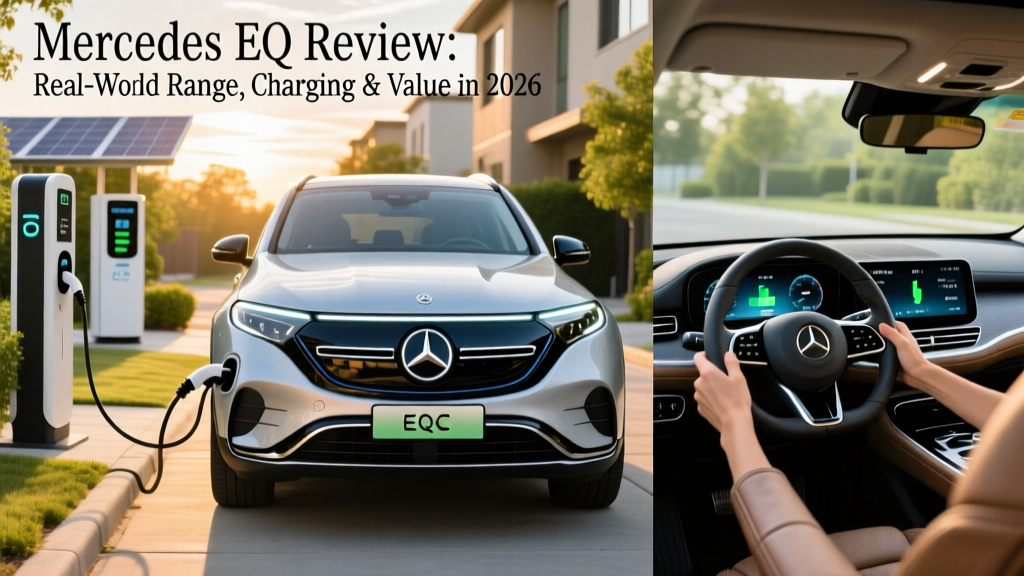
The Mercedes-Benz EQC occupies an unusual space in the electric-vehicle market. Originally launched as Mercedes' first dedicated battery-electric SUV, the EQC was never officially sold new in the United States — a fact that complicates its value proposition for American buyers in 2026. However, with growing grey-market imports, Canadian-spec imports crossing the border, and a robust used-EV market, the EQC remains a vehicle US-based shoppers research frequently. This review covers the EQC's real-world range, charging behavior, ownership economics, and how it stacks up against competitors you can actually buy at a US dealership.
Mercedes EQC at a Glance: Key Specifications
| Specification | Mercedes EQC 400 4MATIC |
|---|---|
| Battery Capacity | 80 kWh usable (NMC chemistry) |
| EPA-Estimated Range | ~220 mi (WLTP-rated 259 mi / 417 km) |
| Real-World Range (Highway) | ~180–200 mi |
| Efficiency | ~2.5 kWh/mi (40 kWh/100 km) |
| Drivetrain | Dual-motor AWD (4MATIC) |
| Horsepower | 402 hp (300 kW) |
| 0–60 mph | 4.8 seconds |
| Max DC Fast Charge | 110 kW (CCS) |
| 10–80% DC Charge Time | ~40 minutes |
| Level 2 AC Charge Rate | 11 kW onboard charger |
| Cargo Volume | 17.7 cu ft (rear seats up) / 51.5 cu ft (folded) |
| Curb Weight | ~5,400 lbs |
| Battery Warranty | 8 years / 100,000 mi (or 70% SoH) |
Range Reality Check: EPA vs. Real World
The EQC's 80 kWh NMC (nickel-manganese-cobalt) battery was sized conservatively even at launch. Mercedes prioritized refinement and noise isolation over range maximization, and the result is a heavy SUV (over 5,400 lbs) that consumes energy at a rate closer to 2.5 kWh per mile. For comparison, the Tesla Model Y Long Range achieves roughly 3.5–4.0 miles per kWh with a similar battery size, thanks to superior aerodynamics and a heat pump.
City driving with frequent regenerative braking opportunities can push the EQC closer to its rated range, but this is not a vehicle designed for maximum efficiency. If your daily commute exceeds 80 miles round-trip and you lack home charging, the EQC's range becomes a genuine constraint.
Charging Performance: Where the EQC Shows Its Age
| Charging Level | Power / Rate | Time / Speed |
|---|---|---|
| Level 1 (120V household) | ~1.4 kW | ~3–4 miles per hour |
| Level 2 (240V home) | 11 kW | ~25–30 miles per hour; full charge in ~8 hours |
| DC Fast Charge (CCS) | 110 kW peak | 10–80% in ~40 minutes |
The EQC's 110 kW peak DC fast-charge rate was adequate in 2019 but falls well short of 2026 standards. Modern competitors like the Hyundai Ioniq 5 (240 kW peak), Kia EV6 (240 kW), and Tesla Model Y (250 kW on V3 Superchargers) can add range two to three times faster on compatible infrastructure.
The charge curve also matters. The EQC holds near-peak rates only between roughly 10% and 40% state of charge, then tapers progressively. From 80% to 100%, charging slows dramatically — adding that final 20% can take nearly as long as the 10–80% session. On a road trip, plan for 40-minute stops every 170–180 miles and avoid charging past 80% unless your destination is within the remaining buffer.
On Level 2 home charging, the 11 kW onboard charger is a bright spot — faster than many rivals limited to 7.2 or 9.6 kW. A full overnight charge from empty takes about 8 hours on a 48-amp Level 2 circuit. Most owners will arrive home at 30–50% SoC and wake to a full battery in 4–5 hours.
One important note for US importers: the EQC uses the CCS1 connector standard, which remains compatible with most US public DC fast-charging networks (Electrify America, EVgo). However, as the industry shifts toward NACS (the Tesla connector), CCS-only vehicles may face reduced fast-charging access at Tesla Supercharger stations unless an adapter is available. Mercedes has offered NACS adapters for newer models, but EQC compatibility should be verified before purchase.
Performance and Driving Dynamics
The EQC 400 4MATIC delivers 402 horsepower and 564 lb-ft of torque from its dual asynchronous motors. The 0–60 mph time of 4.8 seconds is brisk, though not class-leading — the Tesla Model Y Performance hits 60 in 3.5 seconds, and even the Ford Mustang Mach-E GT manages 3.5 seconds.
Where the EQC excels is refinement. Mercedes engineered this platform to isolate occupants from road noise and vibration, and the result is one of the quietest EV cabins in its price class. The air suspension (optional on some trims) smooths rough pavement effectively, and the steering is weighted for comfort rather than sportiness.
The dual-motor AWD system provides confident traction in rain and light snow, though the EQC's 5,400-pound curb weight is noticeable in corners. Body roll is well-controlled but present, and this is clearly a luxury cruiser rather than a performance SUV. Towing capacity is limited to approximately 1,800 lbs — far below the Model Y's 3,500-lb rating.
Pricing, Tax Credits, and Ownership Cost
Because the EQC was never officially sold in the US market, there is no official MSRP from Mercedes-Benz USA. Canadian-market EQC models carried an MSRP of approximately CAD $73,000–$85,000 (roughly USD $55,000–$64,000 depending on exchange rates at the time of sale). On the US used market in 2026, expect to find EQC examples priced between $28,000 and $40,000 depending on mileage, condition, and import documentation.
Insurance costs for the EQC tend to run higher than average for its segment due to limited US parts availability and specialized repair requirements. Expect annual premiums 15–25% above comparable US-market EVs like the Model Y or Mach-E.
Interior, Tech, and Daily Usability
The EQC's interior is where Mercedes' luxury DNA shows most clearly. The cabin uses high-quality materials — real wood trim, leather upholstery, and Mercedes' MBUX infotainment system with dual 10.25-inch displays. Voice control ("Hey Mercedes") works reliably for climate, navigation, and media commands.
However, the MBUX system in the EQC reflects its 2019-vintage hardware. The interface is functional but not as responsive as the hyperscreen or newer NTX systems found in the EQE and EQS. Wireless Apple CarPlay and Android Auto are supported, but the native navigation's EV route planning (which factors in charging stops) is less sophisticated than Tesla's built-in trip planner or the A Better Routeplanner app.
Driver assistance features include adaptive cruise control, lane-keeping assist, blind-spot monitoring, and automatic emergency braking. These are SAE Level 2 systems — the driver must remain engaged and hands on the wheel at all times. The EQC does not offer anything comparable to GM's Super Cruise hands-free highway driving or Ford's BlueCruise.
Cargo space is adequate but not generous: 17.7 cubic feet behind the rear seats and 51.5 cubic feet with the rear seats folded. The rear floor is flat, but there is no front trunk (frunk) — the space under the hood houses the power electronics and the secondary HVAC components. For comparison, the Model Y offers 76 cubic feet total with both rows folded and a usable frunk.
Pros and Cons
Pros
- Exceptionally quiet and refined cabin
- Strong build quality and luxury materials
- Competitive 11 kW Level 2 onboard charging
- Smooth, linear power delivery from dual motors
- Comfortable ride quality with optional air suspension
Cons
- Short real-world range (180–200 mi highway)
- Slow DC fast charging by 2026 standards (110 kW peak)
- No heat pump — significant cold-weather range loss
- Not officially sold in US — parts and service challenges
- Heavy curb weight reduces efficiency (2.5 kWh/mi)
- No frunk; modest cargo space for the class
- Does not qualify for new-vehicle federal tax credit
Who Should Consider the Mercedes EQC?
The EQC suits a narrow buyer profile: someone who prioritizes cabin luxury and ride comfort above range and charging speed, has reliable home Level 2 charging, and drives less than 60 miles per day. It can work as a commuter vehicle for luxury-oriented buyers who don't take frequent road trips exceeding 200 miles.
The EQC is a poor fit for road-trippers, families needing maximum cargo space, buyers in cold climates without garage parking, or anyone who values cutting-edge EV technology. The charging speed and range limitations make it impractical as a sole vehicle for households that regularly drive long distances.
Look elsewhere if: You need 300+ miles of range, fast road-trip charging, full US warranty support, or the latest driver-assistance technology.
Frequently Asked Questions
What is the real-world range of the Mercedes EQC?
Expect 180–200 miles in highway driving at moderate temperatures. City driving with regenerative braking can push this to 210–220 miles. In cold weather below freezing, range drops to 150–170 miles due to the lack of a heat pump and resistive cabin heating.
How fast does the EQC charge at home and on the road?
At home on a Level 2 (240V) charger, the EQC accepts up to 11 kW, adding roughly 25–30 miles of range per hour. A full charge from empty takes about 8 hours. On DC fast chargers, it peaks at 110 kW and takes approximately 40 minutes from 10–80% SoC.
Does the Mercedes EQC qualify for the federal EV tax credit?
Not for the new-vehicle §30D credit, because it was never sold new in the US market. A used EQC purchased for $25,000 or less from a licensed dealer may qualify for the used-EV credit (up to $4,000) under IRC §25E, subject to income caps. Always verify current rules at IRS.gov and consult a tax professional.
Is the EQC worth buying vs. a Tesla Model Y or Hyundai Ioniq 5?
For most US buyers, no. The Model Y offers 310+ miles of EPA range, 250 kW Supercharging, a frunk, and full US service infrastructure for a similar or lower price. The Ioniq 5 offers 300+ miles of range and 240 kW charging with an 18-minute 10–80% session. The EQC's only compelling advantage is Mercedes cabin luxury, which comes at the cost of range, charging speed, and serviceability.
Can I get the EQC serviced in the United States?
Some Mercedes-Benz dealerships will service grey-market and Canadian-spec vehicles, but this is not guaranteed. Parts availability may be limited, and warranty coverage from Mercedes-Benz USA does not apply to vehicles not originally sold through US channels. Confirm service capability with your local dealer before purchasing.
What battery chemistry does the EQC use, and how long will it last?
The EQC uses an NMC (nickel-manganese-cobalt) lithium-ion battery. NMC chemistry offers good energy density but is more susceptible to degradation from frequent DC fast charging and sustained high SoC. Mercedes warranties the battery for 8 years or 100,000 miles against dropping below 70% state of health. Real-world data from European fleets suggests 10–15% capacity loss after 100,000 miles with normal use patterns.