Quick Verdict: The Mercedes EQC in 2026
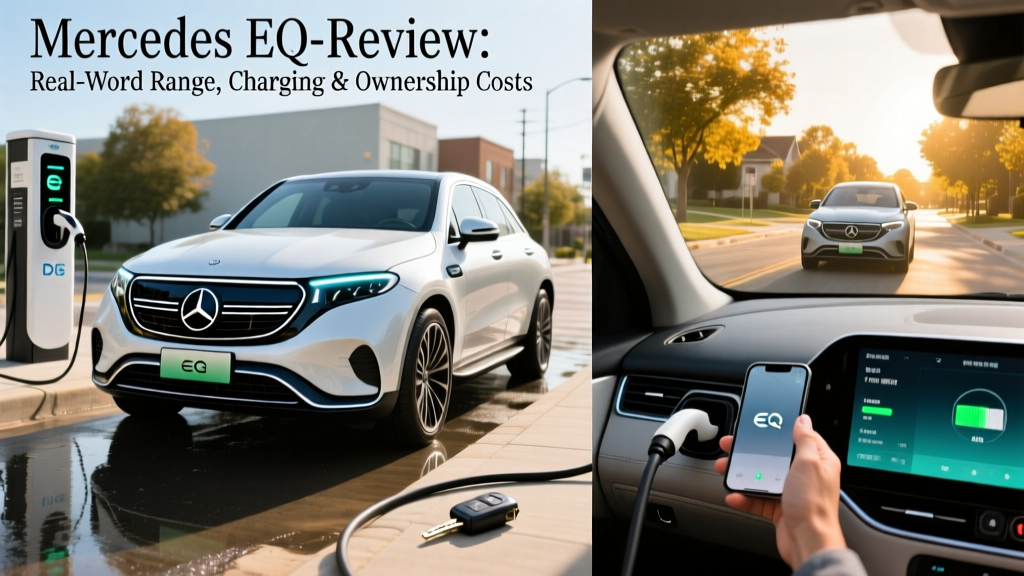
The Mercedes-Benz EQC 400 4MATIC occupies a complicated space in the luxury electric SUV segment. Originally launched for the 2020-2022 model years in the U.S. market before Mercedes pivoted its EV naming strategy toward the EQE and EQS SUV lines, the EQC remains a relevant used-EV option for buyers seeking German luxury build quality with electric drivetrain practicality. For the 2026 model year, Mercedes-Benz has not reintroduced the EQC nameplate to the U.S. market, making this profile essential reading for anyone considering a certified pre-owned EQC or evaluating how it stacks against current competitors.
This review covers the final U.S.-spec EQC 400 4MATIC with full EPA data, real-world range expectations, charging benchmarks, and ownership economics — including whether it qualifies for federal or used-EV tax credits.
Range, Battery, and Real-World Efficiency
The U.S.-spec Mercedes EQC 400 4MATIC carries an 80 kWh lithium-ion battery pack (79.2 kWh usable) using NMC (nickel manganese cobalt) cell chemistry. This chemistry prioritizes energy density over the cycle-life longevity of LFP packs, which is typical for luxury EVs in this era.
The EPA rated the EQC at 220 miles of combined range. Efficiency lands at 74 MPGe combined, translating to roughly 43 kWh per 100 miles — on the thirstier side of the luxury EV spectrum.
EPA Sticker: 220 miles combined
Highway driving (70-75 mph): Expect 180–195 miles. The EQC's aerodynamic profile and 4,900+ lb curb weight penalize highway efficiency noticeably.
City/commuter driving: 210–225 miles is achievable thanks to regenerative braking recuperation.
Cold weather (below 32°F): Plan for 150–175 miles. The EQC uses a resistance heater rather than a heat pump, which draws heavily from the battery in winter conditions. Preconditioning while plugged in is essential to preserve range.
Source: EPA fueleconomy.gov
| Spec | Value |
|---|---|
| EPA Range | 220 mi (combined) |
| Battery (Usable) | 79.2 kWh / 80 kWh gross, NMC |
| Efficiency | 74 MPGe / 43 kWh/100 mi |
| Drivetrain | Dual-motor AWD (4MATIC) |
| Horsepower / Torque | 402 hp / 564 lb-ft |
| 0-60 mph | 4.8 seconds |
| Max DC Fast Charge | 110 kW (CCS1) |
| 10-80% DC Charge Time | ~40 minutes |
| Level 2 Charge Rate | 7.4 kW (~22 mi/hr) |
| Cargo Volume | 17.4 cu ft (rear seats up) / 50.8 cu ft (folded) |
| Original MSRP (2022) | $67,900 base / ~$74,000 as-tested |
| Battery Warranty | 8 years / 100,000 miles |
Charging Speed: DC Fast, Level 2, and the Curve Reality
The EQC's charging performance is where modern buyers need to manage expectations. Mercedes equipped the U.S. EQC with a 110 kW peak DC fast-charge rate via the CCS1 connector. That was competitive in 2020 but falls well short of 2026 benchmarks — the Hyundai Ioniq 5 peaks at 240 kW, and even the Tesla Model Y sustains higher rates on V3 Superchargers.
| Level | Power | Speed | Notes |
|---|---|---|---|
| Level 1 (120V) | 1.4 kW | ~4 mi/hr | Emergency/trickle only; full charge in ~55+ hours |
| Level 2 (240V) | 7.4 kW | ~22 mi/hr | Full charge in ~10 hours; overnight home charging |
| DC Fast (CCS1) | 110 kW peak | 10-80% in ~40 min | Peak only at low SoC; tapers significantly above 60% |
Charging curve reality: The EQC hits its 110 kW peak only between roughly 10-30% state of charge (SoC). By 50% SoC, expect rates to drop to 70-80 kW, and above 80% the rate falls below 30 kW. This taper means the advertised 10-80% time of 40 minutes is realistic only at a charger capable of sustaining 110+ kW — many older Electrify America and EVgo stations may deliver less. Always precondition the battery via the MBUX navigation system before arriving at a DC fast charger; the EQC's thermal management system needs 15-20 minutes of routing to warm the pack for optimal charge acceptance.
For home charging, the 7.4 kW onboard charger means a full 0-100% session takes roughly 10-11 hours on a 240V Level 2 circuit. Most owners will plug in overnight and rarely deplete below 20%, making the practical nightly charge session around 5-6 hours. A 48-amp hardwired Level 2 station (like a ChargePoint Home Flex or Tesla Wall Connector with J1772 adapter) will maximize the onboard charger's capacity.
Performance, Drivetrain, and Driving Impressions
The EQC 400 4MATIC uses a dual-motor all-wheel-drive setup producing 402 horsepower and 564 lb-ft of torque. The 0-60 mph sprint takes 4.8 seconds, which feels brisk in daily driving but trails the Tesla Model Y Performance (3.5 sec) and the BMW iX xDrive50 (4.4 sec).
What the EQC sacrifices in outright acceleration, it compensates for in ride refinement. The suspension tuning is distinctly Mercedes — compliant, quiet, and isolated. Road noise suppression is excellent, and the cabin remains hushed even at highway speeds. The steering is light and precise, though it lacks the communicative feedback that driving enthusiasts might prefer.
Regenerative braking offers multiple modes via steering-wheel paddles: D+ (coasting), D (mild regen), D- (moderate regen), and D Auto (which uses radar and navigation data to adjust recuperation dynamically). D Auto is the standout — it'll coast when the road ahead is clear and brake when approaching slower traffic or intersections. However, the EQC does not offer true one-pedal driving to a complete stop, which some EV converts may miss.
Interior, Cargo, and Technology
The EQC interior is essentially a GLC with electric-specific displays. You get Mercedes' dual-screen MBUX setup with a 10.25-inch digital instrument cluster and a 10.25-inch central touchscreen running the MBUX infotainment system. Voice control via "Hey Mercedes" is responsive, and wireless Apple CarPlay and Android Auto are standard. The EQ-specific features include energy flow visualizations, range prediction overlays on navigation, and departure-time preconditioning scheduling.
Cargo space is the EQC's most practical limitation. With rear seats upright, you get 17.4 cubic feet — less than a Tesla Model Y (30.2 cu ft behind the second row) and even less than some compact gas crossovers. Fold the rear seats and capacity expands to 50.8 cubic feet, which is adequate for weekend trips but not class-leading. There is no front trunk (frunk); the space under the hood houses power electronics.
Passenger space is comfortable for four adults, with 40.9 inches of front legroom and 38.1 inches in the rear. The rear floor hump (a carryover from the GLC's ICE architecture) compromises the middle-seat position for a fifth passenger on longer trips.
Driver assistance: The EQC comes equipped with Mercedes' Active Distance Assist DISTRONIC (adaptive cruise control), Active Steering Assist (lane centering), Active Brake Assist, and Active Blind Spot Assist. These constitute a SAE Level 2 driver-assistance system — the driver must remain attentive and keep hands on the wheel at all times. This is not autonomous driving. The system is competent on highways but requires regular steering input to avoid disengagement warnings.
Pricing, Tax Credits, and Ownership Economics
The Mercedes EQC 400 4MATIC was sold in the U.S. for the 2020, 2021, and 2022 model years with a single well-equipped trim level. Original MSRP started at $67,900 (plus $1,050 destination), with typical as-tested prices reaching $72,000–$76,000 after options like the Premium Package, AMG Line exterior, and metallic paint.
As of 2026, the EQC is no longer sold new in the U.S. market. Mercedes-Benz replaced it in the lineup with the EQE 350+ SUV (starting ~$74,900) and the larger EQS SUV. Used EQC pricing varies widely by mileage and condition, with 2022 models typically listing between $32,000 and $42,000 on the pre-owned market.
New vehicle credit (§30D): The EQC was eligible for a partial federal tax credit when sold new, but availability varied by model year and battery-sourcing compliance. This credit is no longer applicable since the EQC is not sold new.
Used EV credit (§25E): Buyers purchasing a pre-owned EQC from a dealer for $25,000 or less may qualify for a used-EV tax credit of up to $4,000 (30% of sale price, capped at $4,000). Key requirements per IRS §25E rules:
- Sale price must be $25,000 or below
- Buyer income caps: $75,000 (single) / $112,500 (head of household) / $150,000 (joint)
- Vehicle must be at least 2 model years old
- Must purchase from a licensed dealer (private-party sales excluded)
- Credit can be transferred to the dealer as a point-of-sale discount
Given current used EQC pricing ($32K–$42K), most listings exceed the $25,000 cap — making the used credit difficult to claim unless you find a higher-mileage example or negotiate aggressively. Always verify eligibility with a tax professional before relying on this credit.
| Cost Factor | Used 2022 EQC (~$38K) | New 2026 Tesla Model Y LR (~$48K) | New 2026 BMW iX xDrive50 (~$87K) |
|---|---|---|---|
| Purchase Price | $38,000 | $47,990 | $87,250 |
| Fed. Tax Credit | $0 (over $25K cap)* | $0 (post-2025 phase-out) | $0 |
| 5-Yr Electricity (12K mi/yr) | ~$3,900 | ~$3,100 | ~$3,600 |
| 5-Yr Insurance (est.) | ~$11,500 | ~$10,800 | ~$14,200 |
| 5-Yr Maintenance | ~$2,800 | ~$1,900 | ~$3,500 |
| 5-Yr Total (est.) | ~$56,200 | ~$63,790 | ~$108,550 |
*Used-EV credit possible if purchase price drops to $25,000 or below. Electricity costs based at $0.14/kWh national average. Insurance estimates via IIHS industry averages for luxury EVs.
Warranty Coverage and Battery Longevity
Mercedes-Benz backed the EQC with a comprehensive warranty package:
- High-voltage battery: 8 years / 100,000 miles (whichever comes first), covering capacity loss below 70% of original state of health (SoH)
- Powertrain (e-motors, reduction gears): 8 years / 100,000 miles
- New-vehicle limited warranty: 4 years / 50,000 miles
- Corrosion protection: 4 years / 50,000 miles
For used buyers in 2026, the critical question is remaining battery warranty coverage. A 2022 model year EQC purchased in early 2022 would retain battery/powertrain warranty coverage through early 2030 or 100,000 miles — offering meaningful protection. NMC chemistry in the EQC has shown moderate degradation in real-world fleet data: expect roughly 8-12% capacity loss over 100,000 miles under normal use patterns. Keeping the battery between 20-80% SoC for daily use and avoiding repeated DC fast-charging to 100% will minimize long-term degradation.
How the EQC Compares to Key Competitors
| Spec | Used Mercedes EQC 400 | Tesla Model Y LR (2026) | BMW iX xDrive50 (2026) | Hyundai Ioniq 5 (2026) |
|---|---|---|---|---|
| EPA Range | 220 mi | 330 mi | 324 mi | 310 mi |
| Battery | 80 kWh NMC | 78.1 kWh NMC | 111.5 kWh NMC | 84 kWh NMC |
| DC Fast Charge (peak) | 110 kW | 250 kW | 200 kW | 240 kW |
| 10-80% Time | ~40 min | ~25 min | ~31 min | ~18 min |
| 0-60 mph | 4.8 sec | 5.0 sec | 4.4 sec | 5.1 sec |
| Cargo (rear up) | 17.4 cu ft | 30.2 cu ft | 35.5 cu ft | 27.2 cu ft |
| Typical Price (2026) | $32K–$42K (used) | $47,990 (new) | $87,250 (new) | $45,500 (new) |
- Luxury ride quality and cabin quietness rival vehicles costing far more
- MBUX infotainment is intuitive with strong voice control
- Dual-motor AWD provides confident all-weather traction
- 402 hp delivers effortless passing power
- Used pricing offers luxury EV entry under $40K
- Remaining factory battery warranty on 2021-2022 models
- 220-mile EPA range is the shortest in its class
- 110 kW DC fast charging is slow by 2026 standards
- 17.4 cu ft cargo space trails every competitor
- No heat pump — significant winter range loss
- Based on adapted GLC platform (not EV-dedicated) — rear floor hump, no frunk
- Used-EV tax credit difficult to claim due to $25K price cap
- Discontinued — no new model years, limited dealer EV service familiarity
Who Should Buy the Mercedes EQC?
The EQC makes the most sense for a specific buyer profile:
Best fit: Luxury-oriented commuters who drive 40-80 miles daily, have reliable home Level 2 charging, rarely take road trips exceeding 180 miles, and value cabin refinement over maximum range or cargo utility. If you want a quiet, comfortable, well-built luxury EV for daily driving and can acquire one under $38,000 with remaining battery warranty, the EQC delivers an experience that feels more premium than its price suggests.
Look elsewhere if: You regularly drive more than 150 miles in a day, need serious cargo space for family hauling, live in a cold climate where the lack of a heat pump will gut your range, or rely on public DC fast charging for your primary routine. The Tesla Model Y, Hyundai Ioniq 5, or BMW iX all offer substantially more range, faster charging, and greater practicality — though at higher acquisition costs (new).
Choose the used EQC if: Budget is under $40K, you prioritize luxury ride and quietness, your daily commute is under 80 miles round-trip, and you have home Level 2 charging.
Choose a new Model Y or Ioniq 5 if: You need 300+ miles of range, fast DC charging for road trips, maximum cargo space, and the latest EV platform technology.
Choose the BMW iX if: Budget allows $80K+, you want German luxury with 320+ miles of range and 200 kW charging, and cargo space matters.
Frequently Asked Questions
What is the real-world range of the Mercedes EQC?
The EPA rates the EQC at 220 miles combined, but real-world results vary significantly. Expect 180-195 miles on the highway at 70+ mph, 210-225 miles in city driving with regenerative braking, and as low as 150-175 miles in freezing temperatures. The EQC's lack of a heat pump makes it particularly range-sensitive in cold weather — preconditioning while plugged in is critical for winter usability.
How fast does the EQC charge at home and on DC fast chargers?
On a Level 2 home charger (240V, 7.4 kW), the EQC adds about 22 miles of range per hour, with a full charge taking roughly 10-11 hours. On a DC fast charger, it peaks at 110 kW via CCS1, achieving a 10-80% charge in approximately 40 minutes. The charge curve tapers sharply above 60% SoC, so charging above 80% at a public station is time-inefficient. For comparison, the Hyundai Ioniq 5 completes 10-80% in about 18 minutes at 240 kW.
Does the Mercedes EQC qualify for the federal EV tax credit?
Since the EQC is no longer sold new, the new-vehicle §30D credit does not apply. For the used-EV credit (§25E), the vehicle must sell for $25,000 or less from a licensed dealer, and buyer income must fall below IRS thresholds ($75K single / $150K joint). Most used EQC listings in 2026 exceed the $25,000 price cap, making the credit difficult to claim. Consult a tax professional and review IRS §25E guidelines before relying on this credit.
Is the Mercedes EQC worth buying in 2026 versus newer competitors?
It depends on your priorities and budget. At $32,000-$42,000 used, the EQC offers luxury build quality and a refined driving experience that no new EV under $50K can match. However, its 220-mile range, 110 kW charging, and limited cargo space are significant compromises versus a new Tesla Model Y, Hyundai Ioniq 5, or even the Mercedes EQE SUV. If your daily driving is short, you charge at home, and you value comfort over cutting-edge EV specs, the EQC is a solid value play. For road-trippers or families needing space, newer alternatives are meaningfully better.
How long will the EQC battery last?
Mercedes warranties the high-voltage battery for 8 years or 100,000 miles against capacity loss below 70% SoH. NMC batteries in the EQC typically show 8-12% degradation over 100,000 miles based on fleet data. A 2022 EQC in 2026 should still have 4+ years of battery warranty remaining. To maximize longevity, charge to 80% for daily use, avoid frequent 100% charges, and minimize consecutive DC fast-charging sessions.
Does the EQC have a front trunk (frunk)?
No. Because the EQC was built on Mercedes' MRA platform (adapted from the GLC), the space under the hood is occupied by power electronics and the electric motor. All cargo must go in the rear compartment, which offers 17.4 cubic feet with seats up.