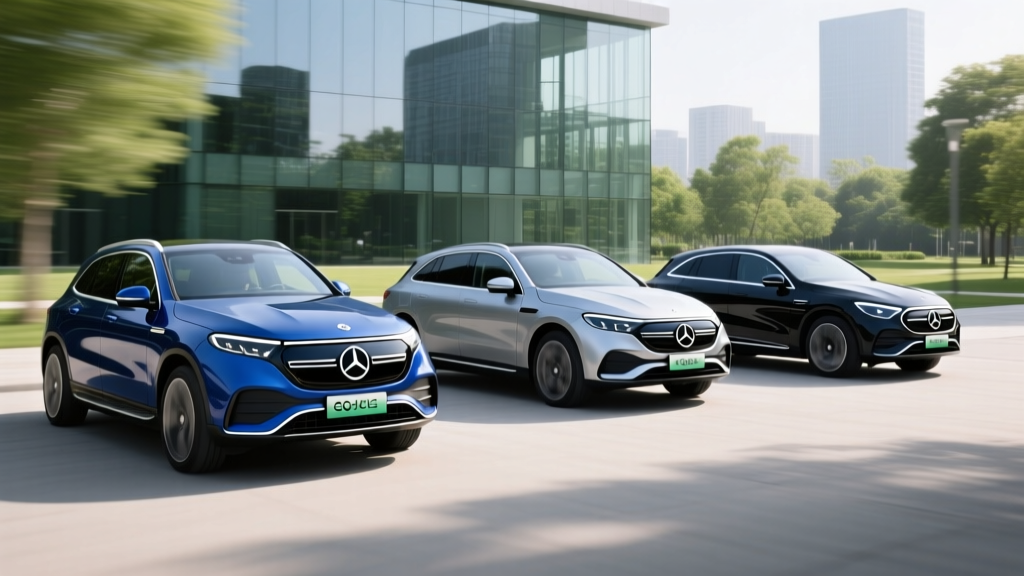
If you've been searching for a new Mercedes-Benz EQC in the United States, you won't find one. The original EQC — a compact luxury electric crossover built on a modified GLC chassis — was never officially sold stateside and has been discontinued globally. What you're encountering in forums and search results as the "EQC merger" is actually Mercedes-Benz's broader consolidation of its EQ electric lineup, where the EQC's market slot is now covered by the redesigned 2026 EQB (compact family EV) and the 2026 EQE SUV (midsize luxury EV).
Rather than reviewing a car you can't buy, this profile treats the EQC merger as a practical buying decision: which current Mercedes EV actually replaces what the EQC was supposed to be, and how do those models stack up on range, charging, pricing, and real-world usability in 2026?
What the EQC Merger Actually Means for Buyers
Mercedes-Benz announced in 2024 that it would streamline its EQ naming convention, eventually aligning electric models more closely with their internal-combustion counterparts. The EQC, which launched in Europe in 2019 with a 80 kWh battery and roughly 255 miles of WLTP range, was the first casualty. It was heavy, built on a compromised platform, and outpaced by rivals like the BMW iX3 and Audi Q4 e-tron.
For the 2026 model year, Mercedes positions two vehicles where the EQC would have competed:
- 2026 Mercedes-Benz EQB 350 4MATIC — A compact three-row electric crossover, the spiritual successor to the EQC's size and price class.
- 2026 Mercedes-Benz EQE 350+ SUV — A dedicated EV-platform midsize SUV that delivers the premium experience the EQC promised but couldn't achieve on a shared chassis.
Let's examine the specs that matter for each.
Spec Comparison: EQB 350 vs EQE 350+ SUV
| Specification | 2026 EQB 350 4MATIC | 2026 EQE 350+ SUV |
|---|---|---|
| EPA Estimated Range | 245 miles | 303 miles |
| Battery Capacity (Usable) | 66.5 kWh (NMC) | 90.6 kWh (NMC) |
| Drivetrain | Dual-motor AWD | Rear-wheel drive (single motor) |
| Horsepower | 288 hp | 288 hp |
| 0–60 mph | 5.8 seconds | 6.4 seconds |
| Max DC Fast Charge Rate | 100 kW | 170 kW |
| 10–80% DC Charge Time | ~32 minutes | ~30 minutes |
| Level 2 Home Charge Rate | 11 kW (~25 mi/hr) | 11 kW (~32 mi/hr) |
| Efficiency (MPGe Combined) | 80 MPGe | 87 MPGe |
| Energy Consumption | 42 kWh/100 mi | 39 kWh/100 mi |
| Cargo Volume (Behind 2nd Row) | 22.0 cu ft | 52.6 cu ft |
| Cargo Volume (Max) | 62.0 cu ft | 74.0 cu ft |
| Seating | 5 or optional 7 | 5 |
| Base MSRP | $56,900 | $77,900 |
| Battery/Powertrain Warranty | 8 yr / 100,000 mi | 8 yr / 100,000 mi |
Sources: fueleconomy.gov, Mercedes-Benz USA. Specs reflect 2026 model-year data where published; carryover figures used where 2026 MY data remains preliminary.
Real-World Range: What the EPA Sticker Doesn't Tell You
EQB 350 4MATIC: EPA 245 miles. Expect 210–225 miles in mixed highway driving at 70+ mph, and as low as 175–190 miles in sub-freezing winter conditions. The EQB's boxy shape and AWD drivetrain impose a real highway and cold-weather penalty.
EQE 350+ SUV: EPA 303 miles. Expect 265–280 miles on the highway in mild weather. The heat pump (standard on the EQE SUV) helps preserve range in cold climates — expect 230–250 miles in winter, a meaningful advantage over the EQB, which lacks a standard heat pump in all trims.
Neither vehicle uses LFP (lithium iron phosphate) chemistry. Both employ NMC (nickel-manganese-cobalt) lithium-ion packs. NMC offers higher energy density — essential for the EQB's compact footprint — but degrades slightly faster than LFP over thousands of cycles. Mercedes' 8-year/100,000-mile battery warranty covers capacity retention below 70% of original, which is industry-standard though not class-leading (Hyundai/Kia offer 10-year/100,000-mile).
Charging Speed: The EQB's Biggest Weakness
Charging performance is where the EQC merger's two successors diverge sharply — and where the EQB reveals its older-platform origins.
| Charging Level | EQB 350 4MATIC | EQE 350+ SUV |
|---|---|---|
| Level 1 (120V, 12A) | ~1.4 kW / ~3 mi/hr | ~1.4 kW / ~4 mi/hr |
| Level 2 (240V, 48A) | 11 kW / ~25 mi/hr | 11 kW / ~32 mi/hr |
| DC Fast Charge (Peak) | 100 kW | 170 kW |
| 10–80% DC Time | ~32 min | ~30 min |
| Charging Curve Note | Tapers sharply above 60% SoC | Sustains peak to ~70% SoC, then tapers |
| Preconditioning | Available via MBUX nav routing | Available via MBUX nav routing |
The EQB's 100 kW DC ceiling is a significant limitation for 2026. Competitors like the Hyundai Ioniq 5 (peak 240 kW on 800V architecture) and even the Tesla Model Y (peak ~250 kW) charge dramatically faster. On a road trip, the EQB's 32-minute 10–80% session feels dated. The EQE SUV's 170 kW is better but still not class-leading — the BMW iX xDrive50 peaks at nearly 200 kW and charges 10–80% in roughly 28 minutes.
Preconditioning matters. Both models will warm the battery when you navigate to a DC fast charger via the MBUX system, which is essential for achieving peak charge rates in cold weather. If you arrive at a charger without preconditioning in 30°F weather, expect charge rates 30–50% below peak until the pack warms up.
Pricing, Tax Credits, and Total Cost
| Item | EQB 350 4MATIC | EQE 350+ SUV |
|---|---|---|
| Base MSRP | $56,900 | $77,900 |
| As-Tested (Typical Options) | ~$62,000 | ~$86,000 |
| IRS §30D MSRP Cap (SUVs) | $80,000 ✓ | $80,000 ✗ (exceeds cap) |
| Potential Federal Credit | Up to $7,500* | $0 (MSRP exceeds cap) |
| Point-of-Sale Transfer | Available if eligible* | N/A |
*Critical tax credit caveats for the EQB: Even though the EQB's MSRP falls under the $80,000 SUV cap defined by the IRS §30D rules, the full $7,500 credit depends on battery-component and critical-minerals sourcing requirements that shift annually. Additionally, buyer income caps apply: $300,000 MAGI for joint filers, $225,000 for heads of household, $150,000 for single filers. The EQB's battery supply chain has historically struggled to meet the critical-minerals threshold for the full $7,500 — you may qualify for $3,750 (half credit) or none at all depending on the specific build month and sourcing. Always verify with your tax professional and the IRS's current qualified vehicle list before purchasing.
The EQE 350+ SUV, at $77,900 base, technically sits under the $80,000 SUV cap — but once you add common packages (AMG Line, Premium Plus, Driver Assistance), the as-tested price routinely exceeds $80,000, disqualifying it from §30D entirely. Build carefully if the credit matters to you.
Tech, Interior, and Driver Assistance
Both vehicles feature Mercedes' MBUX infotainment system with dual screens (10.25-inch instrument cluster and 10.25-inch central touchscreen on the EQB; 12.8-inch OLED central display on the EQE SUV). The EQE SUV's interior is a generation ahead — higher-quality materials, available Hyperscreen passenger display, and superior noise insulation.
Driver assistance (SAE Level 2 — driver must remain engaged at all times):
- EQB: Active Distance Assist DISTRONIC (adaptive cruise), Active Lane Keeping, Active Blind Spot. Functional but a generation behind Mercedes' latest systems.
- EQE SUV: Latest-generation DISTRONIC with route-based speed adaptation, Active Lane Change Assist, and available DRIVE PILOT (SAE Level 3, currently limited to specific highway conditions in approved regions — not yet broadly available in the US).
Important: Neither vehicle offers "self-driving." Mercedes' DRIVE PILOT is Level 3 (conditional automation on approved highways under 40 mph), and it remains geofenced and unavailable in most US states as of early 2026. All standard driver-assist features are Level 2 and require continuous driver supervision.
Who Should Buy Which — and Who Should Look Elsewhere
Choose the EQB 350 if: You need a compact luxury EV with optional third-row seating, your daily commute is under 50 miles, you charge at home, and your road trips are short. It's the closest thing to what the EQC was meant to be — a practical family electric crossover at a sub-$60K starting price.
Choose the EQE 350+ SUV if: You want genuine long-range capability, a dedicated EV platform, a premium interior, and rarely need more than five seats. The 303-mile EPA range and heat pump make it a far better road-trip companion — but at nearly $80K base, it competes with the BMW iX and Tesla Model X.
Look elsewhere if: Fast DC charging is a priority (Hyundai Ioniq 5, Kia EV6, Porsche Macan EV), you want the most range per dollar (Tesla Model Y at 320+ miles EPA from ~$48K), or you need LFP battery longevity (base Tesla Model Y RWD).
Pros and Cons at a Glance
EQB 350 4MATIC — Pros
- Optional 7-seat configuration (rare in compact EVs)
- Under $80K MSRP cap — potential §30D eligibility
- Compact footprint, easy urban maneuvering
- AWD standard, confident in inclement weather
EQB 350 4MATIC — Cons
- 100 kW DC fast-charge ceiling is outdated for 2026
- 245-mile EPA range trails most rivals
- No heat pump standard — cold-weather range suffers
- Older MFA2 platform, not a dedicated EV architecture
EQE 350+ SUV — Pros
- 303-mile EPA range, strong real-world usability
- Standard heat pump preserves winter range
- Dedicated EVA2 platform — better packaging and ride
- Latest MBUX tech and available Level 3 DRIVE PILOT
EQE 350+ SUV — Cons
- $77,900 base MSRP; options push past §30D cap
- No federal tax credit on most builds
- RWD only on 350+ (AWD requires 350 4MATIC or 500 4MATIC trims)
- Depreciation has been steep on EQE sedans — SUV may follow
Frequently Asked Questions
Is the Mercedes EQC still available in 2026?
No. The Mercedes-Benz EQC was discontinued globally and was never officially sold in the United States. Its market position is now covered by the EQB (compact) and EQE SUV (midsize) in Mercedes' 2026 lineup.
What is the real-world range of the EQB and EQE SUV?
The EQB 350 delivers roughly 210–225 highway miles in mild weather and 175–190 in freezing conditions. The EQE 350+ SUV achieves 265–280 highway miles in mild weather and 230–250 in winter, aided by its standard heat pump.
How fast do these EVs charge at home and on DC fast chargers?
At home on a 240V Level 2 charger (48A), the EQB adds ~25 miles per hour and the EQE SUV adds ~32 miles per hour. On DC fast chargers, the EQB peaks at 100 kW (10–80% in ~32 minutes) while the EQE SUV peaks at 170 kW (10–80% in ~30 minutes). The EQB's charge rate is notably slow by 2026 standards.
Does the EQB qualify for the federal EV tax credit?
The EQB's MSRP is under the $80,000 SUV cap, making it potentially eligible. However, the actual credit amount ($0, $3,750, or $7,500) depends on battery-sourcing compliance for the specific build month and your adjusted gross income. Consult the IRS §30D guidance and a tax professional before relying on the credit.
Is the EQE SUV worth the premium over the EQB?
If range, charging speed, interior quality, and long-term platform relevance matter to you, yes — the EQE SUV is a generational leap over the EQB's adapted platform. However, the $21,000+ price gap and likely ineligibility for federal tax credits make the EQE SUV a significantly more expensive proposition. For buyers who primarily commute and charge at home, the EQB remains adequate.
Which competitors should I cross-shop?
Against the EQB: BMW iX1, Audi Q4 e-tron, Volvo EX40, Tesla Model Y. Against the EQE SUV: BMW iX, Genesis Electrified GV70, Tesla Model X, Porsche Macan EV. All of these competitors generally offer faster DC charging; several offer longer range at lower prices.