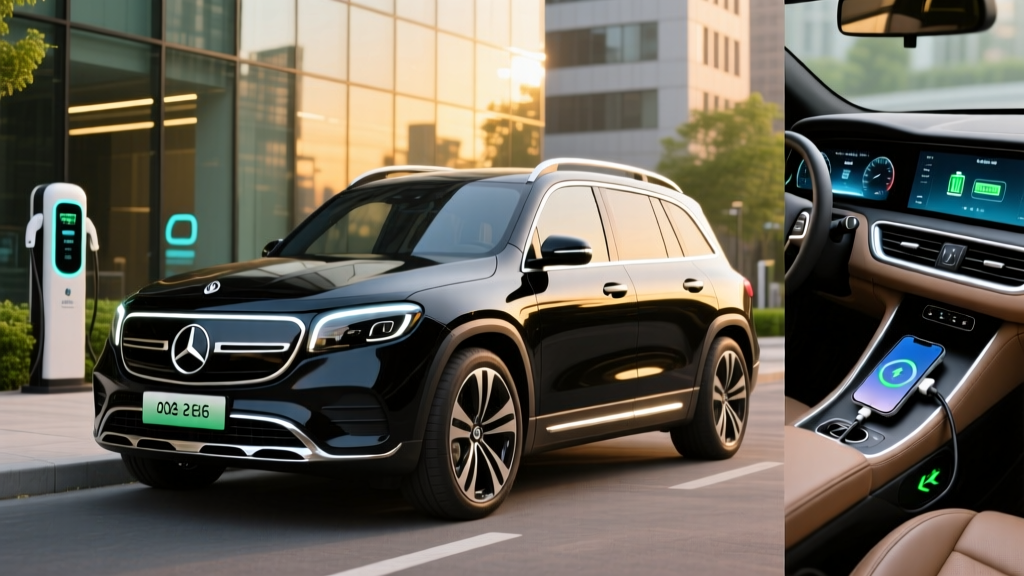
The Mercedes-Benz EQB occupies a rare niche in the premium EV market: a compact luxury crossover with an available third row, targeting families who need practicality without stepping up to the larger, pricier EQE or EQS SUVs. For 2026, the EQB lineup continues with the EQB 300 4MATIC and EQB 350 4MATIC, both riding on a modified MFA2 platform shared with the gas-powered GLB. That architecture gives it genuine interior volume but also reveals its ICE origins in ways that matter for EV buyers — from the charging curve to the floor height. Here's everything you need to know before signing a lease or purchase agreement.
2026 Mercedes EQB at a Glance: Core Specifications
| Spec | EQB 300 4MATIC | EQB 350 4MATIC |
|---|---|---|
| EPA Range | 245 miles | 227 miles |
| Battery (Usable) | 66.5 kWh (NMC) | 66.5 kWh (NMC) |
| Drivetrain | Dual-motor AWD | Dual-motor AWD |
| Horsepower | 225 hp | 288 hp |
| Torque | 288 lb-ft | 384 lb-ft |
| 0–60 mph | 7.7 sec | 6.0 sec |
| DC Fast Charge (Peak) | 100 kW | 100 kW |
| 10–80% DC Time | ~32 min | ~32 min |
| Level 2 Charge Rate | 9.6 kW (AC) | 9.6 kW (AC) |
| EPA Efficiency | 93 MPGe (2.86 kWh/mi) | 89 MPGe (3.01 kWh/mi) |
| Cargo (Behind 3rd Row) | 13.0 cu ft | 13.0 cu ft |
| Cargo (3rd Row Folded) | 35.6 cu ft | 35.6 cu ft |
| Cargo (All Rows Folded) | 62.0 cu ft | 62.0 cu ft |
| Base MSRP | $54,200 | $58,200 |
| Battery Warranty | 8 yr / 100,000 mi | 8 yr / 100,000 mi |
Real-World Range: What the EPA Number Doesn't Tell You
EPA sticker: 245 miles
Highway (70 mph, mild weather): ~210–225 miles
City/suburban mixed driving: ~235–250 miles
Cold weather (below 32°F): ~175–200 miles
Hot weather (A/C heavy, 95°F+): ~215–230 miles
The EQB's boxy shape creates more aerodynamic drag than sleeker crossovers, which hurts highway efficiency noticeably. The lack of a standard heat pump (it's optional on some trims) means cold-weather range loss can hit 25–30% if you're relying on resistive cabin heating. Source: fueleconomy.gov
The EQB 300's 245-mile EPA rating is adequate for most daily commutes and suburban errands, but it falls short of rivals like the BMW iX (up to 324 miles) or the Tesla Model Y Long Range (320 miles). The EQB 350 sacrifices even more — 227 miles — because its higher-output motors and sportier tuning trade efficiency for acceleration.
For a family doing 30–40 miles of mixed driving per day with home charging, the EQB's range means charging every 4–5 days, which is manageable. But if your routine includes frequent 200-mile highway stretches, you'll be planning DC fast-charge stops, and the EQB's modest 100 kW peak charge rate becomes a real limitation.
Charging Speed: The EQB's Biggest Competitive Weakness
| Charging Method | Rate | Time / Miles Added |
|---|---|---|
| Level 1 (120V, 12A) | ~1.4 kW | ~4 mi/hr — overnight adds ~40 mi |
| Level 2 (240V, 40A) | 9.6 kW | ~28 mi/hr — full charge in ~7.5 hr |
| DC Fast Charge (Peak) | 100 kW | 10–80% in ~32 min |
| DC Sustained (50–80%) | ~65–75 kW | Charge curve tapers significantly above 60% SoC |
The 100 kW peak DC fast-charge rate is the EQB's most dated specification. Competitors have moved well past this: the Hyundai Ioniq 5 peaks at 240 kW (10–80% in ~18 minutes), the Tesla Model Y at 250 kW (~15 minutes), and even the BMW iX hits 150 kW. On a road trip, the EQB's 32-minute 10–80% session means longer stops — and because the charge curve tapers sharply after 60% State of Charge (SoC), the last 20% can feel interminable.
At home on a Level 2 charger, the 9.6 kW onboard charger is respectable. A full charge from near-empty takes about 7.5 hours, so plugging in when you get home means a full battery by morning. For home charging installation, expect to spend $800–$2,500 for a quality Level 2 wallbox and electrician labor, depending on whether your electrical panel needs an upgrade. The EQB uses the CCS1 connector standard; if you plan to use Tesla Superchargers, you'll need to confirm Mercedes-Benz's NACS adapter availability for the 2026 model year.
Performance and Driving Dynamics
The EQB 350's 288 horsepower and 6.0-second 0–60 time make it genuinely quick off the line — dual-motor AWD provides confident traction in rain and light snow. The EQB 300, at 225 hp and 7.7 seconds, is more relaxed but adequate for merging and passing. Neither variant offers a sport-tuned suspension that truly distinguishes it; the ride is comfortable and compliant, tuned for comfort over cornering precision.
Regenerative braking offers multiple levels selectable via steering-wheel paddles, including a D Auto mode that uses radar and navigation data to modulate regen based on traffic and terrain ahead. It's not true one-pedal driving in the way a Nissan Leaf or Tesla delivers, since the EQB doesn't always come to a complete stop under regen alone — you'll still use the brake pedal at low speeds.
The driving experience is refined and quiet, with good isolation from road and wind noise. However, the vehicle's ICE-platform origins are visible in the transmission tunnel hump in the rear floor and a slightly elevated cargo floor to accommodate the battery pack underneath.
Interior Space, Tech, and the Third-Row Question
The EQB's interior follows the familiar Mercedes MBUX dual-screen layout: a 10.25-inch digital instrument cluster and a 10.25-inch central touchscreen running the latest MBUX software. Wireless Apple CarPlay and Android Auto are standard, along with ambient lighting, dual-zone climate control, and the "Hey Mercedes" voice assistant.
The optional third row is best understood as a 5+2 configuration: the two rearmost seats are suitable only for children or very short adults on brief trips. With the third row deployed, cargo space shrinks to 13.0 cu ft — enough for a few grocery bags or a compact stroller, but not much more. Fold the third row flat and you get 35.6 cu ft, competitive with compact luxury rivals.
Second-row legroom measures 38.1 inches, which is generous for the segment. The second-row seats slide fore and aft, letting you prioritize either passenger space or cargo volume. ISOFIX/LATCH anchors are present on the outboard second-row positions, and the third row includes top-tether anchors — a key advantage for families juggling car seats.
ADAS and Driver Assistance: The EQB comes with Active Brake Assist, Active Lane Keeping Assist, Blind Spot Assist, and Attention Assist standard. The optional Driver Assistance Package adds Active Distance Assist DISTRONIC (adaptive cruise with stop-and-go), Active Steering Assist (lane centering), and Active Lane Change Assist.
Mercedes' Active Steering Assist and DISTRONIC together constitute an SAE Level 2 driver-assistance system. You must keep your hands on the wheel and remain fully engaged at all times. This is not an autonomous driving system and does not replace driver attention. Only Level 4 services (like Waymo in designated geofenced areas) operate without a human driver supervising.
Pricing, Trims, and Federal Tax Credit Eligibility
| Trim | Base MSRP | As-Tested (Typical Options) | §30D Credit Eligible? |
|---|---|---|---|
| EQB 300 4MATIC | $54,200 | $59,000–$63,000 | Possible — see rules below |
| EQB 350 4MATIC | $58,200 | $64,000–$70,000 | Possible — see rules below |
The EQB's pricing places it squarely in premium compact territory. Well-equipped examples with the Driver Assistance Package, Premium Package, and panoramic roof routinely land between $60,000 and $70,000 out the door.
Federal Tax Credit (§30D) — Critical Details:
- MSRP Cap: The EQB is classified as an SUV, so the MSRP cap is $80,000. Both trims fall under this limit — even well-optioned examples.
- Buyer Income Cap: Modified adjusted gross income must not exceed $150,000 (single), $225,000 (head of household), or $300,000 (joint filers).
- Battery Sourcing: The credit is split into two halves — $3,750 for meeting critical-minerals requirements and $3,750 for meeting battery-component sourcing. As of the 2026 tax year, the EQB's battery supply chain compliance must be verified via the VIN on fueleconomy.gov or the IRS's official list. Mercedes-Benz has been working to shift sourcing, but eligibility can change model year to model year.
- Point-of-Sale Transfer: If eligible, you can transfer the credit to the dealer at purchase, reducing your out-of-pocket cost immediately rather than waiting for a tax refund.
Always verify your specific VIN's eligibility before purchase. Tax rules are subject to change. Consult a tax professional or check IRS.gov for current requirements.
EQB vs. Key Competitors: Where It Stands
| Attribute | Mercedes EQB 300 | BMW iX xDrive50 | Tesla Model Y LR | Genesis GV60 |
|---|---|---|---|---|
| EPA Range | 245 mi | 324 mi | 320 mi | 248 mi |
| Battery | 66.5 kWh | 111.5 kWh | ~81 kWh | 77.4 kWh |
| DC Fast Charge | 100 kW | 150 kW | 250 kW | 233 kW |
| 10–80% Time | ~32 min | ~31 min | ~15 min | ~18 min |
| Third Row? | Yes (optional) | No | Yes (optional) | No |
| Base MSRP | $54,200 | $87,250 | $48,990 | $53,350 |
| 0–60 mph | 7.7 sec | 4.4 sec | 4.8 sec | 5.3 sec |
The comparison reveals the EQB's specific value proposition: it's the only vehicle in this group offering an optional third row at a sub-$60K starting price (the Model Y's third row is very tight and less practical). If third-row seating is non-negotiable, the EQB's closest rival is actually the Tesla Model Y, which starts lower and charges dramatically faster but sacrifices interior material quality and offers a less traditional luxury experience.
The BMW iX is in a different price class entirely — nearly $33K more to start — but delivers substantially more range and a far more modern EV platform. The Genesis GV60 is a strong value pick with 800V-class fast charging and a premium interior, but it lacks a third row entirely.
Pros, Cons, and the Ownership Verdict
- Available third row — unique in the compact luxury EV segment at this price
- Refined, quiet ride with comfortable seating and quality materials
- MBUX infotainment is intuitive with strong voice control
- Comprehensive standard safety suite
- Practical cargo space with flexible second-row sliding seats
- Under the $80K MSRP cap for full federal tax credit eligibility (if sourcing rules are met)
- 100 kW peak DC charging is slow for 2026 — 32 min 10–80%
- 245-mile EPA range trails most competitors by 50–80 miles
- No standard heat pump — cold-weather range loss is significant
- ICE platform compromises (transmission tunnel, elevated cargo floor)
- Third row is children-only — not a true 7-seater
- Not eligible for Tesla Supercharger network without adapter (confirm 2026 availability)
Who Should Buy the Mercedes EQB?
Choose the EQB if:
- You need an occasional third row for children and want a luxury badge under $60K
- Your daily driving is under 50 miles and you have reliable home Level 2 charging
- You value ride comfort, cabin quietness, and MBUX tech over outright range or charging speed
- You rarely take road trips over 200 miles without overnight stops
Look elsewhere if:
- Road-trip charging speed is a priority (get a Tesla Model Y, Ioniq 5, or GV60)
- You need 300+ miles of range for long commutes or rural driving (BMW iX, Model Y LR)
- You need a genuine adult-capable third row (consider a minivan PHEV or larger SUV)
- You live in a very cold climate and can't tolerate 25–30% winter range loss without a heat pump
Frequently Asked Questions
What is the real-world range of the Mercedes EQB?
The EQB 300 carries a 245-mile EPA rating. In real-world mixed driving, expect 210–230 miles in mild weather and 175–200 miles in cold conditions (below freezing). Highway driving at 70+ mph reduces range to roughly 210–225 miles due to the EQB's boxy aerodynamics. The EQB 350 rates at 227 miles EPA and delivers proportionally less in real-world use.
How fast does the EQB charge at home and on the road?
At home on a 240V Level 2 charger, the EQB charges at 9.6 kW, adding about 28 miles of range per hour — a full charge takes roughly 7.5 hours. On DC fast chargers, it peaks at 100 kW and takes approximately 32 minutes from 10–80%. This is noticeably slower than 800V-architecture rivals like the Hyundai Ioniq 5 (~18 minutes) or the Genesis GV60 (~18 minutes).
Does the 2026 Mercedes EQB qualify for the $7,500 federal EV tax credit?
It may qualify for the full $7,500, a partial $3,750, or nothing — depending on battery-sourcing compliance for the specific VIN at time of purchase. The EQB's MSRP is below the $80,000 SUV cap, and most buyers fall within income limits. However, critical-mineral and battery-component sourcing requirements under IRS §30D are strict and subject to change. Always verify eligibility at the point of sale.
Is the Mercedes EQB worth buying over the Tesla Model Y?
It depends on your priorities. The Model Y Long Range offers 320 miles of range, 250 kW DC fast charging, and a lower starting price ($48,990 vs. $54,200). The EQB counters with a more traditional luxury interior, quieter ride, MBUX interface, and optional third row that's slightly more usable than Tesla's. If charging speed and range dominate your decision, the Model Y wins. If cabin refinement and brand prestige matter more, the EQB is competitive.
Does the EQB have a heat pump for cold weather?
A heat pump is not standard on all 2026 EQB trims — it may be included in optional cold-weather packages depending on configuration. Without a heat pump, the EQB relies on resistive electric heating, which draws directly from the traction battery and can reduce winter range by 25–30%. If you live in a cold climate, confirm heat pump inclusion before finalizing your build.
What is the battery warranty on the Mercedes EQB?
Mercedes-Benz provides an 8-year/100,000-mile high-voltage battery warranty, covering defects and excessive capacity loss (typically defined as dropping below 70% State of Health). The basic vehicle warranty is 4 years/50,000 miles. This is in line with industry norms, though some competitors like Hyundai/Kia offer 10-year/100,000-mile battery coverage.