The Short Answer on the Electric G-Class
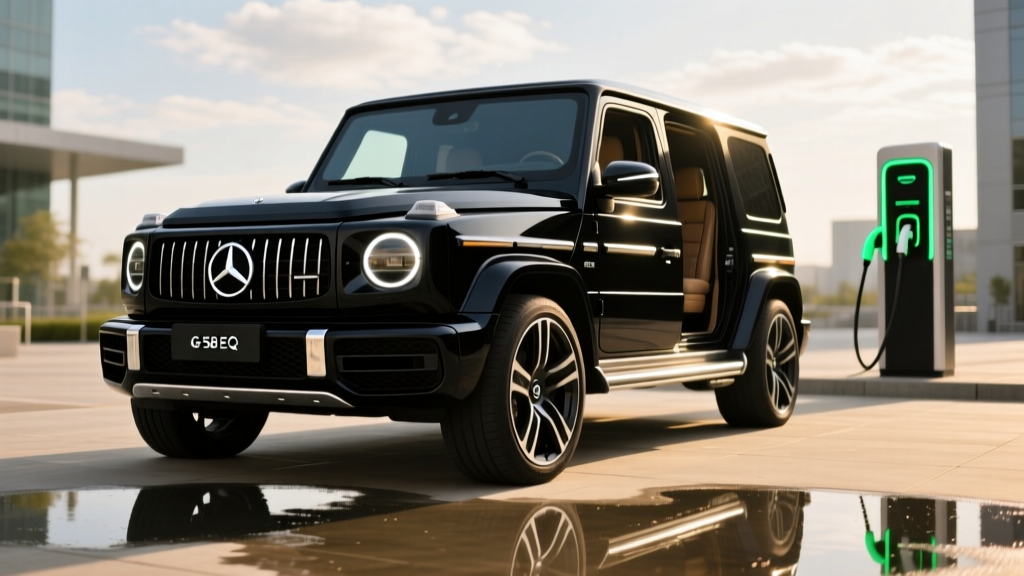
The 2026 Mercedes-Benz G 580 with EQ Technology (the electric G-Class) is a luxury off-road SUV starting at $164,900 MSRP with 239 miles of EPA-estimated range from a 116 kWh (usable) lithium-ion battery. It produces 855 horsepower, charges at up to 320 kW DC (10-80% in approximately 32 minutes), and qualifies for no federal §30D tax credit because it exceeds the $80,000 SUV MSRP cap. Real-world highway range drops to roughly 190–210 miles at 70+ mph, and cold-weather driving can shave another 15–20% off that figure. It is best suited for owners with reliable Level 2 home charging who want a status-oriented EV with genuine off-road capability — not maximum efficiency or range-per-dollar value.
Range, Battery & Real-World Efficiency
The electric G-Class uses a floor-mounted battery pack with approximately 116 kWh of usable capacity housed in a torsion-resistant casing engineered to protect cells during off-road use. Mercedes-Benz quotes an EPA range of 239 miles, placing it well behind efficiency-focused luxury EVs like the BMW iX xDrive50 (309 mi EPA) but competitive with the Hummer EV SUV (314 mi EPA on larger battery) and the Rivian R1S Quad (up to 220 mi EPA on the Dual-Motor Standard pack).
Real-World Range Expectations
EPA Sticker: 239 miles
Highway (70-75 mph, mild weather): ~190–210 miles
Cold Weather (below 32°F, highway): ~155–175 miles
Off-Road / Low-Speed Trail Use: Range varies heavily by terrain and elevation; G-Turn and crawl modes consume significant energy.
The G 580's boxy aerodynamics (drag coefficient approximately 0.44 Cd) are the primary efficiency penalty. At highway speeds, air resistance dominates energy consumption. Expect efficiency in the range of 55–60 MPGe combined (roughly 55-60 kWh/100mi), which is steep for a luxury EV but reasonable given the vehicle's 6,800+ lb curb weight and frontal area.
Charging Speed & Infrastructure
Mercedes equips the G 580 EQ with an 800-volt architecture capable of accepting up to 320 kW peak DC fast charging. However, peak rate is not sustained rate — the charge curve tapers significantly above 60% state of charge to protect battery health.
| Charging Level | Power (kW) | Speed | Use Case |
|---|---|---|---|
| Level 1 (120V household) | ~1.4 kW | ~3–4 mi/hr | Emergency trickle only; ~40+ hours for full charge |
| Level 2 (240V home/public) | Up to 11 kW | ~22–25 mi/hr | Overnight home charging; ~10-12 hours for full charge |
| DC Fast Charging | Up to 320 kW peak | 10-80% in ~32 min | Road trips; sustained rate drops above 60% SoC |
On a 350 kW Electrify America or Tesla Supercharger (with NACS adapter, available via Mercedes-Benz's partnership), you can expect to add roughly 140–160 miles of range in 15 minutes under ideal conditions when starting below 20% SoC. Above 80%, charging slows dramatically — a reality of lithium-ion chemistry, not a G-Class-specific limitation.
Home charging reality: To fully utilize Level 2 charging at 11 kW, you need a dedicated 60-amp circuit (48-amp continuous draw). Most homes can accommodate this, but older panels (100-amp service) may require a $1,500–$3,000 electrical panel upgrade. Budget $800–$2,000 total for a quality Level 2 charger (e.g., ChargePoint Home Flex, Emporia Level 2) plus licensed electrician installation. Always defer final electrical specifications to a licensed electrician.
Performance & Off-Road Capability
The electric G-Class is no efficiency-first commuter — it's a performance and capability statement. Four independently controlled electric motors (one per wheel) produce a combined 855 horsepower and an estimated 850 lb-ft of torque, enabling a 0–60 mph time of 4.1 seconds per Mercedes-Benz. That's supercar acceleration in a vehicle that weighs nearly three tons.
Off-road credentials are genuine, not cosmetic:
- G-Turn: Tank turns by spinning left-side and right-side wheels in opposite directions — possible only with individual wheel motors.
- G-Steering: Tightens turning radius by braking the inside rear wheel, reducing the turning circle significantly on trails.
- Water fording: Up to 33.5 inches (improved over the gas G-Class thanks to sealed battery and no air intake).
- Approach/departure/breakover angles: Competitive with the G 550, with slight improvements from the flat underbody.
- Three differential locks (simulated): Torque vectoring replaces mechanical locking differentials.
The tradeoff is weight. At roughly 6,800 lbs curb weight, tire wear, braking distance, and energy consumption all increase. Plan for premium tire replacement costs ($400–$600 per all-terrain tire) and understand that regenerative braking handles most deceleration but the physical mass still demands robust friction brakes for emergency stops.
EV vs Gas G-Class: Cost & Ownership Comparison
The most direct comparison is the gasoline Mercedes-Benz G 550, which starts around $148,250 MSRP (2025/2026 model year) and achieves approximately 14 MPG city / 16 MPG highway / 15 MPG combined per EPA estimates.
| Metric | G 580 EQ (Electric) | G 550 (Gas) |
|---|---|---|
| Starting MSRP | $164,900 | ~$148,250 |
| Federal Tax Credit (§30D) | $0 (exceeds $80K SUV cap) | $0 |
| EPA Range / Tank | 239 mi | ~330 mi (22-gal tank) |
| Fuel/Energy Cost (15,000 mi/yr) | ~$1,050–$1,500/yr (home charging at $0.14/kWh) | ~$3,300–$3,800/yr (premium at $4.00/gal, 15 MPG) |
| Annual Maintenance | ~$300–$500 (no oil, fewer fluids) | ~$800–$1,200 (oil, filters, spark plugs) |
| 0-60 mph | 4.1 sec | ~5.3 sec |
| Insurance (est. annual) | $3,800–$5,200 | $3,200–$4,500 |
| Estimated 5-Year Energy/Fuel Savings (EV) | $9,000–$12,000 in fuel savings over gas G 550 | |
The math: The G 580 EQ commands a ~$16,650 premium over the gas G 550 at base MSRP. Over five years at 15,000 miles/year, you'll save approximately $10,000–$12,000 in fuel costs (charging at home on average residential rates). Add $2,000–$3,500 in maintenance savings. That narrows the gap to roughly break-even or a slight premium for the EV — before factoring in higher insurance costs (EVs typically cost 15–25% more to insure due to repair complexity and parts pricing) and faster depreciation uncertainty on a first-generation electric platform.
Federal Tax Credit & Incentive Reality
Under current IRS §30D rules, the G 580 EQ does not qualify for the federal Clean Vehicle Credit. The law caps eligible SUVs at an $80,000 MSRP, and the G 580 starts at nearly double that threshold. There is also no used-EV credit path for the foreseeable future given the vehicle's newness and pricing.
- MSRP cap: $80,000 for SUVs — G 580 at $164,900 fails this requirement
- Buyer income cap: $300K MFJ / $150K single — moot since MSRP disqualifies
- Battery sourcing & critical minerals: Would need to meet thresholds, but irrelevant due to price
- Point-of-sale transfer: Not applicable
Some states offer their own EV incentives that are not MSRP-capped (e.g., certain utility rebates for Level 2 charger installation, or state-specific purchase rebates). Check your state's energy office or utility provider for local programs — these vary by jurisdiction and change frequently, so consult official state sources for current amounts.
Who Should Buy the Electric G-Class?
Decision Framework
Choose the G 580 EQ (electric) if:
- You have reliable Level 2 home charging (garage or driveway with 240V access)
- Your daily driving is under 150 miles round-trip and you take road trips infrequently (or can plan DC fast-charging stops)
- You want the quietness, instant torque, and G-Turn capability that only electric motors enable
- You're willing to pay a premium for a first-generation electric platform with unproven long-term depreciation
- You value lower running costs (fuel + maintenance) offsetting higher insurance and upfront cost
Choose the gas G 550 if:
- You lack consistent home charging access (apartment, street parking, no garage circuit)
- You regularly tow (the gas G-Class has established towing ratings; the electric version's range drops sharply under load)
- You drive in extreme cold frequently and cannot tolerate 155-175 mi real-world range
- You want proven long-term reliability data and stronger residual value history
- You take frequent long road trips through areas with sparse DC fast-charging infrastructure
Common Misconceptions
| Myth | Fact |
|---|---|
| "The electric G-Class gets the $7,500 federal tax credit." | False. The G 580's $164,900 MSRP far exceeds the §30D $80,000 SUV cap. No federal purchase credit applies. |
| "239 miles of range means I can drive 239 miles before charging." | The EPA figure assumes a mix of city/highway at moderate temperatures. Real-world highway driving at 70+ mph yields ~190-210 miles; cold weather reduces that further. Plan trips using 80% of rated range as a safe buffer. |
| "It charges in 32 minutes, so road trips are easy." | The 10-80% time of ~32 min applies only at a functioning 320 kW-capable DC fast charger with the battery preconditioned. Many public chargers deliver 50-150 kW, extending charge time to 45-70+ minutes. |
| "Electric means no maintenance." | Tires, brake fluid, cabin air filters, coolant loops, and windshield washer fluid still require service. The G 580's weight accelerates tire wear. Budget $300-$500/year minimum. |
| "It can't really go off-road — it's electric." | The G 580 has genuine off-road hardware: four independent motors, torque vectoring, 33.5 inches of water fording, and underbody protection. G-Turn is an EV-exclusive capability impossible with a conventional drivetrain. |
Battery Warranty, Longevity & Replacement
Mercedes-Benz provides a high-voltage battery warranty of 10 years or 155,000 miles (whichever comes first), guaranteeing a minimum state of health (SoH) — typically 70% capacity retention, consistent with industry norms. If the battery degrades below the warranty threshold within that period, Mercedes will repair or replace modules at no cost.
Out-of-warranty battery replacement on a pack this size (116 kWh usable) would likely cost $25,000–$40,000+ based on current luxury-EV replacement pricing. However, modern lithium-ion packs with active thermal management (which the G 580 has) typically degrade only 10-15% over the first 150,000 miles under normal use. Avoid habitual DC fast charging above 90% SoC and frequent deep discharges to 0% to maximize longevity.
For detailed battery chemistry and degradation data, refer to fueleconomy.gov's EV technology resources and Mercedes-Benz's official owner documentation.
Frequently Asked Questions
What is the real-world range of the electric G-Class?
The EPA rates it at 239 miles, but expect roughly 190–210 miles at highway speeds in mild weather and 155–175 miles in freezing conditions. The boxy shape and 6,800+ lb weight make it one of the least efficient luxury EVs on the market — you're paying for capability and presence, not efficiency.
Can I charge the G 580 EQ at a Tesla Supercharger?
Yes, via the NACS adapter that Mercedes-Benz offers for its CCS-equipped vehicles. The Tesla Supercharger network (now open to non-Tesla EVs via adapter or built-in NACS on newer models) provides broad coverage. Confirm adapter compatibility with your specific model year at purchase.
How much does it cost to charge at home vs. gas?
At the US average residential electricity rate of ~$0.14/kWh, fully charging the 116 kWh battery costs approximately $16–$18, yielding ~239 miles of range. That's roughly $0.07–$0.08 per mile. The gas G 550 at 15 MPG combined on premium ($4.00/gal) costs about $0.27 per mile — nearly four times more per mile driven.
Does the electric G-Class qualify for any incentives?
Not the federal §30D credit — the $164,900 MSRP exceeds the $80,000 SUV cap. Some state utility programs offer charger installation rebates or time-of-use electricity rates that reduce charging costs. Consult your local utility and state energy office for specifics, as these vary by jurisdiction.
How does insurance compare to the gas G-Class?
Expect to pay 15–25% more for insurance on the G 580 EQ compared to the gas G 550. EVs carry higher repair costs (specialized labor, battery proximity concerns, sensor recalibration) that insurers factor into premiums. Get quotes from multiple carriers before purchasing — luxury EV insurance varies widely by provider.
Is the electric G-Class good for towing?
Mercedes-Benz rates the G 580 for towing, but range drops significantly under load — expect a 30–50% reduction depending on trailer weight and aerodynamics. If you tow frequently or over long distances, the gas G 550 offers more predictable range and established towing infrastructure.