Quick Answer: Are Mercedes Electric Cars Worth It in 2026?
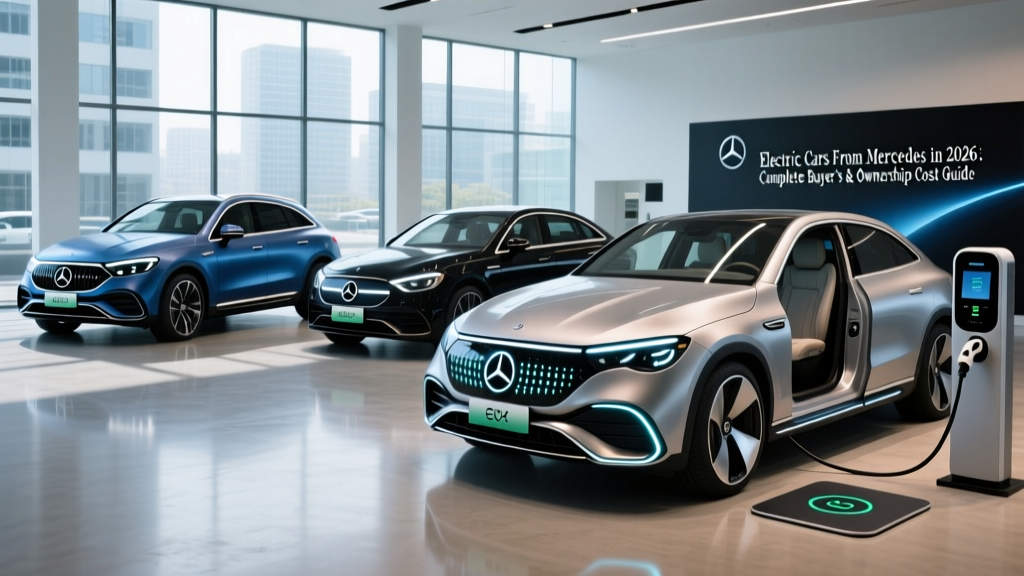
Mercedes currently sells three core battery-electric models in the U.S.: the EQB (compact SUV, ~245 mi EPA range, from ~$54,200), the EQE Sedan/SUV (mid-size, ~275–305 mi, from ~$75,050), and the EQS Sedan/SUV (flagship, ~305–390 mi, from ~$105,550). All use 400V architecture with peak DC fast-charging between 170 kW and 200 kW, meaning 10–80% charges take roughly 28–32 minutes — slower than Hyundai/Kia's 800V rivals. None currently qualify for the full $7,500 federal §30D tax credit due to battery-sourcing rules, though lease deals may capture a $7,500 commercial-credit pass-through. They're best for buyers who prioritize luxury ride quality, interior refinement, and dealership service over maximum range or fastest charging.
The 2026 Mercedes EV Lineup: Specs at a Glance
Mercedes has consolidated its EQ branding for 2026, but the core products remain the same platforms introduced earlier this decade. Here's how the lineup stacks up on the numbers that matter most to EV buyers.
| Model | Battery (kWh usable) | EPA Range | Peak DC Charge | 10–80% Time | 0–60 mph | Base MSRP |
|---|---|---|---|---|---|---|
| EQB 300 4MATIC | 66.5 kWh (NMC) | 245 mi | 100 kW | ~32 min | 7.7 sec | $54,200 |
| EQE 350+ Sedan | 90.6 kWh (NMC) | 305 mi | 170 kW | ~32 min | 6.2 sec | $75,050 |
| EQE 350 4MATIC SUV | 90.6 kWh (NMC) | 279 mi | 170 kW | ~32 min | 6.4 sec | $78,050 |
| EQS 450+ Sedan | 108.4 kWh (NMC) | 390 mi | 200 kW | ~31 min | 5.9 sec | $105,550 |
| EQS 580 4MATIC SUV | 108.4 kWh (NMC) | 305 mi | 200 kW | ~31 min | 4.4 sec | $120,550 |
Sources: fueleconomy.gov, Mercedes-Benz USA press specifications. Real-world highway range typically runs 10–15% below EPA; cold-weather (below 32°F) can reduce range 20–30%.
Real-World Range Reality Check
The EQS 450+ Sedan's 390-mile EPA figure is class-leading, but expect roughly 330–350 miles in mixed highway driving at 70–75 mph, and as low as 270–290 miles in sub-freezing winter conditions. The EQB, with its smaller pack and boxier shape, often delivers 195–215 miles on the highway — plan road trips accordingly.
How Do Mercedes EVs Compare to Gas and Hybrid Alternatives?
The natural cross-shops for Mercedes electric cars are the automaker's own ICE and mild-hybrid models — the GLB, E-Class, and S-Class — plus competing luxury EVs from BMW (i5, iX), Audi (e-tron GT, Q8 e-tron), and Genesis (Electrified G80).
| Factor | EQE 350+ Sedan (EV) | E 350 Sedan (Gas/Mild Hybrid) |
|---|---|---|
| Base Price | $75,050 | $62,350 |
| EPA Efficiency | 94 MPGe (36 kWh/100mi) | 28 MPG combined |
| Fuel/Energy Cost (15k mi/yr) | ~$630/yr (home charging at $0.16/kWh) | ~$1,875/yr (premium at $3.50/gal) |
| Annual Maintenance | ~$200–$400 | ~$800–$1,200 |
| 0–60 mph | 6.2 sec | 6.1 sec |
| Federal Tax Credit | $0 (new purchase; possible via lease) | N/A |
The EV carries a $12,000–$13,000 price premium upfront but saves roughly $1,200–$1,400 per year in fuel and maintenance. Break-even on pure operating costs takes about 9–10 years without a tax credit — or roughly 5 years if you capture a lease pass-through credit. The gas E-Class remains the simpler choice for apartment dwellers without home charging access.
Total Cost of Ownership: 5-Year Breakdown
Luxury EVs carry higher insurance premiums and steeper depreciation than mainstream models. Here's a realistic 5-year/75,000-mile ownership projection for the EQE 350+ Sedan versus the E 350 gas sedan.
| Cost Category | EQE 350+ Sedan | E 350 Sedan |
|---|---|---|
| Purchase Price (base) | $75,050 | $62,350 |
| Estimated Depreciation (5 yr) | $37,500 (50%) | $28,000 (45%) |
| Energy/Fuel (5 yr) | $3,150 | $9,375 |
| Maintenance (5 yr) | $1,500 | $5,000 |
| Insurance (5 yr avg) | $12,500 | $9,500 |
| Federal Tax Credit | $0 (purchase) | $0 |
| Estimated 5-Year Net Cost | $54,650 | $51,875 |
Insurance estimates based on national luxury-sedan averages; get personalized quotes. Depreciation figures reflect historical luxury-EV trends from sources like Kelley Blue Book. Actual results vary by market and condition.
The gap narrows to roughly $2,800 over five years, and flips in the EV's favor if you lease (capturing the $7,500 commercial-credit pass-through) or if gas prices rise above $4.00/gallon in your area.
Charging at Home and on the Road: What Mercedes Owners Need to Know
All current Mercedes EQ models use the CCS1 connector for DC fast charging and the J1772 connector for Level 2 AC charging. Mercedes has announced adoption of the NACS (Tesla) connector for future models, but 2026 vehicles still ship with CCS1. Adapters for Tesla Supercharger access are available but add a step.
| Charging Level | Power | Connector | Miles Added per Hour | Best For |
|---|---|---|---|---|
| Level 1 (120V) | ~1.4 kW | Standard outlet | 3–5 mi/hr | Emergency/trickle only |
| Level 2 (240V, 48A) | ~11.5 kW | J1772 / Wallbox | 30–40 mi/hr | Daily home charging |
| DC Fast (EQE/EQS) | 170–200 kW peak | CCS1 | ~180 mi in 15 min | Road trips |
Home charging setup cost: Expect $800–$2,500 for a quality Level 2 wallbox (ChargePoint Home Flex, Emporia, or Wallbox Pulsar Plus) plus electrician installation on an existing 240V/50A circuit. If your panel needs an upgrade to 200A service, add $1,500–$3,500. Mercedes offers its own Wallbox-branded home charger at approximately $700 for the unit.
Charging-curve reality: The EQS peaks at 200 kW but only sustains that rate between roughly 10–35% state of charge. From 35–80%, the curve tapers progressively, averaging closer to 100–120 kW. This is why the 10–80% time is ~31 minutes despite the impressive peak number. The EQB's 100 kW peak is its most significant limitation — plan for 40-minute stops on road trips.
Tax Credits and Incentives: The Complicated Truth
Under current IRS §30D rules, the federal EV tax credit of up to $7,500 requires that battery components and critical minerals meet North American sourcing thresholds. As of 2026, no Mercedes EQ model qualifies for the purchase credit because their batteries (primarily CATL- and LG-sourced) don't meet the critical-minerals and foreign-entity-of-concern (FEOC) requirements.
- MSRP cap: Sedans must be under $55,000; SUVs/vans under $80,000 (the EQB SUV could theoretically qualify on price, but fails sourcing)
- Income cap: $150K single / $225K head of household / $300K joint filers
- Battery sourcing: Critical minerals and component thresholds increase yearly — Mercedes doesn't currently meet them
- Lease loophole: Lessors can claim the $7,500 commercial clean-vehicle credit (§45W) and may pass savings to lessees as a capitalized-cost reduction — ask your dealer explicitly
- Point-of-sale transfer: If a credit were available, you could apply it at purchase rather than waiting for tax filing
State incentives vary widely. California, Colorado, Massachusetts, and others offer additional rebates — check your state's energy office or the Alternative Fuels Data Center for current programs.
Common Misconceptions About Mercedes EVs
| Myth | Fact |
|---|---|
| "The EQS gets 390 miles in real driving." | 390 is the EPA estimate for the 450+ with 19" wheels. Highway driving at 75 mph yields ~330–350 miles; cold weather drops it further. The AWD EQS 580 is rated at 330 miles EPA. |
| "Mercedes EVs charge as fast as a Hyundai Ioniq 5." | No. Hyundai/Kia use 800V architecture enabling 240+ kW peaks and 10–80% in ~18 minutes. Mercedes uses 400V, topping out at 200 kW with longer charge times. |
| "All Mercedes EVs qualify for the $7,500 tax credit." | None currently do for purchase due to battery-sourcing rules. Lease deals may pass through the credit. |
| "The battery will need expensive replacement in a few years." | Mercedes warranties the high-voltage battery for 8 years/100,000 miles with a 70% capacity-retention threshold. NMC degradation data from similar packs shows ~10–12% loss over 150,000 miles with normal use. |
| "I can use Tesla Superchargers directly." | Current Mercedes EVs use CCS1. You need an aftermarket CCS-to-NACS adapter (~$200–$300) for Supercharger access, and not all stalls support non-Tesla vehicles. |
Decision Framework: Which Mercedes EV Is Right for You?
Choose Based on Your Situation
Choose the EQB if: You need a compact luxury SUV with an optional third row, your daily commute is under 60 miles round-trip, you charge at home, and budget is around $55K–$65K. Accept that road trips require more frequent stops due to 100 kW DC charging.
Choose the EQE Sedan if: You want a mid-size luxury EV with strong real-world range (~280–300 mi), a comfortable daily driver with executive-class interior quality, and you value ride refinement over sporty handling. Best for two-car households where the EV handles daily duty and a gas car covers long trips.
Choose the EQS Sedan if: Range is your top priority (390 mi EPA is the longest of any current Mercedes), you regularly drive 200+ miles between charges, and your budget exceeds $100K. The 108.4 kWh battery is the largest in the lineup and provides the most road-trip flexibility.
Choose an EQ SUV (EQE or EQS SUV) if: You need cargo height, easy ingress/egress, or all-wheel drive for snow-belt climates. Expect a 10–15% range penalty versus the sedan equivalents due to weight and aerodynamics.
Look elsewhere (BMW i5, Hyundai Ioniq 5, Lucid Air) if: Fastest DC charging is a priority, you want the maximum federal tax credit on a purchase, or you need 800V architecture for frequent road-trip charging. BMW's i5 offers similar luxury with better credit eligibility prospects; Lucid Air exceeds 400 miles with faster charging.
Frequently Asked Questions
What is the cheapest electric car from Mercedes?
The EQB 300 4MATIC starts at $54,200 for the 2026 model year. It's a compact SUV based on the GLB platform with 245 miles of EPA range and seating for up to seven with the optional third row. It's also the most range-limited in the lineup — best suited for suburban commuting with home charging.
How long does a Mercedes EV battery last?
Mercedes warranties its high-voltage batteries for 8 years or 100,000 miles, whichever comes first, guaranteeing at least 70% of original capacity. Real-world data from similar NMC packs suggests 10–15% degradation over 150,000 miles with typical use. Out-of-warranty replacement for an EQS-class battery can cost $20,000–$30,000+, though individual module repairs are often possible at lower cost.
Can I charge a Mercedes EV at a Tesla Supercharger?
Yes, but only with a CCS-to-NACS adapter. Current Mercedes EVs ship with CCS1 ports. Mercedes has committed to NACS for future models, but 2026 vehicles still require an adapter. Check Tesla's "Charge Your Non-Tesla" map for compatible Supercharger stalls in your area.
Is the Mercedes EQS being discontinued?
Mercedes has announced it will consolidate its naming convention, with future electric sedans adopting traditional class names (e.g., an electric C-Class or E-Class). The current EQS and EQE nameplates are expected to evolve with the next-generation MMA and MB.EA platforms arriving later this decade. The 2026 models remain fully in production and on sale.
How does Mercedes Drive Pilot compare to Tesla Autopilot?
Mercedes Drive Pilot is certified as SAE Level 3 in limited conditions (pre-mapped highways, under 40 mph, clear weather in approved states like Nevada and California), meaning the driver can legally disengage attention. Tesla Autopilot and FSD (Supervised) remain SAE Level 2 — the driver must remain attentive at all times. However, Drive Pilot's operational envelope is extremely narrow compared to Tesla's broader geographic coverage. Both systems require understanding their limitations.
What does it cost to charge a Mercedes EQS at home?
The EQS has a 108.4 kWh usable battery. A full 0–100% charge at the U.S. residential average of $0.16/kWh costs approximately $17.35. For the typical driver covering 35 miles daily (~10 kWh), that's about $1.60/day or $48/month — roughly a third of what premium gasoline would cost for the same distance in an S-Class.