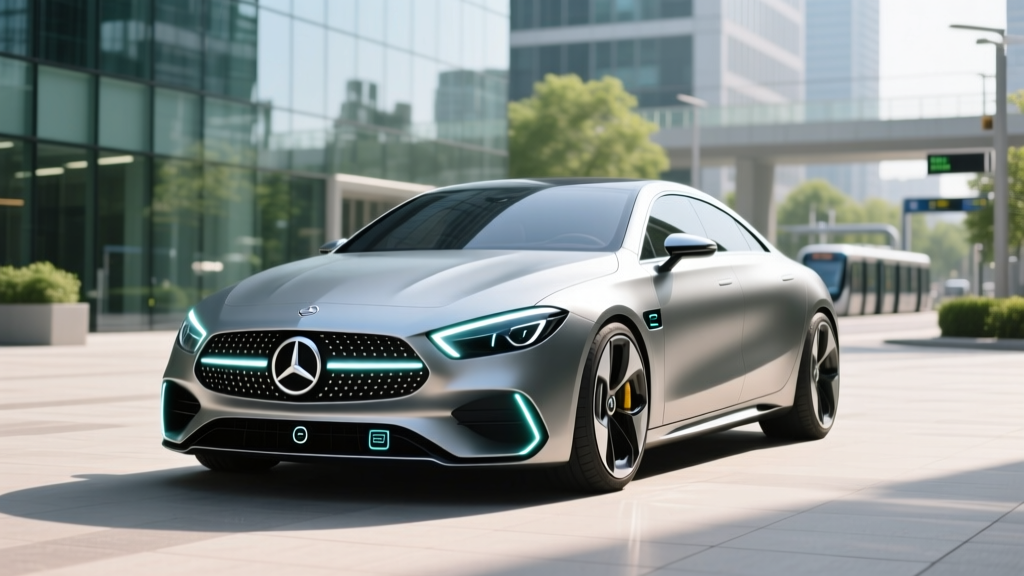
The short answer: Mercedes-Benz does not sell a battery-electric C-Class sedan. The closest equivalent is the 2026 Mercedes-Benz CLA EV, built on the new MMA (Mercedes Modular Architecture) 800-volt platform. It delivers an EPA-estimated ~350 miles of range, peaks at ~250 kW DC fast charging (10–80% in roughly 17 minutes), and starts near $47,000. The gasoline C300 sedan, by contrast, starts around $46,500 and returns 30 MPG combined. If you want a battery-electric Mercedes in the compact-executive segment, the CLA EV is the model to evaluate — not a nonexistent "C-Class EV."
Why There Is No Electric C-Class (and What Replaces It)
Mercedes-Benz restructured its EV naming convention in 2024–2025, consolidating its electric lineup. The C-Class nameplate remains reserved for internal-combustion and mild-hybrid sedans and wagons. Battery-electric models in the compact-executive segment migrated to the CLA nameplate, which sits on the dedicated MMA platform rather than the modified MRA2 architecture used by the C-Class.
The distinction matters for buyers cross-shopping the segment. The CLA EV is a ground-up electric vehicle with a flat battery floor, 800V electrical architecture, and a heat pump as standard equipment. The gasoline C300 is a conventional luxury sedan with a 2.0-liter turbocharged inline-four and a 48-volt mild-hybrid system. They compete in the same price corridor but are engineered for entirely different use cases.
2026 Mercedes-Benz CLA EV: Core Specifications
| Specification | CLA EV (RWD, Estimated) | CLA EV 4MATIC (AWD, Estimated) |
|---|---|---|
| Battery (usable) | 85 kWh (NMC) | 85 kWh (NMC) |
| EPA Range (est.) | ~350 mi | ~320 mi |
| Efficiency | ~130 MPGe / ~26 kWh/100mi | ~115 MPGe / ~29 kWh/100mi |
| Horsepower | ~268 hp | ~349 hp |
| 0–60 mph | ~6.2 sec | ~4.5 sec |
| Peak DC Fast Charge | ~250 kW | ~250 kW |
| 10–80% DC Charge | ~17 min | ~17 min |
| Level 2 AC Charge | 11 kW (~38 mi/hr) | 11 kW (~38 mi/hr) |
| Starting MSRP (est.) | $47,000 | $52,000 |
| Battery/Powertrain Warranty | 8 yr / 100,000 mi | 8 yr / 100,000 mi |
Real-world range reality: The ~350-mile EPA estimate assumes moderate temperatures, mixed driving, and speeds under 65 mph. On sustained 75+ mph highway runs, expect ~290–310 miles. In sub-freezing winter conditions without preconditioning, range can drop to ~250–275 miles. The CLA EV's standard heat pump mitigates cold-weather losses better than resistive heating, but physics still applies — plan road trips around 250 miles between stops to maintain a comfortable buffer.
CLA EV vs. Gasoline C300: Cost and Efficiency Compared
The most common buyer question: does the electric Mercedes save money compared to the gas C-Class? The answer depends heavily on your driving volume, electricity cost, and whether you qualify for federal incentives.
| Factor | 2026 CLA EV (RWD) | 2026 C300 Sedan (Gas) |
|---|---|---|
| Starting MSRP | $47,000 | $46,500 |
| Federal Tax Credit (§30D) | Up to $7,500 (eligibility varies — see below) | None |
| Effective Price (w/ max credit) | ~$39,500 | $46,500 |
| Energy Cost (15,000 mi/yr) | ~$585 (at $0.15/kWh) | ~$1,750 (at $3.50/gal, 30 MPG) |
| Annual Fuel/Energy Savings | ~$1,165/yr in favor of CLA EV | |
| Maintenance (5-yr est.) | ~$1,800 | ~$3,200 |
| Insurance (avg. annual) | ~$2,400 | ~$2,100 |
The CLA EV's higher insurance premiums partially offset its fuel savings, but over five years and 75,000 miles, the EV still nets roughly $4,000–$5,500 in total savings when the full federal credit applies. Without the credit, the breakeven point extends to roughly year six or seven depending on your local electricity rates.
Federal Tax Credit: What You Actually Qualify For
The IRS §30D clean vehicle credit offers up to $7,500, but eligibility hinges on three moving targets that change annually:
- MSRP cap: Sedans must be priced at or below $55,000. The CLA EV RWD qualifies; a fully loaded AWD model may exceed the cap.
- Buyer income cap: Modified AGI must not exceed $150,000 (single), $225,000 (head of household), or $300,000 (joint filing).
- Battery sourcing: The credit splits into two halves — $3,750 for critical-mineral sourcing and $3,750 for battery-component manufacturing. Both must be satisfied for the full $7,500. Mercedes has been working to shift sourcing to FTA-partner countries, but verify current-year compliance on the fueleconomy.gov tax credit lookup before purchasing.
- Point-of-sale transfer: You can transfer the credit to the dealer at purchase to reduce your out-of-pocket cost immediately, rather than waiting to claim it on your tax return.
Critical caveat: Battery-sourcing requirements tighten each year. A model that qualifies for the full $7,500 in early 2026 may see a reduction if supply-chain composition shifts. Always confirm eligibility at the point of sale.
Charging the CLA EV: Home Setup and Road-Trip Reality
The CLA EV's 800-volt architecture is its most practical feature for real-world ownership. Here is what charging actually looks like across different scenarios:
| Charging Level | Power | Connector | Miles Added per Hour | Use Case |
|---|---|---|---|---|
| Level 1 (120V) | ~1.4 kW | NACS / J1772 | ~4–5 mi/hr | Emergency / overnight trickle |
| Level 2 (240V, 48A) | 11 kW | NACS | ~38 mi/hr | Daily home charging |
| DC Fast Charge | Peak ~250 kW | NACS | ~180 mi in 10 min | Road trips |
Home charging installation: A Level 2 home charger on a dedicated 60-amp circuit typically costs $800–$2,500 total (charger hardware plus electrician labor and permit), assuming your electrical panel has sufficient capacity. If a panel upgrade from 100A to 200A is needed, add $1,500–$3,000. Most CLA EV owners will charge overnight at home, waking to a full battery every morning — effectively eliminating routine fuel stops.
DC fast-charging curve reality: The 250 kW peak rate is not sustained across the entire session. The CLA EV holds peak power from roughly 10% to 40% State of Charge, then tapers progressively. A 10–80% session takes about 17 minutes under ideal thermal conditions. Above 80%, charging slows dramatically to protect battery longevity — plan to unplug at 80% on road trips rather than waiting for a full charge.
Preconditioning matters: The CLA EV's navigation system will precondition the battery when you route to a DC fast charger. If you arrive at a charger without preconditioning (especially in cold weather), peak charge rates can drop by 30–50%. Always use the built-in navigation for charging stops.
5-Year Ownership Cost Breakdown
| Expense Category (5 yr / 75,000 mi) | CLA EV (RWD) | C300 Sedan |
|---|---|---|
| Purchase Price (after credit) | $39,500 | $46,500 |
| Energy / Fuel | $2,925 | $8,750 |
| Maintenance | $1,800 | $3,200 |
| Insurance | $12,000 | $10,500 |
| Depreciation (est.) | $18,500 | $19,000 |
| Total 5-Year Cost | $74,725 | $87,950 |
| Cost per Mile | $0.997 | $1.173 |
The CLA EV wins on total cost primarily through the federal tax credit and energy savings. Insurance is the EV's biggest cost disadvantage — expect premiums 10–15% higher than the C300, driven by higher repair costs for battery-adjacent components and limited body-shop familiarity with 800V systems. Shop multiple insurers before purchase.
Common Misconceptions About the Mercedes Electric C-Class
| Myth | Fact |
|---|---|
| "The EQC is the electric C-Class." | The EQC was a compact electric SUV discontinued after the 2023 model year. It was never a C-Class equivalent, and it is no longer sold new in the U.S. |
| "Electric Mercedes can't road-trip." | The CLA EV's 800V system charges 10–80% in ~17 minutes at a 250 kW station. With 350 miles of range, a 600-mile trip requires one 20-minute stop — comparable to a gas-car break. |
| "The battery will need replacing in 5 years." | Mercedes warranties the battery for 8 years/100,000 miles against degradation below 70% capacity. NMC chemistry in thermally managed packs typically retains 85–90% capacity at 100,000 miles based on industry-wide fleet data. |
| "I can't charge at home in an apartment." | This is a legitimate limitation. If you lack home or workplace charging access, the CLA EV becomes significantly less convenient. Public-only charging adds time and cost — evaluate your situation honestly before purchasing. |
| "All EVs qualify for the $7,500 credit." | Eligibility depends on MSRP caps, buyer income, and battery-sourcing rules that change annually. Always verify on fueleconomy.gov and with your tax professional. |
Decision Framework: Should You Buy the CLA EV or the C300?
Choose the CLA EV if:
- You have reliable Level 2 home or workplace charging access
- You drive 12,000+ miles per year (higher mileage = faster payback on energy savings)
- Your household income falls under the §30D AGI caps
- You value instant torque, quiet operation, and minimal scheduled maintenance
- Your typical daily driving is under 200 miles (covering 95%+ of trips without mid-day charging)
Choose the gasoline C300 if:
- You live in an apartment or condo without charging access and cannot install a Level 2 charger
- You frequently drive in extreme cold (below 10°F) for long distances where range loss and charging speed penalties compound
- You regularly tow or carry heavy loads that further reduce EV range
- Your AGI exceeds the §30D income caps, eliminating the tax credit and extending the cost breakeven point significantly
- You prefer the C-Class's specific interior layout, wagon availability, or established dealer service familiarity
Frequently Asked Questions
Is there a Mercedes electric C-Class sedan for sale in 2026?
No. Mercedes-Benz does not produce a battery-electric C-Class. The closest electric equivalent in size, price, and positioning is the CLA EV, built on the dedicated MMA platform. The C-Class continues as a gasoline/mild-hybrid model.
How does the CLA EV's range compare to competitors?
At an estimated 350 miles (RWD), the CLA EV sits at the top of the compact luxury EV segment. The BMW i4 eDrive40 achieves an EPA-estimated 307 miles, and the Tesla Model 3 Long Range delivers approximately 341 miles. The CLA EV's combination of range and 250 kW charging speed is among the best in its class.
What connector does the CLA EV use?
The 2026 CLA EV uses the NACS (North American Charging Standard) connector, giving it native access to Tesla Supercharger stations alongside Electrify America, EVgo, and other networks. No adapter is required for either NACS or legacy CCS stations in most cases, though verify adapter inclusion with your dealer.
How much does it cost to charge a CLA EV at home?
Charging the 85 kWh battery from 10% to 100% at the U.S. average residential rate of $0.15/kWh costs approximately $11.48. That buys roughly 315 real-world miles — equivalent to about $36 worth of gasoline in the C300 at $3.50/gallon.
Does the CLA EV qualify for the $7,500 federal tax credit?
It may, depending on the trim MSRP, your income, and the current battery-sourcing compliance status. The RWD model is more likely to clear the $55,000 MSRP cap for sedans. Check the fueleconomy.gov credit lookup tool and consult a tax professional before relying on the credit in your purchase budget.
What is the battery warranty on the CLA EV?
Mercedes-Benz covers the high-voltage battery for 8 years or 100,000 miles, whichever comes first, against defects and capacity loss below 70% of original capacity. This is consistent with industry-standard EV battery warranties from BMW, Audi, and Tesla.
Can the CLA EV use Tesla Superchargers?
Yes. With its native NACS port, the CLA EV can access Tesla's Supercharger network (V3 and V4 stations) directly. Mercedes-Benz has confirmed compatibility, though maximum charge rates at Superchargers may be capped at 150–250 kW depending on station generation. Use the Mercedes me app or the vehicle's built-in navigation to locate compatible stations.