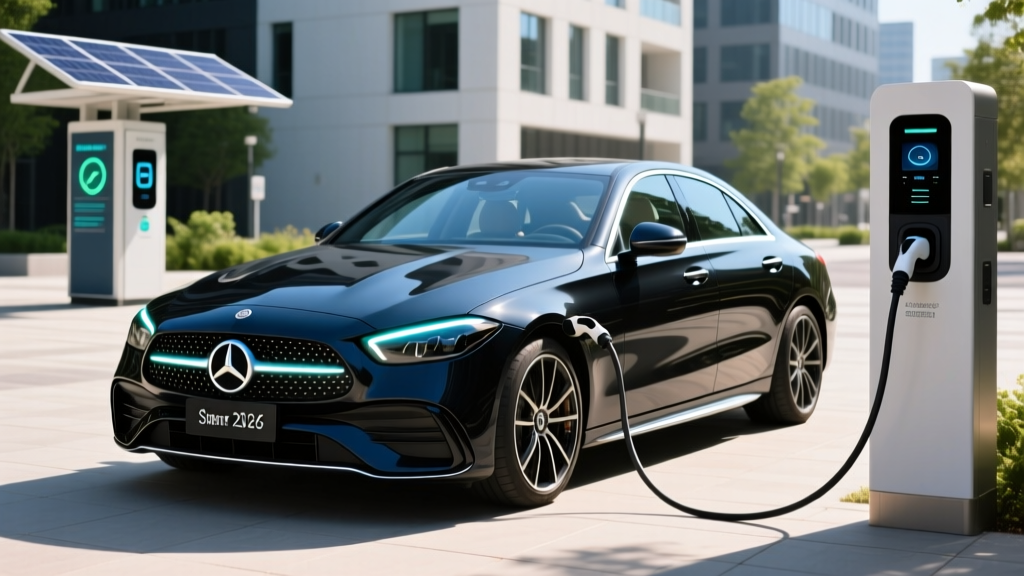
Quick Answer: The Mercedes-Benz C-Class EV (internally tied to the CLA-based MMA platform) is expected to arrive for the 2026–2027 model year with an EPA-estimated range near 340–380 miles on a ~85 kWh (usable) NMC battery, DC fast charging up to 250 kW (10–80% in approximately 20 minutes), and a starting MSRP around $52,000–$58,000 before incentives. It will compete directly with the BMW i4, Tesla Model 3, and Polestar 2 in the luxury compact electric sedan segment. Federal §30D tax credit eligibility remains unconfirmed until Mercedes finalizes battery sourcing — buyers should not assume the full $7,500 credit applies.
What the Mercedes C-Class EV Actually Is
Mercedes-Benz has been restructuring its naming conventions. Going forward, the "C-Class" badge will be reserved for sedans, while the electric counterpart built on the new Mercedes Modular Architecture (MMA) — first previewed by the Concept CLA Class — will slot into the same compact-luxury segment. The production C-Class EV sedan is expected to debut in late 2026 as a 2027 model, sharing the MMA platform's 800-volt electrical architecture, silicon-carbide inverters, and next-generation battery options.
This is not a converted gas car. The MMA platform was designed as electric-first, meaning the battery pack sits low in a skateboard layout, optimizing interior space and weight distribution. Mercedes has confirmed that MMA vehicles will also offer a range-extended hybrid variant, but the pure BEV version is the volume play.
Expected Specs: Range, Battery, and Charging
Based on Mercedes' published MMA platform data and the CLA concept's WLTP figures (which run 15–20% higher than EPA), here is what we project for the U.S.-spec C-Class EV:
| Specification | Expected Figure |
|---|---|
| Battery (usable) | ~85 kWh, NMC chemistry |
| EPA Range (est.) | 340–380 miles |
| WLTP Range (published) | Up to 750 km (~466 mi) — not US-applicable |
| DC Fast Charge Peak | 250 kW (800V architecture) |
| 10–80% DC Charge Time | ~20 minutes (estimated) |
| Level 2 AC Charge Rate | 11 kW (standard), 22 kW (optional) |
| Efficiency | ~3.8–4.2 miles/kWh (~85–92 MPGe) |
| 0–60 mph | ~5.5 seconds (RWD), ~4.2 seconds (AWD) |
| Horsepower | ~268 hp (RWD), ~402 hp (AWD dual motor) |
| Drivetrain | Rear-wheel drive standard; AWD optional |
Real-World Range Reality: The EPA sticker may say 360 miles, but plan for ~290–320 miles on highway trips at 70–75 mph, and ~240–270 miles in sub-freezing winter conditions. Mercedes' 800V architecture and standard heat pump should mitigate cold-weather losses better than older 400V platforms, but physics still applies — battery internal resistance increases in cold, and cabin heating draws energy even with a heat pump.
On charging: the 250 kW peak rate is exactly that — a peak. Expect the charge curve to sustain roughly 200–230 kW between 10–40% SoC, then taper progressively. The 10–80% time of ~20 minutes assumes a 350 kW-capable DC fast charger (such as Electrify America or Tesla Supercharger V4 stalls). On older 150 kW stations, plan for 30–35 minutes for the same session. At home on a Level 2 (240V/48A) charger, a full charge takes approximately 8–9 hours — easily an overnight top-up.
EV vs. Gas C-Class vs. Plug-In Hybrid: Cost and Efficiency
Mercedes currently sells the C300 (gas, ~255 hp, EPA 30 mpg combined) and the C300e plug-in hybrid (estimated ~30 miles electric-only range, ~65 MPGe combined when charged). Here is how the C-Class EV stacks up in a five-year ownership scenario, assuming 12,000 miles/year and national average energy costs:
| Category | C300 (Gas) | C300e (PHEV) | C-Class EV (Est.) |
|---|---|---|---|
| Base MSRP | $46,550 | $56,000 | $54,000 (est.) |
| Fuel/Energy Cost (5 yr) | $10,800 | $6,500 | $3,600 |
| Maintenance (5 yr) | $3,200 | $3,000 | $1,400 |
| Insurance (5 yr avg) | $9,500 | $10,200 | $11,000 |
| Federal Tax Credit | $0 | Up to $3,750* | Up to $7,500* |
| Est. 5-Year Total Cost | $69,050 | $72,200 | $62,500 |
*Tax credit eligibility depends on IRS §30D sourcing, MSRP, and buyer income rules. Verify at irs.gov before purchase. PHEV credit is reduced based on battery capacity.
The EV's advantage is energy and maintenance savings — no oil changes, no transmission fluid, no spark plugs, and regenerative braking extends pad life significantly. However, EV insurance premiums run 10–20% higher on average due to repair cost structures and battery replacement considerations.
Pricing, Trims, and Tax Credit Eligibility
Mercedes has not published final U.S. trim pricing. Based on the current C300 positioning and the CLA EV's expected pricing, we project the following structure:
- C-Class EV (base RWD): ~$52,000–$54,000 MSRP
- C-Class EV (AWD/Premium): ~$58,000–$62,000 MSRP
- AMG variant (if offered): ~$68,000+ MSRP
Federal §30D Tax Credit Checklist (2026 Rules):
- Vehicle MSRP must not exceed $55,000 for sedans — base trim may qualify; AWD and AMG trims likely exceed the cap
- Buyer AGI must not exceed $150,000 (single) / $300,000 (joint)
- Battery must meet critical-mineral and component-sourcing thresholds (increasing yearly)
- Credit can now be transferred to the dealer at point of sale as an immediate discount
- Verify current eligibility at irs.gov/credits-deductions/credits-for-new-clean-vehicles
The $55,000 sedan MSRP cap is the critical constraint here. If Mercedes prices the base RWD model at $54,000, it clears the cap — but only barely, and destination charges could push it over. This is worth monitoring closely as pricing is finalized.
Real-World Ownership: What First-Time EV Buyers Need to Know
Buying a C-Class EV is not the same transaction as buying a C300. Here is what changes:
Home Charging Access Is Non-Negotiable
If you cannot charge at home (or at a dedicated workplace charger), an EV in this price class will frustrate you. Public DC fast charging costs $0.35–$0.55/kWh on networks like Electrify America, compared to $0.12–$0.18/kWh for home electricity. That erases much of the fuel-cost advantage. A Level 2 home charger installation runs $800–$2,200 depending on panel capacity and run length. Homes with 100-amp panels may need a $1,500–$3,000 service upgrade to 200 amps — factor this in.
Charging Deserts Still Exist
While the Supercharger network has opened to NACS-equipped non-Tesla vehicles and Electrify America has expanded, rural Interstate corridors in the Mountain West, Great Plains, and parts of the Southeast still have gaps of 80–120 miles between reliable DC fast chargers. With a 340+ mile range, the C-Class EV handles this comfortably — but only if you plan stops and precondition the battery.
Cold Climate Considerations
If you live where winters regularly drop below 25°F, expect 20–30% range reduction. The MMA platform's standard heat pump helps, but it does not eliminate the loss. Garage parking and preconditioning while plugged in are essential habits for cold-climate EV ownership.
Maintenance Is Minimal — But Tires Aren't
EVs eliminate oil changes, coolant flushes (mostly), and transmission service. But they are heavier (the C-Class EV will likely weigh 4,600–4,900 lbs) and deliver instant torque, which accelerates tire wear. Budget for tire replacement every 25,000–35,000 miles rather than the 40,000–50,000 miles typical on a gas sedan. A set of four premium all-season tires for this class runs $800–$1,200.
Myths vs. Facts: C-Class EV Misconceptions
| Myth | Fact |
|---|---|
| "The battery will need replacing in 5 years" | NMC batteries on modern thermal-managed platforms retain 85–90% capacity at 100,000 miles. Mercedes warranties the battery for 8 years / 100,000 miles (minimum 70% retention). |
| "It qualifies for the full $7,500 tax credit" | Eligibility depends on battery mineral sourcing, MSRP cap ($55K for sedans), and buyer income. Only the base RWD trim may qualify, and only if sourcing requirements are met. Check IRS guidelines. |
| "I can charge on any public charger" | Mercedes is expected to equip the C-Class EV with a NACS connector (following the industry-wide Tesla standard adoption). CCS adapters are available but add a step. Confirm connector type before purchasing. |
| "Fast charging ruins the battery" | Occasional DC fast charging does not materially degrade modern batteries. Daily use of DCFC may add ~1–2% additional degradation over 5 years vs. Level 2 charging. The battery management system limits peak charge rate as the battery ages. |
| "The range is the same as the WLTP number" | WLTP figures (up to 750 km / 466 mi) are measured under less demanding conditions. U.S. EPA estimates are 15–20% lower. Always use EPA numbers for purchase decisions. |
Decision Framework: Is the C-Class EV Right for You?
Choose the C-Class EV if:
- You have home Level 2 charging (or can install it)
- Your daily commute is under 80 miles round-trip
- You take 2–4 road trips per year and can plan charging stops
- You want Mercedes interior quality and MBUX tech with zero tailpipe emissions
- Your household income is under $300,000 (joint) and you want to pursue the §30D credit on the base trim
Choose the C300 (gas) or C300e (PHEV) instead if:
- You live in an apartment or condo without charging access and workplace charging is unavailable
- You regularly drive 300+ miles in single stretches through rural areas with sparse charging
- You want the lowest possible upfront purchase price (C300 starts ~$46,550)
- You prefer the flexibility of a 5-minute gas stop with zero route planning
- You want AWD and the MSRP will exceed the $55,000 sedan tax-credit cap regardless
Frequently Asked Questions
When will the Mercedes C-Class EV be available to buy?
Mercedes has indicated the MMA-based compact electric sedan will enter production in 2026, with U.S. deliveries likely beginning late 2026 or early 2027 as a 2027 model-year vehicle. Exact on-sale dates have not been confirmed.
Will the C-Class EV use NACS or CCS?
Mercedes-Benz has committed to adopting the Tesla NACS connector for its North American vehicles beginning in 2025. The C-Class EV is expected to ship with a native NACS port, granting direct access to the Tesla Supercharger network (17,000+ stalls) without an adapter.
How does it compare to the Tesla Model 3 and BMW i4?
The Model 3 Long Range (EPA 363 mi, ~$42,000 MSRP, 250 kW charging) undercuts the C-Class EV on price and has proven efficiency. The BMW i4 eDrive40 (EPA 307 mi, ~$57,000 MSRP, 205 kW charging) competes more directly on luxury positioning. The C-Class EV aims to split the difference — Mercedes interior refinement with competitive range and the fastest charging architecture of the three.
What is the battery warranty?
Mercedes typically warrants its EV battery packs for 8 years or 100,000 miles, guaranteeing a minimum of 70% state-of-health retention. This is consistent with federal requirements for advanced-technology vehicle components and matches competitors like BMW and Audi.
Can I tow with the C-Class EV?
Compact luxury EV sedans in this segment are generally not rated for towing, or are rated for very light loads (under 1,600 lbs). If towing is a priority, consider a larger platform like the Mercedes EQE SUV or an electric truck.
Sources: Mercedes-Benz MMA platform announcements, fueleconomy.gov, IRS §30D clean vehicle credit guidelines. Specifications for unreleased vehicles are estimated based on published platform data and may change before production.