The Short Answer
The Mercedes C-Class electric interior arrives via the 2026 Mercedes-Benz CLA EV (the electric sedan positioned at the C-Class price point). Built on the new MMA (Mercedes-Benz Modular Architecture) platform, it features the next-generation MBUX Superscreen spanning the dashboard, a 10.2-inch rear passenger display, sustainable microfiber and recycled-material upholstery, and a flat floor enabling limousine-like legroom. The CLA EV targets an EPA-estimated 330 miles of range from an 85 kWh NMC battery, DC fast charging at up to 250 kW (10–80% in ~22 minutes), and a starting MSRP around $47,000. If you're shopping for a premium compact electric sedan with a tech-forward cabin, this is Mercedes' answer — but the gas C300 remains a strong alternative if you lack home charging or drive frequently in extreme cold.
Inside the 2026 CLA EV: The Electric C-Class Cabin
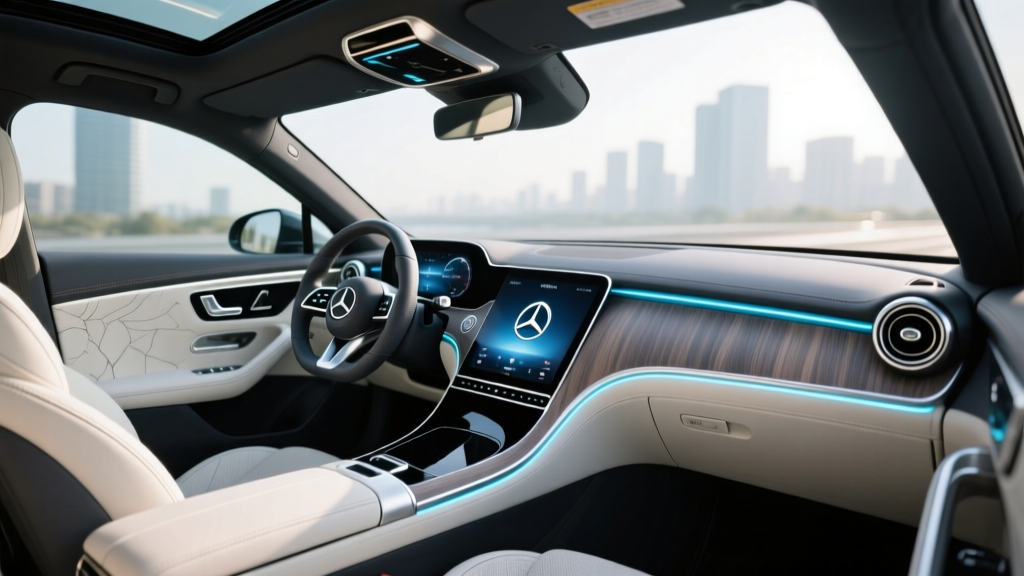
Mercedes has repositioned the CLA nameplate as its entry-level electric sedan for the 2026 model year, effectively serving as the electric equivalent of the C-Class in terms of pricing, positioning, and interior volume. The cabin is the centerpiece of the vehicle, and Mercedes has invested heavily in making the Mercedes C-Class electric interior experience distinct from anything in the current ICE C-Class lineup.
MBUX Superscreen and Digital Cockpit
The dashboard is dominated by the MBUX Superscreen — a continuous glass panel stretching from driver to passenger side. The configuration includes:
- 12.3-inch driver instrument cluster with customizable EV-specific readouts (energy flow, regen level, SoC percentage, range estimation)
- 14.4-inch central touchscreen running the latest MBUX with wireless Apple CarPlay, Android Auto, and Mercedes' AI-driven voice assistant ("Hey Mercedes")
- 12.3-inch front passenger display with media streaming capability (visible only to the passenger to avoid driver distraction)
- 10.2-inch rear-seat entertainment screen available on Premium and Exclusive trims
The system supports over-the-air (OTA) updates, augmented-reality navigation overlay on the central screen, and a new "Zero Layer" interface that surfaces the most-used functions without menu diving. Wireless phone charging is standard, with two USB-C ports in front and two in the rear (all 60W fast-charge capable).
Materials and Sustainability
Mercedes has moved away from traditional leather in the CLA EV, offering:
- Artico microfiber (standard) — a synthetic, animal-free upholstery made from recycled PET bottles
- Nappa leather (optional on Exclusive trim) — sourced from certified tanneries with Chrome-free processing
- Open-pore wood trim from FSC-certified forests, plus aluminum and carbon-fiber accent options
The flat floor (no transmission tunnel) creates genuinely usable middle-rear-seat space — a first for this class from Mercedes. Rear legroom measures an estimated 37.8 inches, roughly 1.5 inches more than the current gas C-Class.
Spec Table: 2026 Mercedes CLA EV at a Glance
| Specification | CLA 250 EV (RWD) | CLA 350 EV (AWD) |
|---|---|---|
| Battery Capacity | 85 kWh usable (NMC) | 85 kWh usable (NMC) |
| EPA Range (est.) | 330 miles | 305 miles |
| Real-World Range (highway 70 mph) | ~275–290 miles | ~255–270 miles |
| Real-World Range (cold, 20°F) | ~240–260 miles | ~220–240 miles |
| Motor Output | 268 hp / 284 lb-ft | 402 hp / 443 lb-ft |
| 0–60 mph | 6.2 sec | 4.4 sec |
| DC Fast Charge (peak) | 250 kW | 250 kW |
| 10–80% DC Charge Time | ~22 min | ~22 min |
| Level 2 Charge Rate | 11 kW (AC) | 11 kW (AC) |
| Level 2 0–100% Time | ~8.5 hours | ~8.5 hours |
| EPA Efficiency (est.) | 110 MPGe | 100 MPGe |
| Base MSRP | $47,000 | $54,500 |
| Battery/Powertrain Warranty | 8 yr / 100,000 mi | 8 yr / 100,000 mi |
Note: Specs are preliminary based on Mercedes-Benz MMA platform announcements. Final EPA figures will be confirmed closer to the on-sale date. Source: Mercedes-Benz
Real-World Range Reality Check
The EPA sticker may say 330 miles for the RWD model, but plan for 275–290 miles on sustained highway driving at 70+ mph. In freezing temperatures (below 30°F), expect a 20–25% reduction, bringing usable range to roughly 240–260 miles. The CLA EV includes a heat pump (standard on all trims), which helps mitigate cold-weather losses compared to EVs without one — but physics still applies. Preconditioning the battery while plugged in (via the Mercedes me app) is essential for maximizing range and fast-charge speed in cold weather.
CLA EV vs. Gas C300: Interior and Ownership Compared
Many buyers considering the Mercedes C-Class electric interior are cross-shopping the gas-powered C300 sedan. Here's how they stack up on the dimensions that matter:
| Factor | 2026 CLA 250 EV | 2026 C300 (Gas) |
|---|---|---|
| Starting MSRP | $47,000 | $46,550 |
| Federal Tax Credit (§30D) | Up to $7,500 (see eligibility) | None |
| Effective Price After Credit | ~$39,500 | $46,550 |
| EPA Range / Fuel Economy | 330 mi / 110 MPGe | 30 mpg combined |
| Annual Fuel/Energy Cost (12k mi) | ~$550 (home charging, $0.14/kWh) | ~$1,680 ($3.50/gal) |
| 5-Year Energy Cost | ~$2,750 | ~$8,400 |
| 5-Year Maintenance (est.) | ~$1,200 | ~$3,500 |
| Dashboard Display | MBUX Superscreen (triple) | 12.3" cluster + 11.9" central |
| Rear Floor | Flat (no tunnel) | Transmission tunnel hump |
| Cargo Volume (est.) | 15.5 cu ft + frunk ~1.5 cu ft | 12.6 cu ft |
| Home Charging Needed? | Yes (strongly recommended) | No |
Gas cost estimate based on fueleconomy.gov data and EIA national average pricing. EV energy cost assumes 85% home Level 2 charging at the US average residential rate of $0.14/kWh.
Total Cost of Ownership: 5-Year Breakdown
Sticker price is only the starting point. Here's a realistic 5-year / 60,000-mile ownership comparison for the CLA 250 EV vs. the gas C300:
| Cost Category | CLA 250 EV | C300 (Gas) |
|---|---|---|
| Purchase Price (after credit) | $39,500 | $46,550 |
| Depreciation (5-yr, est. 45%) | $17,775 | $20,948 |
| Energy/Fuel (5 yr) | $2,750 | $8,400 |
| Maintenance (5 yr) | $1,200 | $3,500 |
| Insurance (5-yr avg.) | $9,500 | $7,800 |
| Home Charger Install (one-time) | $1,200 | $0 |
| Total 5-Year Cost | $32,425 | $40,648 |
Key takeaway: The CLA EV saves roughly $8,200 over five years despite higher insurance premiums (EV insurance averages 15–20% more due to repair costs and battery valuation). The savings widen further if you have access to free or low-cost workplace charging, solar panels at home, or utility time-of-use rates below $0.10/kWh.
However, note the assumptions: this calculation requires home Level 2 charging access. If you rely entirely on public DC fast charging at $0.35–$0.50/kWh, your 5-year energy cost jumps to $5,000–$7,000, narrowing the advantage significantly.
Federal Tax Credit: What You Actually Qualify For
The CLA EV's eligibility for the §30D Clean Vehicle Credit (up to $7,500) depends on several factors that change year to year. As of 2026, the IRS requirements include:
- MSRP cap: Sedans must be priced at or below $55,000. The CLA 250 EV at $47,000 qualifies; the CLA 350 EV at $54,500 also qualifies, but loaded options could push it over.
- Buyer income cap: Adjusted gross income must not exceed $150,000 (single), $225,000 (head of household), or $300,000 (joint).
- Battery sourcing: At least 80% of critical minerals and 100% of battery components must be sourced from the US or free-trade-agreement partners (as of 2026 phase-in thresholds). Mercedes has confirmed MMA-platform vehicles meet these requirements for the 2026 model year, but always verify the specific VIN on the fueleconomy.gov credit lookup tool before purchasing.
- Point-of-sale transfer: You can elect to transfer the credit to the dealer at purchase, reducing your out-of-pocket cost by $7,500 at the time of sale rather than waiting to claim it on your tax return.
Source: IRS.gov — Credits for New Clean Vehicles. Tax rules are subject to change; consult a tax professional for your specific situation.
Charging at Home: What First-Time EV Buyers Need to Know
If you're coming from a gas C-Class, the biggest ownership shift is fueling at home. Here's a realistic picture:
| Charging Level | Power (kW) | Miles Added per Hour | Typical Use Case |
|---|---|---|---|
| Level 1 (120V outlet) | 1.4 kW | ~4–5 miles/hr | Emergency/top-up only |
| Level 2 (240V, home) | 7.7–11 kW | ~25–37 miles/hr | Daily home charging (recommended) |
| DC Fast Charge | Up to 250 kW | ~700+ mi/hr (peak) | Road trips, 10–80% in ~22 min |
For daily driving, Level 2 home charging is effectively mandatory for a satisfying EV ownership experience. The CLA EV's 11 kW onboard charger means a full 0–100% charge in about 8.5 hours on a 240V/48A circuit — plug in when you get home, wake up to a full battery every morning.
Home charger installation costs: Expect $800–$2,500 for a quality Level 2 wallbox (ChargePoint Home Flex, Emporia Vue, or Wallbox Pulsar Plus) plus $500–$2,000 for licensed electrician labor, depending on your panel capacity and the distance from panel to garage. If your home has a 100A electrical panel and no spare capacity, a panel upgrade to 200A can add $2,000–$4,000. Always get a quote from a licensed electrician before committing to the vehicle.
Common Misconceptions About the CLA EV
| Myth | Fact |
|---|---|
| "Electric Mercedes interiors feel cheap to save weight." | The CLA EV uses premium Artico microfiber and optional Nappa leather. Sustainable materials are a brand choice, not a cost-cut — and the fit and finish match C-Class standards. |
| "The battery will need replacement in 5 years." | Mercedes warranties the battery for 8 years / 100,000 miles against degradation below 70% capacity. NMC chemistry in the MMA platform is designed for 200,000+ mile lifespans under normal use. |
| "330 miles of range means I'll get 330 miles." | Expect ~275–290 miles at highway speeds and ~240–260 miles in freezing weather. The EPA test cycle includes low-speed city driving that inflates the number. |
| "I can charge at any public station." | The CLA EV uses the NACS (Tesla-style) connector for DC fast charging in North America. This grants access to Tesla Superchargers (with adapter, standard on 2026 models) plus Electrify America and other NACS-equipped networks. CCS-only stations require an adapter. |
| "EVs are cheaper in every way." | Insurance costs 15–20% more on average. Upfront price is comparable only after the tax credit. Public-only charging can cost more than gas per mile. |
Decision Framework: Is the CLA EV Right for You?
Choose the 2026 CLA EV if:
- You have (or can install) Level 2 home charging — this is the single biggest factor in EV satisfaction
- Your daily commute is under 80 miles round-trip (you'll rarely need public charging)
- You qualify for the §30D tax credit (income under $150K single / $300K joint)
- You value a tech-forward, screen-heavy cabin with sustainable materials
- You take 2–4 road trips per year and can plan around DC fast-charging stops
- You live in a region with moderate winters or have a garage (cold-weather range loss is manageable but real)
Choose the gas C300 instead if:
- You live in an apartment or condo without charging access and your workplace doesn't offer it
- You regularly drive 400+ miles in a single day through areas with sparse charging infrastructure
- Your winters are severe (consistently below 10°F) and you cannot garage the vehicle
- You exceed the income caps for the federal tax credit, erasing the price advantage
- You prefer the C-Class's traditional luxury interior with conventional leather and analog-digital blend
Consider the C300e plug-in hybrid if:
- You want ~40 miles of electric-only range for commuting but need gas flexibility for frequent long trips
- You have Level 2 home charging but take 6+ road trips per year through charging deserts
- The PHEV bridges the gap: electric daily driving, gas for road trips, no range anxiety
Frequently Asked Questions
Does the 2026 CLA EV replace the C-Class?
No. The gas-powered C-Class (W206 generation) continues alongside the electric CLA. Mercedes positions the CLA EV as its entry electric sedan, while the C-Class remains the entry ICE sedan. They share similar pricing and dimensions but target different powertrain preferences. The CLA EV's interior volume and tech arguably surpass the current C-Class, but they are distinct model lines.
What connector does the CLA EV use?
In North America, the 2026 CLA EV is equipped with the NACS (North American Charging Standard) connector, the same connector used by Tesla. This provides native access to Tesla Superchargers and the growing NACS-equipped public charging network. For Level 2 AC charging, it uses the standard J1772 connector (NACS includes J1772 compatibility).
How fast does the CLA EV charge on a road trip?
At a 250 kW DC fast charger (such as Electrify America or Tesla V4 Supercharger), the CLA EV can charge from 10% to 80% in approximately 22 minutes. However, charging speed tapers significantly above 80% — going from 80% to 100% can take an additional 25–30 minutes. For road trips, plan to charge to 80% and move on; the last 20% is only worth the wait if you're at your overnight destination.
Is the CLA EV's MBUX Superscreen distracting?
Mercedes addresses this with the "Zero Layer" interface, which keeps critical driving information (speed, range, navigation) in the driver's sightline without requiring touchscreen interaction. Voice control via "Hey Mercedes" handles most climate, navigation, and media requests. The passenger-side screen uses a filter that prevents the driver from viewing video content while the vehicle is in motion. Whether it's distracting ultimately depends on personal preference — if you prefer physical buttons and a minimal screen layout, the Superscreen's screen-heavy approach may feel overwhelming initially.
What does the CLA EV battery replacement cost?
Mercedes has not published an out-of-warranty replacement cost for the MMA-platform battery. For reference, comparable 85 kWh NMC battery packs in the industry currently cost $12,000–$18,000 for replacement. However, battery failures within the 8-year/100,000-mile warranty period are covered, and NMC degradation data from similar platforms shows an average of 8–12% capacity loss over 100,000 miles — meaning most owners will never face a full replacement.
Can I get the CLA EV with Tesla Supercharger access?
Yes. Because the CLA EV uses the native NACS connector, it is compatible with Tesla Superchargers without an adapter. Mercedes has confirmed that 2026 MMA-platform vehicles will integrate Supercharger locations into the MBUX navigation system's route planner, automatically preconditioning the battery when a Supercharger is selected as a waypoint.
Specs and pricing in this article reflect Mercedes-Benz announcements and preliminary data available as of early 2026. Final EPA certification, MSRP, and tax-credit eligibility should be verified at the time of purchase via fueleconomy.gov and IRS.gov.