Quick Answer: Which Mercedes-Benz New Electric Car Should You Buy?
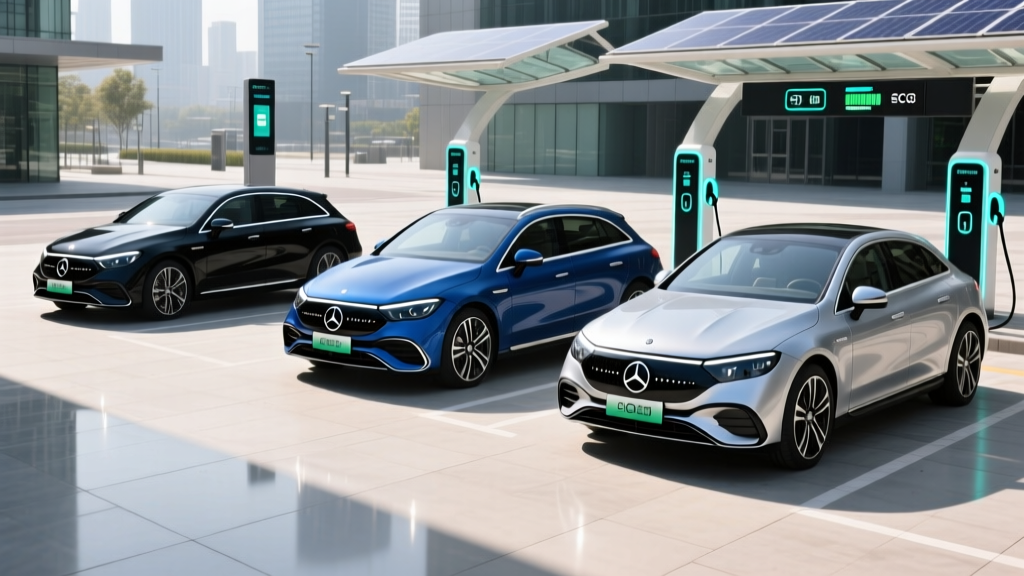
If you're shopping for a Mercedes-Benz new electric car in 2026, the lineup boils down to three practical choices: the EQB (compact SUV, ~245 mi EPA, starting ~$54,500) for urban families, the EQE Sedan/SUV (mid-size, ~305 mi EPA, starting ~$76,000) for daily commuters wanting performance and comfort, and the EQS (flagship, ~390 mi EPA, starting ~$105,550) for luxury buyers prioritizing range and tech. None currently qualify for the full §30D federal tax credit due to battery-sourcing rules — plan your budget accordingly.
The 2026 Mercedes-Benz EV Lineup at a Glance
Mercedes-Benz has streamlined its EQ portfolio for the 2026 model year around the EVA2 platform architecture. The EQA was discontinued in the U.S. market, and the upcoming MMA-based CLA EV remains announced but not yet on sale. Here's what you can actually order today:
| Model | Body Style | Battery (usable kWh) | EPA Range | Peak DC Charge (kW) | 10–80% Time | 0–60 mph | Base MSRP |
|---|---|---|---|---|---|---|---|
| EQB 350 4MATIC | Compact SUV (3-row) | 66.5 kWh (NMC) | 245 mi | 100 kW | ~32 min | 5.9 sec | $54,500 |
| EQE 350+ Sedan | Mid-size Sedan | 90.6 kWh (NMC) | 305 mi | 170 kW | ~31 min | 6.2 sec | $76,050 |
| EQE 350 4MATIC SUV | Mid-size SUV | 90.6 kWh (NMC) | 279 mi | 170 kW | ~31 min | 6.4 sec | $79,400 |
| EQS 450+ Sedan | Full-size Sedan | 118 kWh (NMC) | 390 mi | 200 kW | ~31 min | 5.9 sec | $105,550 |
| EQS 450 4MATIC SUV | Full-size SUV | 118 kWh (NMC) | 330 mi | 200 kW | ~31 min | 5.7 sec | $111,500 |
Source: EPA fueleconomy.gov and Mercedes-Benz USA spec sheets. Real-world range varies — see below.
Real-World Range vs. the EPA Sticker
Mercedes quotes competitive EPA numbers, but real-world ownership tells a more nuanced story. Based on highway-heavy driving at 70–75 mph in moderate temperatures:
What to Actually Expect
- EQB 350: EPA 245 mi → expect ~200–215 mi highway; ~170–185 mi in freezing temps
- EQE 350+ Sedan: EPA 305 mi → expect ~260–280 mi highway; ~220–240 mi in freezing temps
- EQS 450+ Sedan: EPA 390 mi → expect ~330–350 mi highway; ~280–300 mi in freezing temps
Mercedes includes a heat pump on 2026 EQE and EQS models (standard), which reduces cold-weather range loss compared to resistive cabin heating. The EQB uses a resistive heater, contributing to steeper winter losses.
The EQS 450+ Sedan's 118 kWh battery is among the largest in any production EV, giving it a genuine 300+ mile highway buffer — a meaningful advantage for road-trippers. The EQB, by contrast, is best suited for daily commutes under 80 miles round-trip with regular home charging.
Charging Speed: The Curve That Matters
Peak kW figures can mislead. What matters is the sustained charge rate from 10–80% State of Charge (SoC). Here's how Mercedes models perform at a compatible DC fast charger:
| Charging Level | Power (kW) | EQB Miles/Hr | EQE Sedan Miles/Hr | EQS Sedan Miles/Hr |
|---|---|---|---|---|
| Level 1 (120V household) | 1.4 kW | ~3 mi/hr | ~4 mi/hr | ~5 mi/hr |
| Level 2 (240V home/public) | 7.2–9.6 kW | ~20–26 mi/hr | ~27–36 mi/hr | ~34–45 mi/hr |
| DC Fast (public) | 100–200 kW peak | ~170 mi in 30 min | ~180 mi in 30 min | ~220 mi in 30 min |
Charging-curve reality: The EQS peaks at 200 kW but sustains ~150–170 kW only up to ~40% SoC, then tapers progressively. Above 80%, charging slows dramatically to protect the NMC cells — a 80–100% top-up can add 25+ minutes. For road trips, plan stops around the 10–80% window for the fastest turnaround. All 2026 EQ models use the CCS1 connector; Mercedes has not yet adopted NACS on these vehicles (that transition begins with the MMA-platform CLA EV).
Mercedes-Benz EV vs. Gas vs. Hybrid: Cost Comparison
Luxury buyers cross-shopping a Mercedes-Benz new electric car against the E-Class (gas) or S-Class need concrete numbers. Here's a 5-year cost comparison using the EQE 350+ Sedan vs. the E 350 (gas) vs. a hypothetical plug-in hybrid alternative:
| Cost Factor (5 yr / 75,000 mi) | EQE 350+ Sedan (EV) | E 350 Sedan (Gas) | Notes |
|---|---|---|---|
| Purchase Price (MSRP) | $76,050 | $60,500 | EV premium: ~$15,550 |
| Federal Tax Credit (§30D) | $0 (sourcing rules) | $0 | See IRS §30D details below |
| Fuel / Electricity | $4,200 (home L2 avg) | $10,875 ($3.25/gal, 25 MPG) | EV saves ~$6,675 |
| Maintenance | $1,800 | $4,200 | No oil, fewer brake jobs (regen) |
| Insurance (avg) | $12,500 | $9,800 | EV premiums ~25–30% higher |
| Depreciation (est.) | $38,000 | $28,500 | Luxury EVs depreciate faster currently |
| 5-Year Total | ~$132,550 | ~$113,875 | EV costs ~$18,675 more over 5 yr |
Electricity cost based on $0.16/kWh national average; gas based on E 350 combined 25 MPG at $3.25/gal. Your actual costs depend on local utility rates, driving patterns, and whether you charge at home vs. public DC stations (which can cost $0.35–$0.55/kWh, narrowing savings significantly). Source: fueleconomy.gov.
Common Misconceptions — Corrected
| Myth | Fact |
|---|---|
| "All Mercedes EVs get the $7,500 tax credit" | No 2026 EQ model currently qualifies for the full §30D credit due to battery critical-mineral sourcing requirements. The credit also has MSRP caps ($55,000 sedans / $80,000 SUVs) — only the EQB SUV potentially qualifies, and only if sourcing rules are met. Check IRS.gov before purchasing. |
| "The EQS charges as fast as a Tesla" | The EQS peaks at 200 kW (CCS1). Tesla Model S on V3 Superchargers peaks at 250 kW. Real-world 10–80% times are comparable (~31 min), but the Tesla network has broader availability. |
| "I'll save money going electric" | On luxury vehicles, higher purchase prices, faster depreciation, and elevated insurance premiums can offset fuel and maintenance savings over 5 years. The economics improve with higher annual mileage (15,000+ mi/yr) and cheap home electricity. |
| "EV batteries need replacing every few years" | Mercedes warranties its EQ batteries for 8 years / 100,000 miles against degradation below 70% capacity. NMC chemistry in these models typically retains 85–90% capacity after 100,000 miles based on industry fleet data. |
Federal Tax Credit & Incentive Reality for 2026
The §30D Clean Vehicle Credit remains complex for luxury EV buyers. Key constraints that affect the Mercedes-Benz EQ lineup:
- MSRP caps: $55,000 for sedans, $80,000 for SUVs/vans. This eliminates the EQE Sedan ($76,050), EQS Sedan ($105,550), and EQS SUV ($111,500). The EQB 350 ($54,500) and EQE SUV ($79,400) fall under the SUV cap.
- Buyer income limits: AGI must not exceed $150,000 (single) / $300,000 (joint). Many Mercedes buyers exceed these thresholds.
- Battery sourcing rules: Critical minerals and battery components must meet escalating domestic/free-trade-agreement percentages. As of 2026, Mercedes EQ batteries (primarily CATL and Farasis-sourced) do not meet the full requirements, reducing or eliminating the credit.
- Point-of-sale transfer: If eligible, you can transfer the credit to the dealer at purchase for an immediate price reduction — but only if the vehicle qualifies.
Bottom line: Do not budget assuming a $7,500 credit. Verify eligibility on IRS.gov and consult a tax professional. Some states offer additional rebates (e.g., California's CVRP, Colorado's state credit) — check your local jurisdiction.
Real-World Ownership: What First-Time Buyers Must Know
Home Charging Is Non-Negotiable for Most Owners
If you cannot install a Level 2 (240V) home charger, owning a Mercedes EQ vehicle becomes significantly less convenient and more expensive. Public DC fast charging at $0.35–$0.55/kWh erases most fuel-cost savings vs. a gas E-Class. Home L2 installation costs $1,200–$3,500 depending on panel capacity and run length — budget $2,000 as a baseline. A 200-amp panel is usually sufficient; older homes with 100-amp service may need a $2,000–$5,000 panel upgrade.
Insurance Premiums Run Higher
Luxury EVs carry 25–30% higher insurance premiums than equivalent gas models due to repair costs, battery replacement risk, and specialized body-shop requirements. Expect $2,200–$2,800/year for an EQE, and $2,800–$3,500/year for an EQS. Get quotes before signing a purchase agreement.
Driving Patterns Determine Whether an EV Makes Sense
The Mercedes EQ lineup rewards specific usage patterns. A daily commute of 40–80 miles with overnight home charging is the ideal scenario — you'll use 15–25% of battery daily and wake up full every morning. Frequent 300+ mile road trips are viable (especially in the EQS) but require planning around CCS-compatible DC fast chargers, which remain less ubiquitous than Tesla's Supercharger network in rural corridors.
Decision Framework: Which Mercedes-Benz New Electric Car Fits You?
Choose the EQB 350 if: You need a compact 3-row SUV for school runs and city driving, your daily commute is under 60 miles, you want the lowest entry price, and you can charge at home nightly. Accept that road trips require more frequent stops (~every 180–200 real-world miles).
Choose the EQE 350+ Sedan if: You want a premium daily driver with strong performance, ~270 real-world highway miles of range, and you value the MBUX Hyperscreen tech. You drive 12,000–18,000 miles/year and have reliable home charging.
Choose the EQE 350 SUV if: You prefer the SUV ride height and cargo space but want the same powertrain as the EQE Sedan. Expect ~240–255 real-world highway miles.
Choose the EQS 450+ Sedan if: Range is your top priority, you regularly drive 300+ miles between charges, and budget is secondary. The 118 kWh battery delivers genuine 330+ real-world highway miles — the most in the lineup.
Choose the EQS 450 SUV if: You need full-size luxury SUV space with 3-row seating and can accept ~280–300 real-world highway miles. Towing capacity is 3,500 lbs.
Consider a gas E-Class or S-Class instead if: You lack home charging access, regularly drive in extreme cold (below 10°F) where range drops 25–35%, your annual mileage is under 8,000 miles (savings won't offset the EV premium), or you need the flexibility of 5-minute refueling in charging-desert regions.
Battery Warranty & Long-Term Degradation
All 2026 Mercedes-Benz EQ models carry an 8-year / 100,000-mile high-voltage battery warranty covering capacity loss below 70% of original. Mercedes uses NMC (nickel manganese cobalt) chemistry across the EQ lineup — it offers higher energy density than LFP but is more sensitive to sustained high-SoC storage and extreme heat.
Maximizing battery life:
- Set daily charge limit to 80% (configurable in MBUX)
- Avoid leaving the car at 100% SoC for more than a few hours
- Use DC fast charging sparingly — rely on Level 2 for daily top-ups
- Precondition the battery (via MBUX departure timer) before fast charging in cold weather
Battery replacement costs, should you need one out of warranty, range from $18,000–$32,000 depending on the model — a significant long-term ownership risk that gas vehicles don't carry.
Frequently Asked Questions
Does any Mercedes-Benz new electric car qualify for the federal tax credit in 2026?
As of the current §30D rules, no Mercedes EQ model qualifies for the full $7,500 credit. The EQB and EQE SUV fall under the MSRP cap, but battery critical-mineral sourcing requirements are not met. Always verify on IRS.gov before purchasing, as rules update periodically.
What connector does Mercedes use — can I charge at Tesla Superchargers?
2026 EQ models use CCS1 connectors. Tesla Superchargers (NACS) are not directly compatible without an adapter. Mercedes has announced NACS adoption starting with the upcoming MMA-platform vehicles, but current EQ models remain CCS-only. You can use Electrify America, EVgo, ChargePoint, and other CCS networks.
How does the EQS compare to the Tesla Model S on range and price?
The EQS 450+ offers EPA 390 miles at $105,550. The Tesla Model S Long Range offers EPA 402 miles at ~$81,630. The EQS provides a more luxurious interior and quieter ride; the Model S offers faster charging (250 kW peak), Supercharger network access, and a significantly lower price. Neither qualifies for the federal credit.
Is the MBUX Hyperscreen worth the $8,000+ option cost?
The Hyperscreen (56-inch glass panel spanning the dashboard) is visually impressive but adds cost and complexity. If you prioritize tech and passenger entertainment, it's compelling. If you prefer simpler interfaces or plan to sell within 3–4 years (when tech-heavy options depreciate fastest), the standard dual-screen setup is adequate.
Can I tow with a Mercedes EQ vehicle?
Yes. The EQB is rated for 3,500 lbs, the EQE SUV for 3,500 lbs, and the EQS SUV for 3,500 lbs. The EQE and EQS sedans are not rated for towing. Note that towing reduces range by 30–50% depending on trailer weight and aerodynamics.