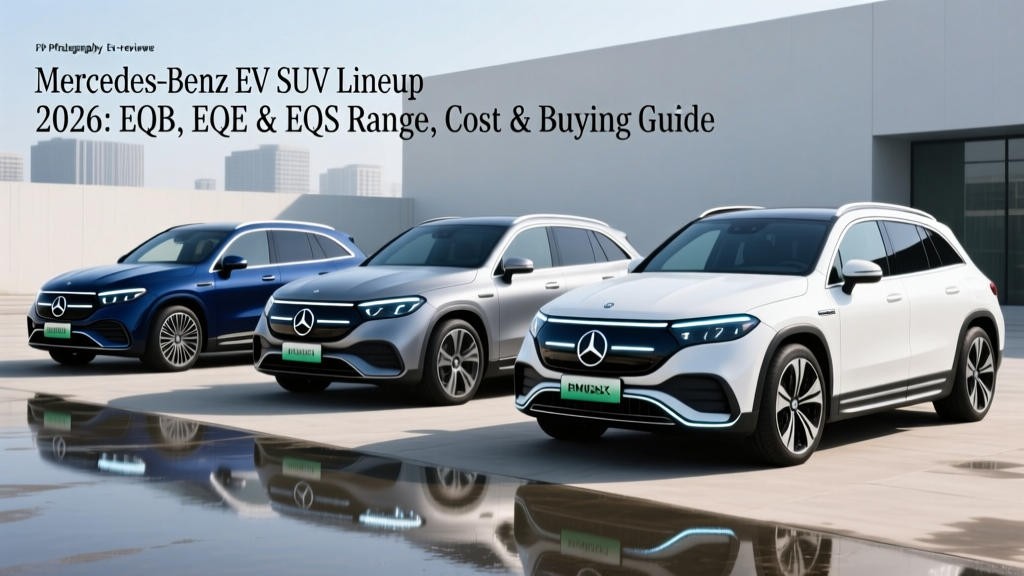
If you're shopping for a Mercedes-Benz EV SUV, you're choosing from three distinct battery-electric models in 2026: the compact EQB (up to 7 seats, ~250 miles EPA range), the midsize EQE SUV (~300 miles, luxury-focused), and the flagship EQS SUV (~330 miles, three rows). All three use 400V architectures (not 800V), which limits DC fast-charging speeds compared to rivals like Hyundai/Kia and Porsche. Home Level 2 charging is essential for ownership satisfaction — public-only charging adds significant time and cost. Federal §30D tax credit eligibility is extremely limited for Mercedes-Benz EVs due to battery-sourcing and MSRP cap requirements, so most buyers should expect to pay full MSRP.
Quick Answer: Which Mercedes-Benz EV SUV Fits You?
- Budget under $50K, need 3rd row: EQB 350 4MATIC (starts ~$47,550)
- Midsize luxury, daily commuter: EQE 350+ SUV (starts ~$74,900, best efficiency)
- Full-size luxury, max range & tech: EQS 450+ SUV (starts ~$105,550)
The 2026 Mercedes-Benz EV SUV Lineup at a Glance
Mercedes-Benz currently sells three all-electric SUVs in the U.S. market, each targeting a different buyer profile. Unlike the EQE and EQS sedans (which ride on dedicated EVA2 platforms), the EQB is based on the GLB's MFA2 architecture — a converted ICE platform that shows in packaging and efficiency. Here's how they stack up on paper:
| Spec | EQB 350 4MATIC | EQE 350+ SUV | EQS 450+ SUV |
|---|---|---|---|
| EPA Range | ~250 mi | ~300 mi | ~330 mi |
| Battery (usable) | 66.5 kWh (NMC) | 90.6 kWh (NMC) | 108.4 kWh (NMC) |
| Drivetrain | AWD (dual motor) | RWD (single motor) | RWD (single motor) |
| Horsepower | 288 hp | 288 hp | 355 hp |
| 0-60 mph | 5.9 sec | 6.4 sec | 6.3 sec |
| Max DC Fast Charge | 100 kW | 170 kW | 200 kW |
| 10-80% DC Time | ~32 min | ~32 min | ~31 min |
| Level 2 Rate | 9.6 kW | 9.6 kW | 9.6 kW |
| Seating | 5-7 (optional 3rd row) | 5 | 5-7 |
| Cargo (behind 2nd row) | 22.0 cu ft | 25.3 cu ft | 23.0 cu ft |
| Base MSRP | ~$47,550 | ~$74,900 | ~$105,550 |
| Battery Warranty | 8 yr / 100,000 mi | 8 yr / 100,000 mi | 8 yr / 100,000 mi |
Real-World Range Reality Check
EPA estimates assume moderate speeds and mild weather. In real-world highway driving at 70-75 mph, expect a 10-15% range reduction across all three models. In cold weather (below 32°F), lithium-ion batteries lose efficiency and cabin heating draws significant energy — plan for 20-30% less range. The EQS 450+ SUV's 330-mile EPA sticker might deliver 250-270 miles on a winter road trip. The EQB's 250-mile rating can drop to ~185-200 miles in freezing conditions with highway speeds.
All three models feature a heat pump (standard or included in packages depending on trim), which recovers waste heat from the drivetrain to warm the cabin — reducing winter range loss compared to resistive heating. Always precondition the battery and cabin while plugged in before a cold-weather drive to preserve range.
Charging Speed: Mercedes' 400V Limitation Explained
The single biggest competitive weakness of the Mercedes-Benz EV SUV lineup is charging speed. All three models use a 400-volt electrical architecture, while rivals like the Hyundai Ioniq 5, Kia EV9, Porsche Macan Electric, and Lucid Gravity use 800V systems that accept 250-350 kW at DC fast chargers.
| Charging Level | Power (kW) | Connector | Miles of Range Per Hour | Typical Use Case |
|---|---|---|---|---|
| Level 1 (120V) | ~1.4 kW | NACS / J1772 | 3-5 mi/hr | Emergency / overnight trickle |
| Level 2 (240V) | 9.6 kW | NACS (2025+ models) | 25-35 mi/hr | Home / workplace daily charging |
| DC Fast (EQB) | 100 kW peak | NACS (2025+ models) | ~250 mi/hr (peak) | Road trips, 10-80% in ~32 min |
| DC Fast (EQE/EQS) | 170-200 kW peak | NACS (2025+ models) | ~400-500 mi/hr (peak) | Road trips, 10-80% in ~31-32 min |
kW vs kWh — the critical distinction: kW (kilowatts) measures power — the rate at which energy flows into the battery. kWh (kilowatt-hours) measures energy — the total capacity of the battery. Think of kW as the width of a hose and kWh as the size of the bucket.
The EQB's 100 kW peak charge rate is particularly slow for 2026. On a 350 kW Electrify America or Tesla Supercharger stall, the EQB can only accept about 100 kW — meaning a 10-80% charge takes roughly 32 minutes even under ideal conditions. The EQE and EQS SUV fare better at 170 and 200 kW respectively, but still trail 800V competitors that complete 10-80% in 18-20 minutes.
Charge curve taper: Peak kW is not sustained. Mercedes' DC fast charging rates peak around 10-30% state of charge (SoC) and taper progressively. Above 80% SoC, charging slows dramatically to protect battery health — expect the final 80-100% to take nearly as long as the 10-80% session. For road trips, plan stops at 10-80% intervals to minimize time at the charger.
Starting with 2025 model-year production, Mercedes-Benz EVs sold in North America come equipped with the NACS (North American Charging Standard) port, granting native access to Tesla Supercharger stations without an adapter. Earlier models with CCS1 ports require a NACS adapter for Supercharger access.
Real Costs: Mercedes-Benz EV SUV vs. Gas Equivalent
Luxury EV ownership economics depend heavily on your home charging setup and local electricity rates. Let's compare the EQE 350+ SUV against its closest gas-powered sibling, the GLE 350, over five years and 75,000 miles of mixed driving.
| Cost Factor | EQE 350+ SUV (EV) | GLE 350 (Gas) |
|---|---|---|
| Base MSRP | $74,900 | $62,050 |
| Est. Federal Tax Credit (§30D) | $0 (see below) | $0 |
| Home Level 2 Charger Install | $1,200-$2,500 | N/A |
| Energy/Fuel (75K mi) | $3,375 (home @ $0.15/kWh) | $9,375 (premium @ $4.20/gal, 22 MPG) |
| Maintenance (5 yr) | ~$1,500 | ~$4,200 |
| Insurance (5 yr est.) | ~$14,000 | ~$11,500 |
| Est. Depreciation (5 yr) | ~$38,000 | ~$28,000 |
| 5-Year Total Cost | ~$97,475 | ~$87,125 |
Key takeaways from this comparison:
- Fuel savings are real: Home charging at $0.15/kWh saves roughly $6,000 over 5 years vs. premium gasoline. In states with expensive electricity (California at $0.30+/kWh), savings narrow to ~$3,000.
- Maintenance favors EVs: No oil changes, no transmission fluid, fewer brake replacements (regenerative braking extends pad life). Mercedes-Benz EVs still require cabin air filters, brake fluid checks, tire rotations, and wiper/coolant service.
- Insurance costs more: EV luxury SUVs carry 15-25% higher insurance premiums due to higher repair costs and specialized parts. Get quotes before purchasing.
- Depreciation is the wildcard: EV depreciation has been steeper than gas luxury SUVs in recent years, driven by rapid tech advancement, price wars, and lease-battery return volumes. The EQE and EQS SUV have experienced significant first-year depreciation.
- Upfront price gap: The EQE 350+ SUV commands a ~$12,850 premium over the GLE 350. Energy and maintenance savings partially offset this, but the 5-year total cost still favors the gas model for most buyers.
Federal Tax Credit: Why Most Mercedes-Benz EV SUVs Don't Qualify
This is where many buyers encounter unpleasant surprises. The IRS §30D clean vehicle credit offers up to $7,500 for qualifying new EVs, but the rules — effective through 2026 — impose three hurdles that eliminate nearly all Mercedes-Benz EV SUVs:
- MSRP cap: SUVs must have an MSRP at or below $80,000. This eliminates the EQS SUV entirely and most EQE SUV trims (only the base EQE 350+ SUV at $74,900 qualifies on price).
- Battery sourcing requirements: A percentage of critical minerals and battery components must be sourced from the U.S. or FTA-partner countries. Mercedes-Benz battery supply chains have not consistently met these thresholds, disqualifying most models year to year.
- Buyer income limits: Modified adjusted gross income must not exceed $300,000 (joint), $225,000 (head of household), or $150,000 (single).
- Final assembly in North America: The EQB is assembled in Kecskemét, Hungary — this alone disqualifies it from §30D. The EQE and EQS SUVs are built in Bremen, Germany and Vance, Alabama respectively. The EQS SUV assembled in Alabama meets the assembly requirement.
Bottom line: As of early 2026, the EQS SUV built in Vance, Alabama may partially qualify depending on the specific model year's battery-sourcing compliance, but the MSRP cap ($80K for SUVs) eliminates it since the EQS starts at $105,550. The EQE 350+ SUV is the only model near the MSRP cap, but battery-sourcing compliance has been inconsistent. Always verify current eligibility on the fueleconomy.gov tax credit lookup tool before relying on a credit. Some states offer additional incentives — check your state energy office or Alternative Fuels Data Center.
EV vs. Hybrid: Should You Consider a Mercedes Plug-In Hybrid Instead?
For buyers with range anxiety or limited home charging access, Mercedes-Benz also offers plug-in hybrid (PHEV) versions of the GLE and GLC. Here's a direct comparison to help you decide:
| Factor | EQE 350+ SUV (BEV) | GLE 350e 4MATIC (PHEV) | GLE 350 (Gas HEV) |
|---|---|---|---|
| Electric-Only Range | ~300 mi | ~45 mi | 0 mi |
| Total Range | ~300 mi | ~440 mi (electric + gas) | ~440 mi |
| MPGe (combined) | 88 MPGe | 56 MPGe | 23 MPG combined |
| Base MSRP | $74,900 | $73,450 | $62,050 |
| Home Charging Required? | Yes (essential) | Recommended for EV benefit | No |
| Maintenance Complexity | Lowest | Highest (two powertrains) | Moderate |
| Best For | Home chargers, daily commutes under 300 mi | Mixed driving, some home charging, road trips | No home charging, long road trips |
The PHEV GLE 350e makes sense if you can charge at home (capturing ~45 miles of electric daily commuting) but also need gas-engine range for frequent long trips. However, you're maintaining two complete powertrains — the most complex and potentially expensive long-term ownership scenario. The pure EV is simpler mechanically and cheaper to operate daily, provided charging access is reliable.
Myths vs. Facts: Common Mercedes-Benz EV SUV Misconceptions
| Myth | Fact |
|---|---|
| "The battery will need a $30K replacement in 5 years." | NMC batteries in Mercedes EVs degrade ~1-2% per year under normal use. At 8 years, expect ~85-90% capacity retention. The 8-year/100,000-mile warranty covers defects and capacity below 70%. Full replacements are rare; module-level repairs are more common and less costly. |
| "I can charge on any 120V outlet and be fine." | Level 1 (120V) adds only 3-5 miles of range per hour. Charging the EQE SUV's 90.6 kWh battery from empty would take ~65 hours. Level 2 (240V) home charging is essential for daily use — budget $1,200-$2,500 for professional installation. |
| "All Mercedes EVs qualify for the $7,500 tax credit." | As of 2026, most do not. MSRP caps, battery-sourcing rules, and foreign assembly disqualify the majority. Verify each specific VIN on fueleconomy.gov. |
| "Mercedes Drive Pilot is self-driving." | Mercedes Drive Pilot is a SAE Level 3 system — meaning it can handle driving in very specific conditions (pre-mapped highways, under 40 mph, good weather, daylight) without active driver input. It is NOT available everywhere and is limited to certain highways in Nevada and California. It is not comparable to Level 4 robotaxi services like Waymo. |
| "Regenerative braking means I never need new brake pads." | Regen significantly extends pad life (many EV owners report 80,000-100,000+ miles on original pads), but brake fluid still requires periodic replacement (every 2 years), and pads/rotors should be inspected for corrosion from lack of use. |
Ownership Practicalities: What First-Time Mercedes-Benz EV Buyers Must Know
Decision Framework: Is a Mercedes-Benz EV SUV Right for You?
Choose a Mercedes-Benz EV SUV if:
- You have access to home Level 2 charging (garage or driveway with 240V circuit)
- Your daily driving is under 200 miles round-trip
- You value Mercedes interior quality, MBUX infotainment, and dealer service network
- You don't mind paying a premium for brand cachet over charging-speed performance
- You primarily take road trips under 300 miles or can plan 30-minute DC fast-charge stops
Look elsewhere if:
- You rely exclusively on public charging (consider a faster-charging EV like the Ioniq 5, EV9, or Rivian R1S)
- You need maximum DC fast-charging speed for frequent 400+ mile road trips
- You expect a federal tax credit — the math rarely works for Mercedes-Benz EVs
- You want 800V architecture for future-proofing at high-power charging stations
- Depreciation concerns are paramount — luxury EVs have lost value faster than gas counterparts
Home charging installation reality: A Level 2 home charger (like the ChargePoint Home Flex or Tesla Wall Connector) on a 48-amp/60-amp circuit will fully recharge any Mercedes-Benz EV SUV overnight. Installation costs typically range from $1,200 to $2,500 for a straightforward install (panel has capacity, short run to garage). If your electrical panel needs an upgrade to 200A service, add $1,500-$3,500. Always get a quote from a licensed electrician — never DIY high-voltage work.
Climate considerations: If you live in a region with harsh winters (Minnesota, Michigan, New England), preconditioning is non-negotiable. Use the Mercedes me app to warm the battery and cabin while plugged in — this draws from grid power instead of your battery, preserving range. All three models offer heated seats and steering wheels, which use far less energy than heating the entire cabin air.
Driving pattern match: The EQB works best for urban and suburban families who rarely exceed 150 miles/day. The EQE SUV suits commuters with 50-100 mile round trips who want luxury and efficiency. The EQS SUV fits buyers who want maximum range, three-row seating, and flagship technology — but its size and price make it a niche choice.
Frequently Asked Questions
Do Mercedes-Benz EV SUVs use the NACS or CCS charging connector?
2025 and later model-year Mercedes-Benz EVs sold in North America come with the NACS port natively, allowing direct access to Tesla Superchargers without an adapter. Earlier models (2022-2024) have CCS1 ports and require a NACS adapter for Supercharger access. All models can use Electrify America, EVgo, and ChargePoint DC fast chargers.
What is the real-world range of the EQS SUV on a road trip?
The EQS 450+ SUV's 330-mile EPA rating translates to approximately 270-290 miles at 70 mph highway speeds in mild weather. In cold weather (below freezing), expect 230-260 miles. With the 200 kW peak DC fast-charge rate, a 10-80% stop takes about 31 minutes under optimal battery temperature conditions.
How much does it cost to charge a Mercedes-Benz EV SUV at home?
At the U.S. average residential electricity rate of ~$0.17/kWh (as of early 2026, per EIA data), fully charging the EQE SUV's 90.6 kWh battery costs approximately $15.40. For 1,000 miles of driving at ~2.8 kWh/mile efficiency, expect roughly $47.60 in electricity. Compare this to ~$190 in premium gasoline for the same distance in a GLE 350.
Is the Mercedes-Benz EQB a dedicated EV platform?
No. The EQB is built on Mercedes' MFA2 platform, which was designed primarily for internal-combustion vehicles. This shows in the packaging — the battery sits in a modified floor pan rather than a purpose-built skateboard. Efficiency, interior space utilization, and charging speed all reflect this compromise. The EQE and EQS SUVs use the dedicated EVA2 platform, which offers better packaging and efficiency.
Can I tow with a Mercedes-Benz EV SUV?
The EQS SUV has a maximum towing capacity of 3,500 pounds when properly equipped. The EQE SUV is rated for 3,500 pounds as well. The EQB is rated for 3,500 pounds. Towing significantly reduces range — expect a 30-50% range reduction depending on trailer weight, aerodynamics, and terrain. Plan charging stops accordingly when towing.
What happens if the battery degrades below 70% capacity?
Mercedes-Benz covers the high-voltage battery for 8 years or 100,000 miles (whichever comes first) against defects and capacity loss below 70% of original. If degradation exceeds this threshold within the warranty period, Mercedes will repair or replace the battery at no cost. Real-world data from early EQS and EQE owners suggests degradation of 1-2% per year under normal charging habits, meaning most batteries retain 85-90% capacity at 8 years.
Sources: EPA fuel economy data via fueleconomy.gov, Mercedes-Benz USA press specifications, IRS §30D clean vehicle credit guidelines, NHTSA safety ratings. Pricing and tax credit eligibility reflect early 2026 data and are subject to change. Consult a tax professional for credit eligibility specific to your situation.