Quick Answer: Should You Buy a Mercedes-Benz EV?
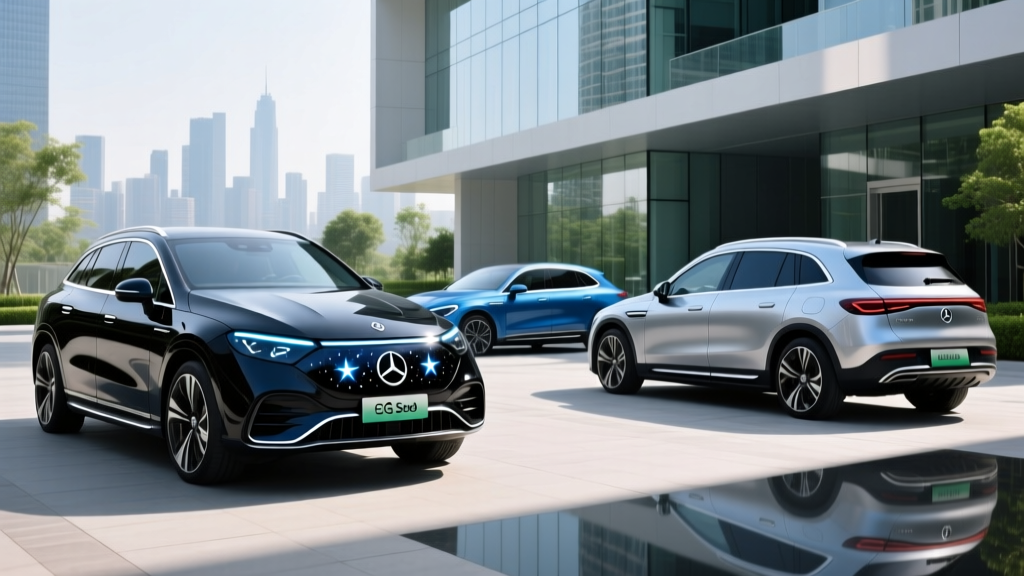
The 2026 Mercedes-Benz EV lineup centers on the EQE sedan (EPA 305 miles, ~$76,000), EQS sedan (EPA 390 miles, ~$105,000), and EQB compact SUV (EPA 251 miles, ~$54,000). These vehicles deliver premium refinement, strong DC fast-charging (up to 200 kW on the EQS), and advanced Level 2 driver-assist tech. However, most Mercedes-Benz EVs do not qualify for the full $7,500 federal tax credit due to battery-sourcing and MSRP cap rules under IRS §30D. They best suit buyers who prioritize luxury, have home Level 2 charging access, and can absorb the premium price. If your priority is maximum range-per-dollar or tax-credit eligibility, competitors like the Hyundai Ioniq 6 or Tesla Model S may serve you better.
The 2026 Mercedes-Benz EV Lineup at a Glance
Mercedes-Benz has streamlined its EQ battery-electric portfolio for the 2026 model year. The brand also sells plug-in hybrids (badged as EQ Power), but this guide focuses on its full battery-electric vehicles (BEVs). Here are the core models currently on sale:
| Model | Body Style | Battery (kWh usable) | EPA Range | Peak DC Charge | 10–80% Time | 0–60 mph | Base MSRP |
|---|---|---|---|---|---|---|---|
| EQB 300 4MATIC | Compact SUV (3-row) | 66.5 kWh (NMC) | 251 mi | 100 kW | ~32 min | 7.7 sec | $54,200 |
| EQE 350+ Sedan | Mid-size sedan | 90.6 kWh (NMC) | 305 mi | 170 kW | ~32 min | 6.2 sec | $76,050 |
| EQE 350 4MATIC SUV | Mid-size SUV | 90.6 kWh (NMC) | 279 mi | 170 kW | ~32 min | 6.4 sec | $78,050 |
| EQS 450+ Sedan | Full-size luxury sedan | 108.4 kWh (NMC) | 390 mi | 200 kW | ~31 min | 5.9 sec | $105,550 |
| EQS 580 4MATIC SUV | Full-size luxury SUV | 108.4 kWh (NMC) | 330 mi | 200 kW | ~31 min | 4.4 sec | $110,500 |
Sources: EPA fueleconomy.gov, Mercedes-Benz USA. Real-world highway range typically runs 10–20% below EPA estimates; cold weather (below 32°F) can reduce range by 20–30%.
Real-World Range: What the EPA Sticker Doesn't Tell You
The EPA range figures above are measured under controlled laboratory conditions. In actual ownership, several factors compress usable range significantly:
EQS 450+ Sedan — Range Reality Check
EPA sticker: 390 miles
Highway cruising (70–75 mph, 70°F): Expect ~320–340 miles
Cold weather (20°F, city/highway mix): Expect ~270–300 miles
Mountain driving with elevation gain: Expect ~280–310 miles (though regen recovers some on descent)
The EQS sedan's massive 108.4 kWh battery and slippery 0.20 drag coefficient give it the longest real-world range in the lineup. The EQB, by contrast, has a smaller 66.5 kWh pack and boxier aerodynamics — on a 75-mph highway trip in winter, you may see as little as 180–190 miles before needing to charge. Plan road trips around the EQB's realistic ~200-mile highway buffer.
Mercedes uses NMC (nickel manganese cobalt) chemistry across the EQ lineup. NMC offers higher energy density than LFP (lithium iron phosphate), which is why the EQS can pack 108.4 kWh into a sedan platform. The trade-off: NMC batteries degrade slightly faster over time and are best kept between 20–80% state of charge for daily use. Mercedes recommends setting the charge limit to 80% for routine driving and 100% only before long trips.
Charging Speeds and Infrastructure
Understanding the difference between kW (kilowatts — the rate of power delivery) and kWh (kilowatt-hours — the energy stored in the battery) is critical. Think of kW as how fast water flows from a hose, and kWh as the size of the bucket.
| Charging Level | Power (kW) | Typical Miles Added per Hour | Where You'll Find It |
|---|---|---|---|
| Level 1 (120V household) | 1.4–1.9 kW | 3–5 mi/hr | Any standard outlet |
| Level 2 (240V home/public) | 7.2–11.5 kW | 20–35 mi/hr | Home wallbox, workplace, shopping centers |
| DC Fast Charging | 50–200 kW (varies by vehicle) | 150–400+ mi/hr (at peak) | Electrify America, EVgo, Tesla Supercharger (with adapter) |
Charging curve reality: The EQS sedan peaks at 200 kW, but only between roughly 10–40% state of charge. Above 50%, the rate tapers to ~120 kW, and above 80% it drops sharply to ~40 kW to protect the battery. The published "10–80% in 31 minutes" figure reflects this taper. You will never see a sustained 200 kW for the full session.
All 2026 Mercedes-Benz EVs sold in the U.S. use the NACS (North American Charging Standard) connector, aligning with Tesla's Supercharger network. If you're purchasing a 2024 or earlier model, it will have a CCS1 connector and may need a NACS adapter for Tesla Supercharger access. Mercedes-Benz includes a complimentary adapter with new NACS-equipped vehicles.
For home charging, the EQE and EQS accept up to 9.6 kW on Level 2 (a 40-amp circuit). The EQB accepts up to 7.2 kW. A full overnight charge from 20–80% takes roughly 6–7 hours for the EQS on a Level 2 home wallbox — more than enough for daily replenishment.
Cost of Ownership: Mercedes-Benz EV vs. Gas Equivalent
Let's compare the EQE 350+ sedan against its closest gas counterpart, the E 350 sedan, over a 5-year/75,000-mile ownership period. This comparison isolates the powertrain economics while holding the luxury segment constant.
| Cost Category | EQE 350+ (EV) | E 350 (Gas) |
|---|---|---|
| Base MSRP | $76,050 | $59,950 |
| Federal Tax Credit (§30D) | $0 (MSRP/sourcing)* | $0 |
| Fuel / Energy (75k mi) | $4,500 (home L2 @ $0.14/kWh) | $9,375 (26 MPG avg @ $3.25/gal) |
| Maintenance (5 yr) | $1,800 (cabin filter, wipers, tires, brake fluid) | $4,200 (oil, filters, brakes, spark plugs, transmission) |
| Insurance (5 yr avg) | $12,500 | $10,000 |
| Estimated Depreciation | $32,000 (42%) | $25,000 (42%) |
| 5-Year Total Cost | ~$94,850 | ~$83,525 |
*The EQE's $76,050 base MSRP exceeds the IRS §30D sedan cap of $55,000, making it ineligible for the new-vehicle federal credit regardless of battery sourcing. The EQB at $54,200 falls under the SUV cap of $80,000, but its battery components and critical minerals may not meet 2026 sourcing thresholds. Always verify current eligibility at IRS.gov before purchasing.
Key takeaway: The EQE saves roughly $7,275 in fuel and maintenance over 5 years compared to the E 350. However, the higher purchase price, steeper insurance premiums (typically 15–25% more for EVs in the luxury segment), and comparable depreciation mean the total cost gap remains around $11,000. You buy the EQE for the driving experience, refinement, and environmental benefit — not to save money versus a gas E-Class.
If you have access to free or heavily subsidized workplace or public charging, the energy cost advantage widens. Conversely, if you rely exclusively on DC fast charging at $0.40–0.55/kWh, your 5-year energy cost could reach $7,500–9,000, narrowing the gap further.
Tax Credits and Incentives: What You Actually Qualify For
The federal §30D clean vehicle credit offers up to $7,500, but multiple eligibility gates apply. Here's the 2026 checklist:
- MSRP caps: Sedans must be under $55,000; SUVs, vans, and trucks under $80,000. This immediately disqualifies the EQE sedan, EQS sedan, and EQS SUV.
- Buyer income limits: AGI must not exceed $150,000 (single), $225,000 (head of household), or $300,000 (joint).
- Battery component sourcing: A percentage of battery components must be manufactured or assembled in North America (threshold increases annually).
- Critical minerals sourcing: A percentage of critical minerals must be sourced from the U.S. or free-trade-agreement countries.
- Point-of-sale transfer: Eligible buyers can transfer the credit to the dealer for an immediate price reduction rather than waiting for tax filing.
- Final assembly: Vehicle must undergo final assembly in North America.
Bottom line for Mercedes-Benz EVs: The EQB (SUV classification, ~$54,200 MSRP) is the only model with a path to partial or full credit eligibility, and even that depends on meeting the battery-sourcing thresholds for the specific build month. Mercedes-Benz has been working to localize battery supply chains, but compliance varies by production batch. Confirm your specific VIN's eligibility at fueleconomy.gov and with your dealer before signing.
Many states offer additional rebates or tax credits (California's CVRP, Colorado's state credit, New York's Drive Clean rebate). These vary by jurisdiction and income — check your state energy office or DMV for current programs.
Myths vs. Facts: Mercedes-Benz EV Ownership
| Myth | Fact |
|---|---|
| "The battery will need replacing in 5 years for $20,000." | Mercedes-Benz warranties the high-voltage battery for 8 years / 100,000 miles against capacity loss below 70%. Real-world NMC degradation data from similar platforms shows ~8–12% loss over 100,000 miles. Replacement is rare and typically covered if premature. |
| "I can charge on any Tesla Supercharger." | Only 2026 and later models with the native NACS connector have full Supercharger access. Older CCS-equipped models require a Mercedes-approved adapter, and not all Supercharger stalls accommodate non-Tesla vehicles yet due to cable length or parking geometry. |
| "Mercedes' Drive Pilot is self-driving." | No. Drive Pilot is an SAE Level 3 system in limited conditions (specific highways, under 40 mph, clear weather) and Level 2 elsewhere. The driver must remain available to take over. It is not a Level 4/5 autonomous system. Mercedes has received limited Level 3 approval in Nevada and California — availability is geofenced and conditional. |
| "EVs are cheaper to own than gas cars, period." | Lower fuel and maintenance costs are real, but higher purchase prices, insurance premiums, and depreciation in the luxury EV segment often offset those savings in the first 5 years. The economics improve with home charging, high annual mileage, and available tax credits. |
| "The EQS takes forever to charge on road trips." | At peak 200 kW DC, the EQS adds roughly 180 miles of range in 15 minutes (10–40% SoC). A typical 10–80% stop takes ~31 minutes — comparable to a lunch break. Route planning with the Mercedes me Charge app and battery preconditioning minimizes wait times. |
Understanding SAE Automation Levels
Level 2: The car can steer, accelerate, and brake, but the driver must remain fully engaged and hands-on or eyes-on at all times. This describes Mercedes' standard Active Distance Assist DISTRONIC and Active Steering Assist.
Level 3: The car handles all driving tasks in specific, limited conditions, and the driver may disengage (but must be ready to resume). Mercedes' Drive Pilot qualifies as Level 3 only in approved geofenced zones under 40 mph.
Level 4: Fully driverless in defined areas with no human intervention needed. Only robotaxi services like Waymo operate at Level 4. No consumer Mercedes-Benz vehicle is Level 4.
Who Should Buy a Mercedes-Benz EV? Decision Framework
Buy the EQB if:
- You need a compact 3-row SUV and want the most affordable entry into the Mercedes EV lineup (~$54,200).
- Your daily commute is under 60 miles round-trip and you have home Level 2 charging.
- You want a potential (though not guaranteed) path to the federal tax credit.
- Accept that road-trip charging will be slower (100 kW peak) and range is limited (~200 real highway miles).
Buy the EQE 350+ Sedan if:
- You want a premium mid-size electric sedan with 300+ miles of real-world range and strong refinement.
- You value Mercedes' interior quality, MBUX infotainment, and available rear-axle steering over the Tesla Model S's tech-first approach.
- You have reliable home or workplace charging and don't depend exclusively on public DC fast charging.
- You accept that the total 5-year cost will exceed a gas E 350 by ~$11,000.
Buy the EQS 450+ Sedan if:
- You want the longest-range luxury EV sedan available (390 EPA / ~320–340 real-world highway miles).
- Budget is flexible ($105,550+ before options) and you prioritize ride comfort, cabin silence, and flagship technology.
- You take regular road trips and want 200 kW DC fast-charging capability with NACS Supercharger access.
- You understand this vehicle will not qualify for the federal tax credit due to MSRP cap rules.
Look elsewhere if:
- You need a sub-$50,000 EV with guaranteed tax-credit eligibility — consider the Tesla Model 3, Hyundai Ioniq 5, or Chevrolet Equinox EV.
- You live in an apartment without charging access and your area has limited public charging infrastructure.
- Your priority is maximum performance-per-dollar — the Tesla Model S Plaid or BMW i5 M60 offer more power for the money.
First-Time EV Buyer Essentials
If this is your first electric vehicle, these practical considerations apply across the Mercedes-Benz EQ lineup:
Home charging is non-negotiable for convenience. A Level 2 (240V) home wallbox costs $500–800 for the unit and $800–2,500 for professional installation by a licensed electrician, depending on your panel capacity and conduit run. If your home has a 100-amp electrical panel, you may need a $1,500–3,000 panel upgrade to support a 40-amp EV circuit. Get a quote before purchasing the car.
Preconditioning matters. The Mercedes me app allows you to precondition the battery before a DC fast-charging stop. This warms the battery to optimal temperature, enabling the vehicle to reach peak charge rate faster. In cold weather, preconditioning can shave 5–10 minutes off your 10–80% charge time.
Tire costs are higher. EVs are heavier (the EQS sedan weighs ~5,600 lbs) and deliver instant torque, which accelerates tire wear. Budget $300–500 per tire for EV-rated rubber, and expect replacement every 25,000–35,000 miles rather than the 40,000–50,000 miles typical for gas sedans.
Insurance premiums run 15–25% higher for luxury EVs compared to their gas counterparts, driven by higher repair costs, specialized parts, and battery replacement risk. Get quotes from your insurer before committing.
Frequently Asked Questions
Is the Mercedes-Benz EQC still available?
No. The EQC compact SUV was discontinued after the 2023 model year in most markets and was never widely sold in the U.S. The EQB serves as the current compact electric SUV in the lineup.
How long does the Mercedes-Benz EV battery warranty last?
Mercedes-Benz provides an 8-year / 100,000-mile high-voltage battery warranty that covers capacity retention below 70% of original capacity. This is standard across the EQB, EQE, and EQS lineup.
Can I charge a Mercedes-Benz EV at Tesla Superchargers?
2026 model-year Mercedes-Benz EVs with the native NACS connector can access Tesla Superchargers directly. Older models with CCS connectors require a Mercedes-approved NACS-to-CCS adapter. Always confirm stall compatibility — some Supercharger locations have short cables designed for Tesla's charge-port placement.
What is the cheapest Mercedes-Benz EV?
The 2026 EQB 300 4MATIC starts at $54,200 (including destination). It is the most affordable and most tax-credit-eligible model in the lineup, though actual credit qualification depends on battery-sourcing compliance for your specific vehicle build.
How does the Mercedes EQ lineup compare to BMW's i-series?
The BMW i5 (EPA ~295 mi, ~$67,000) undercuts the EQE on price while offering similar range and a more driver-focused chassis. The BMW i7 (EPA ~318 mi, ~$120,000) competes with the EQS but offers less range. Mercedes generally leads in cabin luxury and ride comfort; BMW leans toward driving dynamics and pricing value.
Will Mercedes-Benz release new EV models soon?
Mercedes-Benz has announced the next-generation MMA platform, expected to underpin future compact EVs with improved efficiency and 800-volt architecture. These models are announced but not yet on sale. For current availability, stick with the EQB, EQE, and EQS lineup.